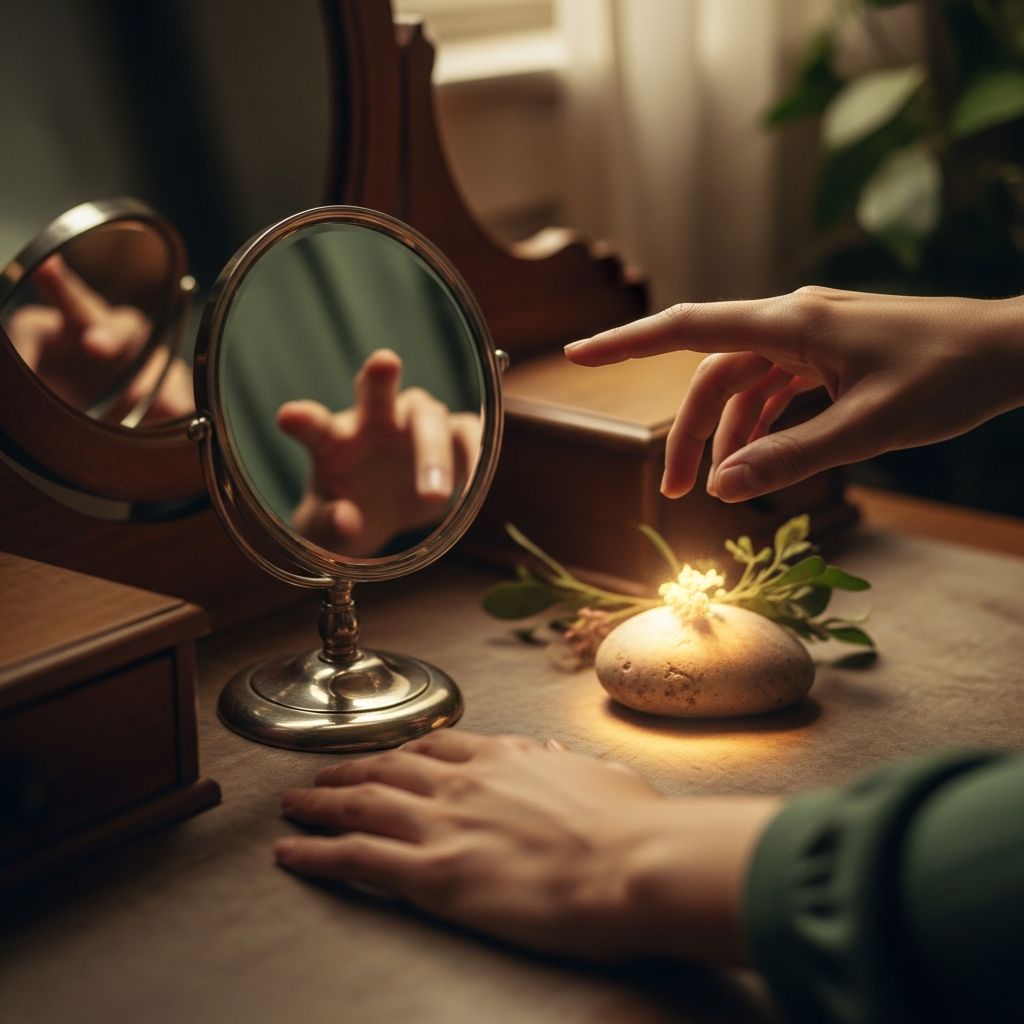
Magnifying mirrors promise precision, but for many people they quietly amplify anxiety instead of confidence. What begins as a tool for grooming can turn into a daily ritual of self-criticism that erodes self-esteem and distorts how you see your own face.
This article explores how extreme close-ups of your appearance affect your mood and body image, and offers practical steps to step back—literally and emotionally—from harsh self-scrutiny. The goal is not to abandon all mirrors, but to use them in a way that supports your mental wellbeing, not undermines it.
Why Magnifying Mirrors Feel So Harsh
A magnifying mirror does exactly what its name suggests: it enlarges every pore, line, and hair so that tiny details look enormous. Under that intense zoom, normal skin texture and natural asymmetries can suddenly appear like serious flaws.
The problem is that nobody else sees you at that extreme distance. The view that feels “real” in the magnifying mirror is actually the least realistic angle and scale you present to the world. You end up judging yourself by a standard no one else is applying.
- Small, normal features look exaggerated.
- Natural variations in skin and hair can seem like defects.
- Once noticed, these details are hard to unsee in your mind, even in normal mirrors.
The Emotional Spiral of Close-Up Scrutiny
The more time you spend under magnified scrutiny, the easier it is to slip into an emotional spiral. What starts as a quick check can turn into an extended session of picking apart your face and leaving the mirror feeling worse than when you walked up to it.
Common emotional patterns that show up around magnifying mirrors include:
- Anxiety: Worrying that others notice every detail you just saw up close.
- Shame: Feeling like your face is something that needs to be hidden or fixed.
- Perfectionism: Believing you must eliminate every small imperfection before you are “presentable.”
- Rumination: Replaying specific perceived flaws in your mind long after leaving the bathroom.
When Attention Becomes Obsession
Being aware of your appearance is not inherently unhealthy. Problems arise when occasional checking turns into a repetitive, time-consuming ritual that feels impossible to skip. You may notice you keep going back to the mirror to re-evaluate the same details, even though nothing has changed.
Signs that mirror use is shifting from attention to obsession include:
- Spending more and more time in front of mirrors each day.
- Feeling intense distress if you cannot access your usual mirror.
- Planning your schedule around grooming or checking routines.
- Canceling plans because you are unhappy with how you look.
How Close-Ups Distort Your Self-Image
Your brain builds a mental picture of what you look like based largely on the reflections you see the most. If your most frequent view is a magnified one, your internal image may become more extreme than reality. Over time, you may start to believe that the zoomed-in view is the truth and the normal mirror is the “flattering” one.
This distorted mental image can make you more self-conscious in social situations. You may assume that every conversation partner is as focused on your pores, wrinkles, or tiny asymmetries as you are—when in reality they are seeing the full picture from a natural distance.
Normal Skin vs. “Perfect” Skin: A Reality Check
Magnifying mirrors often become a stage for battles with completely normal features that marketing has taught you to treat as problems. Under intense zoom, even the healthiest skin has texture, tiny hairs, and color variations.
This simple comparison table can help reset expectations and put what you see in perspective:
| Feature | Under Magnification | How Others Actually See It |
|---|---|---|
| Pores | Look large, deep, and uneven. | Mostly invisible at normal distance; slight texture is typical. |
| Fine lines | Appear sharp and prominent. | Blend into natural facial expression and movement. |
| Light facial hair | Seems thick and dark against skin. | Rarely noticed unless someone is very close. |
| Minor blemishes | Feel like the central feature of your face. | One small part of a much bigger picture. |
Practical Steps to Reduce Magnifying Mirror Dependence
You do not have to get rid of every mirror in your home to feel better about yourself. Small, deliberate changes in how you use mirrors—especially magnified ones—can have a big impact on your mood and self-image over time.
1. Change the Physical Environment
The easiest place to start is by changing how accessible the magnifying mirror is. When the mirror is front and center, checking becomes an automatic habit. When it is less convenient, you have a moment to decide whether you truly need it.
- Store the magnifying mirror in a drawer or cabinet instead of leaving it on the counter.
- Use a standard, non-magnified mirror for most daily tasks.
- Reserve magnification for specific, time-limited tasks like precise grooming.
- Adjust lighting to be softer rather than harsh and unforgiving.
2. Set Time Limits and Intentions
Turning mirror time into a structured routine instead of an open-ended activity helps prevent spirals of scrutiny. Before you begin, decide what you are using the mirror for and how long it should reasonably take.
- Set a timer for tasks that tend to stretch on, like makeup or skincare.
- Use the mirror only for functional checks (e.g., shaving, brushing teeth, fixing hair) rather than general inspection.
- Say out loud, “I am using this mirror to [task], not to judge my face.”
3. Practice “Zooming Out” Mentally and Physically
When you catch yourself inching closer and closer to the mirror, step back until you are at the distance most people stand when talking to you. Notice how different your face looks when you see the whole picture instead of just a fragment.
- Take one or two steps back from the mirror before evaluating your appearance.
- Focus on your overall expression, not individual features.
- Ask: “How would a kind friend see me right now?”
Building a Kinder Inner Commentary
Even if you adjust your physical mirror use, harsh self-talk can keep the emotional impact alive. The good news is that inner commentary is a habit too—and like any habit, it can be reshaped with practice.
Try these strategies to make your internal voice more supportive:
- Notice your first thought when you see your reflection; label it as “critical,” “neutral,” or “kind.”
- When you hear a critical thought, gently replace it with a realistic, non-attacking version.
- Include at least one appreciation each time you look in the mirror (for example, “I like my smile” or “I appreciate that my body carries me through my day”).
A Simple Mirror-Use Routine for Mornings
Creating a predictable, calm routine around mirrors can reduce anxiety and decision fatigue. Here is an example of a balanced morning mirror routine that safeguards your sanity while still letting you feel put together.
- Functional check only: Use a regular mirror for basic grooming tasks (washing your face, brushing your teeth, styling your hair).
- Brief appearance scan: Step back, look at your whole face and outfit for 10–20 seconds, and make any quick adjustments.
- One positive statement: Acknowledge something you appreciate about your appearance today, even if it is small.
- Walk away: Once the routine is done, leave the mirror area and move on with your day.
When Magnifying Mirrors Are Actually Helpful
Magnifying mirrors are not inherently “bad”; they can be useful tools when used sparingly and deliberately. The key is to ensure that you are controlling the mirror, rather than letting it control your mood.
Consider using magnification only when:
- You have a specific, practical task (such as precise makeup or grooming) that truly benefits from detail.
- You set a clear time limit before you begin.
- You feel emotionally stable enough that a closer look will not trigger a spiral.
Supporting Children and Teens Around Mirrors
Young people absorb messages about appearance from the adults around them. If you are constantly hovering over a magnifying mirror and criticizing your own face, children and teens may learn to do the same, even if you never say a word about their looks.
Healthier mirror modeling for younger people might include:
- Using mirrors briefly, for practical reasons, instead of lingering over every detail.
- Avoiding negative self-talk about your appearance out loud.
- Emphasizing function, comfort, and self-expression over flaw-hunting.
Frequently Asked Questions
Is it unhealthy to use a magnifying mirror at all?
Occasional use is not automatically unhealthy. It becomes a concern when you feel compelled to use it, experience distress when you cannot, or notice that your mood regularly drops after close-up checking. If that is happening, it may be worth limiting or temporarily removing the magnifying mirror to see how you feel.
How do I know if my mirror use is affecting my mental health?
Pay attention to how you feel before and after mirror sessions. If you walk away feeling tense, ashamed, or anxious most of the time, or if you start avoiding social situations because of things you see in the mirror, those are signs your mirror habits are affecting more than just your grooming routine.
What can I do instead of checking my face repeatedly?
Replace the impulse with a short, grounding activity. Step away from the mirror, take a few slow breaths, drink some water, stretch, or redirect your attention to a task unrelated to appearance. These small interruptions can weaken the habit loop that pulls you back to the mirror again and again.
Is avoiding mirrors completely a good idea?
For most people, a balanced approach works better than total avoidance. Some mirror exposure is practical and can help you feel prepared and put together. The goal is to use mirrors in a neutral or supportive way instead of allowing them to become tools of self-attack.
When should I seek professional help?
If thoughts about your appearance dominate your day, if you feel driven to fix or hide perceived flaws, or if you experience significant distress or impairment in daily life, it may be helpful to talk with a mental health professional. Support is not just for “extreme” situations; it is also there to help you build a more peaceful relationship with yourself before things feel overwhelming.
Final Thoughts: Choosing a Gentler Reflection
Magnifying mirrors will always reveal more than the world ever sees, but you get to decide whether that extra information deserves so much of your time and energy. By stepping back, softening your self-talk, and using mirrors with intention, you can shift from daily self-critique to a more compassionate, realistic view of your own face.
You will still notice imperfections—they are part of being human—but they no longer need to dictate your mood or your worth. A kinder relationship with mirrors is, at its core, a kinder relationship with yourself.