The final moments of Joker do more than end Arthur Fleck’s story. They collide his personal tragedy with one of the most famous scenes in comic book history: the murder of Bruce Wayne’s parents in a dark alley. By tying these events together during Gotham’s riots, the film suggests a new, unsettling way to understand how Batman is born and what Joker represents in this universe.
From Stand-Up Failure to Symbol of Chaos
Before the alley, before the pearls, the film carefully charts Arthur Fleck’s collapse and transformation into the Joker. Across the movie, Arthur is:
- Marginalized by underfunded mental health systems and social services.
- Humiliated by media and late-night television, particularly the Murray Franklin show.
- Rejected by paternal figures, including the possibility that Thomas Wayne could be his father.
- Abandoned when his medications and therapy are cut due to budget decisions.
These threads culminate in Arthur’s live, televised murder of Murray Franklin, a moment that ignites Gotham’s simmering anger into full-blown insurrection. In that instant, Arthur stops being just a lonely man with a clown face; he becomes a symbol that Gotham’s disenfranchised seize as their own.
Gotham on Fire: The Riot That Changes Everything
After the TV studio killing, the movie cuts to Gotham unraveling. Protesters in clown masks swarm the streets, vandalizing, looting, and attacking symbols of wealth and order. Neither Arthur nor the rioters planned a coordinated revolution, but the imagery is unmistakable: Arthur’s personal act of violence has become the spark in a city packed with social and economic kindling.
Key elements of this sequence include:
- Clown masks as a mass identity, turning one man’s face paint into a populist uniform.
- Targeted rage toward Gotham’s elite, especially the Wayne family and financial institutions.
- Breakdown of law enforcement as overwhelmed police fail to contain the unrest.
This chaotic backdrop sets the stage for a pivotal reinterpretation of Bruce Wayne’s origin.
The Alley Reimagined: How Bruce Wayne’s Trauma Is Reframed
Traditionally, Bruce Wayne’s parents are killed by a random mugger, often named Joe Chill, in a senseless act of street crime. This randomness helps define Batman’s mission: to fight crime in all its forms because any criminal could create another Bruce.
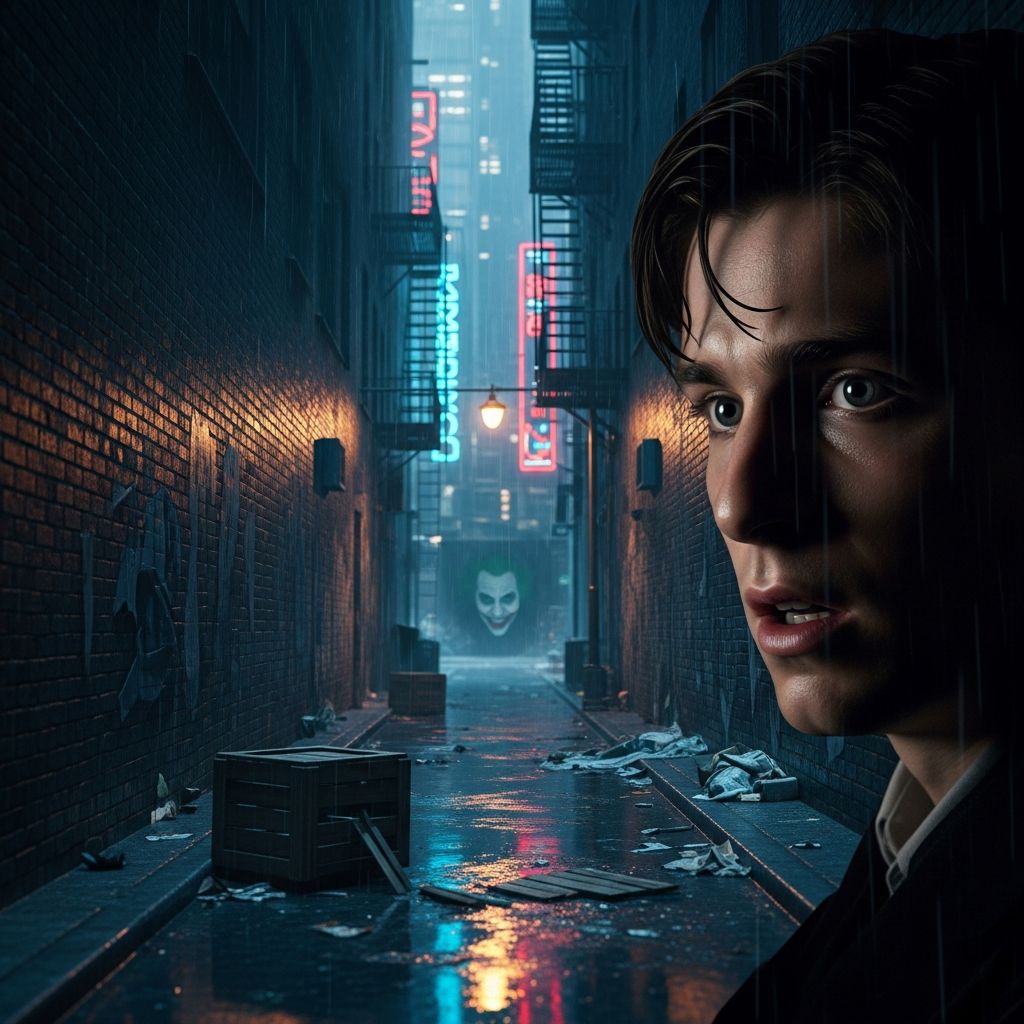
Joker changes the context. Here, Thomas and Martha Wayne are leaving a movie theater during citywide riots when a masked rioter corners them in an alley and shoots them, leaving young Bruce alone. The murder is not portrayed as an isolated robbery but as part of a class-driven uprising inspired by Joker’s televised act.
That subtle but crucial shift changes the meanings behind the Waynes’ deaths:
- They die as symbols of Gotham’s wealthy elite, not just random victims.
- The killer acts under the influence of a political and social movement, however chaotic.
- Bruce’s trauma is now directly linked to Gotham’s inequality and institutional failures, not just street crime.
| Element | Classic Batman Origin | Joker Version |
|---|---|---|
| Killer’s motive | Robbery, basic street crime | Riot-fueled hatred of the rich |
| Context | Single, random attack | Part of a broader social uprising |
| Symbolism | Crime can strike anyone, anywhere | Systemic inequality breeds violent backlash |
| Connection to Joker | Often separate timelines, separate origins | Waynes’ death tied directly to Joker’s rise |
Did Joker “Create” Batman?
One of the boldest implications of the film is that Joker’s emergence indirectly leads to Batman’s birth. The chain reaction is:
- Arthur’s humiliation and alienation push him to murder on live TV.
- Gotham’s discontent crystallizes around Joker as a symbol.
- Rioters kill the Waynes in the chaos that Joker helped unleash.
- Bruce, traumatized by this event, is set on the path to eventually becoming Batman.
In many prior stories, Batman’s existence drives Joker’s theatrical form of crime, presenting Joker as a reaction to Batman’s crusade. Here, the relationship is inverted. Joker’s symbolic act of rebellion indirectly leads to the formative tragedy that will one day inspire Batman. This inversion raises philosophical questions the movie leaves deliberately open:
- Is Batman a response to Joker, or a response to Gotham itself?
- If Gotham had supported people like Arthur, would Batman ever have needed to exist?
Unreliable Memories: Did Any of This Really Happen?
The film’s final scene introduces a powerful layer of ambiguity. Arthur is shown in Arkham State Hospital talking to a therapist, laughing to himself. When asked what’s funny, he says she “wouldn’t get it,” intercut with an image of the newly orphaned Bruce Wayne.
Some critics and viewers interpret this as a suggestion that the entire film—or at least parts of it—might be Arthur’s distorted recollection or even a complete fabrication. The movie supports this idea by earlier revealing that Arthur’s perceived romantic relationship with his neighbor Sophie was imagined, signaling that he is an unreliable narrator.
If we apply that lens to the ending:
- The riot and the Waynes’ death may be Arthur’s way of mythologizing his role in Gotham’s story.
- He could be fantasizing that he indirectly created Batman, elevating his own importance.
- Small continuity details and tonal shifts encourage the audience to question what is literal and what is filtered through Arthur’s fractured mind.
This ambiguity aligns with broader cinematic trends that use unreliable narrators to complicate linear storytelling and challenge audience assumptions, a technique discussed in film scholarship and narrative theory in media studies.
Thomas Wayne: Victim, Villain, or Something in Between?
Joker also reshapes Thomas Wayne’s image. Traditionally, he is a benevolent doctor-philanthropist whose murder robs Gotham of its moral center. In this film, he is depicted as a wealthy politician and business leader who calls protestors “clowns” and seems disconnected from the struggles of the poor.
Within this framework:
- Thomas becomes a lightning rod for resentment against Gotham’s elite.
- His encounter with Arthur in the restroom is confrontational, not compassionate.
- His death feels less like random tragedy and more like backlash from a city that views him as part of the problem.
This depiction echoes real-world debates about how economic inequality, political rhetoric, and failing social systems can fuel unrest and violence, issues widely examined in social science and public policy research.
Gotham as a Character: Systemic Failure and Shared Guilt
By the time the credits roll, Joker has made Gotham feel like a character in its own right—sick, unjust, and nearing collapse. Institutions meant to help people like Arthur—social work, mental health care, and public safety—are underfunded or dehumanizing.
In public health and criminology, research has long shown that underinvestment in mental health services, social inequality, and social exclusion can increase the risk of violence and social unrest. The film dramatizes those findings in exaggerated form, presenting Gotham as a city that has collectively failed its most vulnerable residents.
In that sense, no single character “creates” Joker or Batman. Instead:
- Arthur Fleck is a tragic byproduct of systemic neglect.
- Batman is the reaction of another victim—Bruce Wayne—to the visible explosion of that neglect.
- Gotham’s institutions are, collectively, the unseen architect behind both figures.
The Zorro Connection: Movies Within Myths
In many classic portrayals of Batman’s origin, the Waynes leave a screening of a Zorro film on the night they die. This detail appears in several key Batman comics and film adaptations, where Zorro represents a heroic, masked figure who fights injustice outside the law.
By invoking this tradition, Joker layers its story with intertextual meaning:
- Bruce’s final night with his parents is tied to a story about a masked vigilante.
- His future as Batman becomes a dark echo of the swashbuckling hero he watched on screen.
- It blurs the line between fictional heroism and real-world violence, a theme that runs throughout the movie.
Film and comics scholars have often noted how superhero narratives draw on earlier pulp heroes like Zorro, reworking their themes of justice, identity, and vigilantism for modern audiences.
Joker and Batman as Two Sides of Gotham’s Trauma
When you step back from the specifics of the plot, Joker frames Joker and the future Batman as mirror responses to the same environment:
- Arthur’s answer to trauma is to externalize his pain through public violence and chaos.
- Bruce’s implied answer is to direct his trauma into a lifelong struggle against crime and corruption.
- Both are masked identities formed in the crucible of Gotham’s failures.
The crucial difference lies in how they interpret responsibility:
- Joker blames the world and revels in watching it burn.
- Batman, traditionally, blames crime and vows to fight it, though in some stories he also scrutinizes the city’s institutions and his family’s role in them.
By suggesting that Joker’s rise triggers the specific trauma that forms Batman, the movie implies that Gotham’s story is cyclical: neglect breeds violence, violence breeds masked responses, and those masked responses continue to shape the city’s destiny.
Frequently Asked Questions (FAQs)
Does Joker intend to be a canonical Batman origin story?
No. The film is often described by critics and commentators as a standalone character study that borrows key Batman mythology elements without necessarily fitting into any established comic or cinematic canon. It plays with familiar pieces—Bruce, the alley, the Waynes—while leaving their long-term future ambiguous.
Is the rioter who kills the Waynes supposed to be Joker’s ally or follower?
The film does not show direct coordination between Joker and the gunman. Instead, the killer appears to be one of many rioters who have adopted the clown mask as a symbol, responding to the chaos Joker helped unleash rather than following explicit orders.
Could the Waynes’ murder have been imagined by Arthur?
The intercutting of Arthur’s laughter in Arkham with Bruce over his parents’ bodies invites the interpretation that the sequence could be part of Arthur’s fantasy or storytelling. The film never confirms this outright, leaving it up to viewers to decide how literally to take what they see.
How does the film’s portrayal of mental illness relate to real-world research?
Mental health experts and public health organizations note that most people with mental illness are not violent, and that stigma can worsen social exclusion. Official guidelines emphasize that structural factors—poverty, lack of access to care, and social stress—play major roles in both mental health outcomes and societal unrest, themes the movie dramatizes in a heightened, fictional way.
Why connect Joker so directly to Bruce Wayne’s origin?
Tying Joker’s rise to the Waynes’ death heightens the sense that Gotham’s iconic figures are entangled from the very beginning. It makes their future conflict feel less like a coincidence and more like an inevitable consequence of the city’s systemic failures and escalating cycles of violence.
References
- “Joker” Ending Explained: How the Conclusion Undermines the Movie — Collider. 2019-10-11. https://collider.com/joker-ending-explained/
- The ‘Joker’ Ending Explained — No Film School. 2019-10-10. https://nofilmschool.com/joker-ending-explained
- ‘Joker’ ending explained: Director Todd Phillips on fan theories — Los Angeles Times. 2019-10-04. https://www.latimes.com/entertainment-arts/movies/story/2019-10-04/joker-ending-explained-todd-phillips
- Joker Ending, Explained — Game Rant. 2020-07-26. https://gamerant.com/joker-ending-explained/
- Joker: Folie à Deux’s Twist Ending, Explained — Time Magazine. 2024-10-03. https://time.com/7029237/joker-folie-a-deux-ending-explained/