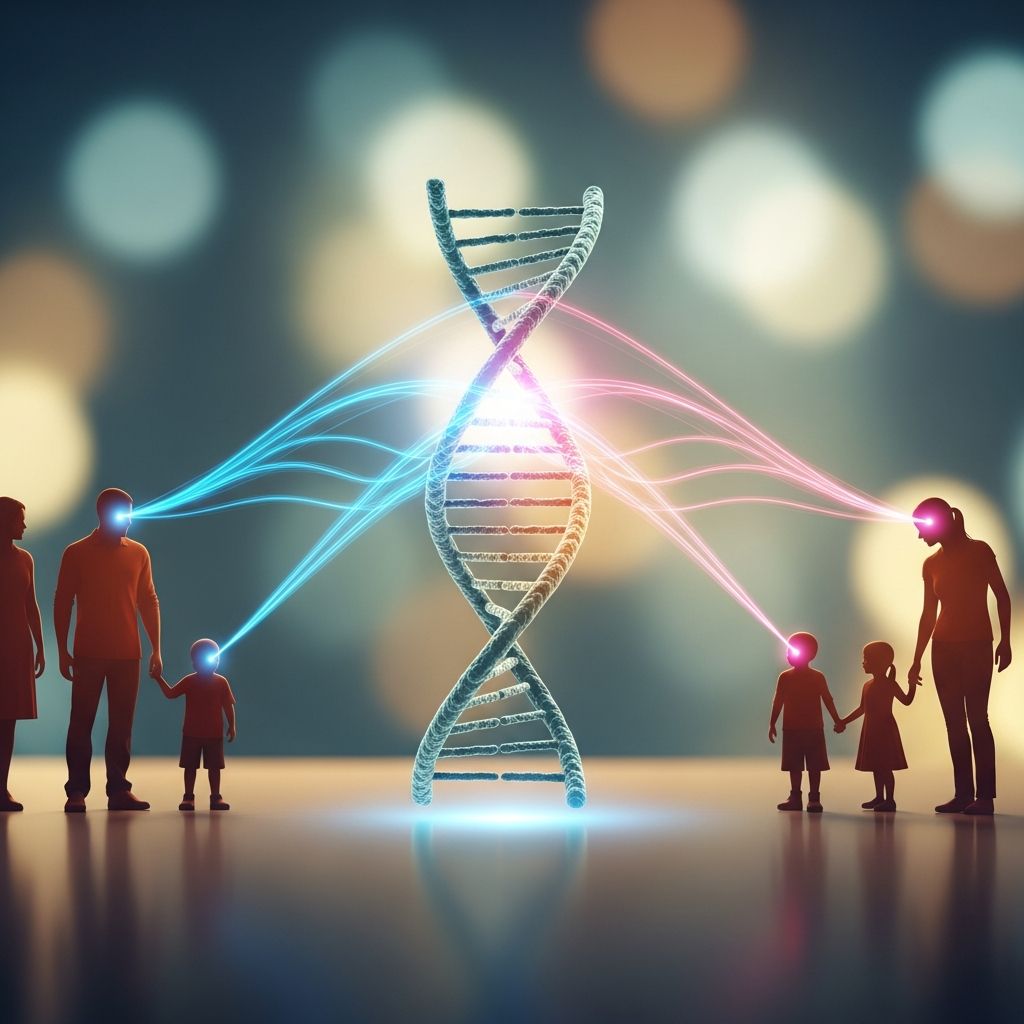
Every child is a unique blend of their parents’ genetic material, shaped by the intricate dance of DNA passed down through generations. Understanding how genes work reveals why siblings differ despite shared parents and how certain traits or health risks emerge. This article dives deep into the mechanisms of inheritance, from basic gene pairs to complex patterns influencing physical attributes and medical conditions.
Foundations of Genetic Transmission
Genetic inheritance begins at conception when a sperm and egg unite, each contributing half of the child’s DNA. Humans have 23 pairs of chromosomes, totaling 46, with one set from each parent. Traits arise from genes—segments of DNA that code for specific characteristics. Each gene typically exists in pairs, one allele from mom and one from dad.
Gregor Mendel’s foundational experiments established key rules: genes don’t blend but remain distinct, dominant alleles mask recessive ones, and traits segregate independently during reproduction. Sex cells carry only one allele per gene, ensuring offspring receive a complete set without overload. This probabilistic system means no child is identical to parents or siblings.
Dominant vs. Recessive: The Power Struggle in Genes
Genes come in variants called alleles. A dominant allele expresses its trait even if paired with a recessive one, while recessive alleles need two copies to show. For autosomal dominant conditions, one mutated gene from either parent triggers the disorder in about 50% of offspring. Examples include Marfan syndrome, where elongated limbs and heart issues appear if inherited.
Recessive inheritance requires two defective alleles, one from each parent. Carrier parents, with one normal and one mutated allele, face a 25% chance per child of the disorder manifesting, 50% carrier odds, and 25% fully normal. Conditions like autosomal recessive polycystic kidney disease (ARPKD) follow this, affecting kidneys equally in both sexes.
| Inheritance Type | Requirement | Child Risk (if one parent affected/carrier) | Examples |
|---|---|---|---|
| Autosomal Dominant | One mutated allele | 50% | Marfan syndrome, Neurofibromatosis |
| Autosomal Recessive | Two mutated alleles | 25% (both carriers) | ARPKD, Primary hyperoxaluria |
| X-linked Dominant | One mutated X allele | 50% (affected parent) | Fragile X syndrome |
| X-linked Recessive | One mutated X (males) | 50% sons (carrier mom) | Hemophilia A, Hunter syndrome |
Sex Chromosomes: X and Y’s Unique Roles
The 23rd chromosome pair determines sex: XX for females, XY for males. Females inherit an X from each parent; males get X from mom and Y from dad. Y-linked traits, rare due to the chromosome’s size, pass exclusively father-to-son, like hypertrichosis (excess ear hair) or syndactyly (webbed toes).
X-linked recessive disorders hit males harder since they lack a second X to compensate. A carrier mother passes the risk to 50% of sons, who express it, while daughters become carriers. Hemophilia A exemplifies this, impairing blood clotting. X-linked dominant conditions affect females more, with all daughters of affected fathers inheriting it.
- X from Mom: Carries most color vision and clotting factor genes.
- Y from Dad: Drives male development, few but potent genes.
- Imprinting: Some genes express based on parental origin, like growth promoters from dad overriding mom’s suppressors.
Height and Growth: Dad’s Genetic Edge
Height involves over 700 genetic variants, but paternal genes often dominate via insulin-like growth factor 2 (IGF2). Dad’s IGF2 promotes bone elongation, while mom’s IGF2R receptor tempers it, creating a balance favoring taller stature from father’s side. Environmental factors like nutrition modulate this, but genetics set the potential.
Studies confirm children regress toward mid-parental height, calculated as (father’s height + mother’s height ± adjustment)/2. Yet, imprinted genes tip scales: paternal alleles push upward growth. Achondroplasia, a dwarfism form, shows 80% arise de novo, not inherited, highlighting mutation’s role.
Beyond Basics: Imprinting, Polygenic Traits, and Mutations
Not all inheritance follows simple dominant-recessive rules. Genomic imprinting silences genes based on parental origin—dad’s active for growth, mom’s for restraint. Polygenic traits like skin tone or intelligence aggregate many genes, making prediction complex.
De novo mutations occur spontaneously in sperm, egg, or early embryo, bypassing inheritance. These explain sporadic cases of dominant disorders. Somatic mutations affect only body cells, not passed on, unlike germline ones in reproductive cells.
Probability governs outcomes: even knowing parents’ genomes, each child’s combination is unique, like a 1-in-4 recessive risk resetting per pregnancy. Tools like Punnett squares visualize this.
Health Risks: Spotting Hereditary Disorders Early
Family history flags risks. Autosomal recessive diseases like Bardet-Biedl syndrome require carrier screening. Dominant ones like HNF1B nephropathy prompt genetic counseling for 50% transmission odds.
Testing identifies carriers, enabling informed family planning. For X-linked risks, maternal history is key since fathers can’t pass X to sons. CDC emphasizes genomics for public health, tracking inheritable changes.
Environmental Interplay: Genes Aren’t Destiny
Epigenetics adds layers—chemical tags on DNA alter expression without changing sequence, influenced by diet or stress. Identical twins diverge over time due to environment. Nutrition amplifies genetic height potential; exercise tempers predispositions.
Understanding empowers: parents can optimize conditions for positive traits while mitigating risks through screening and lifestyle.
Frequently Asked Questions
Can a father pass traits to his daughter but not son?
Yes, X-linked traits from dad go to all daughters (carriers or affected), but sons get Y, so no X traits from father.
What if both parents are carriers for a recessive disorder?
Each child has 25% disease risk, 50% carrier, 25% unaffected—independent per child.
Do all genetic conditions come from parents?
No, many like achondroplasia (80%) are de novo mutations.
How much does dad influence height?
Significantly via IGF2; studies show paternal genes boost growth over maternal suppressors.
Can genetic testing predict my child’s traits?
Partially for single-gene traits; polygenic ones like height are probabilistic.
Empowering Families with Genetic Knowledge
Grasping inheritance demystifies why kids resemble parents selectively. From eye color to disease susceptibility, DNA’s lottery shapes us, but knowledge allows proactive health steps. Consult geneticists for personalized risks, blending science with family planning.
References
- 6 Traits Babies Inherit From Their Father — FamilyEducation. 2023. https://www.familyeducation.com/family-life/relationships/history-genealogy/6-traits-babies-inherit-from-their-father
- Genetics & Inheritance — ERKNet. 2024-10-15. https://www.erknet.org/patients/your-kidney-disease/genetics-inheritance
- How Do Genes Work? — Lurie Children’s Hospital. 2023. https://www.luriechildrens.org/en/specialties-conditions/pediatric-genetic-disorders/about-genes/
- Probability, chance and genetic inheritance — Genomics Education Programme. 2023-05-10. https://www.genomicseducation.hee.nhs.uk/blog/probability-chance-and-genetic-inheritance/
- Concept 5 Genetic inheritance follows rules — DNA from the Beginning. 2022. https://www.dnaftb.org/5/
- Genetics Basics | Genomics and Your Health — CDC. 2025-01-20. https://www.cdc.gov/genomics-and-health/about/index.html