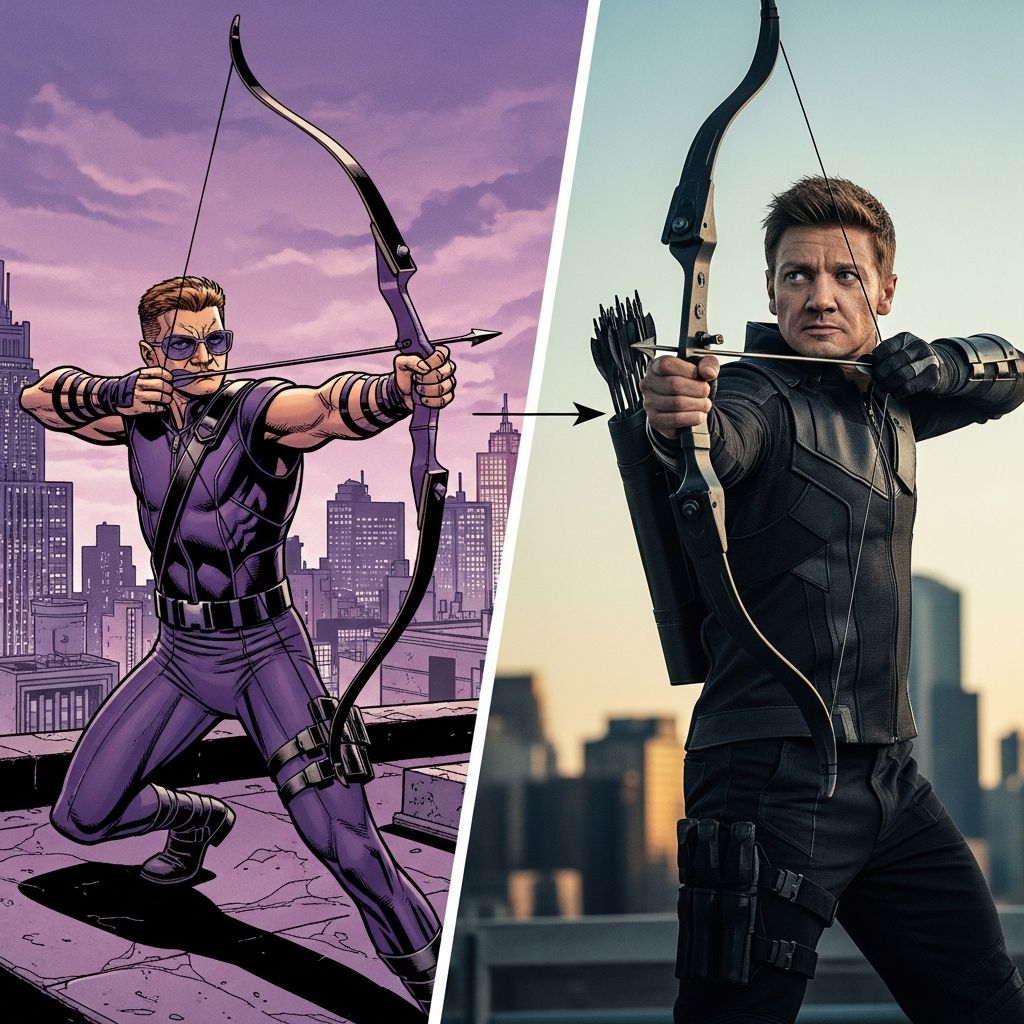
For decades, Hawkeye was one of Marvel’s most reliable supporting players: a skilled archer, a sarcastic voice in team books, and often the only human on a roster of gods and geniuses. Yet it took a single celebrated comic run by writer Matt Fraction and artist David Aja to transform Clint Barton from a background Avenger into the emotional center of a story that could anchor a Disney+ series.
This article examines how that comic run reshaped Hawkeye’s identity, why its grounded tone made it perfect for streaming adaptation, and how the key characters, themes, and visuals translated—often surprisingly faithfully—into live action.
Clint Barton Before Fraction: The Long Road of a Human Avenger
To understand why Fraction’s Hawkeye felt radical, it helps to see where the character came from.
- First appearance: Hawkeye debuted as a reluctant supervillain opposing Iron Man in Tales of Suspense #57 (1964), created by Stan Lee and Don Heck.
- Avenger status: Within a year, he reformed and joined the Avengers, quickly becoming one of the team’s core human members alongside Captain America.
- Defining traits: Exceptional marksmanship, a stubborn streak, a chip on his shoulder about fighting next to superpowered icons, and a tendency to challenge authority.
- Team-centric storytelling: Most of Hawkeye’s major stories unfolded in ensemble books such as Avengers, West Coast Avengers, and later, New Avengers.
Over time, Clint led teams, died in battle, was resurrected, briefly took on the masked identity of Ronin, and even passed the Hawkeye mantle to a new hero, Kate Bishop. Yet his solo reputation remained limited. He was respected by fans, but rarely the emotional heart of Marvel’s publishing line.
The Fraction & Aja Run: A Street-Level Reset
Matt Fraction and David Aja’s early-2010s Hawkeye series approached the character with one central question: What does Hawkeye do when he’s not saving the world with the Avengers?
Instead of leaning into grand cosmic sagas, the run focused on Clint’s day-to-day life in a shabby Brooklyn apartment building, his complicated partnership with Kate Bishop, and the small-scale crimes that would never make Avengers headlines.
Core creative choices that redefined Hawkeye
- Grounded stakes: The series highlights rent disputes, organized crime targeting a neighborhood, and the emotional toll of never-ending conflict—rather than apocalyptic threats.
- Visual minimalism: David Aja’s designs use clean layouts, limited palettes, and striking iconography, giving the book an instantly recognizable, almost indie-comic aesthetic.
- Nonlinear storytelling: Fraction experiments with structure, including out-of-order timelines, silent issues, and storytelling from a dog’s point of view.
- Comedy with consequence: The series is genuinely funny but never flippant; jokes coexist with trauma, disability, and emotional fallout.
This approach turned Hawkeye into a critical favorite and a frequent entry point for readers who normally ignored Avengers-heavy continuity.
Clint Barton Reimagined: Vulnerable, Flawed, and Human
Fraction’s version of Clint leans into his weaknesses as much as his strengths. Rather than depicting a perfectly composed marksman, the comic emphasizes human error, poor decisions, and the messy reality of being a nonpowered Avenger.
| Aspect | Traditional Team-Book Hawkeye | Fraction’s Hawkeye |
|---|---|---|
| Role | Snarky archer among superhumans | Burned-out tenant, reluctant neighborhood protector |
| Strengths | Marksmanship, battlefield leadership | Resilience, stubborn moral compass, willingness to take a hit |
| Flaws | Hot-headed, authority issues | Self-sabotage, trauma, difficulty maintaining relationships |
| Setting | Global or cosmic Avengers missions | Run-down NYC building and the surrounding streets |
Centering disability and consequence
The run also reintroduces a crucial element from earlier comics: Hawkeye’s hearing loss. Clint has been portrayed as partially deaf in previous stories, and Fraction’s run uses hearing aids and sign language as natural parts of his life, not as one-off plot devices.
- Clint’s injuries accumulate, underscoring that he is not invulnerable.
- Action scenes often reflect his perspective, including moments where sound drops out entirely.
- This portrayal aligns with Marvel’s broader efforts to represent disability, and it later influences how the Disney+ series approaches the character’s physical toll from years of battles.
Enter Kate Bishop: The Co-Lead, Not a Sidekick
Although Clint Barton was the original Hawkeye, the heroic identity now also belongs to Kate Bishop, who debuted in the early 2000s as part of the Young Avengers. She took up the Hawkeye name while Clint was believed dead and refused to give it up even after his return.
Fraction’s run treats Kate as an equal, not a junior partner.
- Skill parity: Kate is every bit as competent an archer as Clint, often depicted as more composed and emotionally mature.
- Complementary personalities: Where Clint tends toward self-destructive decisions, Kate is more clear-eyed, often calling him out on his worst habits.
- Shared mantle: The comic sends the message that “Hawkeye” is a role, not a single person—laying groundwork for a generational handoff that the Disney+ show builds on.
This dynamic—older, damaged mentor paired with a sharp, idealistic protégé—inspired much of the interpersonal core of the streaming adaptation.
The Tracksuit Mafia and Street-Level Villainy
Rather than pit Hawkeye against world-ending threats, the Fraction run introduces grounded antagonists, most memorably the Tracksuit Mafia—a gang of tracksuit-wearing criminals whose mix of menace and absurdity perfectly suits the series’ tone.
These villains are important to the Disney+ version for several reasons:
- They embody the idea that Clint’s post-Avengers life is still dangerous, just on a more relatable scale.
- Their repeated clashes with Clint connect the apartment-building plotline to wider New York crime networks.
- Their comedic dialogue balances the darker elements of Hawkeye’s personal life with a sense of pulpy fun.
By focusing on local-level crime instead of supervillain showdowns, the comic provides a template for a streaming series that feels distinct from the giant-scale Avengers films while still existing in the same universe.
Why Fraction’s Hawkeye Was Perfect for Disney+
When Marvel Studios began building its slate of Disney+ projects, it needed stories that could support serialized, character-centered narratives. Fraction and Aja’s Hawkeye run offered a ready-made blueprint.
Serialized storytelling and episodic structure
The comic is naturally episodic: each issue or small arc focuses on a specific problem—repairing a building, confronting a gang, protecting a neighbor—while contributing to a larger emotional portrait of Clint and Kate.
- This structure maps easily onto a six-episode limited series format.
- It allows for bottle episodes, flashbacks, and character-centric installments without losing overall momentum.
Tonal balance: Action, humor, and heart
Marvel’s film and TV output often aims for a blend of spectacular action, quippy humor, and emotional stakes. Fraction’s run is a near-perfect tonal match:
- Action scenes are inventive but rarely rely on massive CGI spectacles.
- Dialogue is witty and character-driven, rooted in personality rather than punchlines for their own sake.
- The emotional weight comes from relationships, trauma, and responsibility, not just from saving the world.
This harmony made it easier for the Disney+ adaptation to feel of a piece with the Marvel Cinematic Universe while still telling an intimate, grounded story.
Visual DNA: How Aja’s Design Influenced the Show
Although comics and television are different mediums, the Hawkeye show borrows heavily from David Aja’s visual language.
- Logo and typography: The angular, minimalist logo designs from the comics inspire the show’s marketing and credits.
- Color palettes: Muted purples, grays, and urban night tones dominate both the comics and series imagery.
- Iconic imagery: The sight of Clint and Kate firing arrows side by side, the use of simple arrow symbols, and stylized action poses echo Aja’s covers and interiors.
By visually signaling its debt to the comics, the show invites fans to trace the lineage from page to screen, enhancing its credibility among long-time readers.
Echoes of Canon: How the Series Fits Hawkeye’s Larger History
Fraction’s run does not exist in a vacuum; it builds on Hawkeye’s long comics history and, in turn, informs the MCU portrayal.
- From villain to Avenger: Clint’s early career as an Iron Man antagonist and subsequent Avengers membership provide the backstory for the “ordinary guy among gods” theme.
- Leadership and guilt: His time leading the West Coast Avengers and surviving devastating events like the Scarlet Witch’s breakdown shape his sense of responsibility and trauma.
- Death and resurrection: Hawkeye’s death in a Kree attack and later resurrection in the House of M era underline the idea that he has literally been through more than most people could bear.
- Passing the torch: His mentorship of Kate Bishop, and the fact that she independently claims the Hawkeye mantle, reflect a broader comics tradition of legacy heroes.
The Disney+ series selectively draws from these decades of continuity—referencing Clint’s traumatic past, his guilt, and his desire for a quieter life—while leaning heavily on Fraction’s day-in-the-life framing.
Key Themes Carried from the Comics to the Series
Several themes that defined the Fraction & Aja run also sit at the emotional center of the Disney+ adaptation.
1. Responsibility to ordinary people
Fraction’s Clint is obsessed, sometimes to his own detriment, with helping the tenants of his building and the people in his orbit. He cannot ignore injustice, even when his body and mind are telling him to rest.
- The series picks up this thread by showing Clint pulled away from his family to clean up unfinished business and protect a younger hero.
- Instead of focusing on alien invasions, both the comics and show highlight the moral stakes of failing the people directly in front of you.
2. The cost of being human in a superhuman world
Hawkeye’s human limitations are not just a joke—they are a constant risk factor.
- The comic foregrounds chronic injuries, hearing damage, and physical exhaustion.
- The MCU likewise emphasizes Clint’s bruised, battered body as evidence of years spent keeping up with gods and supersoldiers.
3. Legacy and mentorship
Clint’s relationship with Kate Bishop is, at its core, a story about legacy: what it means to see someone else pick up your symbol and possibly surpass you.
- In the comics, that legacy is messy, full of arguments, miscommunications, and mutual admiration.
- On Disney+, the dynamic plays similarly: Kate idolizes Hawkeye’s bravery, while Clint is uneasy about anyone following his dangerous path, even as he grows to trust her.
For New Readers: Where to Start with Hawkeye Comics
If you discovered Hawkeye through Disney+ and want to explore the source material, you do not need to read every Avengers issue from the 1960s onward. Instead, you can use a focused approach.
Suggested entry points
- Fraction & Aja’s Hawkeye (2012–2015): The foundational run that inspired the show—ideal for understanding the tone and relationships that define modern Hawkeye.
- Classic Avengers stories (1960s–1980s): Key issues where Hawkeye joins the Avengers, clashes with leadership, and becomes a mainstay member help you see how far he has come.
- Young Avengers era: Stories introducing Kate Bishop show how she claims the Hawkeye name in Clint’s absence and why she resonates so strongly with modern readers.
- Later team books: Runs where Clint leads or joins teams like the West Coast Avengers and Secret Avengers expand his role as a tactician and mentor.
Frequently Asked Questions (FAQs)
Is the Disney+ Hawkeye series a direct adaptation of Matt Fraction’s comic?
The series is not a panel-for-panel adaptation, but it heavily borrows the comic’s tone, visual style, and key elements such as Clint’s apartment-centered problems, the Tracksuit Mafia, and his partnership with Kate Bishop. Many specific story beats are new or recontextualized to fit the Marvel Cinematic Universe.
Do I need to read older Avengers comics to enjoy Fraction’s Hawkeye?
No. Fraction and Aja structured their run as a largely self-contained story focusing on Clint’s life between big missions. Some references land deeper if you know his history with the Avengers, but the series is designed to work as a starting point.
How accurate is the portrayal of Hawkeye’s hearing loss?
Fraction’s comic reestablishes Hawkeye as partially deaf, a status that has appeared in earlier comics as well. It uses silent panels, sign language, and hearing aids to convey his perspective. The Disney+ series follows suit by acknowledging the cumulative impact of years of loud, violent battles on Clint’s hearing, reflecting a realistic consequence for a human hero.
Why is Kate Bishop also called Hawkeye?
In the comics, Kate Bishop adopts the Hawkeye name during a period when Clint is believed dead and later keeps it even after his return. Fraction’s run portrays them as coexisting Hawkeyes, framing the mantle as something that can be shared across generations rather than retired.
Is Hawkeye really just a “guy with a bow” compared to other Avengers?
While Clint has no superhuman powers, his skills are portrayed as elite even within the Marvel universe: he is a world-class archer, acrobat, and tactician with decades of experience alongside the Avengers. Fraction’s series and the Disney+ show both highlight that his humanity is a strength—he connects most directly with everyday people and often absorbs the physical and emotional costs that others avoid.
References
- Hawkeye (fictional character) — EBSCO Research Starters. 2023-05-01. https://www.ebsco.com/research-starters/literature-and-writing/hawkeye-fictional-character
- Hawkeye (Clint Barton) In Comics — Marvel Entertainment. 2022-11-10. https://www.marvel.com/characters/hawkeye-clint-barton/in-comics
- Hawkeye (Clint Barton) — Marvel Comics character overview, via encyclopedia-style entry. 2022-08-15. https://en.wikipedia.org/wiki/Hawkeye_(Clint_Barton)
- Who is Hawkeye? Complete Marvel Character History & Powers Guide — SuperHeroToyStore Blog. 2021-12-01. https://www.superherotoystore.com/blogs/news/who-is-hawkeye-complete-marvel-character-history-powers-guide
- Hawkeye – Collecting Guide and Reading Order — Crushing Krisis. 2020-10-12. https://www.crushingkrisis.com/collecting-avengers-comic-books-as-graphic-novels-a-definitive-guide/the-definitive-hawkeye-collecting-guide-and-reading-order/