Your ears are tiny sound detectives working all day to help you listen, learn, play, and stay safe. They do much more than just hear music or voices – they also help you keep your balance so you do not tip over when you run, jump, or spin around.
This guide explains how ears are built, how sound travels through them, what can go wrong, and what you can do every day to protect your hearing and keep your ears healthy.
Three Main Parts of the Ear
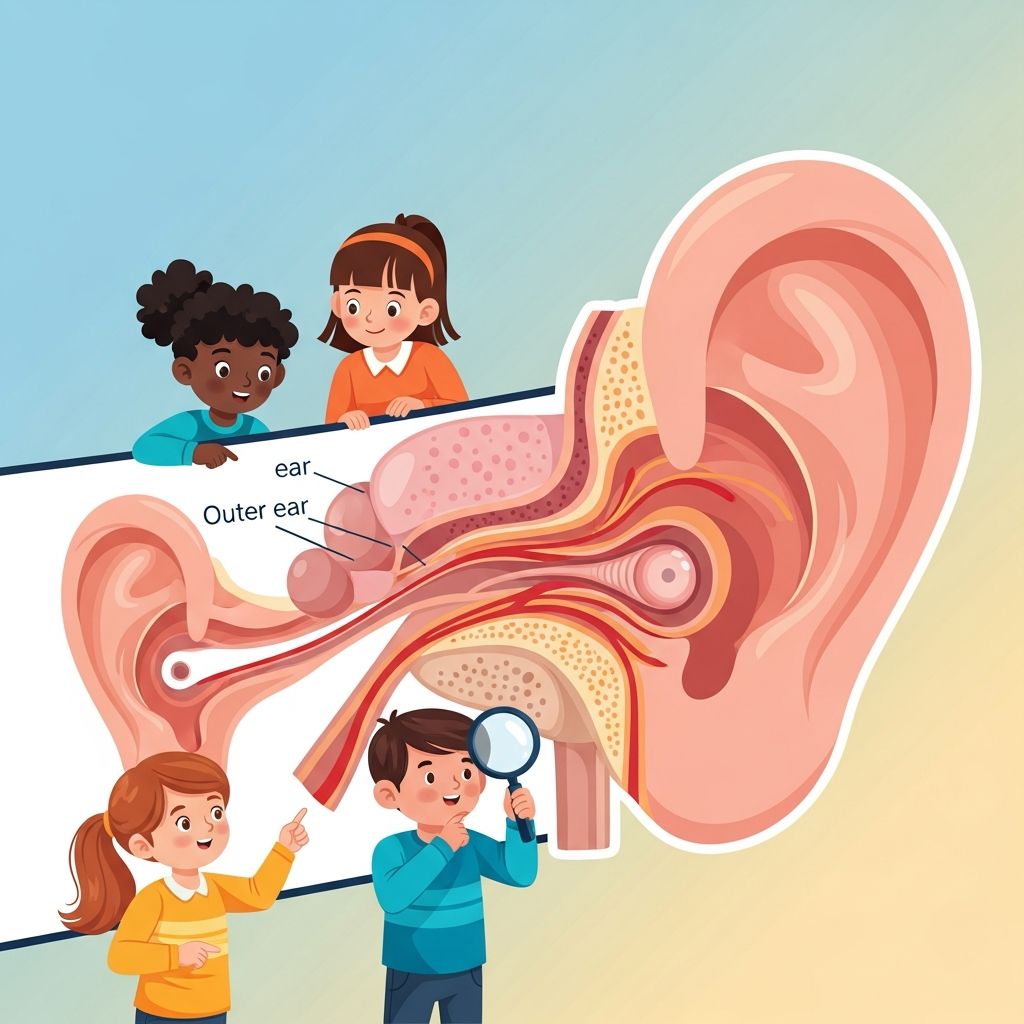
Even though ears look small from the outside, each one has three main sections that work together like a team: the outer ear, the middle ear, and the inner ear.
Outer Ear: The Sound Catcher
The outer ear is the part you can see on the side of your head plus the short tunnel that leads inside. Its job is to catch sounds and guide them toward the middle of the ear, a bit like a funnel catching raindrops and sending them into a pipe.
- Ear flap (pinna): The curved part on the outside that collects sound waves.
- Ear canal: The narrow passage that carries these sounds deeper into the ear.
- Earwax: A sticky, yellowish substance that protects the ear canal by trapping dust and germs.
Middle Ear: The Tiny Drum and Bones
The middle ear starts at a thin, stretchy sheet called the eardrum. When sound reaches it, the eardrum vibrates, shaking three tiny bones behind it. These bones are some of the smallest in your body, but they are very powerful because they pass the sound along and make it stronger.
- Eardrum: A flexible membrane that moves back and forth when sound hits it.
- Three small bones: A chain of mini-bones that carry the vibrations from the eardrum inward.
- Air-filled space: A small room behind the eardrum that needs the right air pressure to work well.
Inner Ear: The Hearing and Balance Center
The inner ear is hidden deep inside your skull. It has a coiled structure that looks a bit like a snail shell and some curved tubes that help with balance. Together, they turn vibrations into messages that your brain can understand.
- Snail-shaped part: Changes vibrations into electrical signals for the brain.
- Tiny hair cells: Delicate sensors that respond to different pitches of sound.
- Balance canals: Curved, fluid-filled tubes that sense when your head moves.
From Sound to Brain: Step-by-Step Journey
Hearing might feel instant, but there is a clear path that every sound must follow. Here is how the journey usually goes from the outside world to your brain in just a fraction of a second.
- Sound is created when something vibrates, like a guitar string, a barking dog, or a person’s vocal cords.
- Sound waves travel through the air until they reach your outer ear and are guided into the ear canal.
- The eardrum vibrates when sound waves hit it, moving back and forth very quickly.
- The tiny bones move in a chain reaction, passing and boosting the vibration into the inner ear.
- Fluid in the inner ear begins to move, bending tiny hair cells in different ways depending on the sound.
- Signals are sent along the hearing nerve to the brain, which decides what the sound is and where it is coming from.
All of this happens so quickly that you hear a word almost at the exact moment someone says it.
Why Hearing Matters So Much for Kids
Hearing is a huge part of learning, especially when you are young. It helps you pick up new words, follow instructions, and join in conversations with family and friends.
- Hearing makes it easier to learn how to speak clearly and use the right words.
- Listening in class helps you understand lessons, remember facts, and ask good questions.
- Being able to hear friends and teammates lets you play games safely and join in social activities.
Common Ear Problems in Children
Because kids are still growing, their ears can be more likely to have certain problems. Many of these issues are treatable, especially when adults spot them early and take you to a doctor or nurse.
| Ear Issue | Where It Happens | Possible Signs |
|---|---|---|
| Middle ear infection | Behind the eardrum | Ear pain, fussiness, fever, trouble hearing, pulling at the ear |
| Fluid without infection | Middle ear space | Muffled hearing, saying “What?” a lot, turning up the volume |
| Swimmer’s ear | Ear canal | Itchy or sore ear, pain when the ear is tugged, sometimes drainage |
| Wax buildup | Outer ear canal | Feeling blocked, mild hearing trouble, sometimes ringing |
| Noise-related hearing damage | Inner ear | Ringing in the ears after loud sounds, difficulty hearing quietly spoken words |
Middle Ear Infections
Middle ear infections are very common in young children because the small tube that drains the middle ear does not always clear fluid easily. When this area fills with thick liquid and germs, it can hurt and make sounds seem quieter or muffled.
- Kids may cry, tug their ear, or have trouble sleeping because lying down makes pressure feel worse.
- Sometimes there is a fever, and kids might not want to eat because chewing can be uncomfortable.
- Doctors may check the eardrum with a special light and decide if medicine or careful watching is best.
Swimmer’s Ear
Swimmer’s ear is an irritation or infection of the ear canal, the tunnel that leads inward from the outer ear. It often happens when water stays in the ear after swimming or bathing, creating a damp place where germs can grow.
- The ear may feel itchy at first, then become more painful, especially when the outer ear is gently pulled.
- Sometimes there is clear or cloudy fluid that leaks from the ear.
- Doctors usually treat this with special ear drops and advice to keep the ear dry while it heals.
Wax Buildup
Earwax is normal and helpful, but sometimes there can be more than the ear can slowly move out on its own. When wax becomes packed deep in the ear canal, it can block sound and cause discomfort.
- Kids might say their ear feels “full,” or sounds may seem softer than usual.
- Sticking objects into the ear to remove wax can push it deeper, making the problem worse.
- A health professional can safely remove extra wax if it is causing trouble.
Noise-Related Hearing Damage
Very loud sounds can harm the delicate hair cells in the inner ear. Once these cells are badly damaged, they usually cannot grow back, which can cause permanent hearing loss.
- Concerts, fireworks, power tools, and very loud headphones can all be risky if you listen too long or too close.
- Ringing in the ears or muffled hearing after loud noise is a warning sign that the sound was too intense.
- Wearing hearing protection and turning volumes down helps protect your ears for life.
Everyday Ear Care Tips for Kids
Taking care of your ears does not have to be complicated. A few simple habits can make a big difference in keeping them healthy and working well.
Safe Cleaning Habits
- Wash the outside of your ears gently with a washcloth during a bath or shower.
- Never put cotton swabs, pencils, fingers, or other objects inside the ear canal.
- If you feel like there is too much wax, ask a parent or caregiver to talk with a doctor instead of trying to dig it out.
Protecting Your Hearing from Loud Sounds
- Keep music players and headphones at a level where you can still hear someone speaking near you.
- Wear earplugs or special earmuffs at loud events like sports games or concerts.
- Take “quiet breaks” in a calmer place if you have been around loud noise for a while.
Staying Healthy to Help Your Ears
- Wash your hands often and avoid sharing cups or utensils to lower your chance of getting colds.
- Breathe clean air whenever possible and stay away from cigarette smoke.
- Follow your doctor’s advice about checkups, vaccines, and vision and hearing tests.
Spotting Possible Hearing Trouble
Because hearing loss in children can be mild or gradual, it is not always easy to notice at first. Paying attention to certain signs can help families catch problems early, when they are easier to manage.
Things Kids Might Notice
- Having to move closer to hear the television or tablet.
- Feeling like one ear hears better than the other.
- Struggling to hear in noisy places like cafeterias or playgrounds.
- Hearing a steady ringing, buzzing, or whooshing sound that does not seem to come from outside.
Things Adults Might Notice
- Frequently repeating instructions or questions because a child does not seem to hear the first time.
- Seeing a child watch other kids to copy what they are doing instead of following spoken directions.
- Reports from teachers that a child seems distracted, daydreamy, or often “misses” information.
When to See a Doctor or Hearing Specialist
Some ear problems go away quickly, but others need medical help. It is always better to ask for help early instead of waiting and hoping a problem will disappear.
- Strong ear pain, especially with fever or if it lasts more than a day.
- Fluid, blood, or thick discharge coming out of the ear.
- Sudden trouble hearing or a hearing change that seems to stay the same for several days.
- Balance problems, frequent falls, or feeling very dizzy along with ear symptoms.
Doctors and hearing specialists can look inside the ear, test how well sounds are heard, and decide on the best treatment or follow-up plan.
Fun Ear and Hearing Facts
- Some of the smallest bones in your whole body live inside your ears.
- Your ears help you know which direction sound is coming from, even when you are not looking.
- Many people feel a bit off balance or dizzy after spinning because the balance canals in the inner ear are still settling down.
- Your brain can focus on one voice in a noisy room, which is sometimes called the “cocktail party” effect.
Frequently Asked Questions (FAQs)
Can you damage your hearing just once from a loud noise?
Yes, a very loud sound such as an explosion or fireworks close to your ear can cause harm in just a moment. That is why it is important to stand at a safe distance and use hearing protection when you know loud sounds are coming.
Is it normal for ears to make popping sounds?
Soft popping sounds can happen when you yawn, swallow, or go up and down in an airplane or car. This is usually just air pressure balancing on each side of your eardrum, and in most cases it is not a problem.
Why do my ears feel blocked when I have a cold?
When you have a cold, the small passage that helps air move in and out of your middle ear can get swollen or blocked. This can trap fluid or air behind the eardrum, making your ears feel full or making sounds seem far away.
Is earwax dirty or bad?
Earwax may look messy, but it actually helps protect your ears by catching dust and germs before they can go deeper inside. Your body usually moves extra wax outward slowly on its own, so most of the time it only needs gentle cleaning on the outer ear.
Can headphones be safe for kids?
Headphones can be safe if the volume is kept at a moderate level and if you take breaks. A good rule is that if someone sitting next to you can hear your music clearly, it is probably too loud.
Key Takeaways for Kids and Families
- Your ears are powerful tools that help you hear, talk, learn, and keep your balance.
- Outer, middle, and inner parts of the ear work together to turn vibrations into sounds the brain understands.
- Ear infections, wax buildup, swimmer’s ear, and loud noises can all affect how well you hear.
- Simple habits like gentle cleaning, staying away from very loud sounds, and visiting the doctor when something seems wrong can keep your ears healthy.
By learning how ears work and how to care for them, you are taking important steps to protect your hearing now and for the rest of your life.