How Early Do Babies Begin Understanding Language?
Recent scientific investigations have fundamentally challenged long-held assumptions about when infants begin to engage with language. Rather than viewing language acquisition as a process that begins when children speak their first words, contemporary research demonstrates that babies are actively processing and recognizing linguistic patterns from remarkably early stages of development. This discovery has profound implications for how parents and caregivers approach early childhood development and communication.
The traditional timeline suggested that meaningful language comprehension emerged around six to twelve months of age. However, modern neurological studies and behavioral experiments reveal that infants as young as three to four months old exhibit sophisticated responses to language input. These findings suggest that the foundation for language development is being laid during the earliest months of life, long before parents typically expect their children to understand words or produce speech.
The Biological Foundations of Language Processing
Infants possess innate neurological mechanisms that allow them to distinguish and process linguistic signals from their environment. Research indicates that this capacity extends beyond spoken language to include visual linguistic systems, such as sign language. The human brain appears to be fundamentally organized to recognize and respond to language, regardless of the modality through which it is presented.
Studies measuring brain activity in infants reveal distinct neural responses when infants encounter language-based input compared to other types of auditory or visual stimulation. These responses suggest that the infant brain automatically categorizes and processes linguistic information as fundamentally different from non-linguistic signals. This early neural distinction indicates that language recognition is not a learned behavior that develops gradually, but rather a capacity that emerges from the biological architecture of human cognition.
Decoding the Role of Infant-Directed Speech
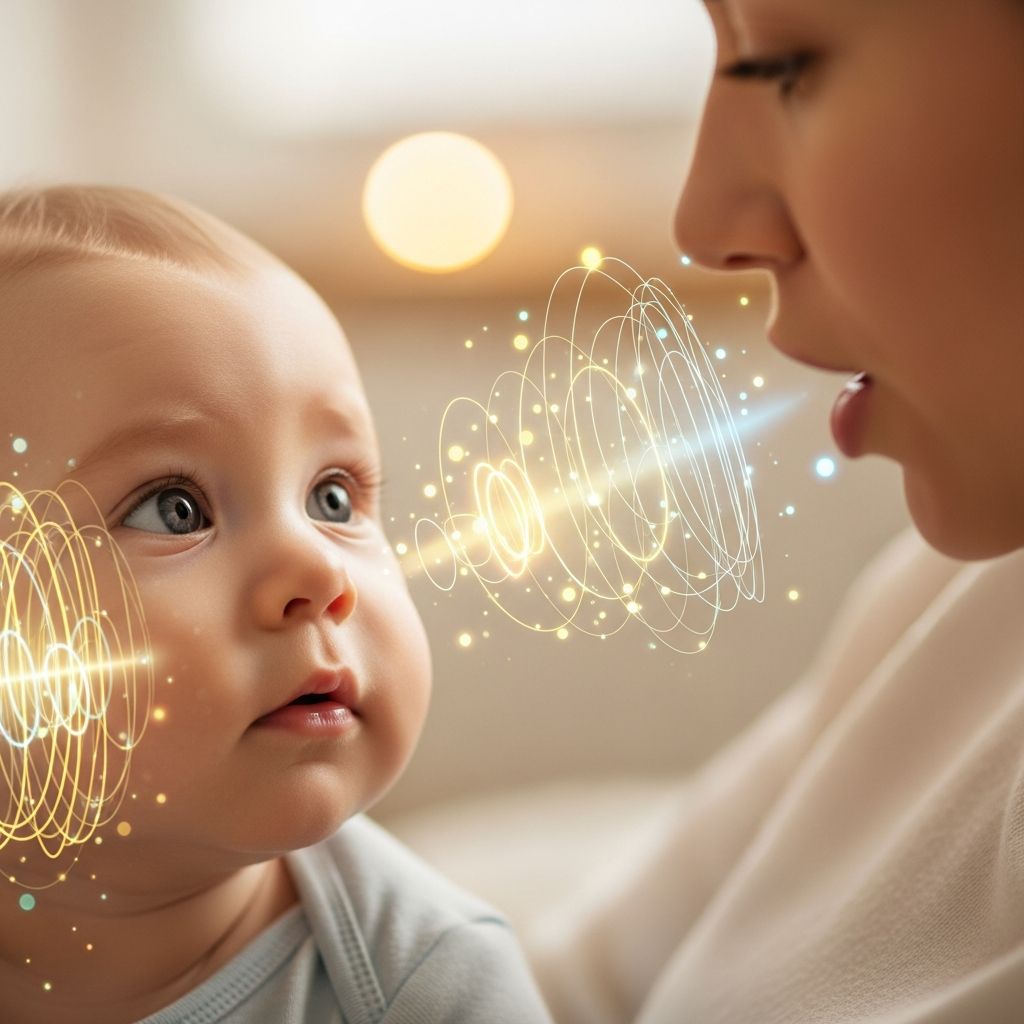
One of the most significant discoveries in recent language development research concerns the importance of infant-directed speech, commonly known as “baby talk.” Rather than being merely a cute communication style used by parents, this modified form of speech appears to serve a critical function in supporting early language learning. The characteristic features of baby talk—including elevated pitch, exaggerated vowel sounds, and simplified syntax—appear to facilitate infants’ ability to process and recognize language patterns.
When researchers compared brain responses to infant-directed speech versus standard adult conversation, they found striking differences in how four-month-old infants processed these two forms of input. Babies hearing exaggerated, infant-directed speech demonstrated more advanced neural responses to vowel distinctions compared to when they heard the same sounds produced in typical adult conversation. This suggests that the prosodic and acoustic features characteristic of baby talk may enhance infants’ ability to perceive and distinguish between speech sounds during a critical period of language development.
The implications extend beyond individual parent-child interactions. Understanding the cognitive benefits of infant-directed speech validates an instinctive behavior that caregivers have employed for generations. Rather than dismissing baby talk as unnecessary or even counterproductive, research now demonstrates that this communication style directly supports the neural processes underlying language acquisition.
Sign Language and Cognitive Development in Hearing Infants
A groundbreaking study from Northwestern University expanded understanding of how flexibly the infant brain processes language by examining whether hearing infants exposed to American Sign Language (ASL) demonstrate cognitive benefits similar to those observed with spoken language exposure. The findings were striking: even hearing infants with no prior exposure to sign language showed enhanced cognitive development when exposed to ASL.
In this research, three to four-month-old infants who viewed American Sign Language performed significantly better on object categorization tasks compared to control groups. This cognitive advantage mirrored the benefits observed when infants were exposed to their native spoken language. The results suggest that the linguistic structure of language, rather than its modality, is what engages infant cognition and supports early learning.
Notably, researchers determined that it was specifically the linguistic elements of sign language—not mere pointing or gesturing—that produced these cognitive benefits. This distinction clarifies that infants recognize and respond to true linguistic structures, demonstrating that language is defined by its grammatical and communicative properties rather than by whether it is transmitted through sound or visual display.
However, the cognitive advantage from ASL exposure diminished by six months of age in hearing infants. This developmental shift likely reflects the brain’s increasing specialization in processing the linguistic systems most prevalent in the infant’s environment, supporting the broader understanding that early childhood is characterized by progressive refinement of perceptual and cognitive abilities.
The Speech-Processing Foundation for Vocabulary Growth
Understanding early language recognition requires examining how this foundational ability connects to later language development. Research tracking infants from eighteen to twenty-four months reveals a clear pathway from early language exposure to robust vocabulary development. Infants who heard more child-directed speech demonstrated both greater efficiency in processing familiar words and larger expressive vocabularies by two years of age.
The relationship between early language exposure and vocabulary size appears to be mediated by infants’ developing speech-processing efficiency. Infants who receive abundant linguistic input develop faster, more accurate responses when identifying familiar words in real-time language processing. This enhanced processing skill then translates into more rapid vocabulary acquisition, as children can more efficiently extract and learn new words from ongoing speech.
Importantly, researchers controlled for the possibility that infants who are naturally more vocal might receive more speech input from caregivers. Even after accounting for infants’ own vocalization patterns, the relationship between child-directed speech exposure and later vocabulary remained robust. This suggests that caregiver input influences child language development through mechanisms beyond simple reciprocal interaction.
Universal Patterns and Individual Variation in Language Development
Despite the remarkable diversity of languages spoken worldwide, infants follow a relatively consistent developmental sequence in language acquisition. This universal pattern suggests that infants’ brains are organized according to basic principles that apply across linguistic systems. Typical milestones include communicating through crying at birth, producing cooing sounds between one and two months, beginning babbling around six months, understanding gestures and comprehending words between eight and twelve months, and producing first words near thirteen months.
Yet within this universal framework, considerable individual variation exists. The quantity and quality of language exposure significantly influence the pace at which individual children progress through these developmental stages. Some of this variation reflects differences in how much adults talk to infants, while other variation likely stems from infants’ individual neural organization and learning propensities.
The Interaction Between Cognition and Language Development
Contemporary research emphasizes that language development cannot be understood in isolation from broader cognitive development. The development of language abilities is deeply intertwined with the development of conceptual knowledge, abstract reasoning, and the ability to form categories and generalize information.
When parents or caregivers label objects or events for infants, they support both language learning and cognitive development. The act of providing a label helps infants recognize relationships between linguistic forms and conceptual categories. For instance, when caregivers label spatial relationships using words such as “on” or “in,” eighteen-month-old infants more effectively recognize and remember those spatial relationships in visual scenes compared to infants who observe the same scenes without linguistic labels.
This finding illuminates a fundamental mechanism through which language exposure supports cognitive development: language provides scaffolding that helps organize and consolidate infants’ emerging conceptual knowledge.
Practical Implications for Parents and Caregivers
The scientific evidence regarding early language recognition carries clear implications for how families can optimally support infant development:
- Engage in abundant verbal interaction: The quantity of language input matters significantly for both immediate processing efficiency and later vocabulary development. Creating opportunities for frequent, responsive communication with infants supports their linguistic and cognitive development.
- Embrace infant-directed speech: The characteristic features of baby talk—elevated pitch and exaggerated sounds—directly support infants’ ability to perceive and process language. There is no developmental benefit to restricting communication to adult-directed speech.
- Label objects and events: Intentionally naming objects, actions, and relationships helps infants connect linguistic forms to conceptual knowledge, supporting integrated language and cognitive development.
- Maintain face-to-face interaction: Direct visual contact during communication allows infants to observe facial expressions and mouth movements that provide additional cues supporting language processing.
- Provide diverse linguistic models: Exposure to varied vocabulary and grammatical structures from multiple speakers supports more robust language development than consistent input from a single source.
Frequently Asked Questions About Early Language Development
Q: At what age should parents begin talking to their babies?
A: Parents should begin talking to their infants from birth. Research demonstrates that infants process language from the earliest months of life, and early verbal interaction supports both immediate brain development and long-term language acquisition.
Q: Is baby talk harmful to language development?
A: No. Research shows that infant-directed speech, or baby talk, actively supports language development. The exaggerated acoustic features of baby talk enhance infants’ ability to distinguish speech sounds and process language efficiently.
Q: Can sign language be beneficial for hearing infants?
A: Yes. Studies show that exposure to sign language supports cognitive development in hearing infants, indicating that the linguistic structure of language—rather than its modality—is what engages infant cognition.
Q: How does early language exposure affect later vocabulary development?
A: Infants who receive abundant language input develop more efficient speech-processing abilities, which translates into faster vocabulary growth. This relationship remains significant even after controlling for infants’ own vocalization patterns.
Q: What is the relationship between language and cognitive development?
A: Language and cognition develop in tandem. Language provides scaffolding for cognitive development, helping infants organize and consolidate emerging conceptual knowledge through labeling and verbal interaction.
Q: Are there universal patterns in how infants develop language?
A: Yes. Despite linguistic diversity worldwide, infants follow a relatively consistent developmental sequence, from crying and cooing to babbling, word comprehension, and first words. However, individual variation in the pace of development occurs based on language exposure and other factors.
References
- Infants link language and cognition, whether the language is spoken or a sign language — Northwestern University. 2021. https://news.northwestern.edu/stories/2021/september/infants-link-language-and-cognition-whether-the-language-is-spoken-or-a-sign-language
- Using ‘baby talk’ could aid infants’ early language development — University of the Sunshine Coast / Medical Xpress. 2026-01-16. https://medicalxpress.com/news/2026-01-baby-aid-infants-early-language.html
- Research Sheds Light on How Babies Learn and Develop Language — Cornell University. 2007. https://hdtoday.human.cornell.edu/2007/12/05/research-sheds-light-on-how-babies-learn-and-develop-language/
- Talking to children matters: Early language experience strengthens language processing efficiency and vocabulary growth during infancy — National Institutes of Health. https://pmc.ncbi.nlm.nih.gov/articles/PMC5510534/