Bridging the Education Gap for Displaced Children Worldwide
The global refugee crisis presents unprecedented challenges for millions of vulnerable children. According to international data, half of the world’s refugees are children, yet only a small fraction of humanitarian funding—approximately 2%—is allocated specifically to education initiatives. This funding disparity leaves countless young people without access to formal schooling, structured learning environments, or the emotional support systems they desperately need. The consequences extend beyond academic achievement; children who experience displacement and conflict face significant psychological trauma, anxiety, and developmental delays that impact their long-term wellbeing and future opportunities.
Recognizing this critical gap, innovative partnerships between educational organizations and humanitarian agencies have emerged to create culturally relevant solutions. These initiatives demonstrate that entertainment and education can work synergistically to address both immediate emotional needs and foundational learning objectives. By combining media production, community engagement, and direct services, these programs offer holistic support to children navigating the complexities of forced displacement.
The Partnership Model: Combining Entertainment with Humanitarian Services
One notable example of this collaborative approach emerged from a $100 million competition designed to address intractable global problems. The competition specifically targeted organizations capable of addressing trauma and toxic stress among children in crisis situations, particularly in the Middle East region where displacement has reached catastrophic levels. The winning partnership brought together two established institutions: a well-known children’s educational organization renowned for its four decades of teaching foundational literacy and numeracy skills, and an international refugee assistance organization with deep operational experience in conflict zones and refugee camps.
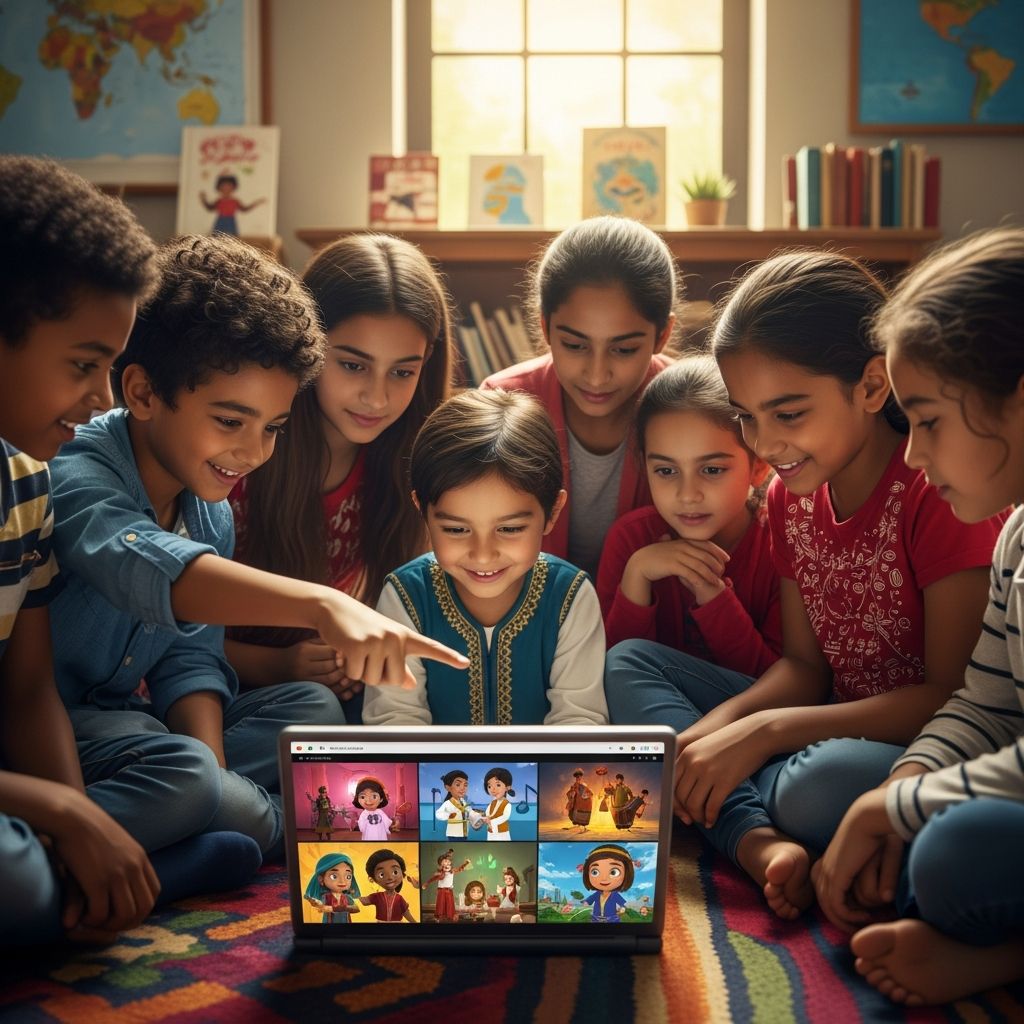
This partnership developed a comprehensive two-pronged strategy. The first component involved creating original television content specifically designed for the region, featuring culturally appropriate characters and storylines reflecting the experiences of displaced children. The second component expanded direct services delivered by humanitarian workers, including early childhood centers, home visiting programs, and community-based learning initiatives. This integrated approach ensures that children receive both mediated educational content and in-person human interaction, recognizing that trauma recovery and learning require multiple touchpoints and delivery mechanisms.
Characteristics of Culturally Responsive Programming
Successful programs serving refugee populations recognize that imported content, even if well-intentioned, may not resonate with children’s lived experiences or cultural contexts. Instead, culturally responsive programming incorporates several key elements:
- Local characters and representation: Original Muppet characters are designed to reflect regional aesthetics and are voiced by performers from the communities they serve, creating authentic representation and cultural familiarity.
- Emotionally relevant narratives: Rather than focusing exclusively on academic skills, programming addresses psychological themes such as fear, loss, loneliness, and adjustment to new environments—emotions that directly mirror children’s daily realities.
- Accessible story scenarios: Plots incorporate subtle references to displacement without explicitly labeling characters as refugees, allowing children to see their own experiences reflected while maintaining age-appropriate storytelling.
- Multilingual expansion: Programs develop content in multiple languages spoken across regions, recognizing the linguistic diversity of refugee and displaced populations including minority languages often underserved by mainstream media.
- Community-centered formats: Programming combines television broadcasts with supplementary materials used in educational settings, home environments, and community centers, creating multiple engagement opportunities.
Educational Content Beyond Traditional Academics
While foundational literacy and numeracy remain important, innovative programs for refugee children prioritize social-emotional learning and trauma-informed education. These approaches recognize that children affected by violence and displacement cannot benefit from traditional academics until their psychological and emotional needs receive adequate attention.
Programming addresses this reality by integrating several educational dimensions. Music serves as a powerful tool for emotional expression and processing, allowing children to engage with difficult feelings through familiar, enjoyable formats. Humor and lighthearted interactions provide necessary moments of joy and normalcy in otherwise disrupted childhoods. Story-based learning presents complex emotions and challenging situations within narrative contexts that children can safely explore. Interactive elements encourage participation and agency, counteracting the helplessness many refugee children experience.
The curriculum balances emotional development with practical skills. Children learn coping strategies for managing fear and anxiety, develop vocabulary for expressing emotions, and gain understanding that feelings are normal and manageable. Simultaneously, programs incorporate basic learning skills—pattern recognition, counting, letter recognition—embedding academic content within emotionally supportive frameworks.
Operational Scale and Implementation Strategy
Addressing the needs of millions of displaced children requires operational infrastructure capable of delivering services at scale. Partnerships expand reach through multiple distribution channels and service delivery models:
| Service Delivery Model | Geographic Reach | Target Population | Format |
|---|---|---|---|
| Television and broadcast media | 20+ countries across Middle East, North Africa, and Gulf regions | Nearly 8 million children | Satellite transmission and streaming |
| Early childhood centers | Established camps and settlement areas | Hundreds of thousands of children | In-person preschool and play-based learning |
| Home visiting programs | Informal settlements and non-camp locations | Millions of children in dispersed populations | One-on-one and small group interactions |
| School-based materials | Educational facilities in refugee-hosting regions | School-age children in formal settings | Storybooks, learning materials, teacher training |
This multi-channel approach acknowledges that refugee populations are not homogeneous. Some families live in established camps with infrastructure including satellite dishes and communal gathering spaces. Others inhabit informal settlements—essentially tents positioned along roadsides—where access to centralized services is limited. Still others integrate into urban communities, requiring different engagement strategies. By providing content through multiple modalities and delivering services across diverse settings, programs ensure equitable access regardless of families’ specific circumstances.
The Role of Local Voices and Community Leadership
Sustainable impact requires centering the expertise and perspectives of people from affected communities. Programs employ local puppeteers, storytellers, and educators who understand cultural nuances, communication preferences, and community values. This localized approach ensures that content resonates authentically rather than feeling imposed or culturally incongruent.
Community workers play equally critical roles in implementation. Home visitors establish relationships with families, understanding individual circumstances and providing personalized support. Early childhood educators create safe spaces where traumatized children can gradually rebuild trust and engagement. Teachers integrate program materials into formal educational settings, extending reach into organized school systems. This distributed workforce multiplies impact while ensuring that services remain culturally grounded and responsive to local needs.
Measuring Impact: From Viewership to Outcomes
Programs serving vulnerable populations require rigorous evaluation to demonstrate effectiveness and justify continued investment. Measurement approaches typically include quantitative metrics—viewership numbers, attendance at centers, reach statistics—and qualitative assessments of emotional and behavioral changes. Organizations track indicators such as children’s ability to identify and express emotions, caregiver capacity to support children’s emotional needs, engagement with learning activities, and social-emotional development milestones.
The challenge of evaluation in humanitarian contexts is substantial. Conflict, displacement, and limited infrastructure complicate data collection. Ethical considerations require careful handling of information involving vulnerable populations. Despite these challenges, rigorous evaluation remains essential for understanding what works, identifying improvement opportunities, and maintaining accountability to donors and communities served.
Expansion and Future Directions
The success of existing programs has prompted expansion into additional languages and regions. Development is underway for content in Dari, Pashto, Spanish, Ukrainian, and English, with additional languages planned. This expansion recognizes that displacement occurs across multiple regions and affects diverse linguistic communities. Ukrainian-language content, for example, responds to ongoing displacement in Eastern Europe, while Dari and Pashto expansion serves Afghan refugee populations. Spanish-language materials address the needs of Central American and Venezuelan displaced families.
Each language expansion requires not only translation but cultural adaptation. Stories, characters, and situations must reflect regional contexts, cultural values, and specific displacement experiences. This localization process is more complex and resource-intensive than simple translation but is essential for authentic cultural relevance.
Addressing Systemic Challenges in Refugee Education
While programs like these represent significant progress, they operate within broader systemic constraints. The fundamental disparity between global humanitarian needs and available resources remains stark. Even with $100 million commitments, programs can reach only a fraction of the world’s displaced children. Systemic change requires increased international funding prioritization for refugee education, policy reforms that facilitate access to formal schooling, and sustained political will to address root causes of displacement.
Additionally, programs must navigate complex operational environments. Delivering services in active conflict zones presents security risks. Political instability threatens program continuity. Supply chain disruptions affect program materials. Despite these challenges, organizations persist because the alternative—leaving millions of children without educational access and emotional support—is unconscionable.
Frequently Asked Questions
Why is emotional support prioritized alongside academics in refugee education programs?
Children who have experienced trauma and displacement often cannot benefit from traditional academic instruction until their psychological needs receive attention. Integrating social-emotional learning creates a foundation for all other learning by helping children manage fear and anxiety, rebuild trust, and develop coping skills.
How do programs ensure cultural appropriateness rather than imposing outside values?
Successful programs employ local storytellers, puppeteers, and community leaders in content development. They conduct extensive community consultation, conduct pilot testing with target audiences, and iterate based on feedback. This localized approach ensures content reflects cultural values and communication preferences rather than external assumptions.
What percentage of refugee children can these programs realistically reach?
Current programs deliver services to millions of children across multiple countries, but this represents only a fraction of the global refugee child population. Reaching all displaced children would require substantially increased funding and international coordination beyond current capacity.
How do programs accommodate children in informal settlements without centralized infrastructure?
Home visiting programs bring services directly to families living in informal settings. Community workers establish relationships, deliver personalized support, and provide educational materials that families can access in their living spaces, ensuring no children are left out due to geographic limitations.
Can programs created for one region be adapted for other displaced populations?
While the core model can be adapted, each new context requires significant localization. Different regions have different displacement causes, cultural contexts, languages, and community structures. Successful adaptation requires community engagement, cultural consultation, and content modification rather than simple replication.
References
- “A ‘Sesame Street’ Show for Young Refugees” — CBS 60 Minutes. 2019. https://www.youtube.com/watch?v=FZv9AfU12rk
- “Ahlan Simsim: The TV Project Giving Arab Kids a Better Start in Life” — Philanthropy Age, The Impact Room. 2024. https://www.philanthropyage.org/podcasts/the-impact-room/the-tv-project-giving-arab-kids-a-better-start-in-life/
- “Ahlan Simsim—Welcome Sesame in Arabic” — Sesame Workshop. 2024. https://sesameworkshop.org/our-work/shows/mena-ahlan-simsim/