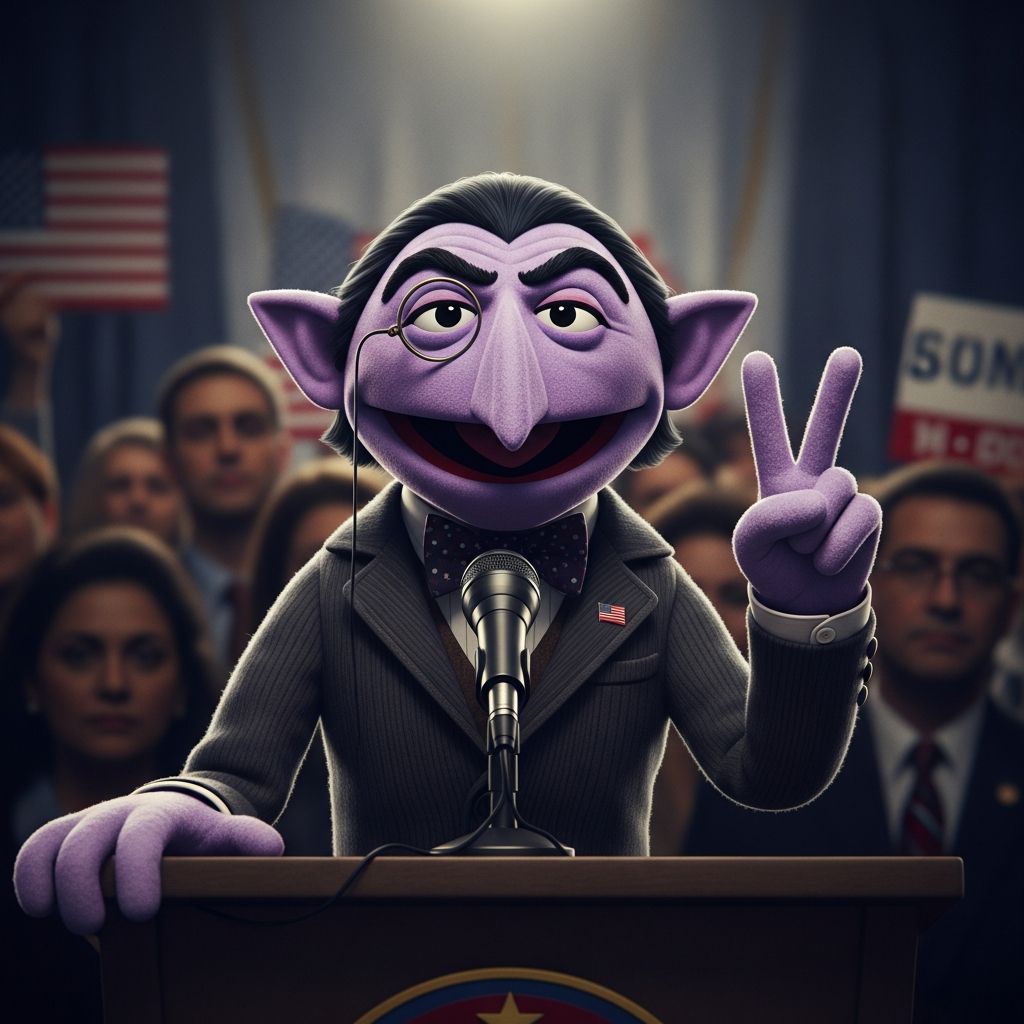
During the tense days of the 2020 U.S. presidential election, as vote counts stretched on for hours and then days, a surprising figure emerged as an unofficial mascot of the moment: Count von Count, the number-obsessed vampire from Sesame Street. What began as a clever joke about counting ballots quickly turned into one of the most widely shared and lighthearted ways to talk about a deeply serious civic process.
From Children’s TV Character To Political Symbol
Count von Count is a long-running muppet from the children’s television show Sesame Street, designed to teach kids basic numeracy through songs, repetition, and jokes about counting everything in sight. The character loves numbers, thunder, and lightning, and turns virtually any situation into a counting lesson. This obsession made him a perfect fit for a moment in U.S. politics when the entire world seemed fixated on one thing: how many votes had been counted, and how many still remained.
In early November 2020, as votes were still being tallied across key swing states, social media feeds filled with images of the Count superimposed over electoral maps, ballot-processing centers, and cable news screenshots. Many memes used captions that imagined the Count joyfully tallying ballots or patiently explaining that every lawful vote must be counted—often in stark contrast to political efforts to sow doubt about the counting process.
Why The Count Resonated During A Stressful Election
The viral appeal of the Count during the 2020 election was not random. Several overlapping factors helped transform a children’s character into a civic icon for a few unforgettable days.
1. A Simple, Nonpartisan Focus On Counting
The Count’s entire personality centers on counting correctly. This perfectly matched the real-world dispute over whether election officials should continue counting legitimately cast ballots. In many memes, the Count was shown insisting that all votes must be counted, echoing real guidance from election officials and legal experts that tallying every eligible ballot is required by law in U.S. elections.
- Clear rules: U.S. election laws require officials to count all properly cast ballots, including mail-in and provisional ballots that meet legal standards.
- No shortcuts: Counting often continues after Election Day to ensure accuracy, especially when ballots arrive by mail or require additional verification.
- The Count as a metaphor: A character who never skips numbers offered a humorous reminder that skipping ballots is not an option either.
2. Comforting Nostalgia In A High-Stress Moment
Sesame Street has aired for more than five decades, and many adults who followed the 2020 election grew up watching it. Research on media and psychology suggests that nostalgic content can reduce stress and increase feelings of social connection, especially in uncertain times. Seeing a familiar childhood character pop up in the middle of a high-stakes political event gave many people a small, comforting emotional break.
- Shared cultural memory: The Count is recognized across generations, making him a unifying reference point.
- Emotional regulation: Lighthearted memes can provide a brief escape from anxiety without ignoring the underlying issue.
- Softening conflict: A cartoon vampire talking about ballots made contentious debates feel slightly less hostile.
3. Humor As A Coping Mechanism
Election nights are often tense, and 2020 was especially fraught because of the COVID-19 pandemic, expanded mail-in voting, and widespread misinformation. Public health and psychological research during the pandemic highlighted how online humor and memes were used widely as a way to cope with crisis conditions and regain a sense of control.
The Count memes fit directly into this pattern:
- They translated complex legal and procedural issues into easily digestible jokes.
- They allowed people to share their anxiety without posting overtly partisan or aggressive content.
- They turned a frustrating waiting game into something people could at least laugh about together.
What The Count Memes Revealed About Vote Counting
Beyond the jokes, the meme wave inadvertently drew attention to how vote counting actually works in the U.S. Many people learned for the first time that it is normal for election results to take days to finalize, particularly when turnout is high and mail ballots are widespread.
| Myth | Reality About Vote Counting |
|---|---|
| All votes are fully counted on election night. | Unofficial election night tallies are preliminary; final certified results often take days or weeks. |
| Late-counted ballots are suspicious or illegal. | Ballots received on time but processed later are still lawful and must be counted if they meet legal requirements. |
| Counting can be stopped simply because one campaign demands it. | State laws dictate when and how counting ends; officials are legally required to complete the tally of valid votes. |
| Slow counting means incompetence. | Deliberate, careful counting can reflect careful verification procedures and efforts to avoid errors. |
Many Count memes exaggerated this reality for comedic effect: the vampire happily insisting on counting “one, two, three, all the ballots” mirrored real-world statements from election officials explaining that democracy depends on counting every lawful vote.
Sesame Street, Civics, And Public Trust
Sesame Street is not a political news program, but it has long incorporated themes of fairness, cooperation, and community responsibility. The show’s producers and educators have worked with child development experts to build episodes around empathy, problem-solving, and basic civic ideas, such as following rules and understanding different perspectives.
Because of this educational mission, the use of one of its characters in a conversation about democracy made a certain kind of sense:
- Educational framing: The Count naturally “teaches” about numbers, which made him a symbolic teacher about vote counts.
- Trust and credibility: Long-running children’s shows that are research-based, like Sesame Street, have earned high levels of public trust for presenting accurate, age-appropriate information.
- Soft introduction to civics: Parents could even use the memes to start simple conversations with kids about elections and why counting matters.
How The Meme Spread Across Platforms
The meme’s rise followed a familiar pattern in the modern social media ecosystem:
- Twitter/X: Early jokes framed the Count as an employee of local election offices, painstakingly tallying ballots in key states.
- Instagram: Sharable image posts and stories adapted the character into infographics or stylized designs about counting every vote.
- Facebook: Political discussion groups circulated Count memes alongside news articles about ongoing vote counts.
- Meme sites and generators: Users rapidly produced variations of the concept, adding new captions and visual punchlines that drew on the Count’s signature laugh and love of numbers.
Because the character was not tied explicitly to any campaign or party, people with varying political views sometimes used the same imagery to support slightly different messages—ranging from “every vote must be counted” to more partisan jokes about which side the Count would favor. This flexibility kept the meme alive longer than a narrower, more overtly partisan reference might have survived.
Memes, Democracy, And Civic Literacy
On the surface, memes about a cartoon vampire might appear trivial, but scholars of digital culture increasingly argue that internet memes play a real role in how people understand political events. They can simplify complex topics, spread information quickly, and reinforce group identities—for better or worse.
The Count meme wave showcased several of these dynamics:
- Accessible explanations: Instead of reading long articles about absentee ballots and state laws, some users encountered the topic first through a single humorous image.
- Norm reinforcement: Jokes about “counting every vote” implicitly supported the democratic norm that all lawful ballots deserve equal consideration.
- Potential oversimplification: At the same time, memes can gloss over legal nuances, such as distinctions between ballots that must be rejected by law and those legitimately counted.
For educators and civic organizations, this phenomenon suggested an opportunity: if people are paying attention to a meme, they might also be receptive to clear, factual explanations that use the same imagery or themes to discuss election processes accurately.
Parents, Kids, And Talking About Elections
Because the Count is, first and foremost, a children’s character, many parents found the meme wave bleeding into family life. Kids recognized the character in adults’ social media feeds or overheard jokes about him “counting votes.” This created openings for age-appropriate conversations about how elections work.
Child development experts generally recommend that when adults talk with children about complex civic events, they should:
- Use simple, concrete language tied to children’s existing knowledge (for example, counting objects or taking turns).
- Emphasize fairness, rule-following, and respect as key values.
- Acknowledge uncertainty or complexity in ways that feel safe, such as, “Adults are still counting to make sure we know who won, and that takes time.”
The Count’s fame in 2020 offered a ready-made metaphor: just as he carefully counts blocks or bats on television, real officials carefully count ballots. While the meme culture was aimed primarily at adults, it indirectly supported family discussions about patience, rules, and democratic outcomes.
Beyond 2020: The Count As A Lasting Political Reference
After the 2020 election, Count von Count did not permanently become a political figure, but the meme established him as a recurring shorthand for counting and verification in public debates. Subsequent elections, recounts, and even discussions about scientific data or public health statistics occasionally revived the character as a symbol of careful, methodical counting.
The broader lesson is that even lighthearted digital culture can leave a lasting mark on the way people talk about institutions:
- Characters as symbols: Fictional figures can become shorthand for ideas like fairness, transparency, or accuracy.
- Shared language: A single meme phenomenon can create references that persist in conversations long after the event passes.
- Potential for education: Civic educators and public officials may choose to harness such symbols to make complex processes feel less intimidating.
Practical Takeaways: What The Count Can Teach About Elections
Underneath the humor, the Count’s unexpected political fame highlighted core principles of democratic practice. These lessons apply far beyond a single election year:
- Every lawful vote counts: Democracies rely on accurate tallies of all eligible ballots, not just early or convenient ones.
- Accuracy beats speed: It is more important to verify results than to report them instantly, especially when margins are close.
- Transparency builds trust: Explaining counting procedures openly and clearly helps counter misinformation.
- Patience is part of democracy: Waiting for full, certified results is not a flaw in the system but a safeguard.
- Humor can support civic engagement: Jokes and memes can draw people into conversations they might otherwise avoid.
Frequently Asked Questions (FAQs)
Q: Did Sesame Street officially participate in the 2020 election meme?
A: The viral memes were largely created by social media users, not by the show itself. Sesame Street generally maintains a nonpartisan, educational stance focused on children, although its characters are sometimes referenced informally in public discussions about real-world events.
Q: Is it normal for vote counting in U.S. elections to take several days?
A: Yes. Unofficial results are reported on election night, but complete tallies and certified outcomes often take days or weeks, especially when there are many mail-in or provisional ballots that require verification under state laws.
Q: Why do people use children’s characters in political memes?
A: Familiar characters offer shared cultural references that are easy to recognize and remix. They can soften tense topics, introduce humor, and tap into nostalgia, all of which help posts spread rapidly on social platforms.
Q: Do memes like The Count’s actually help people learn about elections?
A: Memes alone rarely provide full explanations, but they can spark curiosity, normalize discussions of civic processes, and steer people toward more detailed sources. During COVID-19 and election-related crises, researchers observed that memes often functioned as gateways to deeper conversations about policies and institutions.
Q: Are election officials legally allowed to stop counting ballots early?
A: In general, no. Election officials are bound by state and federal laws that require them to process and count all valid ballots received according to statutory deadlines and procedures. Stopping the count arbitrarily would violate those legal obligations and undermine the integrity of the election.
References
- About Sesame Workshop — Sesame Workshop. 2024-02-01. https://www.sesameworkshop.org/about-us
- politics count – sesame street Memes & GIFs — Imgflip. 2021-11-01. https://imgflip.com/m/politics/tag/count+-+sesame+street
- Can We Stop Counting Votes? Not So Fast, Experts Say — Brennan Center for Justice. 2020-11-04. https://www.brennancenter.org/our-work/research-reports/can-we-stop-counting-votes-not-so-fast-experts-say
- Nostalgia: Conceptual Issues and Counseling Implications — American Psychological Association. 2018-05-01. https://psycnet.apa.org/record/2018-23009-001
- COVID-19 Memes Going Viral: QoL, Coping, and the Dark Side of Humor — Frontiers in Psychology. 2020-11-02. https://www.frontiersin.org/articles/10.3389/fpsyg.2020.577898