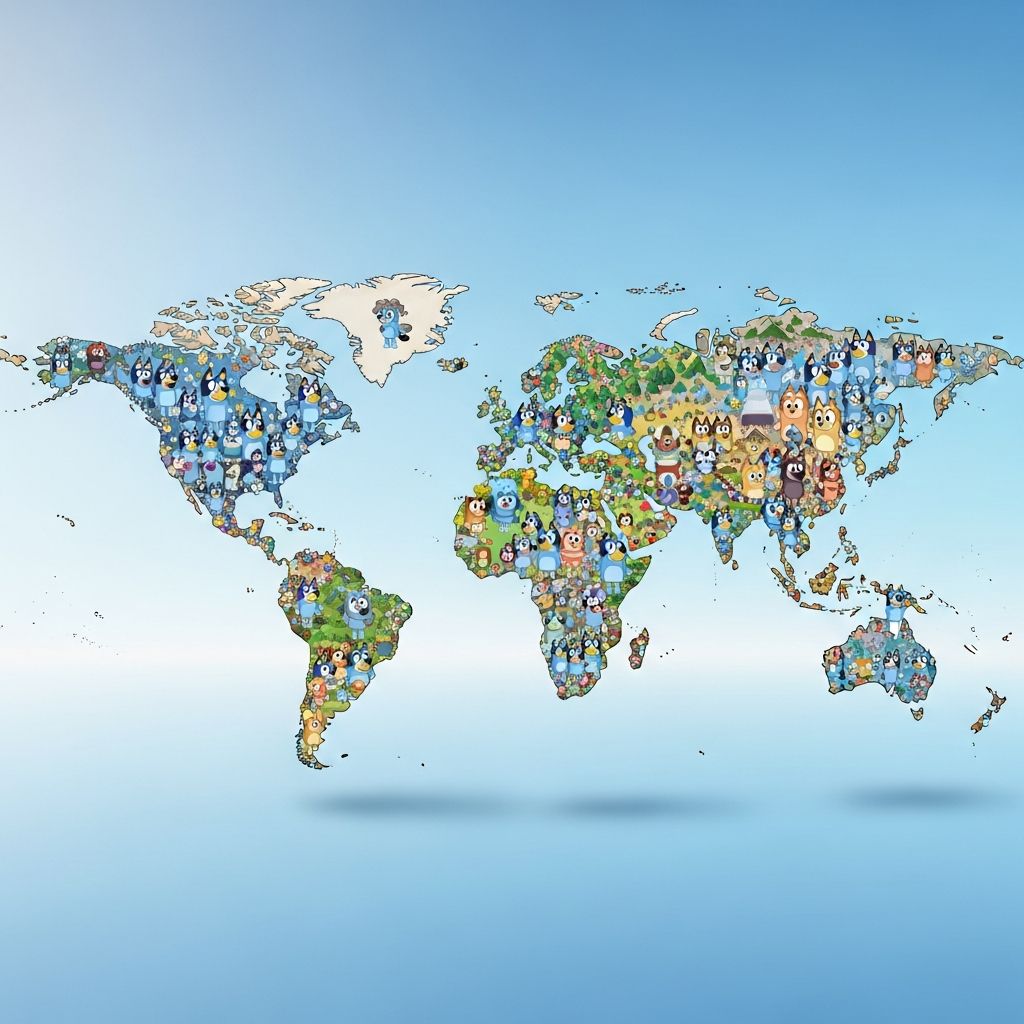
Bluey is one of the most recognizable children’s shows on television, but the version you know depends a lot on where you live and which language you speak. When the series travels beyond Australia, its characters sometimes gain new names, slightly different personalities, and local voices chosen to connect with kids in each region.
This article explores how and why Bluey’s characters shift across borders, and what those changes reveal about translation, culture, and modern children’s television.
Bluey’s Global Journey
Bluey began as an Australian production and is distributed internationally through major broadcasters and streaming services, including the BBC in the UK and Disney platforms in many other countries. As the audience has grown, so has the need to adapt the show for different cultures, languages, and broadcast standards.
- Origin: Produced in Australia and set in Brisbane, with clearly Australian voices and slang.
- Global reach: Dubbed or subtitled into multiple languages for Europe, North America, Latin America, and Asia.
- Core cast: The Heeler family (Bluey, Bingo, Bandit, Chilli) and a large group of friends and neighbors.
With such a large ensemble of characters, localization teams must decide which details should stay consistent and which can be adjusted to feel more familiar to local viewers.
Why Do Character Names Change?
Most of the time, character names are kept as they are in the original Australian version. But in some languages or markets, certain names are modified to make them easier to pronounce, less confusing, or more culturally meaningful.
Common reasons for renaming characters
- Pronunciation: Names that are difficult to say in another language may be simplified so young children can repeat them easily.
- Unintended meanings: A harmless name in English might sound like a rude word or slang term elsewhere, prompting a change.
- Cultural familiarity: A name might be swapped for a more common local name so that kids feel the character is “from their world.”
- Marketing and memorability: Shorter or more recognizable names can be easier to include in merchandise and promotional materials.
This kind of adaptation is part of a broader process known as localization—adjusting a work so it feels natural to a particular audience rather than simply translating words line by line.
Who Stays the Same and Who Might Change?
Not every character is treated equally in translation. The main family members are the foundation of the series, so their identities are usually preserved very closely.
| Character | Role | Typical Treatment in Dubs |
|---|---|---|
| Bluey | Main protagonist, Blue Heeler pup | Core name and personality kept; voice changes with language. |
| Bingo | Younger sister, Red Heeler pup | Usually retains the same name; dubbed by local child actors. |
| Bandit | Dad, Blue Heeler, playful and slightly chaotic | Name and character preserved; humor adjusted through translation. |
| Chilli | Mom, Red Heeler, calm and reflective | Rarely renamed; emotional tone carefully matched in the dub. |
| Friends & neighbors | Schoolmates, cousins, local families | Occasional name tweaks depending on language and cultural fit. |
Because side characters often appear in only a few episodes, translators have more flexibility to adjust their names or small personality details without disrupting the continuity of the series.
Beyond Names: How Dialogue and Humor Are Adapted
Bluey leans heavily on wordplay, family in-jokes, and casual Australian slang, all of which can be challenging to translate literally. Local dubbing teams frequently rework dialogue so jokes and emotional beats still land in the target language.
Key elements translators consider
- Slang and idioms: Australian terms are replaced with local equivalents instead of being translated word for word.
- Children’s voices: Many language versions use actual children rather than adults imitating them, which can change the feel of a character.
- Educational tone: Lines that touch on social behavior, sharing, or emotions are localized carefully to match local parenting and educational norms.
- Cultural references: Small mentions of sports, TV shows, or snacks might be swapped for local favorites, or left as-is to preserve the Australian flavor.
Despite these changes, the heart of each episode—imaginative play and everyday family life—remains consistent across languages.
How Localization Affects Character Perception
Even when names stay the same, the way a character feels can shift once their voice, cultural references, and style of humor are adapted.
- Bluey often sounds slightly older or younger depending on the voice actor chosen in each language, which can make her seem more assertive in one dub and more gentle in another.
- Bandit may come across as more comedic or more serious depending on how jokes and timing are handled in translation.
- Side characters whose personalities rely on wordplay (such as formal speech, rhymes, or exaggeration) may be adapted with new quirks that suit the target culture.
Research on dubbing in children’s media notes that translation choices can subtly shift how kids interpret characters’ age, authority, and emotional tone, even when the plot remains unchanged.
Gender, Family Roles, and Cultural Expectations
Bluey is often praised for its portrayal of modern parenting, especially an involved father and a mother balancing work and home life. When the show is localized, these themes usually remain, but how they are voiced and framed can vary by culture.
Aspects that typically stay consistent
- Bluey and Bingo: Clearly presented as girls with active, adventurous personalities, challenging older stereotypes about what girls “should” do.
- Bandit: A playful but emotionally aware father, often physically active with his kids.
- Chilli: Warm, thoughtful, and capable, frequently modeling emotional language and problem-solving.
Academic work on gender in children’s TV has found that localized dubs sometimes soften or amplify certain traits—for example, making a father sound more authoritative or a mother more nurturing depending on local norms—but concrete analysis for each Bluey dub is still emerging in scholarship.
Keeping the Australian Identity While Traveling
One of Bluey’s distinguishing traits is its specifically Australian identity: the accents, the outdoor settings, and small details like school, food, and sports. Even when translated, many dubs keep references that highlight the show’s origin.
- Place names: References to Brisbane and Australian landscapes are usually unchanged.
- School and play: The structure of school days and unstructured playtime is left largely as in the original, even if it differs from local practice.
- Character breeds: Each character’s dog breed, which often aligns with their personality, is kept consistent because it is part of the show’s visual design.
By keeping these elements, the international versions let children experience another culture while still feeling emotionally connected through localized dialogue and performance.
What Parents Notice vs. What Kids Notice
Adults often pay more attention to translation differences than children do. Parents may compare the original voices with the dubbed ones, notice changes to jokes, or follow online conversations about edits or translation choices.
Young viewers, however, tend to respond most strongly to:
- Character relationships (siblings, parents, friends)
- Playful scenarios and imaginative games
- Clear emotional arcs (feeling left out, learning to share, being brave)
Because these core elements are protected carefully during localization, children usually experience Bluey as a coherent and emotionally satisfying show even when names or details differ from one version to another.
Tips for Families Watching Multiple Versions
In some bilingual households, children might encounter more than one version of Bluey—for instance, an English-language stream plus a local-language TV broadcast.
- Use it for language learning: Watching the same episode in different languages can help kids recognize words, patterns, and expressions.
- Discuss differences: Ask your child to point out where a joke or phrase changed and what they liked better.
- Introduce cultural ideas: When the show keeps an Australian reference, you can pause to explain what it means and how it compares to your own culture.
Media researchers suggest that co-viewing—watching with children and talking about what they see—supports better comprehension and critical thinking about stories and characters.
Frequently Asked Questions About Bluey in Translation
Do Bluey’s main characters ever get completely different names?
The core Heeler family—Bluey, Bingo, Bandit, and Chilli—almost always keep their original names. Minor characters are more likely to be renamed, especially if their names pose pronunciation or meaning issues in another language.
Are there big differences in the personalities of characters across dubs?
The core traits remain intact, but tone can shift slightly. Voice casting, humor style, and cultural context can make a character sound more serious, more comedic, or more energetic in different language versions, even with the same plot.
Are any episodes changed or edited for international audiences?
Some children’s programs are occasionally edited to meet regional broadcast standards or cultural expectations. Bluey is largely shown intact, although certain lines or visual details may be adjusted in specific regions; these changes are usually subtle and do not alter the main story.
Why does my child prefer one language version over another?
Children often gravitate toward the voices and rhythms they find easiest to follow. They may like the local dub because it matches their everyday language, or they may enjoy the original for its distinctive sounds and expressions.
Is it confusing for kids to see characters with slightly different names in another language?
Most children quickly adapt, especially if the character design and relationships stay the same. Parents can help by explicitly mentioning that a character has two names, just as some people use nicknames or different names in different languages.
References
- List of Bluey characters — Wikipedia / production credits summary of character roles and descriptions. 2024-05-10. https://en.wikipedia.org/wiki/List_of_Bluey_characters
- Characters | Bluey Official Website — Ludo Studio / BBC Studios. 2023-11-01. https://www.bluey.tv/characters/bluey/
- Meet the Characters of Bluey! — Vanilla Underground Blog. 2023-06-15. https://www.vanillaunderground.com/blogs/news/meet-the-characters-of-bluey
- Bluey Characters | Learn More About Your Favourites! — Bluey Official Website. 2023-11-01. https://www.bluey.tv/characters/
- Bluey (TV Series 2018– ) — IMDb. 2024-01-20. https://www.imdb.com/title/tt7678620/
- Children, media and digital technologies — UNICEF Office of Research (discussion of dubbing, co-viewing and localization in children’s media). 2017-03-01. https://www.unicef-irc.org/publications/891-children-media-and-digital-technologies.html