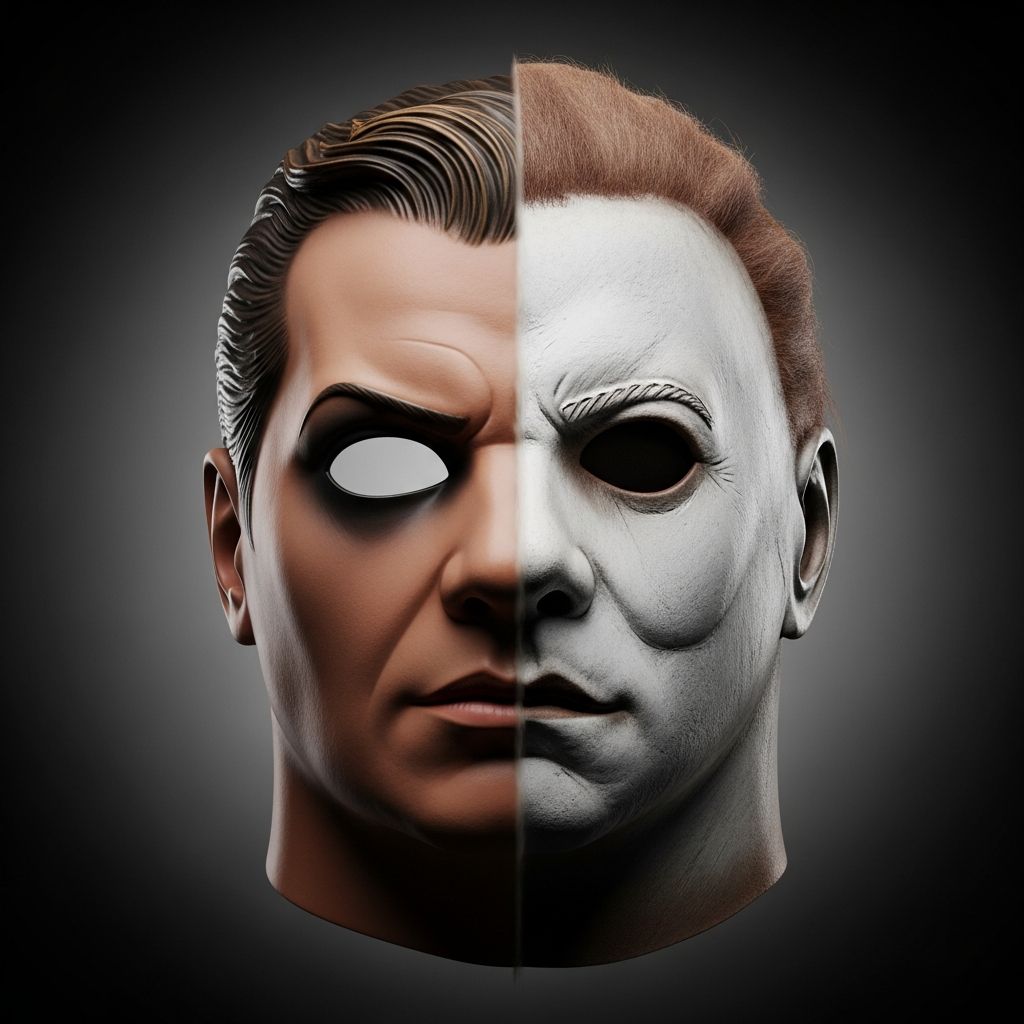
Long before Michael Myers stalked movie screens with his emotionless face, that same plastic stare belonged to a very different character: Captain James T. Kirk from Star Trek. The story of how a budget Captain Kirk mask transformed into one of horror’s most terrifying visages is a mix of thrift-store luck, low-budget creativity, and decades of fan fascination.
The Mask Before the Monster: A Captain Kirk Collectible
In the 1970s, licensed character masks were a growing part of the Halloween business in the United States, as costume companies capitalized on popular TV shows and movies. One of those shows was Star Trek, which, after its original network run, gained a passionate cult following in syndication and fan conventions.
To tap into that fandom, manufacturers created affordable plastic and latex masks of Captain Kirk. These masks were:
- Shipped in bulk to costume and novelty shops
- Lightweight, inexpensive, and mass-produced
- Designed more for recognizability than for realism
No one buying those masks at the time imagined they were looking at the future face of an entirely different genre: slasher horror.
How a Low-Budget Movie Turned to a Cheap Mask
When John Carpenter and his team began making the original Halloween in 1978, they were working with a famously small budget—around $300,000, a fraction of what studio horror films would later cost. That limited funding forced the filmmakers to be resourceful with everything from locations to props, including the killer’s mask.
According to production accounts, the crew explored a local costume shop looking for something unsettling yet simple for the masked killer, Michael Myers. A modified Captain Kirk mask became the unlikely winner. The choice made sense for a cash-strapped production because it was:
- Cheap: Far less expensive than commissioning a custom sculpt
- Available: Readily found in retail costume outlets
- Blank enough: Already had a neutral, somewhat expressionless base
From Starship Captain to Shape: Transforming the Face
The Captain Kirk mask that fans now associate with Michael Myers did not appear on screen untouched. The production team altered it to strip away nearly all traces of its original identity. Changes reportedly included:
- Removing eyebrows and sideburns to reduce recognizable details
- Widening and reshaping the eye holes to create a disturbingly vacant stare
- Spray-painting the mask white to give it a ghostly, lifeless pallor
- Messing and darkening the hair to add to the disheveled, uncanny look
What had been a TV hero’s face became something almost inhuman—no obvious emotion, no personality, just a smooth, pale canvas. That effect aligned perfectly with the way the script described Michael Myers as “The Shape” rather than simply a man in a mask.
Why the Mask Is So Disturbing: Psychology of the Blank Face
The Michael Myers mask is often ranked among the most frightening in horror history, in part because of how it plays with human perception. Psychologists have shown that people are extremely sensitive to facial expressions, using tiny cues to read others’ intentions and emotional states.
The Myers mask undermines that instinct:
- No clear emotion: The flat features provide almost no expression to interpret.
- Uncanny valley effect: It looks human, but not quite—too still, too generic.
- Projective fear: Viewers end up projecting their own fears onto the blank surface.
This ambiguity—part person, part mannequin—helps Michael Myers feel less like a character and more like an unstoppable, emotionless force. The fact that it started as the face of a charismatic star only makes the contrast more jarring.
| Aspect | Captain Kirk Mask | Michael Myers Mask |
|---|---|---|
| Original Purpose | TV hero costume for fans | Slasher film killer disguise |
| Facial Expression | Mild, recognizable likeness | Neutral, drained of personality |
| Color | Flesh-toned | Chalk-white |
| Emotional Effect | Nostalgic, playful | Menacing, uncanny |
Shatner’s Role: An Unintentional Horror Legacy
William Shatner’s likeness was licensed for that mask as part of the broader merchandising wave around Star Trek and similar shows, which helped establish the idea of character-driven consumer products. By the time Halloween arrived, that mask was just one of many TV-themed Halloween items in circulation.
Over the years, Shatner himself has acknowledged the connection with a mixture of amusement and curiosity in interviews, reflecting how surreal it is that his molded face became a horror symbol. His accidental place in slasher history underscores how actors can influence pop culture in ways they never planned—sometimes without even being on screen.
The Mask’s Place in Horror History
The success of Halloween helped popularize the modern slasher film, inspiring a wave of masked killers in the following decades. The Myers mask became a visual shorthand for the genre.
Compared with other horror icons, the mask stands out because it is:
- Almost featureless (unlike the detailed burns of Freddy Krueger)
- Strangely ordinary (compared with Jason Voorhees’ hockey mask)
- Deceptively simple (no fangs, scars, or exaggerated gore)
Its power lies in understatement. That minimalism allowed it to be reused and reinterpreted in sequels, reboots, and fan creations while remaining instantly recognizable.
How Sequels and Reboots Changed the Face
As the Halloween franchise expanded over decades, the mask subtly changed from film to film. Fans have scrutinized details like:
- Thickness and texture of the latex
- Size and angle of the eye holes
- Shape of the nose and lips
- Hairline, styling, and color
Some later installments depicted a more weathered, cracked, or aged mask to reflect in-story time jumps. Others used slightly reshaped molds as original materials became unavailable or deteriorated. This evolution mirrors how many long-running film series manage their signature props—maintaining visual continuity while updating materials for safety, durability, or HD cameras.
Halloween Night: From Movie Prop to Household Costume
As Halloween found success on home video and television, Michael Myers costumes quickly became a staple of October 31st. Retail and online costume shops now routinely stock versions of the mask alongside other classic horror characters, reflecting broader consumer demand for movie-based outfits.
On a typical Halloween, you can expect to see:
- Adults in full coveralls and replica masks
- Teens combining the mask with hoodies or everyday clothes
- Collectors wearing screen-accurate versions at conventions
The irony is hard to miss: children and adults wearing a horror icon whose face started as another piece of licensed merchandise decades earlier.
Fan Culture, Replicas, and Obsession with Accuracy
Today, dedicated fans and prop makers invest enormous time and money into recreating the “perfect” version of the Michael Myers mask. This trend fits into a larger pattern of fan-driven prop replication and cosplay culture, in which enthusiasts meticulously reconstruct screen-used items for display or costuming.
Common areas of focus include:
- Tracking down vintage masks or molds that resemble the original Captain Kirk base
- Repainting and rehairing mass-market masks to match specific films
- Analyzing production photos and frames to replicate tiny details
What began as a thrifty production hack has become a near-archaeological hunt for authenticity among collectors and fans.
What This Story Reveals About Pop Culture
The transformation from a Captain Kirk mask to Michael Myers’ face isn’t just a fun behind-the-scenes anecdote. It highlights several broader themes about popular culture and media history:
- Recycling and remixing: Pop culture constantly reuses and recontextualizes existing objects, characters, and images.
- Power of constraints: Budget limits can prompt creative decisions that end up shaping an entire genre.
- Life beyond original intent: A prop designed for one fandom can unexpectedly come to define another.
- Fan-driven memory: Fans keep these stories alive, retelling how a simple store-bought item became mythic.
The Michael Myers mask stands as a reminder that sometimes the most iconic elements of film history were never meant to be iconic at all—they were simply what the crew could afford on a tight schedule.
Practical Tips for Fans: Safely Enjoying Masked Costumes
For those inspired to wear their own version of the Myers mask or any full-face costume, safety is crucial. Health agencies and consumer groups emphasize the importance of visibility and breathability in masks, especially for children.
When choosing or modifying a mask:
- Ensure adequate eye holes for good peripheral vision.
- Check that nose and mouth openings allow comfortable breathing.
- Use flame-resistant materials when possible, as many Halloween activities involve candles or open flames in decorations.
- Consider face paint or partial masks for younger children to reduce tripping and overheating risks.
With a few precautions, fans can safely celebrate the legacy of the mask without recreating any real-world scares.
Frequently Asked Questions (FAQs)
Q: Was the Michael Myers mask really a Captain Kirk mask?
A: Yes. The mask used in the original Halloween began as a commercially sold Captain Kirk mask, which the production altered heavily—removing features, repainting it white, and reshaping the eyes—until it became the blank, eerie face now associated with Michael Myers.
Q: Why did the filmmakers choose such a simple mask?
A: Budget limitations made an inexpensive, off-the-shelf mask the most practical option. When the altered Captain Kirk mask proved unsettling and emotionless on camera, it fit the film’s vision of Michael Myers as an almost inhuman, faceless presence.
Q: Is William Shatner involved in the Halloween movies?
A: William Shatner did not participate in making Halloween. His connection is indirect—his licensed likeness was used to create the original Captain Kirk mask that the filmmakers later repurposed and transformed for Michael Myers.
Q: Why does a blank mask feel scarier than a detailed monster face?
A: Humans instinctively read facial expressions to understand others’ emotions and intentions. A mask with almost no expression, like Michael Myers’, blocks that process, creating unease and forcing viewers to project their own fears onto the empty surface.
Q: Are replicas of the original mask still available?
A: Exact vintage Captain Kirk masks from the 1970s are rare collectibles, but many companies produce licensed Michael Myers masks inspired by various films in the franchise. Enthusiasts sometimes modify modern masks or create custom sculpts in an attempt to match the original as closely as possible.
References
- Halloween & Seasonal Products: Facts & Figures — National Retail Federation. 2024-09-10. https://nrf.com/insights/holiday-and-seasonal-trends/halloween
- 50 Years of Star Trek — Smithsonian Magazine / Smithsonian Institution. 2016-09-01. https://www.si.edu/stories/50-years-star-trek
- John Carpenter’s Halloween (BFI Film Classics) — BFI Publishing (referenced via British Film Institute). 2018-10-23. https://www.bfi.org.uk/news/john-carpenters-halloween
- Icons of Fright: The Cultural Impact of the Slasher Film — BBC Culture. 2019-10-29. https://www.bbc.com/culture/article/20191029-the-slasher-film-how-halloween-changed-horror
- Facial Expressions and Emotion — American Psychological Association. 2019-03-01. https://www.apa.org/monitor/2019/03/cover-facial-expression
- Cosplay Culture: Historical and Contemporary Perspectives — Mechademia / University of Minnesota Press. 2017-10-01. https://www.upress.umn.edu/book-division/books/cosplay-culture
- Halloween Safety — U.S. Consumer Product Safety Commission. 2023-10-15. https://www.cpsc.gov/Safety-Education/Safety-Education-Centers/Holiday-Safety/Halloween