Home pregnancy tests all aim to answer the same question, but they do not all detect pregnancy at the same time or with the same level of clarity. Understanding how these tests work, what “early result” really means, and how different formats compare helps you choose the right test and use it at the right moment for the most reliable answer.
How Home Pregnancy Tests Work
Most home pregnancy tests detect a hormone called human chorionic gonadotropin (hCG), which is produced after a fertilized egg implants into the uterine lining. The test area on the strip or wand is coated with antibodies that bind to hCG; when enough hormone is present in the urine, a visible signal such as a line, plus sign, or digital word appears.
Implantation usually occurs about 6–12 days after ovulation, and hCG levels typically double every 48–72 hours in early pregnancy. Because of this gradual rise, a test that is highly sensitive may detect pregnancy several days before a missed period, while less sensitive tests only become reliable on or after the day the period is due.
Understanding Test Sensitivity (mIU/mL)
The sensitivity of a pregnancy test is usually described in milli–international units per milliliter (mIU/mL). A lower number means the test can detect smaller amounts of hCG, so in theory it can detect pregnancy earlier than a test with a higher threshold such as 25 mIU/mL.
However, sensitivity numbers describe how much hormone triggers a positive reaction in a controlled setting, not how often the test correctly shows a positive result at different days past ovulation. Real-life factors like urine concentration, uneven hormone production, and user technique all influence how soon that sensitivity translates into a clear positive.
Typical Sensitivity Ranges
- Ultra-sensitive strip or cassette tests: advertised around 10 mIU/mL.
- Early-result branded tests: often around 6–12 mIU/mL in lab conditions.
- Standard midstream and digital tests: commonly 20–25 mIU/mL.
- Older or generic tests: sometimes higher, meaning they are better for testing on or after the missed period.
Types of Home Pregnancy Tests
Different test formats use the same basic chemistry but package it in ways that vary in cost, convenience, and ease of reading. All can be accurate when used correctly, so choosing among them depends on budget, how early you want to test, and how much room for interpretation you’re comfortable with.
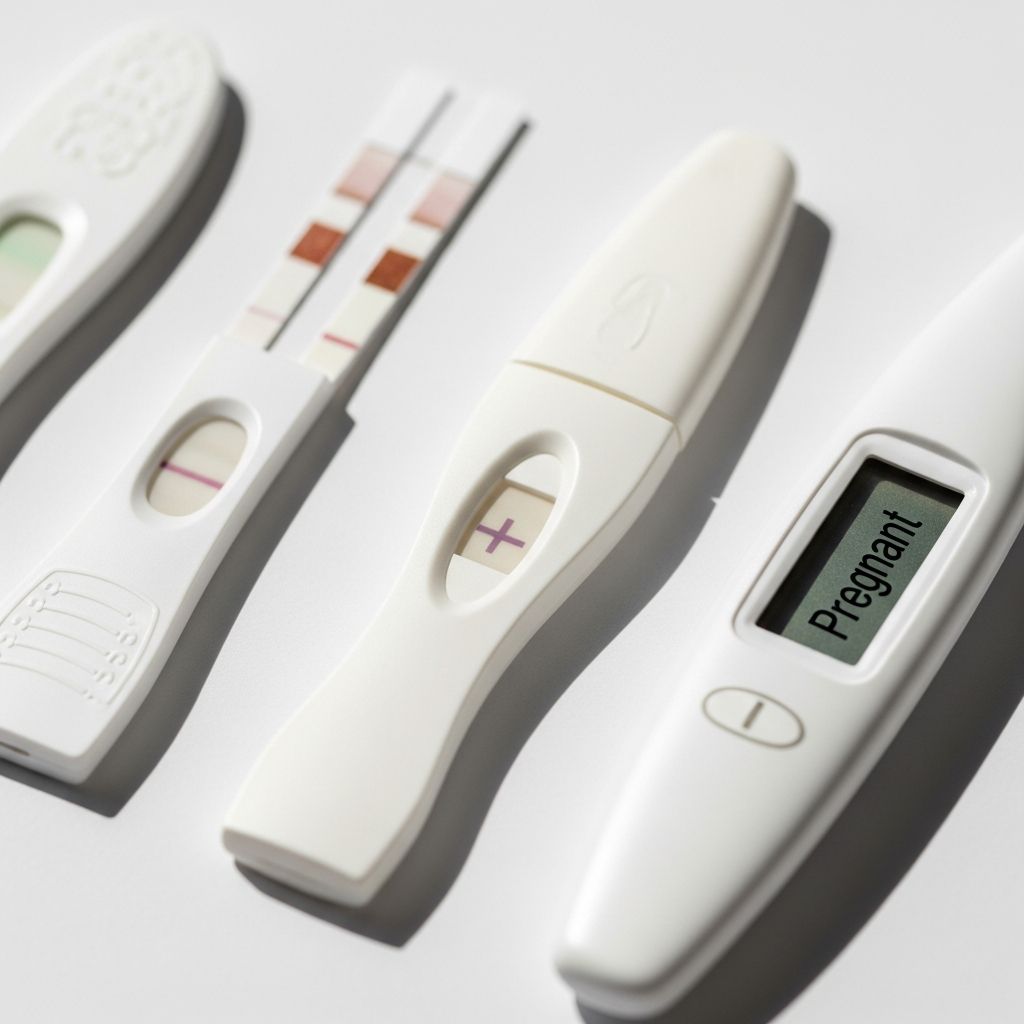
1. Test Strips
Test strips are narrow, un-housed strips that you dip into a cup of collected urine. They are often sold in bulk, making them popular for people who test frequently while trying to conceive.
- Pros: Very inexpensive per test; good for daily testing; often marketed as highly sensitive.
- Cons: No plastic handle; require a clean cup; result lines can be faint and easy to misread; packaging may provide less detailed instructions.
2. Cassette Tests
Cassette tests have a small plastic housing with a sample well and a result window. Urine is added with a dropper, and lines appear inside the viewing window after the recommended wait time.
- Pros: More protected testing area than bare strips; dropper allows controlled sample size; often sold in multipacks.
- Cons: Slightly more steps; still require a cup and dropper; interpretation depends on reading faint lines or changes in color.
3. Midstream (Wand) Tests
Midstream tests are plastic wands with an absorbent tip you hold directly in the urine stream. They are widely available in pharmacies and supermarkets and often come with clear printed instructions.
- Pros: Easy and convenient; no cup needed; more robust housings; branded options usually offer clear diagrams for interpreting results.
- Cons: Higher cost per test; line-based displays can still produce ambiguous faint positives; some people find the physical handling awkward.
4. Digital Pregnancy Tests
Digital tests use similar chemistry but add electronics that interpret the lines internally and display words such as “Pregnant” or “Not Pregnant.” Some models also estimate weeks since conception based on hCG level ranges.
- Pros: Easy to read; removes guesswork over faint lines; particularly helpful if line tests cause anxiety.
- Cons: Usually less sensitive than the most advanced early-result line tests; more expensive per test; some people dislike that the internal line information is hidden.
Earliest-Result vs Most Accurate-Result
Advertised early-result tests claim to detect pregnancy several days before a missed period, but it is important to distinguish between “can detect” and “how accurate” at that point. Even very sensitive tests may only catch a portion of true pregnancies five or six days before the expected period, with accuracy improving rapidly as the period date approaches.
For most users, the “best” test is one that balances early detection with clear, trustworthy results. If testing very early, it is wise to expect that a negative result may not be definitive, and a repeat test closer to or after the day the period is due is usually recommended.
| Timing (relative to expected period) | Ultra-sensitive line tests | Standard midstream tests | Digital tests |
|---|---|---|---|
| 6–5 days before | May detect a minority of pregnancies; results are uncertain. | Often still negative even if pregnant. | Typically not recommended this early. |
| 4–3 days before | Detection rises; some clear positives but still frequent false negatives. | Occasional early positives; many pregnancies still not detected. | May pick up some pregnancies; accuracy still limited. |
| 2–0 days before | High detection rate; many tests market >95% accuracy by this point. | Accuracy approaches or reaches >99% on the expected period day. | Accuracy generally similar to standard midstream tests when used as directed. |
| Day after missed period and beyond | Very high reliability when instructions are followed. | Very high reliability; negative results at this time are more trustworthy. | Very high reliability with easily read results. |
*This table is illustrative and summarizes common patterns reported by manufacturers and clinical reviews rather than providing brand-specific statistics.
Comparing Common Pregnancy Test Features
Because manufacturers frequently update formulations and add new digital features, focusing on core attributes rather than brand names is the most practical way to compare tests. The main features to consider are sensitivity, readability, cost, and how early the brand claims you can test.
| Feature | What It Means | What to Look For |
|---|---|---|
| Sensitivity (mIU/mL) | Lowest hCG level that can trigger a positive result. | Lower number if testing very early; standard sensitivity is usually fine on or after the missed period. |
| Result type | Lines, plus/minus signs, or digital words. | Digital for easiest interpretation; simple lines if budget is a priority and you are comfortable reading them. |
| Format | Strip, cassette, midstream wand, or digital wand. | Strips for frequent, low-cost testing; wands for convenience; digital wands for clarity. |
| Earliest claimed test day | How many days before the missed period the package says you may test. | Earlier claims if you want an early indication, but always plan to confirm around or after the expected period. |
| Price per test | Total cost divided by number of tests in the package. | Bulk strips or multi-packs if testing often; digital singles for occasional, high-clarity use. |
Why Some Tests Show Faint Lines
A faint second line usually means the test has detected some hCG, but the concentration is still relatively low. This often happens when testing very early, when urine is diluted, or when the test’s dye distribution leads to a light yet visible reaction.
Provided you read the result within the manufacturer’s time window, any visible second line on a line test generally indicates the presence of hCG. Many people confirm faint positives by retesting 24–48 hours later, when rising hormone levels usually make the line darker.
Best Time of Day to Test
First-morning urine is usually the most concentrated because it sits in the bladder overnight, giving hCG more time to build up. Especially in the very early days before or just after a missed period, testing with this first sample can improve the chances of detecting a pregnancy.
As pregnancy progresses and hCG levels rise, the time of day becomes less critical, and many people obtain clear positives at any time. If you must test later in the day early on, limiting fluids for a few hours beforehand may help avoid overly diluted urine.
Common Reasons for False Negatives
False negatives occur more often than false positives and can be very frustrating when you have pregnancy symptoms or know that the timing of intercourse was favorable. In most cases, the explanation is that there simply is not yet enough hCG in the urine for the test to detect.
- Testing too early: Ovulation may have occurred later than expected, or implantation may have been slightly delayed, leaving hCG levels below the detection threshold.
- Very diluted urine: Heavy fluid intake can dilute hormone levels, especially if tests are done mid-day.
- Not following instructions: Leaving the test in urine too long or too briefly, or reading results too early or too late, can distort the outcome.
- Defective or expired test: Old reagents or damaged packaging may prevent correct functioning.
Common Reasons for False Positives
False positives are less common, but they do occur. A true positive is defined as a test that detects hCG produced by an implanted pregnancy; a false positive is when a test appears positive but there is no ongoing pregnancy.
- Chemical pregnancy: A very early pregnancy that implants and begins producing hCG but then stops developing, leading to a positive test followed by menstruation.
- Residual hCG after pregnancy: Hormone can remain in the body for a time after birth, miscarriage, or termination, causing lingering positive results.
- Fertility medications: Some medications contain hCG and can temporarily trigger a positive result.
- Evaporation lines mistaken for positives: When line tests are read after the recommended window, colorless or greyish streaks can be confused with true positive lines.
How to Use a Home Pregnancy Test Correctly
Proper technique reduces the chance of misreading and increases the reliability of the result. While each brand has its own instructions, certain steps are common to most home pregnancy tests.
- Check the expiration date on the box or foil pouch before opening the test.
- Read the enclosed instructions fully and note the recommended testing time and result window.
- Use first-morning urine if you are testing early.
- Either dip the strip in a collected sample for the specified number of seconds or hold the absorbent tip of a midstream test in the urine stream as directed.
- Place the test on a flat surface and start timing immediately.
- Check the control line or symbol to confirm the test is functioning correctly.
- Read the result only within the indicated time frame, usually a few minutes after testing.
- Discard the test after the reading window, and do not interpret any changes that occur much later.
Tips for Choosing the Right Pregnancy Test
Personal priorities, including how early you want a possible answer and how comfortable you are interpreting faint lines, will influence which test format is best. Cost, the number of tests included, and local availability also play significant roles in the decision.
- If you test often while trying to conceive, consider inexpensive bulk strips for day-to-day use and keep a higher-end midstream or digital test to confirm.
- If you find line tests stressful or confusing, opt for a digital test that displays clear words, even if it is slightly less sensitive.
- If your cycle is irregular and you are unsure when ovulation occurred, wait at least 14 days after unprotected intercourse before testing or follow serial testing every few days.
- If you receive conflicting results across different brands, re-test after 48 hours or consult a healthcare professional for a blood test.
Frequently Asked Questions (FAQs)
How soon can a home pregnancy test give a reliable result?
Many early-result tests can pick up some pregnancies several days before a missed period, but reliability improves markedly as the expected period date approaches. For the most dependable outcome, most healthcare guidance suggests testing on the day the period is due or afterward, and repeating the test after a couple of days if the result does not match symptoms.
Is a digital test more accurate than a line test?
Digital tests are not necessarily chemically more sensitive than line tests; they use similar technology to detect hCG. Their main advantage is interpretive: the internal electronics read the lines and present words like “Pregnant” or “Not Pregnant,” reducing user error from misreading faint or ambiguous lines.
Does a darker line mean a healthier pregnancy?
Line darkness can vary with urine concentration, time of day, and subtle differences between tests, so it is not a reliable measure of pregnancy health. A single darker or lighter test does not say much about how the pregnancy is progressing; healthcare providers use quantitative blood tests and ultrasounds instead of home test line color to assess viability.
Can medications affect my pregnancy test result?
Most common medications, including hormonal birth control and antibiotics, do not interfere with modern pregnancy tests. The main exception is medication containing hCG itself, often used in fertility treatments, which can temporarily cause positive results independent of an actual pregnancy.
When should I see a doctor after a positive home test?
Many clinicians advise scheduling an appointment shortly after a positive home test, often around 6–8 weeks from the last menstrual period, unless you have pain, heavy bleeding, or a history of complications. If you experience concerning symptoms or repeated faint positives without a clear progression, earlier medical evaluation may be appropriate.
Key Takeaways on Early and Accurate Testing
All modern home pregnancy tests work on the same principle of detecting hCG, but they differ in sensitivity, format, and how clearly they present results. The earliest tests can sometimes detect pregnancy several days before a missed period, yet even the best early-result product becomes much more reliable when used around or after the expected period day.
Choosing a test that fits your timing, comfort level, and budget—and using it exactly as instructed—offers the best chance of getting a clear answer when you need it most.