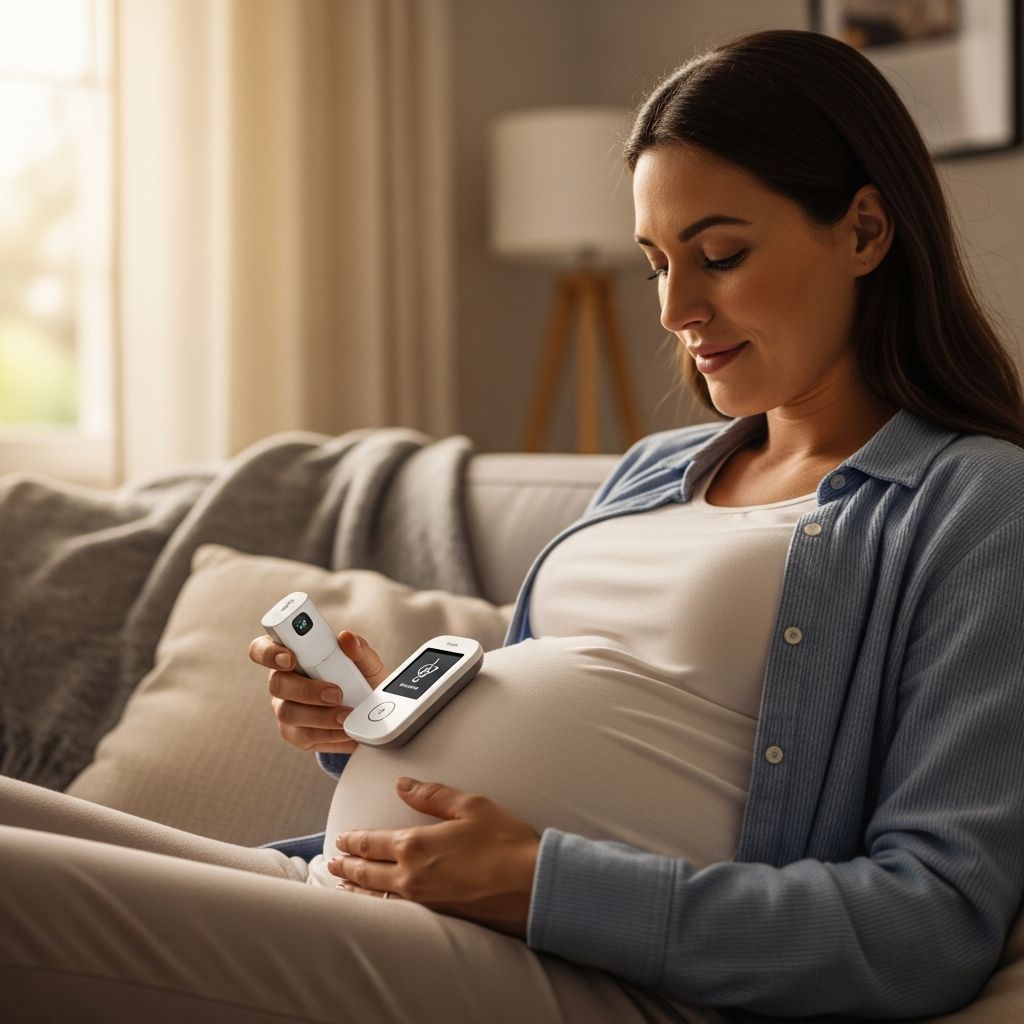
Hearing a baby’s heartbeat for the first time is an unforgettable moment. It is easy to see why many parents consider buying a home fetal Doppler to replay that experience between prenatal visits. Yet professional organizations and regulators worldwide urge caution about using these devices outside clinical settings. This guide explains how fetal Dopplers work, what they can (and cannot) tell you, and why relying on them can sometimes be unsafe.
What Is a Fetal Doppler?
A fetal Doppler is a handheld ultrasound device that sends high-frequency sound waves into the uterus and converts the echoes into an audible sound similar to a heartbeat. In clinics, Doppler is used briefly by trained professionals as part of broader fetal assessment. At home, commercial devices are usually sold for parents to listen to the baby’s heartbeat for reassurance or bonding, not for diagnosis.
- Clinical Doppler: Used in hospitals or clinics by trained staff to obtain fetal heart rate and, in some cases, blood flow measurements in specific vessels.
- Consumer home Doppler: Simplified devices marketed directly to parents to hear a “heartbeat sound” and sometimes show a heart rate number.
Although the underlying technology is similar, the goals and level of training required to use these devices safely are very different.
How Fetal Doppler Technology Works
Fetal Dopplers are based on the Doppler effect. The device emits ultrasound waves that reflect off moving structures, such as blood cells in the fetal heart. The change in frequency of the returning waves is processed into sound or a numeric heart rate.
- Ultrasound transmission: The probe sends high-frequency sound waves into the body.
- Reflection and detection: Moving blood cells and tissues reflect the waves; the probe detects those echoes.
- Signal processing: Electronics inside the device transform the frequency shifts into an audio signal and sometimes an estimated heart rate.
The same core principle is used for sophisticated clinical Doppler studies that measure blood flow in umbilical arteries, uterine arteries, and fetal vessels to assess placental function and fetal well-being.
Clinical Doppler vs. Home Doppler: Key Differences
In professional care, Doppler is just one part of a larger picture that includes ultrasound imaging, growth measurements, and assessment of fetal movements and maternal symptoms. At home, parents usually have only the Doppler and their interpretation.
| Aspect | Clinical Doppler | Home Fetal Doppler |
|---|---|---|
| Who uses it | Trained midwives, obstetricians, sonographers | Parents or family members with no formal training |
| Purpose | Diagnosis, monitoring high-risk pregnancies, labor surveillance | Bonding, informal reassurance, curiosity |
| Context | Used alongside scans, exams, and guidelines | Used in isolation without clinical correlation |
| Safety controls | Regulated equipment, protocols, ALARA principle applied | Variable quality, user-determined frequency and duration of use |
| Interpretation | Based on training, experience, and full clinical picture | Based mainly on sound and device reading, often without guidance |
Why Many Professionals Discourage Home Use
Regulatory agencies and research groups in several countries advise against using home fetal Dopplers, not because they are proven physically dangerous at low exposure, but because of how easily they can be misinterpreted.
Risk of False Reassurance
The most serious concern is that parents may hear a heartbeat (or think they do) and delay seeking medical help when something is wrong.
- You may accidentally pick up your own pulse or placental blood flow instead of the baby’s heart.
- Even a genuine heartbeat only shows that the baby is alive at that moment; it does not assess growth, oxygenation, or infection.
- Changes in fetal movement remain one of the most important warning signs of fetal distress; response should never be delayed because a heartbeat was heard at home.
Stillbirth research groups emphasize that home Dopplers do not reduce the risk of stillbirth and may contribute to dangerous delays in care if parents rely on them instead of contacting healthcare professionals.
False Alarm and Anxiety
On the other side, difficulty in finding the heartbeat can cause unnecessary panic, especially in early pregnancy when it is technically harder to detect.
- The baby’s position, placenta location, and maternal body size all affect how easily a Doppler signal is found.
- Most home devices cannot reliably pick up a fetal heartbeat until well into the second trimester.
- Struggling to hear anything may send parents to emergency services even when the baby is completely well.
Uncertain Long-Term Safety of Repeated Doppler Exposure
Diagnostic ultrasound has a strong safety record when used appropriately, and current evidence does not show clear harm from standard clinical use. However, Doppler mode delivers more acoustic energy than simple imaging ultrasound, and research suggests that high levels of Doppler exposure early in pregnancy can alter developing tissues in animal models.
- One review noted increased cell death (apoptosis) and potential long-term effects in animal studies after high Doppler exposure.
- Human studies have not proven major harm, but researchers recommend applying the ALARA principle: keep exposure “as low as reasonably achievable,” especially in the first trimester.
- Frequent, prolonged home sessions may go beyond what has been well studied and are therefore difficult to label as clearly safe.
Expert and Regulatory Warnings
Several respected bodies have published statements specifically addressing home fetal Dopplers.
- Stillbirth Centre of Research Excellence (Australia): Strongly advises against buying or using home fetal Dopplers because they can create false reassurance and delay urgent care.
- Therapeutic Goods Administration (Australia): Warns clinicians and pregnant people about safety concerns with home Dopplers and stresses that worrying symptoms must trigger professional review, not home monitoring.
- New Zealand College of Midwives: Recommends avoiding home Dopplers; states that the risk of incorrect use outweighs any benefits.
- Independent maternity safety campaigns also highlight multiple cases where parents were falsely reassured by a home Doppler shortly before serious outcomes, including stillbirth.
Although the specific wording differs between organizations, the consistent message is clear: if you are worried about your baby, you should contact your midwife, doctor, or maternity unit immediately, regardless of what a home Doppler appears to show.
Physical Risks: What Is Known About Ultrasound Safety?
Most concerns about ultrasound safety involve two main effects: heating of tissues and mechanical interaction with cells.
- Thermal effects: Ultrasound energy can raise tissue temperature slightly. Prolonged heating in early fetal development has been linked in some contexts to increased risk of abnormalities.
- Mechanical effects: Rapid pressure changes can generate microscopic gas bubbles or mechanical stress in tissues, though typical diagnostic levels are considered low-risk.
A clinical review concluded that there is no clear evidence of immediate or long-term harm from standard obstetric ultrasound, but cautioned that exposure to high-output Doppler early in gestation has not been fully studied and should follow strict ALARA principles.
Consumer devices vary widely in output and do not always give users clear information about intensity or safe usage limits. Medical news sources note that while there is no strong proof that home Dopplers cause harm, there is also no solid evidence that repeated, prolonged home use is safe.
What Home Dopplers Can and Cannot Tell You
It helps to be very clear about what information the device provides—and what remains invisible.
- They can:
- Provide a sound that may correspond to the baby’s heartbeat at that exact moment.
- Display an estimated heart rate if the signal is accurate.
- Offer a bonding experience for some parents who enjoy listening together.
- They cannot:
- Diagnose fetal distress, growth restriction, or placental problems.
- Replace scheduled antenatal appointments, formal scans, or clinical monitoring.
- Guarantee that the baby is healthy simply because a heartbeat is heard.
- Safely guide decisions about staying at home vs. going to hospital if movements change.
Because of these limits, many professionals view home Dopplers as entertainment devices rather than medical tools—and consider them inappropriate for managing pregnancy concerns.
Safer Ways to Monitor Your Baby’s Well-Being
Instead of relying on a home Doppler, parents can focus on methods with proven benefit that healthcare providers recommend.
- Attend all antenatal appointments: Regular checkups allow professionals to monitor blood pressure, growth, and fetal heart rate with validated equipment.
- Track fetal movements: Getting to know your baby’s usual pattern of movements and reporting any reduction or significant change promptly is one of the most effective ways to catch problems early.
- Discuss anxiety openly: If you feel very worried between visits, speak to your midwife or doctor; they may bring you in for an extra check or help you find strategies to manage anxiety without extra devices.
- Follow professional advice for high-risk pregnancies: In higher-risk situations, clinicians may arrange serial scans, Doppler blood-flow studies, or cardiotocography (CTG) rather than suggesting home monitoring.
If You Still Decide to Use a Home Doppler
Some parents will choose to buy or keep using a home Doppler despite warnings. In that case, using it as cautiously as possible is important.
- Never use it to override your instincts: If movements change, you have pain, bleeding, fluid loss, or any symptom that worries you, seek immediate medical advice—even if you think you can hear a heartbeat at home.
- Limit how often and how long you use it: Keep exposure brief and infrequent, especially in early pregnancy, in line with ALARA recommendations.
- Read the instructions carefully: Follow manufacturer guidance for correct gel use, probe angle, and safe operation.
- Ask your care team about your individual risks: Check with a midwife or doctor whether there are specific reasons a Doppler may be more problematic for you.
- Remember its purpose is bonding, not diagnosis: Treat any reassuring sounds as a pleasant experience, not a medical result.
Frequently Asked Questions (FAQs)
Are home fetal Dopplers medically recommended during pregnancy?
No. Multiple professional and research bodies specifically advise against purchasing or relying on home fetal Dopplers because they can give false reassurance or trigger unnecessary anxiety and may delay urgent care.
Can listening with a Doppler harm my baby?
Standard medical ultrasound appears safe when used briefly and appropriately. However, Doppler mode uses higher energy, and frequent or prolonged home use has not been well studied. Experts therefore recommend minimizing unnecessary exposure and avoiding repeated, long sessions, especially in the first trimester.
If I hear a heartbeat on my home Doppler, does that mean my baby is fine?
No. Hearing a heartbeat only confirms that the baby is alive at that moment; it does not assess oxygen levels, growth, infections, or placental problems. You can also easily mistake your own heartbeat or placental sounds for the baby. Any concerning symptom should lead you to call your healthcare provider, regardless of what you hear.
Why do professionals still use Doppler if I am being told not to use one at home?
Clinicians use Doppler as part of a comprehensive assessment, with regulated equipment and specific indications—for example, to monitor high-risk pregnancies or track blood flow in fetal and placental vessels. They are trained to interpret complex patterns, not just the presence of a sound, and to act quickly on concerning findings.
What should I do if I am worried about my baby’s movements?
Contact your midwife, obstetrician, or maternity assessment unit immediately. Do not wait to check with a home Doppler or be reassured by hearing a sound. Changes in movement patterns must always be assessed by a professional.
References
- Why you shouldn’t use a foetal doppler at home when you’re pregnant — Patient.info. 2021-07-21. https://patient.info/features/pregnancy/why-you-shouldnt-use-a-foetal-doppler-at-home-when-youre-pregnant
- Fetal doppler, safe use and what parents should know — Heloa. 2024-02-15. https://heloa.app/en/blog/pregnancy/health/fetal-doppler-safe-use
- At-home fetal Doppler: Safety and how to use — Medical News Today. 2019-08-14. https://www.medicalnewstoday.com/articles/at-home-fetal-doppler
- Long-term effects of in utero Doppler ultrasound scanning — Aiken CE et al., Best Practice & Research Clinical Obstetrics & Gynaecology. 2012-06-01. https://pubmed.ncbi.nlm.nih.gov/22325988/
- Use of home fetal Doppler devices during pregnancy — Stillbirth Centre of Research Excellence. 2023-08-01. https://learn.stillbirthcre.org.au/wp-content/uploads/2023/08/CRE_Home-Doppler-statement.pdf
- Home use fetal dopplers (heartbeat monitor) — Therapeutic Goods Administration (TGA). 2019-04-17. https://www.tga.gov.au/safety/safety-monitoring-and-information/safety-alerts/home-use-fetal-dopplers-heartbeat-monitor
- Advisory Statement: Home use fetal dopplers — New Zealand College of Midwives. 2024-03-01. https://www.midwife.org.nz/wp-content/uploads/2025/03/Home-use-of-dopplers-1.pdf
- The Hidden Risks of Using Fetal Dopplers at Home — Kicks Count. 2020-10-05. https://www.kickscount.org.uk/blog/home-doppler-risks