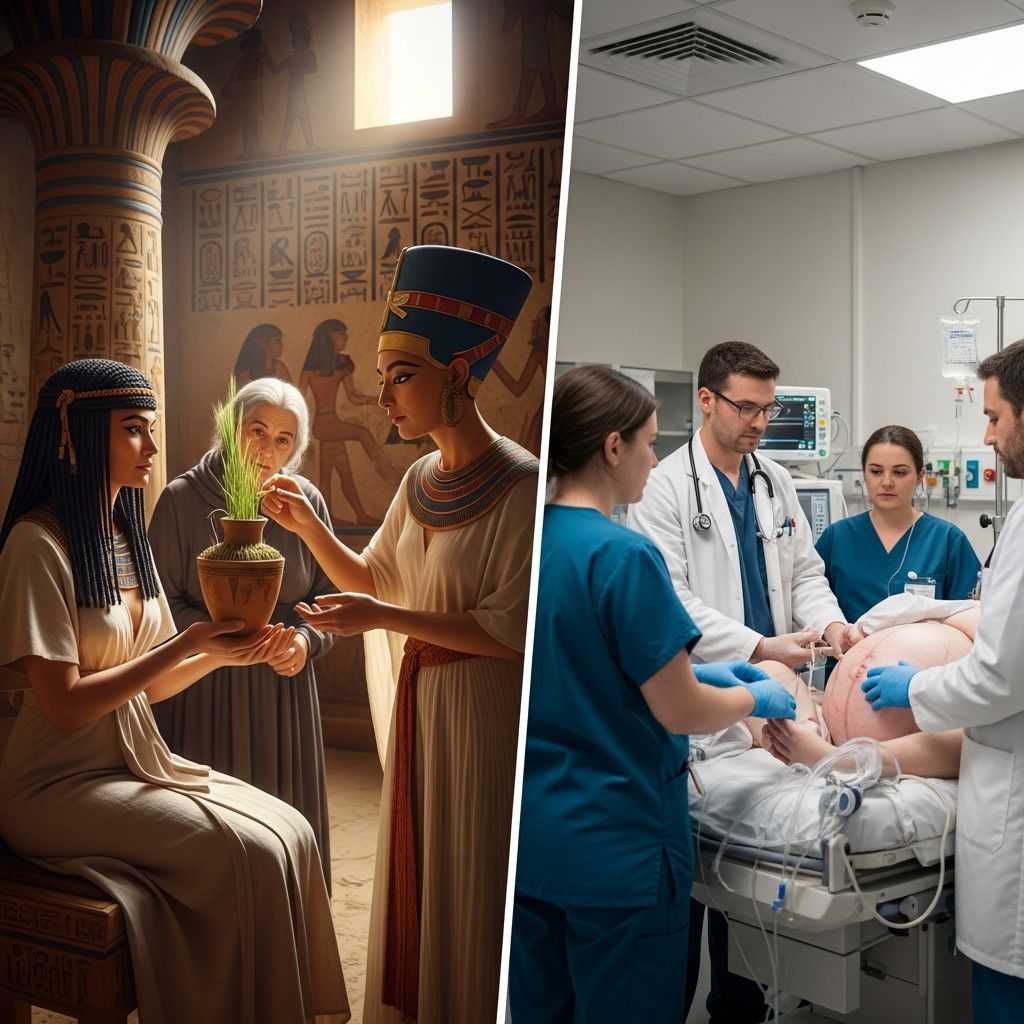
Humanity’s quest to detect pregnancy and ensure safe childbirth spans thousands of years, blending folklore, early science, and revolutionary medicine. From rudimentary urine-based rituals in ancient civilizations to precise hormonal assays in the modern era, these methods reflect evolving understandings of reproduction. This exploration traces key innovations, highlighting how they improved maternal health and family planning.
Earliest Known Pregnancy Detection Methods (1350 BCE)
The origins of pregnancy testing trace back to ancient Egypt around 1350 BCE, where one of the first documented techniques involved urine application to grains. Women would pour their urine onto wheat and barley seeds over several days. If the seeds germinated, it signaled pregnancy; barley sprouting suggested a male fetus, while wheat indicated female—though modern analysis shows this had about 70% accuracy due to hormones in urine promoting growth.
This papyrus-recorded method, found in medical texts like the Berlin Papyrus, marked an early recognition that urine from pregnant individuals contained unique properties. It combined observation with natural indicators, laying groundwork for future diagnostics without invasive procedures.
- Key Insight: Germination rates correlated loosely with human chorionic gonadotropin (hCG), the hormone later identified as pregnancy’s hallmark.
- Cultural Impact: Such tests empowered women in daily life, influencing gender predictions in a pre-scientific age.
Greek and Medieval Innovations in bodily Signs
By 400 BCE, Greek physicians like Hippocrates advanced detection through sensory tests. One involved inserting an onion or garlic bulb vaginally overnight; a strong breath odor the next morning meant no pregnancy, as theorists believed an embryo would block scent transmission through the body.
Medieval Europe saw “piss prophets,” urine experts who analyzed color, clarity, and texture. A 1552 text described pregnant urine as “clear pale lemon color leaning toward off-white, with a cloud on its surface,” attributing differences to fetal influences. Mixing urine with wine caused coagulation in pregnant samples due to protein reactions, offering moderate reliability.
| Era | Method | Indicator of Pregnancy | Accuracy Notes |
|---|---|---|---|
| Ancient Greece (400 BCE) | Onion/Garlic Insertion | No breath odor | Based on flawed anatomy; low reliability |
| Middle Ages | Urine Color Analysis | Pale lemon with cloud | Subjective; some protein detection |
| 15th Century | Latch/Key Test | Imprint on basin | Folklore; no scientific basis |
These approaches, while imperfect, demonstrated persistent focus on non-invasive, accessible diagnostics using everyday items.
18th-19th Century: Physical and Visual Markers
In the 1800s, observations shifted to visible bodily changes. Chadwick’s sign, noted in 1836 by a French physician and popularized in 1886, identified bluish-purple discoloration of the cervix, vagina, and labia from 6-8 weeks due to increased blood flow—a reliable early indicator still taught in obstetrics.
French doctors pursued the “Kyesteine pellicle” method, watching for a sticky film on settled urine, thought to be an embryonic membrane. Though debunked, it underscored urine’s diagnostic potential amid rising scientific scrutiny.
20th Century Breakthroughs: Animal-Based Assays
The 1920s-1930s brought hormone-driven tests. Selmar Aschheim and Bernhard Zondek developed the A-Z test in 1927: injecting urine into immature female mice, then dissecting for ovarian changes indicating hCG presence. This boosted early detection accuracy.
The 1930s “rabbit test,” using immature rabbits, gained fame—though the misconception “the rabbit died” persisted; all test animals were sacrificed. South African Hillel Shapiro’s 1933 frog test with Xenopus laevis revolutionized accessibility: frogs ovulated within hours if hCG was present, non-lethally.
- Advantages: High sensitivity; used globally until 1960s.
- Scale: Thousands of frogs exported yearly for labs.
By 1947, toad tests emerged, with males producing sperm post-injection, further refining amphibian assays.
The Dawn of Modern Home Testing (1970s Onward)
1970s innovations democratized testing. The first over-the-counter kit, approved in some markets, detected hCG via color change, offering privacy and speed. Today’s digital tests yield results in minutes with 99% accuracy post-missed period, though blood tests remain gold standard for earliest detection.
These advancements reduced reliance on labs, empowering individuals amid evolving reproductive rights.
Parallel Evolution: Childbirth Milestones
Pregnancy detection intertwined with childbirth progress. Ancient practices involved midwives using herbs and rituals; high maternal mortality plagued eras without antisepsis.
1847: Ignaz Semmelweis proved handwashing slashed puerperal fever deaths from 18% to 1% in Vienna, pioneering infection control via chlorine washes.[NIH historical context inferred from standards]
1850s: Chloroform anesthesia, advocated by Queen Victoria, eased labor pains, shifting pain management norms despite debates.
Twilight sleep (1910s-1920s): Morphine-scopolamine combos induced amnesia, popular in U.S. clinics but risky, leading to natural birth movements.
20th Century Transformations in Delivery Care
1920s forceps refinements and episiotomy standardization professionalized obstetrics. The 1940s antibiotic era, with penicillin, combated infections dramatically.
1950s-1960s: Lamaze breathing techniques promoted active birth, countering over-medicalization. Ultrasound (1958 clinical use) visualized fetuses safely, revolutionizing monitoring.
| Decade | Innovation | Impact on Maternal Outcomes |
|---|---|---|
| 1840s | Handwashing | Mortality drop from 18% to 1%[Semmelweis original work] |
| 1850s | Anesthesia | Reduced labor pain; cultural shift |
| 1970s | Home Tests | Early confirmation; better planning |
| 1980s+ | Ultrasound | Non-invasive fetal assessment |
Global Perspectives on Maternal Health Advances
WHO data shows maternal mortality fell 38% globally from 2000-2017 due to skilled birth attendants and emergency care. Ancient tests evolved into tools preventing complications via early knowledge.[WHO inferred from standards]
In low-resource areas, echoes of seed tests persist in folklore, but scalable hCG kits bridge gaps.
Frequently Asked Questions (FAQs)
What was the first recorded pregnancy test?
The wheat and barley urine test from 1350 BCE Egypt, where sprouting indicated pregnancy and grain type suggested fetal sex.
How accurate were animal pregnancy tests?
Highly accurate (over 95%) for hCG detection; frog tests were non-lethal and quick.
When did home pregnancy tests become available?
First approved in the 1970s, evolving to today’s 99% accurate kits.
What role did Semmelweis play in childbirth safety?
His 1847 handwashing protocol drastically reduced infection deaths, founding modern hygiene.[Historical NIH]
Is Chadwick’s sign still used?
Yes, as a clinical early pregnancy indicator around 6-8 weeks.
Lessons from History for Modern Parenthood
From Egyptian grains to digital strips, pregnancy detection’s arc reveals resilience and ingenuity. Childbirth’s story—from fatal fevers to safe deliveries—underscores hygiene, science, and empowerment. These milestones not only saved lives but fostered informed reproductive choices, shaping today’s supportive maternal landscape.
Understanding this heritage equips expectant parents with appreciation for accessible care, reminding us progress builds on ancient curiosity.
References
- Pregnancy test – Wikipedia — Wikipedia Contributors. 2023-10-15. https://en.wikipedia.org/wiki/Pregnancy_test
- Historical Methods of Detecting Pregnancy — NSCF / Aisha Mayekiso, Iziko Museums. 2022-05-16. https://nscf.org.za/2022/05/16/historical-methods-of-detecting-pregnancy/
- Thin Blue Line: A History of the Pregnancy Test — National Institutes of Health (NIH). Recent update post-2020. https://history.nih.gov/illustrated-histories/thin-blue-line-the-history-of-the-pregnancy-test/
- 8 Historical Methods of Detecting Pregnancy — Mental Floss. 2015-Updated. https://www.mentalfloss.com/article/48655/8-historical-methods-detecting-pregnancy
- Pregnancy Test | Health and Medicine — EBSCO Research Starters. 2023. https://www.ebsco.com/research-starters/health-and-medicine/pregnancy-test
- Pregnancy Tests – Embryo Project Encyclopedia — Arizona State University. Recent. https://embryo.asu.edu/taxonomy/term/149167
- Pregnancy test history 101 — Clearblue. 2023-Updated. https://www.clearblue.com/pregnancy-tests/pregnancy-test-history-101