Have you ever wondered why you might have the same eye color as your mom or the same laugh as your dad? That mystery is solved by something called heredity. Heredity is the process that passes traits from parents to their children through special instructions inside the body.
What Is Heredity?
Heredity is how living things pass characteristics, called traits, from one generation to the next. These traits are carried in tiny chemical instructions stored inside your cells.
Thanks to heredity, families often share similar features, like face shape, hair texture, or even the way they walk or talk.
What Are Traits?
Traits are the features or characteristics that make you who you are. Some traits you can see, and others are hidden inside your body.
- Physical traits: eye color, hair color, height, dimples, freckles, or attached/loose earlobes.
- Hidden traits: how well your body handles certain foods, your blood type, or your risk for some health conditions.
- Behavior-related traits: how easily you wake up in the morning, how fast you can react in a game, or how you prefer to learn.
Some traits are strongly influenced by heredity, while others are a mix of heredity and the life you live, such as how much you exercise or what you eat.
Where Are These Instructions Stored?
Inside your body are tiny units of life called cells. Most cells are too small to see without a microscope, but they hold all the instructions for building and running your body.
Inside the center of each cell is a structure called the nucleus. The nucleus is like a protected control room where your genetic information is stored.
DNA: The Heredity Instruction Code
The instructions for your traits are written in a special molecule called DNA (deoxyribonucleic acid). DNA looks like a twisted ladder or a spiral staircase if you could zoom in close enough.
- The “sides” of the DNA ladder are made of special sugars and phosphates.
- The “steps” of the ladder are made from four kinds of chemical bases that act like letters in a code.
- By changing the order of these letters, DNA can spell out millions of different instructions.
Your DNA holds the complete set of instructions needed to build and maintain your body from before you were born and all through your life.
Genes: Small Sections of DNA
Genes are short sections of DNA that act like individual recipes in a giant cookbook. Each gene usually carries the instructions to build a specific product, often a protein, that helps your body do a certain job.
- One gene might help decide your eye color.
- Another gene might affect how tall you can grow.
- Other genes help your body break down food, repair damage, or fight off germs.
You have many thousands of genes, and together they form your unique set of instructions, sometimes called your genetic code.
Chromosomes: DNA Packed Up Neatly
DNA molecules are very long, so your body packs them into structures called chromosomes. Chromosomes help organize DNA so it fits inside your cells and can be copied accurately.
Humans usually have 46 chromosomes in most of their cells, arranged in 23 pairs. You get one set of 23 from one parent and one set of 23 from the other parent.
| Source | Number of Chromosomes | What It Means |
|---|---|---|
| Egg cell from one parent | 23 | Carries half of the child’s genetic instructions. |
| Sperm cell from the other parent | 23 | Carries the other half of the instructions. |
| Fertilized egg (first cell of a new baby) | 46 | Has a complete set of instructions, combining both parents. |
Every time your cells divide to make new cells, the chromosomes are copied so the new cells also have the complete set of instructions.
How Traits Are Passed from Parents to Children
When a new baby begins to grow, it starts from a single cell that contains chromosomes from both parents. Each parent contributes one member of every chromosome pair, and those chromosomes carry many genes.
- Each parent passes along one version of each gene.
- The child ends up with two versions of most genes: one from each parent.
- The combination of these versions helps determine the child’s traits.
This is why you might share certain features with both parents or resemble one parent more than the other.
Gene Versions: Why Not Everyone Looks Alike
Genes can come in different versions, called alleles. You can think of them as different flavors of the same recipe. They all describe the same basic trait, but the details change.
- One version of a gene might code for dark eye color, while another version might code for lighter eyes.
- Some versions are more “noticeable” and are called dominant, while others are recessive and are less likely to show up when a dominant version is present.
The mixture of gene versions you receive from your parents creates your own special set of traits. That mixture is why brothers and sisters can look different, even though they have the same parents.
Genotype and Phenotype
Scientists use two important words to describe heredity: genotype and phenotype.
- Genotype: The exact set of gene versions you have. It is like the list of ingredients and steps in a recipe book inside your cells.
- Phenotype: The traits you can observe, like your hair color, height, or how your body functions. It is like the finished recipe you can see and taste.
Your phenotype comes from the combination of your genotype and your environment, such as your nutrition, experiences, and habits.
Family Traits and Family Differences
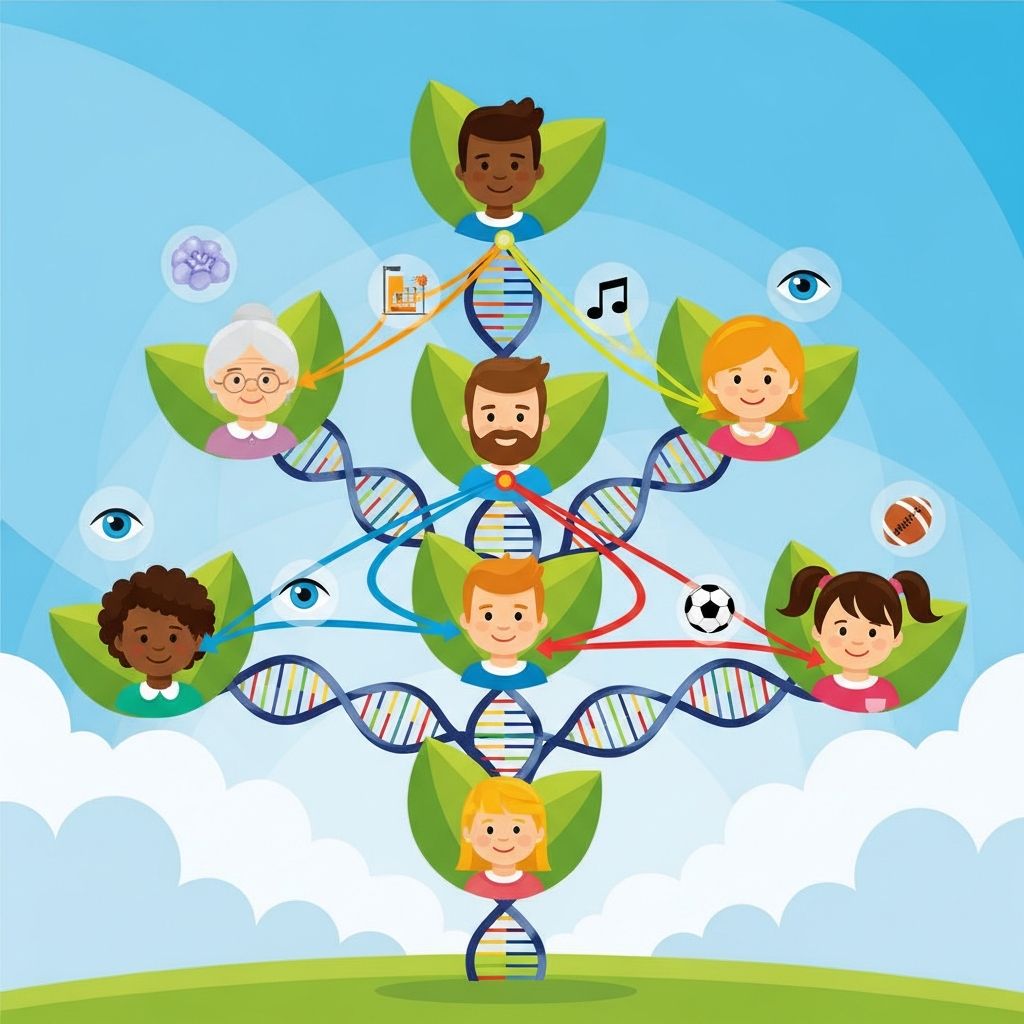
Families often notice traits that seem to “run in the family.” These might be physical features, ways of laughing, or natural talents. Heredity helps explain these patterns.
- You might share eye color or hair type with a parent or grandparent.
- Several people in your family might be naturally good at music or sports.
- Family members might have similar body shapes or heights.
Even with these similarities, no two people are exactly the same. Each person’s genetic combination is unique, which is why you are one of a kind.
Heredity and the Environment
Heredity does not work alone. The world around you, and the choices you make, also play a large role in how your traits turn out.
- Healthy food, exercise, and sleep can help you reach your full height and stay strong, even though your maximum height is influenced by your genes.
- Practicing a skill such as drawing, playing an instrument, or a sport can improve your talent, even if you start with a natural ability.
- Staying safe in the sun and avoiding harmful substances can help protect your body, even if your genes affect how sensitive your skin is.
Your genes give you a starting plan, but your environment and choices help decide how that plan is carried out.
Can Genes Affect Health?
Some health conditions are linked to specific gene versions. If certain versions are present, they can increase the chances of developing a particular condition. Sometimes these conditions appear often in certain families.
- Some conditions show up only when a person inherits particular gene versions from both parents.
- Others appear when just one changed version of a gene is passed down.
- Doctors can sometimes use family health histories to predict and prevent certain problems.
Having a gene for a condition does not always mean you will get sick. Lifestyle choices and the environment also play important roles in health.
Why Siblings Can Be So Different
Children from the same parents share many genes, but they do not receive exactly the same combination of gene versions. Each time a new baby is made, the parent’s genes are shuffled in a new way.
- One sibling may inherit more gene versions from one parent, while another sibling may get more from the other.
- Random mixing of genes creates a fresh combination each time.
This random mixing explains why one child might be very tall while another is shorter, or why one might have straight hair and another curly hair, even though they are part of the same family.
Fun Ways to Notice Heredity
You can explore heredity by observing traits in your own family. This can be a fun way to see genetics in action without any special tools.
- Compare eye color in your family: Who has similar shades?
- Check earlobes: Are they attached or dangling? Who matches whom?
- Look for dimples or freckles: Which relatives share these features?
- Listen for similar laughs or voices: Do any sound alike?
By noticing patterns, you can start to see how traits travel from generation to generation.
Important Things Heredity Does Not Decide
Heredity shapes many traits, but it does not control everything about you. Many of the most important parts of who you are depend on your choices, experiences, and values.
- Your kindness, honesty, and how you treat other people are guided by your decisions.
- Your hobbies and interests grow from what you try and practice, not just from your genes.
- The goals you set and the effort you put into learning new things are up to you.
Genes help build your body, but you decide how to use your abilities and talents.
Simple Glossary of Heredity Words
Here are some important words related to heredity, explained in kid-friendly language:
- Heredity: The process of passing traits from parents to children.
- Trait: A feature or characteristic, such as eye color or height.
- DNA: The molecule that carries genetic instructions for your body.
- Gene: A small section of DNA that gives instructions for a specific trait or job.
- Chromosome: A tightly packed bundle of DNA found in a cell’s nucleus.
- Allele: A version of a gene, like a different flavor of the same recipe.
- Genotype: The set of gene versions you have.
- Phenotype: The traits you can see or measure, such as hair color or height.
Frequently Asked Questions About Heredity
1. Why do I look like my parents?
You look like your parents because you inherited half of your chromosomes from each of them. Those chromosomes contain genes that help decide your appearance, so your traits are a mixture from both sides of your family.
2. If I have the same parents as my brother or sister, why don’t we look exactly alike?
Even though you share parents, you and your siblings receive different combinations of gene versions. Each child gets a unique mix, so you might share some traits but also have many differences.
3. Can my habits change the genes I was born with?
Your basic genetic code stays mostly the same throughout life, but your habits and environment can affect how some genes work. Healthy choices help your body use your genes in the best possible way.
4. Are all diseases passed down through heredity?
No, not all diseases come from genes. Some happen mainly because of germs, injuries, or lifestyle, while others involve a mix of heredity and environment. Doctors study both your genes and your habits to understand health risks.
5. Can I choose which traits I pass to my future children?
People cannot pick individual genes to pass on in everyday life. The genes are mixed and passed randomly when reproductive cells are formed. Scientists can study how traits are likely to be inherited, but the exact combination for each child is still unique.
Heredity Makes You Unique
Heredity is the reason families share similarities, but it also helps explain why every person is different. Your genes give you a special starting set of traits, and your experiences, choices, and environment shape how those traits appear in your life.
Understanding heredity can help you appreciate the features you share with your family and the unique qualities that belong only to you.