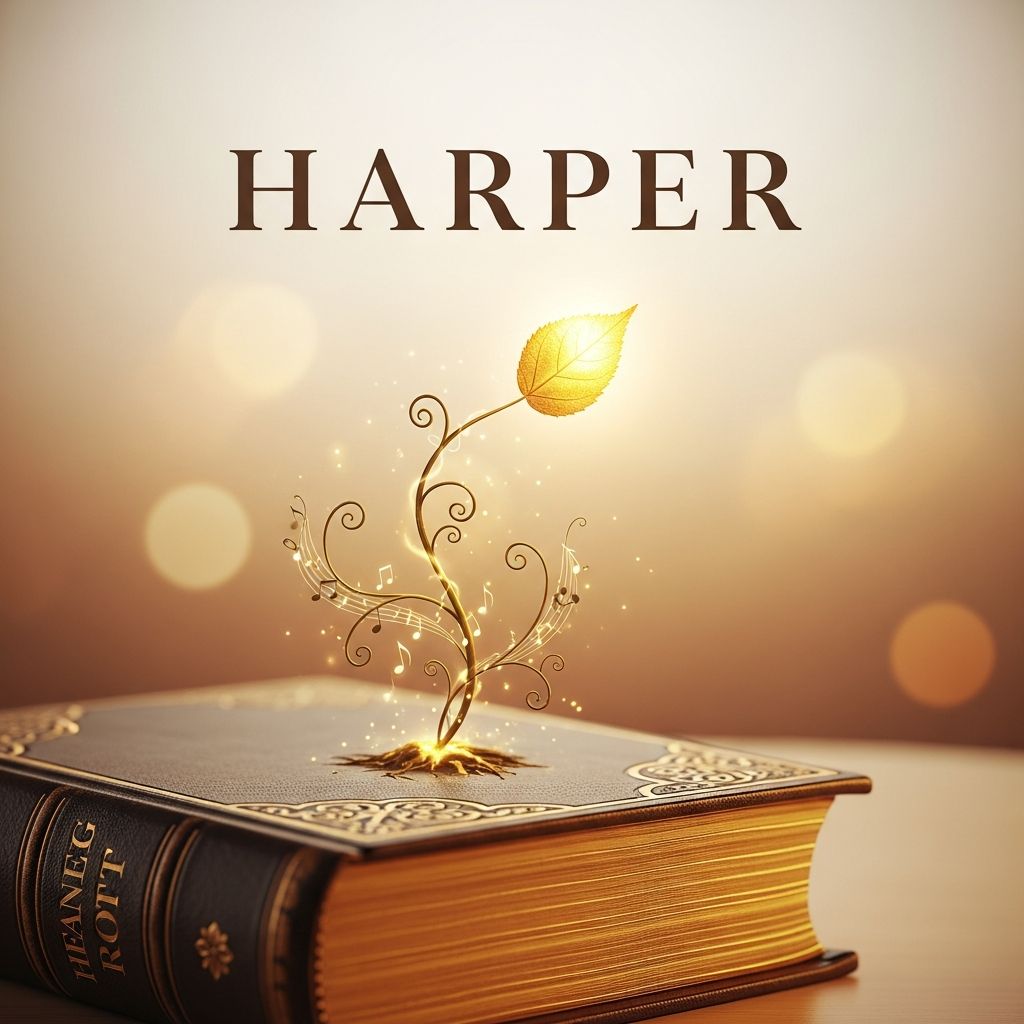
The name Harper carries a melodic legacy tied to music and craftsmanship, evolving from a medieval occupational term into one of today’s most cherished unisex baby names. Parents drawn to its blend of vintage charm and contemporary edge find it perfect for evoking creativity and sophistication.
Etymology and Core Definition
Harper derives directly from Old English ‘hearpere,’ denoting a skilled musician who mastered the harp, a stringed instrument central to medieval entertainment. These professionals performed at grand feasts, noble gatherings, and public festivals, their talents often earning hereditary status in elite households.
This occupational root aligns with other surnames like Smith or Taylor, reflecting trades that defined family identities. In linguistic terms, the name’s simplicity—six letters with a rhythmic flow—contributes to its enduring appeal across generations.
Geographical and Cultural Origins
Primarily English in origin, Harper traces back to Anglo-Saxon communities where harpists held prestigious roles, particularly in northern England and Scotland. Records from the 13th century, such as Henry atte Harpur in Cambridge’s Hundred Rolls of 1273, illustrate its early documentation.
The name spread to Ireland via Norman influences as ‘le Harpur’ and Gaelic forms like Mac Chruiteir, meaning ‘son of the harper,’ integrating into Ulster through 17th-century settlers. In Wales, equivalents like Telynores link to ‘telyn’ (harp), preserving the musical essence. Scottish baronial halls elevated the harper to near-noble standing, sometimes passing the role down family lines.
Anglo-Celtic manuscripts across England, Ireland, Scotland, and Wales feature the name, underscoring its broad medieval footprint. By the late Middle Ages, it appeared in poll taxes, like Isabella Herpour in Yorkshire’s 1379 records, showing usage for both genders.
Historical Evolution from Surname to Given Name
Initially a surname ranking as the 205th most common in the UK, Harper denoted descendants of harp players or makers. Its transition to a first name mirrors trends with Mason or Carter, accelerating in the late 20th century amid surname-as-given-name fashions.
Medieval harpers were cultural luminaries, reciting poetry to harp music in halls, blending artistry with storytelling. This prestige lingered, influencing the name’s revival. In the U.S., it gained traction post-2000, shifting from mostly male to predominantly female, though remaining unisex.
Variants include Harpur, Harpour, and feminized forms like Harperina or Harperia, with European twists such as Harpe or German Härpfer. These adaptations highlight its adaptability across languages and eras.
Popularity Trends Across Decades
| Year/Period | U.S. Girls Rank | U.S. Boys Rank | Other Regions |
|---|---|---|---|
| Pre-2000 | Unranked/ Rare | Occasional | Low in UK/Australia |
| 2011 (Beckham Effect) | Top 20 Surge | Stable | Rising in UK |
| 2018 Peak | #9 | Declining | #34 Canada (2022) |
| 2021 | #10 | Minimal | Top in Virginia |
| 2024-2025 | #12 | Rare | Anglosphere Growth |
Harper’s ascent is remarkable: from obscurity to U.S. top 10 for girls by 2021, peaking at #9 in 2018. In 2022, it ranked among Virginia’s top five for white newborn girls and #34 in Canada. The UK’s 36,000 migration records and 180,000 census entries reflect its surname prevalence, now boosting given-name use.
Celebrity endorsements propelled this: David and Victoria Beckham’s Harper Seven (2011) catalyzed a global spike, alongside U.S. figures. Its unisex versatility endures, though girl usage dominates recent decades.
Why Harper Resonates with Modern Parents
Harper’s allure stems from its crisp pronunciation (HAR-pur), literary vibe, and artistic connotations. It suits musical families or those seeking strength without severity—evoking independence and grace.
Personality numerology assigns Harper a Destiny Number 3 (creative, expressive), Soul Urge 6 (nurturing, harmonious), and Personality 6 (reliable, caring), aligning with careers in arts, teaching, or counseling. Professionally, it projects approachability and polish, thriving in creative or public roles.
Notable Figures Bearing the Name
- Harper Lee: Author of To Kill a Mockingbird, embodying quiet strength and moral insight.
- Harper Seven Beckham: Fashion icon’s daughter, symbolizing modern celebrity influence.
- Historical harpers: Medieval figures like those in noble courts, whose legacies inspire the name’s prestige.
- Sports stars and actors: Emerging Harpers in entertainment reinforce its contemporary edge.
These bearers amplify Harper’s cultural cachet, from literary giants to pop culture darlings.
Variations, Nicknames, and Global Adaptations
- Nicknames: Harp, Harps, Perry, Hattie—affectionate and playful.
- Feminine Variants: Harperley, Harperina, Harperia.
- Masculine Forms: Harpur, Harp.
- International: Telynores (Welsh), Mac Chruiteir (Gaelic), Härpfer (German).
These options allow personalization while honoring the core harpist theme.
Choosing Harper: Practical Considerations
In schools and workplaces, Harper fares well—easy to spell, pronounce, and remember. It pairs seamlessly with surnames, avoiding awkward rhymes. For siblings, it complements classics like Avery, Riley, or Quinn in unisex sets.
Potential drawbacks: High popularity may lead to multiples in classrooms, though its surname roots add distinction. Gender neutrality offers flexibility as identities evolve.
Frequently Asked Questions
What does the name Harper truly mean?
Harper means ‘harp player’ or ‘minstrel,’ rooted in Old English for medieval musicians.
Is Harper more popular for boys or girls?
Primarily for girls since the 2010s (U.S. #12 in 2025), but historically unisex and still used for boys.
Where did Harper originate geographically?
English origins, with spreads to Scotland, Ireland, and Wales; Anglo-Celtic medieval roots.
Has Harper always been a first name?
No, it started as an occupational surname before becoming a given name in recent decades.
What famous people are named Harper?
Harper Lee (author), Harper Beckham (celebrity child), plus historical musicians.
Are there international versions of Harper?
Yes, like Telynores in Welsh or Harpe in European forms.
Final Thoughts on Timeless Appeal
Harper bridges eras: a nod to artisanal pasts, a soundtrack for future creatives. Its rise reflects parents’ love for names that sing history while dancing into tomorrow.
References
- Harper Surname Origin, Meaning & Family Tree — Findmypast.co.uk. Accessed 2026. https://www.findmypast.co.uk/surname/harper
- Harper Baby Name Meaning, Origin, Popularity Insights — Momcozy. Accessed 2026. https://es.momcozy.com/blogs/baby-names/harper
- Harper Coat of Arms, Family Crest — IrishSurnames.com. Accessed 2026. https://www.irishsurnames.com/cgi-bin/gallery.pl?name=harper&capname=Harper&letter=h
- Harper (name) — Wikipedia. 2022-2025 updates. https://en.wikipedia.org/wiki/Harper_(name)
- Harper – Baby Name Meaning, Origin and Popularity — The Bump. Accessed 2026. https://www.thebump.com/b/harper-baby-name
- Harper – Baby Name Meaning, Origin, and Popularity for a Girl — Nameberry. 2025-12-17. https://nameberry.com/b/girl-baby-name-harper