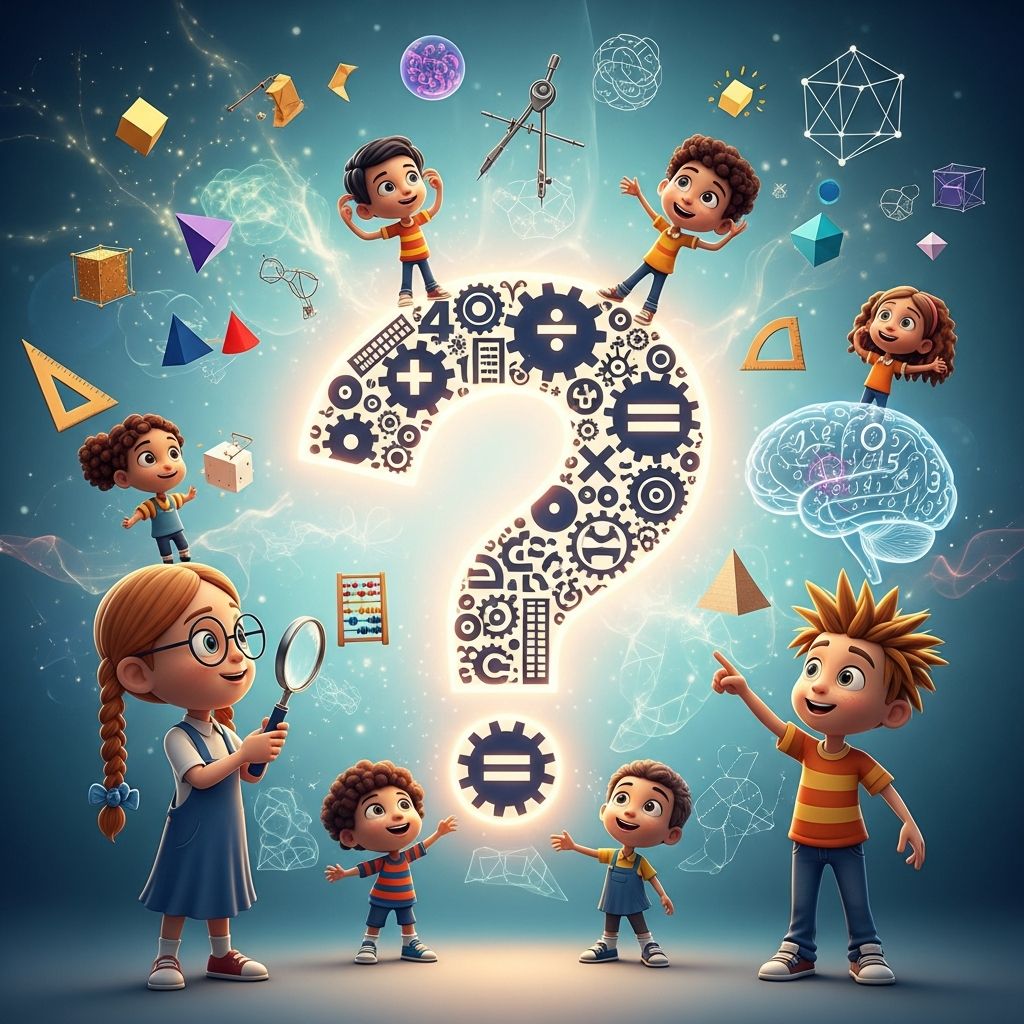
Math riddles blend puzzles, logic, and numbers into bite-sized challenges that kids actually want to solve. They feel like games, but underneath the fun they build real skills: reasoning, persistence, and confidence with math concepts.
Why Math Riddles Are Powerful Learning Tools
Well-designed riddles do more than ask for a right answer. They invite kids to:
- Think flexibly instead of following a memorized procedure.
- Connect ideas from arithmetic, logic, and language.
- Explain their reasoning, not just give a number.
- Enjoy productive struggle — that sweet spot where a problem is tough but doable.
Research on math classrooms shows that open tasks and puzzles can improve problem-solving and communication skills, especially when kids are encouraged to justify their thinking.
Tips for Using Math Riddles With Kids
To get the most benefit from riddles, focus on how kids think, not just how fast they answer.
- Ask for strategies: “How did you figure that out?” or “Can you show me another way?”
- Normalize struggle: Remind kids that tough riddles are brain exercise, not a test.
- Encourage drawing: Diagrams, tallies, or number lines often unlock the solution.
- Work together: Think aloud so kids see how an adult approaches a puzzle.
- Celebrate partial ideas: Even an incorrect guess can contain a useful insight.
Categories of Hard Math Riddles
Challenging riddles can be grouped by the kind of thinking they require. Mixing types helps kids discover their strengths and stretch new skills.
| Type of Riddle | Main Skill Practiced | Typical Difficulty |
|---|---|---|
| Number & arithmetic | Adding, subtracting, multiplying, dividing, estimating | Medium to hard |
| Logic & deduction | Using clues, eliminating possibilities | Medium to very hard |
| Pattern and sequence | Finding rules in numbers, shapes, or words | Medium |
| Word-based math | Interpreting language, spotting tricks and double meanings | Medium |
| Visual & spatial | Imagining cuts, folds, routes, or arrangements | Medium to hard |
Number and Arithmetic Riddles
These puzzles revolve around calculations, but the challenge usually lies in how you interpret the situation, not the size of the numbers.
Example 1: The Sneaky Sale
Riddle: A toy is on sale for half price. After the sale, the store raises the discounted price by 50%. Is the toy back to its original price, cheaper, or more expensive?
Answer: It is cheaper than the original price.
Quick explanation: Think of a simple starting price like 100. Half price is 50. Raising 50 by 50% adds 25, giving 75 — still below 100.
Example 2: The Split Pizza
Riddle: Three friends share one large pizza. The first eats one half, the second eats one third of what remains, and the third eats the rest. What fraction of the whole pizza does the third friend get?
Answer: The third friend gets one third of the pizza.
Quick explanation: After the first friend, half the pizza is left. One third of that half is 1/6, leaving 1/2 − 1/6 = 1/3 for the last friend.
Mini Challenges (With Answers)
- Riddle: A number is doubled, then 10 is added. The result is 34. What was the original number?
Answer: 12. - Riddle: You multiply a number by 9 and then divide by 3. The result is 21. What number did you start with?
Answer: 7. - Riddle: The sum of three consecutive numbers is 45. What are the numbers?
Answer: 14, 15, and 16.
Logic and Deduction Riddles
Logic riddles require careful reading and systematic reasoning. They are especially good for developing the kind of thinking used in problem-solving and proof.
Example 3: The Mismatched Labels
Riddle: Three boxes are labeled “Red Marbles,” “Blue Marbles,” and “Red & Blue.” You are told that every label is wrong. You may take one marble from only one box to fix all the labels. Which box do you draw from, and how does that help?
Answer: Draw from the box labeled “Red & Blue”.
Quick explanation: Since all labels are wrong, the “Red & Blue” box must contain only red or only blue. The color you pull tells you that box’s true label. From there, you can reason out the remaining two labels because they also must both be wrong as written.
Example 4: The Family Photo
Riddle: In a photo, a girl points to a person and says, “This person’s mother is my mother’s only daughter.” Who is the person in the photo?
Answer: The person is the girl’s child.
Quick explanation: The mother’s only daughter is the girl herself. So the person in the picture is the daughter of the girl — her child.
Logic Mini Challenges (With Answers)
- Riddle: Two coins total 30 cents. One of them is not a 10-cent coin. What are the coins?
Answer: A 20-cent coin and a 10-cent coin — only one coin is not a 10-cent coin. - Riddle: A girl has as many brothers as sisters, but each brother has only half as many brothers as sisters. How many boys and girls are in the family?
Answer: 4 girls and 3 boys.
Pattern and Sequence Riddles
Pattern riddles invite kids to search for rules: Is it adding the same number, multiplying, alternating operations, or something to do with shapes or letters?
Example 5: The Growing Staircase
Riddle: Imagine a staircase built from blocks. The first step uses 1 block, the second step uses 3 blocks, the third uses 5 blocks, the fourth uses 7 blocks, and so on. How many blocks are needed for the fifth step?
Answer: 9 blocks.
Quick explanation: Each step uses the next odd number of blocks: 1, 3, 5, 7, 9.
Example 6: The Alternating Sequence
Riddle: What are the next two numbers in this sequence: 2, 4, 3, 6, 5, 10, 9, …?
Answer: 18, 17.
Quick explanation: One pattern doubles (2, 3, 5, 9, … → 2, 4, 10, 18, …) and the other adds 1 to an odd number (2, 5, 9, 17, …). The two patterns alternate.
Pattern Mini Challenges (With Answers)
- Riddle: Fill in the blank: 5, 10, 20, 40, __, 160.
Answer: 80 (each number is double the previous). - Riddle: Fill in the blank: 100, 90, 81, 73, __, 58.
Answer: 66 (subtract 10, then 9, then 8, then 7…).
Word-Based Math Riddles
Some of the hardest riddles hide the trick in the language, not the arithmetic. These help kids become careful readers — a key skill in solving real math word problems.
Example 7: The Missing Minute
Riddle: A digital clock shows 3:15. What is the angle between the hour and minute hands on an analog clock at that time: 0°, 45°, 90°, or something else?
Answer: 7.5°.
Quick explanation: At 3:15, the minute hand is at 3 on the clock (15 minutes). The hour hand has moved a quarter of the way from 3 toward 4. The exact angle works out to 7.5°, which is not one of the simple choices many people guess.
Example 8: The Classroom Count
Riddle: There are 30 students in a class. Half are wearing glasses. One third of the students wear sneakers, and 5 students wear both glasses and sneakers. How many students wear neither glasses nor sneakers?
Answer: 10 students.
Quick explanation: Glasses: 15 students. Sneakers: 10 students. If 5 wear both, then 15 + 10 − 5 = 20 wear at least one. The remaining 10 wear neither.
Wordplay Mini Challenges (With Answers)
- Riddle: A farmer has 17 sheep. All but 9 run away. How many are left?
Answer: 9. “All but 9” means all except 9. - Riddle: You buy a shirt for $20 and a hat for $15, paying with a $50 bill. The cashier gives you the wrong change but you do not notice. What is the smallest amount you could have been short-changed?
Answer: $1 (you could receive $14 instead of $15).
Visual and Spatial Math Riddles
Visual riddles ask kids to imagine arrangements, cuts, and movements in space. This sort of spatial reasoning is linked to later success in STEM fields.
Example 9: The Folded Paper
Riddle: You fold a rectangular sheet of paper exactly in half, then in half again in the same direction. You cut one small triangle off a corner that has all the layers stacked together. When you unfold the paper completely, how many triangles will you see?
Answer: 4 triangles.
Quick explanation: Each fold doubles the number of layers. After two folds, that corner has 4 layers, so one cut slices through all 4.
Example 10: The Chessboard Walk
Riddle: A rook on a blank chessboard can move any number of squares up, down, left, or right. Starting from a corner, what is the smallest number of moves needed for the rook to visit all four corners at least once and end back at the starting corner?
Answer: 3 moves.
Quick explanation: From the starting corner, move to the opposite corner in one move (passing through the two side corners along the way). Then move back in a straight line — another single move — visiting the same corners in reverse. The challenge is seeing the path, not the arithmetic.
Making Riddles a Regular Part of Learning
You can turn riddles into a simple routine at home or in class:
- Start-of-day brain warm-up: One short riddle to wake up thinking.
- Transition activity: Use a puzzle when switching between subjects.
- Family challenge: Ask everyone to bring one new riddle to dinner each week.
- Student creations: Have kids invent their own riddles using numbers they are studying.
Educational organizations emphasize that when students talk about their strategies and hear others’ ideas, they deepen conceptual understanding and build mathematical communication skills.
Frequently Asked Questions (FAQs)
Q: What age are hard math riddles appropriate for?
A: Many challenging riddles work well from about ages 8–12 and up, but the best guide is your child’s comfort level. Start with easier puzzles and gradually introduce ones that take longer to solve.
Q: How often should kids work on math riddles?
A: A few puzzles a week is enough to build habits without feeling like extra homework. Even 5–10 minutes of focused problem-solving can have benefits when it happens regularly.
Q: What if my child finds the riddles too hard?
A: Offer hints instead of answers. Encourage drawing, making tables, or trying small test cases. Emphasize that struggling is normal and that the goal is to think deeply, not to be fast.
Q: Do math riddles really improve school performance?
A: Studies on problem-solving tasks show that open-ended questions and puzzles can improve reasoning, perseverance, and conceptual understanding, which support stronger performance across topics.
Q: Where can I find more high-quality math puzzles?
A: Many educational organizations, math education projects, and school-based resources publish free collections of classroom-tested puzzles and brainteasers suitable for different grade levels.
References
- Principles and Standards for School Mathematics — National Council of Teachers of Mathematics (NCTM). 2000-04-12. https://www.nctm.org/standards/
- Improving Mathematics in Key Stages Two and Three — Education Endowment Foundation. 2017-11-01. https://educationendowmentfoundation.org.uk/education-evidence/guidance-reports/maths-ks-two-three
- Learning Mathematics Through Problem Solving — National Council of Teachers of Mathematics (NCTM). 2010-01-01. https://www.nctm.org/uploadedFiles/Research_and_Advocacy/research_brief_and_clips/Research_brief_02_-_Problem_Solving.pdf
- How Children Learn Mathematics — National Academies Press, Adding It Up: Helping Children Learn Mathematics. 2001-07-23. https://nap.nationalacademies.org/catalog/9822/adding-it-up-helping-children-learn-mathematics