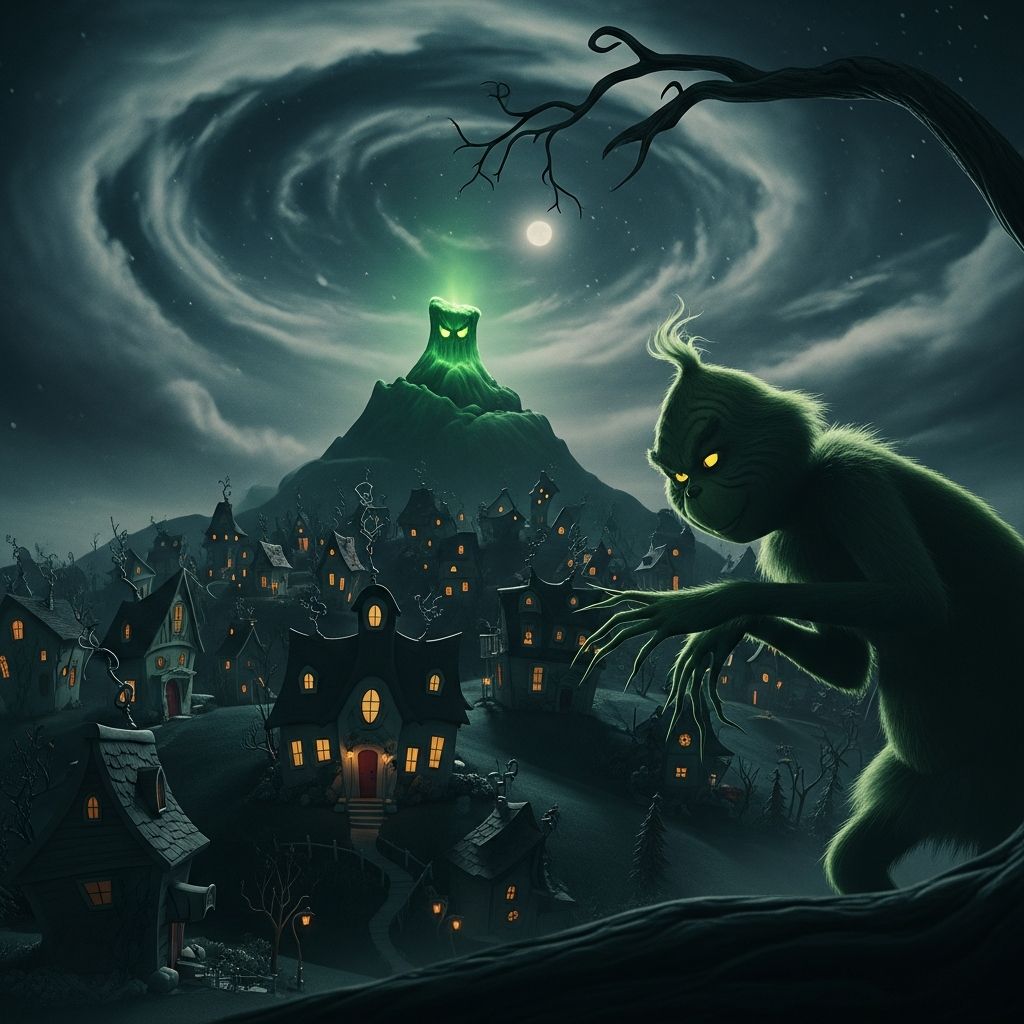
Long before movie studios built cinematic universes around every recognizable character, Dr. Seuss quietly approved a strange, unsettling prequel to his most famous holiday villain: the Grinch. The 1977 animated TV special Halloween Is Grinch Night (often shortened to Grinch Night) takes the familiar world of Whoville and twists it into something darker, weirder, and far more nightmarish than its Christmas counterpart.
This overlooked half-hour special blends whimsical rhymes with surreal horror visuals, turning a beloved children’s icon into a menacing force who walks down the mountain not to steal presents, but to unleash psychological terror. It is, in many ways, the closest thing Dr. Seuss ever created to a children’s horror movie.
From Christmas Cheer to Halloween Fear
How the Grinch Stole Christmas! premiered on television in 1966 and quickly became a holiday staple, with Boris Karloff’s iconic narration and a redemptive story of a heart that grows three sizes. Just over a decade later, audiences were given something very different: an origin-adjacent tale that doesn’t soften the Grinch, but sharpens him.
- Release: Premiered on ABC on October 28, 1977 as a prime-time TV special.
- Format: Roughly half-hour animated special, marketed as a kind of prequel to the Christmas story.
- Creative team: Written by Dr. Seuss (Theodor Seuss Geisel) with music by composer Joe Raposo, known for his work on Sesame Street.
- Recognition: Won the 1978 Primetime Emmy Award for Outstanding Children’s Program.
Rather than revisiting the familiar redemption arc, Halloween Is Grinch Night imagines a world where the Grinch is already an annual menace, and the people of Whoville accept his reign of terror as an unavoidable seasonal event.
What Exactly Is Grinch Night?
The special begins not with costumes or candy, but with a “sour-sweet wind” blowing across the mountains. For the Whos, this specific wind signals a single ominous conclusion: Grinch Night is coming.
Curiously, the word “Halloween” is almost never invoked in the narrative. Instead, the holiday is reframed as a uniquely Whoville event:
- The sour-sweet wind triggers strange behavior in local creatures.
- The Whos interpret it as a warning rather than a simple weather change.
- The night belongs to the Grinch, who is free to descend upon Whoville with his fear-inducing “Paraphernalia Wagon”.
For modern audiences, this functions like a Seussian version of a horror anthology setup: one night, one monster, and a town that tries to survive until morning.
The Plot: A Child, A Wagon, and a Night of Horrors
Though the special is only about 25 minutes long, it packs in a surprisingly intense sequence of events.
The Sour-Sweet Wind Arrives
Life in Whoville is peaceful until wind patterns shift and the dreaded sour-sweet gusts begin. This change causes chaos among the local wildlife, irritating the Grinch on his mountain and pushing him into action.
The Grinch’s Descent
Spurred by the disturbance and his own malicious delight, the Grinch decides it is the perfect night to roll out his Paraphernalia Wagon. Accompanied by his long-suffering dog Max, he sets off toward Whoville with the intention of scaring the inhabitants senseless.
Euchariah Steps Up
Our unlikely hero is Euchariah, a young Who with poor eyesight who gets separated from his family. Realizing that the town is paralyzed by fear, he decides he must delay the Grinch and buy Whoville time.
- Euchariah follows the Grinch’s wagon up the road.
- He repeatedly blocks his way, forcing the Grinch to stop.
- Enraged, the Grinch offers him a so-called “spook’s tour” instead of simply brushing him aside.
Inside the Paraphernalia Wagon
The heart of the special is a long, surreal sequence where the Grinch opens the top of his wagon and plunges Euchariah into a kaleidoscopic realm of nightmares. This is where Halloween Is Grinch Night veers into full-blown horror imagery:
- Distorted bodies and shifting faces.
- Strange, looping creatures that defy physics.
- Abstract shapes and colors that morph into monsters.
These visuals, heavily rooted in Dr. Seuss’s signature art style, are pushed to their most unnerving extreme, making the wagon sequence one of the most memorable—and potentially terrifying—moments in any Seuss adaptation.
How the Night Ends
Euchariah endures the onslaught of phantoms and illusions just long enough for the sour-sweet wind to die down. When the wind stops, Grinch Night ends by its own internal rules, and the Grinch is forced to retreat back to his lair.
Max, exhausted by years of mistreatment, finally chooses to leave the Grinch, following Euchariah home and being welcomed as a hero by the Whos. The Grinch slinks away, promising ominously that the wind—and his return—will come again someday.
A Harsher Grinch: Villainy Without Redemption
One of the most striking aspects of Halloween Is Grinch Night is how little interest it has in softening its title character. This is not the Grinch whose heart has yet to grow; he is instead an almost elemental force of spite and chaos.
| Christmas Grinch (1966) | Halloween Grinch (1977) |
|---|---|
| Steals presents, but ultimately repents and returns them. | Terrorizes Whoville for pleasure, with no real moral growth. |
| Heart grows three sizes after exposure to kindness. | Leaves only because external conditions force him to; his threat remains. |
| Redemption is central to the story’s theme. | Fear and survival are central; redemption is postponed or absent. |
The result is a version of the Grinch that feels less like a grumpy loner and more like a seasonal boogeyman whose power depends on weather, ritual, and the town’s collective fear.
Max the Dog: The Special’s Quiet Tragedy
While the Grinch looms large over every frame, Halloween Is Grinch Night gives unusual emotional weight to his dog, Max. Throughout the special, Max is shown as visibly depressed and nostalgic, dreaming of a happier life far from his master’s cruelty.
In one of the most emotionally charged moments, Max’s perspective underscores the psychological toll of living with the Grinch:
- He is forced to pull the heavy Paraphernalia Wagon.
- He is frequently yelled at, belittled, and exploited.
- He clearly longs for freedom and affection.
His choice to leave the Grinch at the end of the special—following Euchariah back to Whoville—is not simply a gag; it is a small but powerful act of liberation. That decision reframes the Grinch’s cruelty not as lighthearted mischief, but as a toxic relationship that a loyal companion finally escapes.
Behind the Voices and the Music
The special also marks a significant shift in how the Grinch sounds and sings. Boris Karloff, who voiced the Grinch and narrated the original Christmas special, had passed away several years earlier.
- Hans Conried, a veteran voice actor known for voicing Captain Hook in Disney’s Peter Pan, steps into the role of the Grinch.
- Thurl Ravenscroft, the vocalist behind “You’re a Mean One, Mr. Grinch,” returns to provide singing voices, preserving a sliver of audio continuity with the original special.
- Joe Raposo, celebrated for writing many classic Sesame Street songs, composes the score and musical numbers, contributing a mix of eerie motifs and bouncy Seussian tunes.
The overall effect is a sonic world that feels familiar but distinctly more sinister than the warm, choral soundscape of the Christmas special.
Animation Style: Seuss Goes Surreal Horror
Visually, Halloween Is Grinch Night pushes television animation of the 1970s to some unexpected extremes. While the character designs remain recognizably Seussian, the animators lean hard into warped perspectives and uncomfortably fluid transformations.
Particularly in the Paraphernalia Wagon sequence, the animators deploy techniques common to experimental animation of the era:
- Rapid shifts between 2D flatness and implied depth.
- Looped movements that border on hypnotic.
- Shapes and landscapes morphing into faces and creatures.
Compared to other children’s specials of the time, the imagery feels unusually bold, more aligned with darker fantasy or psychedelic shorts than with traditional holiday cartoons.
Why It’s So Little-Known Compared to the Christmas Classic
Despite its Emmy win and strong creative pedigree, Halloween Is Grinch Night never achieved the rerun dominance or cultural penetration of the Christmas special.
Several factors likely contributed:
- Seasonal competition: Christmas programming has historically dominated TV ratings and home releases far more consistently than Halloween content.
- Tonally challenging: Its darker, more unsettling tone may have made broadcasters hesitant to air it frequently in prime family slots.
- Limited home video circulation: For years, it was harder to find in circulation compared to the endlessly reissued Christmas Grinch, which received multiple remasters and re-releases.
As a result, many viewers who grew up watching the Grinch at Christmas may have never realized a Halloween counterpart existed at all.
Watching It Today: Who Is Grinch Night For?
Modern parents and animation fans discovering Halloween Is Grinch Night often have the same question: Is this actually for kids? The answer depends on your audience and expectations.
For Kids Who Love Spooky Stories
For children who already enjoy Halloween scares and are comfortable with eerie imagery, the special can be an intriguing bridge between lighthearted cartoons and slightly more intense fantasy.
- The runtime is short, making it manageable for younger viewers.
- The rhyming dialogue and nonsense words keep it playful.
- The ending, while not fully redemptive, is not graphically violent or hopeless.
For Adults and Animation Fans
For older viewers, Halloween Is Grinch Night works as a fascinating time capsule and a rare example of mainstream children’s media that embraces unease instead of shying away from it.
- Fans of cult animation will appreciate the surreal wagon sequence.
- Seuss enthusiasts can see his visual and linguistic style pushed into darker territory.
- Media historians can trace how TV specials experimented with tone in the 1970s, before franchise synergy dominated planning.
Legacy: A Strange but Important Piece of Grinch History
Though overshadowed by the many adaptations of the Grinch’s Christmas tale—including the Ron Howard film with Jim Carrey and Illumination’s 2018 animated feature with Benedict Cumberbatch—Halloween Is Grinch Night holds a unique place in the character’s history.
- It expands the Grinch’s world beyond Christmas, hinting at a longer-standing relationship of fear between him and Whoville.
- It establishes Max’s dissatisfaction and eventual break away from the Grinch, adding emotional depth to a previously mostly comic sidekick.
- It proves that children’s programming in the 1970s could be visually daring and thematically challenging, even under a beloved family brand.
In a media landscape obsessed with “gritty reimaginings,” it is striking that one of the earliest and oddest examples already existed in the form of a rhyming, Emmy-winning Halloween special about a green curmudgeon and his haunted wagon.
Frequently Asked Questions About Halloween Is Grinch Night
Is Halloween Is Grinch Night officially a prequel to How the Grinch Stole Christmas!?
It is often described as a prequel because it features the Grinch tormenting Whoville years before his Christmas change of heart. However, the continuity is loose, and the special works more as an alternate episode in the Grinch’s life than as a strict origin story.
When and where did the special first air?
The special premiered on the ABC television network on October 28, 1977, as a prime-time animated event.
Who voices the Grinch in this version?
Hans Conried, known for voicing Captain Hook in Disney’s Peter Pan, took over the role of the Grinch, while Thurl Ravenscroft provided singing voices as he did in the original Christmas special.
Is the special too scary for young children?
Some scenes—especially inside the Paraphernalia Wagon—feature surreal, unsettling imagery that may frighten very young or sensitive viewers. Parents may want to preview it first and watch with their children to provide reassurance and context.
Did Halloween Is Grinch Night win any awards?
Yes. The special won the 1978 Primetime Emmy Award for Outstanding Children’s Program, recognizing its impact and quality despite its later obscurity.
References
- 45 Years Ago, Halloween Is Grinch Night Became A Dr. Seuss Horror Movie — Fatherly. 2022-10-26. https://www.fatherly.com/entertainment/halloween-is-grinch-night-dr-seuss-horror-movie
- Halloween Is Grinch Night — Wikipedia. 2024-05-03. https://en.wikipedia.org/wiki/Halloween_Is_Grinch_Night
- It’s Grinch Night (TV Movie 1977) — IMDb. n.d. https://www.imdb.com/title/tt0183288/
- Halloween is Grinch Night — Halloween Love. 2018-10-11. https://halloweenlove.com/halloween-tv-specials-halloween-is-grinch-night/
- You’ve got to see this Halloween-themed prequel to “The Grinch” — 3 News Now / Scripps. 2021-10-27. https://www.3newsnow.com/watch-halloween-themed-prequel-grinch