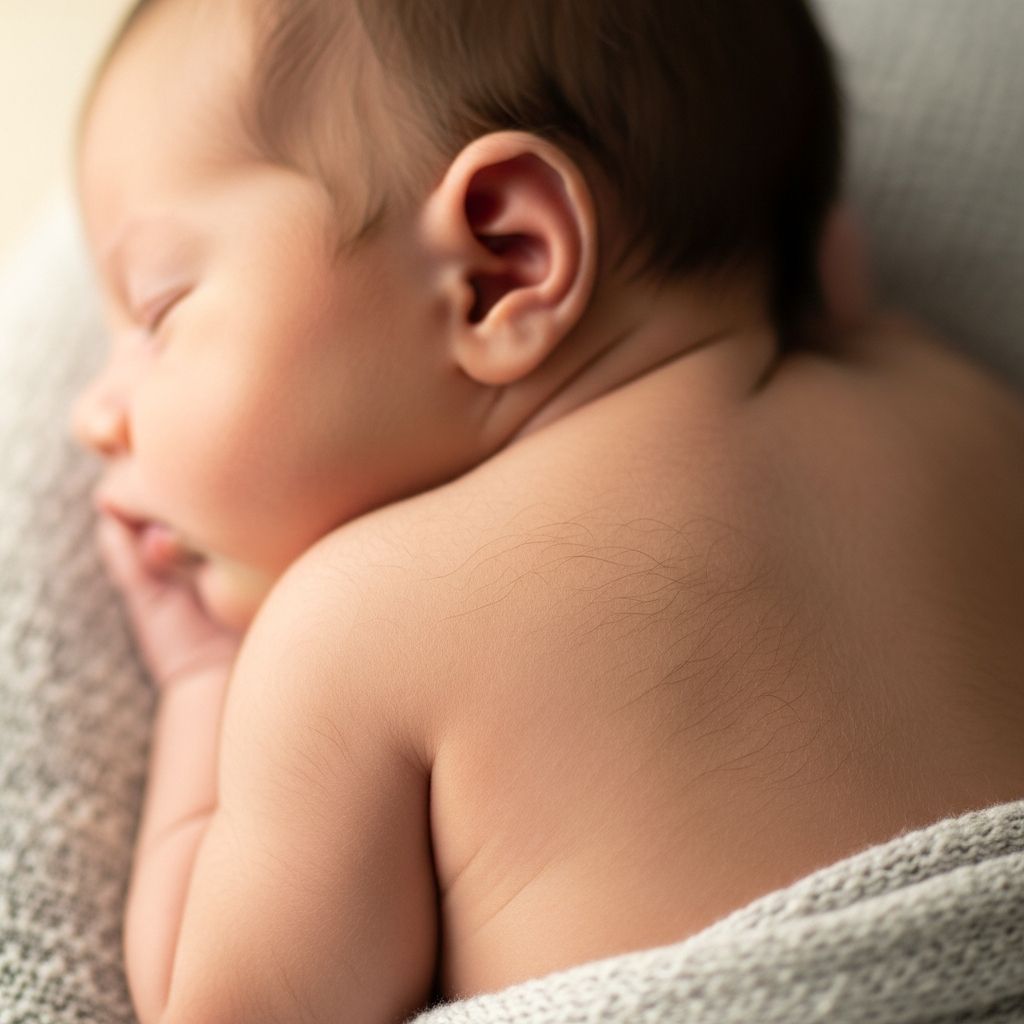
Many parents expect a smooth, soft newborn, only to be surprised when their baby arrives with hair on the back, shoulders, ears, or even across the forehead. This can lead to anxious questions like, “Is something wrong?” or “Did I do something to cause this?” This guide explains why hairiness in newborns is usually normal, what lanugo is, and how your baby’s hair will change over time.
What Is Lanugo?
Lanugo is the fine, soft hair that covers a baby’s body while they are still in the womb. It often looks like a light, fuzzy coating and may appear on the back, shoulders, forehead, ears, and sometimes on the face. This type of hair is different from the thicker scalp hair and from the vellus hair that appears later in childhood.
During pregnancy, lanugo helps protect the baby’s delicate skin and plays a role in regulating temperature and holding vernix (the creamy, white protective coating) against the skin. Most of this hair sheds before birth, but many babies—especially those born early—still have visible lanugo after delivery.
- Lanugo is soft, downy, and usually light-colored.
- It can cover large areas of the body or appear only in patches.
- It is part of normal fetal development, not a sign of poor health in most cases.
Why Are Some Babies Hairier Than Others?
Parents often compare their newborn to photos of bald or nearly bald babies and worry that extra body hair is abnormal. In reality, there is a wide range of what is considered normal. Some babies have almost no visible body hair at birth, while others have very noticeable fuzz across the back and shoulders.
Several factors influence how hairy a baby appears at birth. These include genetic background, gestational age, individual variation, and, in some cases, underlying medical conditions. For the vast majority of babies, however, being extra hairy is simply a harmless variation of normal.
- Full-term and premature babies may look different in their patterns of lanugo.
- Some families tend to have naturally hairier babies and children.
- The appearance of body hair often changes quickly in the first weeks of life.
Lanugo vs. Other Types of Hair
Not all hair on a newborn’s body is the same. Understanding the different types can help parents make sense of what they are seeing. Lanugo is temporary and sheds, while other hair types stick around much longer.
Typically, three main hair types are discussed in relation to babies: lanugo, vellus hair, and terminal hair. Each has its own texture, thickness, and location on the body.
| Hair Type | Texture | Typical Location | When It Appears | How Long It Lasts |
|---|---|---|---|---|
| Lanugo | Very fine, soft, downy | Back, shoulders, face, ears, limbs | Develops in the womb | Usually sheds before or within weeks after birth |
| Vellus Hair | Thin, light, almost invisible | Most of the body surface | Replaces lanugo after birth | Persists through childhood and beyond |
| Terminal Hair | Thicker, darker, coarse | Scalp, eyebrows, eyelashes; later in puberty on armpits and pubic area | Some present at birth (scalp, brows, lashes) | Long-lasting; changes with age and hormones |
Common Places Parents Notice Hair
New parents often become hyper-aware of every detail on their baby’s body, including where hair appears. While each baby is unique, some areas tend to draw more attention because the hair can seem unexpected or more visible against delicate newborn skin.
In most cases, these hairy patches fade or disappear on their own, with no need for treatment. Being familiar with common patterns can ease worries and help parents recognize what is typical.
Hairy Back and Shoulders
One of the most common spots for noticeable lanugo is the upper back and shoulders. This fuzz may feel like a soft blanket when holding your baby and can appear thick in photos, especially under bright light or flash.
- This hair usually thins noticeably over the first month or two.
- It may shed faster in areas where clothing or blankets rub gently against the skin.
Hair on the Ears and Forehead
Short, fine hairs on the ears or at the temples and hairline can be startling at first. Parents sometimes mistake these for signs of a hormonal problem, but they are often just remnants of lanugo that have not yet shed.
- Ear hair often disappears within weeks as the lanugo sheds.
- Forehead and temple fuzz typically become less noticeable as the baby grows and the scalp hair pattern matures.
Upper Lip and Face
Some babies look like they have a faint mustache or extra hair along the jawline. This can be more visible on babies with darker hair or lighter skin, simply due to contrast.
- This fine facial hair almost always fades on its own without intervention.
- Parents should avoid waxing, shaving, or using hair-removal creams on babies, as these can irritate delicate skin.
How and When Lanugo Falls Out
Lanugo begins to shed naturally in the womb during the third trimester of pregnancy. Some of this loose hair floats in the amniotic fluid and may even be swallowed by the baby, eventually contributing to the first bowel movements after birth.
For babies who still have visible lanugo at birth, the shedding process usually continues steadily. Parents may notice less hair week by week, especially during the first two to three months of life, as lanugo is replaced by finer vellus hair.
- Most lanugo disappears by about three to four months of age.
- A few patches of fuzz may linger longer, especially on the shoulders or back.
- The timeline can vary by baby and is rarely a sign of a serious problem on its own.
Hairy Baby and Genetics
Genetics have a strong influence on hair characteristics, even from birth. Families with naturally thick hair or more body hair may be more likely to have babies who appear hairier. The baby’s ethnic background can also influence hair color, density, and growth patterns.
These inherited tendencies do not mean anything is wrong. Instead, they represent the unique combination of traits passed down from parents and ancestors. Over time, the baby’s hair pattern will continue to develop and may change significantly from what is seen at birth.
- Parents with dark or coarse hair often notice more visible fuzz on their newborns.
- Some babies’ hair thins, lightens, or curls as they move into toddlerhood.
Newborn Hair and Hormones
Hormones also play a role in newborn hair patterns. During pregnancy, the baby is exposed to maternal hormones circulating in the bloodstream. After birth, those hormone levels start to drop, and the baby’s body gradually adjusts to life outside the womb.
This hormonal shift can lead to a variety of temporary changes, including baby acne, changes in scalp hair, and shedding of lanugo. In some cases, babies may lose much of their scalp hair and then regrow it with a different texture or color later on.
- Hormonal changes can cause both shedding and new growth of different hair types.
- Fluctuations are usually self-limited and do not require treatment.
When Extra Hair Might Signal a Problem
Although a hairy newborn is typically healthy, there are rare situations where excessive or unusual hair growth can be linked to an underlying condition. Parents should pay attention not just to the amount of hair, but also to its pattern, texture, and whether other symptoms are present.
Medical issues are uncommon, but they are more likely when hair growth is very dense, appears in unusual patterns, or is accompanied by developmental concerns or physical abnormalities. In these cases, a pediatrician may recommend further evaluation.
- Unusual hair growth combined with rapid weight gain, poor growth, or hormonal symptoms should be checked.
- Patches of hair over the spine or near the lower back may, in rare cases, be associated with spinal abnormalities and warrant medical attention.
- Any hair growth that seems to be progressing rapidly or causing skin problems should be discussed with a doctor.
How to Care for a Hairy Newborn
Most of the time, caring for a hairy newborn is no different from caring for any other baby. The main priorities remain keeping the skin clean, moisturized, and protected. There is no need to remove lanugo or other body hair, and attempts to do so can actually harm the baby’s delicate skin.
Gentle routines help the hair shed naturally and keep your baby comfortable. Over time, as the lanugo disappears and new hair patterns emerge, parents usually stop noticing the extra fuzz altogether.
- Use mild, fragrance-free baby cleansers during bath time.
- Pat the skin dry rather than rubbing vigorously.
- Avoid shaving, waxing, or using depilatory creams on any part of your baby’s body.
- Dress your baby in soft fabrics to minimize friction and irritation.
Emotional Reactions: Parent Worries and Cultural Beliefs
Emotional responses to a hairy newborn can vary widely. Some parents find their baby’s fuzz adorable and unique, while others feel anxious or embarrassed, especially if they receive comments from relatives or friends. It can help to remember that differences in appearance are normal and that most people do not understand the biology behind lanugo.
In some cultures, newborn hair is surrounded by rich traditions and beliefs. Families may perform special rituals involving hair cutting, shaving, or blessing the child. As long as these practices are safe and do not involve harsh chemicals or tools on delicate skin, they can be a meaningful way to welcome the baby.
- Parents should feel empowered to set boundaries around comments that make them uncomfortable.
- Discuss any planned cultural hair rituals with a healthcare provider to ensure safety.
When to Talk to Your Pediatrician
In most cases, a quick conversation at a routine checkup is enough to reassure parents about their baby’s hair. It is always appropriate to bring up any worries, point out specific areas that concern you, and ask whether what you see is typical.
However, certain signs should prompt a more urgent call or visit. If you are ever in doubt, it is better to ask and be reassured than to stay worried in silence.
- Contact your pediatrician if hair growth appears suddenly denser or darker over a short time.
- Seek advice if thick hair sits over the spine, especially in the lower back region.
- Mention any hair growth that is associated with changes in feeding, growth, or behavior.
- Ask about any skin irritation or rashes that develop under or around dense patches of hair.
Frequently Asked Questions About Hairy Newborns
Is it normal for my newborn to have hair on the back and shoulders?
Yes. Fine, fuzzy hair on the back and shoulders is very typical and usually represents lanugo. This hair tends to thin and disappear over the first several weeks or months of life without any special treatment.
Did something I ate or did during pregnancy cause my baby to be hairy?
No. Normal variations in newborn hair are driven largely by genetics and development, not by specific foods or everyday activities during pregnancy. There is no reliable evidence that particular diets or behaviors cause a baby to have more or less lanugo at birth.
Will my child stay this hairy as they grow?
Most babies who seem hairy at birth do not stay that way. Lanugo sheds and is replaced by finer vellus hair, and overall hair patterns continue to change throughout childhood. Many parents report that, within a few months, they hardly remember how fuzzy their baby once looked.
Can I safely remove my baby’s body hair?
It is not recommended to remove a baby’s body hair using shaving, waxing, threading, or chemical hair-removal products. These methods can damage the skin, cause irritation, and increase the risk of infection. The best and safest approach is to let the hair shed naturally.
Is there a medical test for too much hair on a baby?
In rare cases where a doctor is concerned about excessive or unusual hair growth, they may recommend further evaluation. This could include a physical examination, blood tests, hormonal studies, or imaging, depending on the suspected cause. Such investigations are only needed in a small minority of cases.
What should I say when people comment on how hairy my baby is?
Parents can respond in whatever way feels comfortable, such as by smiling and saying, “It’s just baby fuzz and will fall out soon,” or by changing the subject. It can be helpful to remember that many comments come from curiosity, not criticism, even if they feel uncomfortable in the moment.
Key Takeaways for Parents
Seeing a hairy newborn can be surprising, but in most cases, it is simply a normal part of development. Understanding lanugo and how baby hair evolves over time helps parents relax and focus on bonding with their child.
- Lanugo is a temporary, protective hair that many babies still have at birth.
- Most extra body hair in newborns disappears naturally in the first few months.
- Attempts to remove baby hair are unnecessary and can irritate the skin.
- Talk to a pediatrician if hair growth seems extreme, unusual in pattern, or linked to other health concerns.