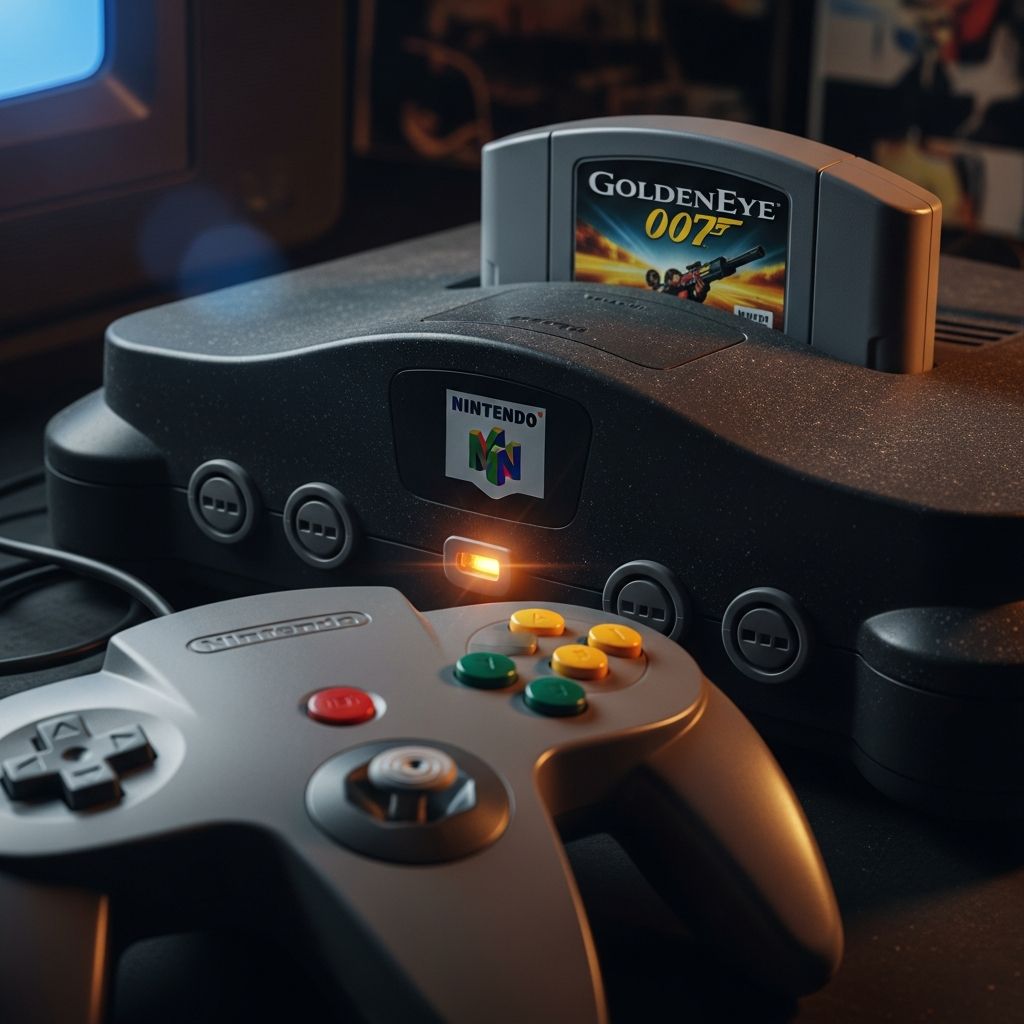
When GoldenEye 007 launched for the Nintendo 64 in 1997, it was just a movie tie-in with modest expectations. Today, it is a cornerstone of retro gaming culture, a game design landmark, and a cartridge that many collectors are willing to pay surprising sums to own again.
This article explores why an old N64 shooter still commands attention and money: the game’s development story, its influence on modern shooters, the emotional pull of couch multiplayer, and the reasons boxed copies and special editions have become hot items among collectors.
The Origins of a Legendary N64 Shooter
GoldenEye 007 began as a licensed adaptation of the 1995 James Bond film, but it quickly evolved into something far more ambitious than a simple action tie-in.
- Platform: Nintendo 64 home console
- Release year: 1997 in North America and other regions
- Developer: Rare, a British studio closely associated with Nintendo at the time
- Film basis: Pierce Brosnan’s Bond debut in the movie GoldenEye
According to the Strong National Museum of Play, development started in the mid-1990s when Nintendo and Rare sought to expand the Nintendo 64’s lineup with a high-profile shooter based on the new Bond film. The project was entrusted largely to a relatively young team experimenting with 3D console technology.
From Experimental Project to Global Hit
GoldenEye 007’s team reportedly drew inspiration from arcade light-gun shooters and early PC first-person shooters, then reshaped their vision as the capabilities of the N64 and the popularity of open 3D worlds became clearer. What was originally a straightforward licensed product grew into a complex game with multi-objective missions, stealth options, and varied difficulty settings, helping distinguish it from many other film-based releases of the era.
Why GoldenEye 007 Felt Revolutionary
On paper, GoldenEye 007 is a first-person shooter about stopping a criminal organization from using a devastating orbital weapon. In practice, it refined and popularized design ideas that console players had barely seen before.
Mission-Based Campaign with Multiple Objectives
Instead of simply moving from point A to point B while shooting everything in sight, GoldenEye’s levels often featured a mixture of goals: planting explosives, photographing evidence, rescuing allies, and escaping intact. Developers have credited other Nintendo 64 titles with influencing this objective-based structure, which pushed console shooters toward more sophisticated mission design.
This mission variety encouraged replaying levels on higher difficulties, where additional objectives and tougher enemies changed the feel of familiar environments.
Innovative Console FPS Controls
GoldenEye 007 helped normalize the idea that a console gamepad could support a fully 3D first-person shooter experience. While PC players already had keyboard-and-mouse precision, console shooters were still figuring out their identity. GoldenEye’s use of the N64 controller’s analog stick for movement and aiming, and an optional precision aiming mode, demonstrated that console FPS controls could be both comfortable and reasonably accurate for the time.
Stealth, AI, and Atmosphere
Compared with many contemporaries, GoldenEye rewarded patience and precision. Alarms could be triggered by cameras and guards; enemies reacted (within hardware limits) to sound and line of sight; silenced pistols and careful movement often felt more effective than running into every corridor.
Coupled with atmospheric music, film-inspired locations, and briefings presented like secret dossiers, the game captured the fantasy of being a movie spy far more convincingly than most previous James Bond adaptations.
The Four-Player Split-Screen Phenomenon
For many players, the strongest memories of GoldenEye 007 are not from the single-player missions but from marathon multiplayer sessions around a television. Its four-player split-screen deathmatches turned Friday nights, sleepovers, and dorm lounges into loud, competitive battlegrounds.
Why Local Multiplayer Mattered So Much
- Accessibility: Anyone could pick up a controller and join a match, regardless of skill level.
- Shared screen chaos: Everyone could see everyone else’s viewpoint, leading to on-the-spot alliances, betrayals, and accusations of “screen peeking.”
- Iconic rule sets: House rules such as “no Oddjob” or “slappers only” became part of shared gaming folklore.
Major retrospectives on GoldenEye emphasize how crucial this living-room multiplayer was to its impact: even players who never finished the campaign often spent countless hours in competitive matches with friends.
Modes, Maps, and Weapons
The multiplayer suite included:
- Multiple modes: Standard deathmatch, team play, and variations with unique win conditions.
- Distinct maps: Arenas inspired by campaign locations, each favoring different tactics (close-quarters chaos vs. long sightlines).
- Weapon sets: Pistols-only rounds felt very different from explosive-heavy matches or sniper-focused setups.
According to histories of the game’s development, the four-player mode was added relatively late in production by a small number of developers, yet it became the feature that defined the game for an entire generation of players.
GoldenEye 007’s Lasting Impact on Video Games
GoldenEye 007 is frequently cited as one of the most influential console shooters ever released. Its design choices helped shape expectations for how first-person shooters should feel on home consoles.
| Design Element | GoldenEye 007’s Contribution | Influence on Later Games |
|---|---|---|
| Mission Objectives | Levels with multiple goals and optional tasks | Inspired more structured campaign design in later console shooters |
| Console FPS Controls | Showed that a gamepad could support fluid first-person aiming | Paved the way for standardized twin-stick control schemes on later systems |
| Local Multiplayer | Popularized four-player split-screen deathmatch on consoles | Set expectations for social play in living-room shooters |
| Licensed Game Quality | Demonstrated that a film-based game could be critically acclaimed | Raised the bar for future movie tie-ins in terms of depth and polish |
From Childhood Cartridge to Collectible
Decades after release, GoldenEye 007 cartridges and complete-in-box copies have become increasingly sought after in the retro gaming market. While individual prices vary by condition and region, several broad factors explain the game’s continued desirability.
Why Retro Prices Have Climbed
- Nostalgia: Players who grew up with N64 now have disposable income and want to rebuild their childhood collections.
- Cultural status: Museums and major media outlets highlight GoldenEye as a landmark game, reinforcing its prestige.
- Finite supply: No new physical cartridges are being produced; boxed and mint-condition copies become scarcer every year.
- Licensing hurdles: Complex James Bond rights arrangements limited re-releases for many years, making the original cartridge the most authentic way to play.
Condition Tiers That Affect Value
Collectors typically distinguish several levels of condition and completeness:
- Loose cartridge: Just the game, no box or manual. Casual players often seek this tier.
- Complete in box (CIB): Cartridge, box, and manual in good condition. Highly desirable for display.
- Sealed: Unopened copy with intact shrink wrap and labels. Often commands a premium as a display piece.
Within each tier, label wear, box creases, discoloration, and region differences (NTSC vs. PAL) can further influence collectability and price. Professional grading services sometimes encapsulate and rate pristine copies, which can push prices higher among dedicated collectors.
How GoldenEye Fits into N64 and Bond History
GoldenEye 007 holds a special place both in the history of Nintendo’s 64-bit console and in the broader James Bond franchise.
Pillar of the N64 Library
The Strong Museum of Play and other archival projects list GoldenEye among the Nintendo 64’s key titles, alongside games such as Super Mario 64 and The Legend of Zelda: Ocarina of Time. While it was not the N64’s top seller, it consistently appears in “best games of all time” rankings and retrospectives.
Its success showed that the N64 could host deeper, more mature experiences in addition to family-friendly platformers and party games, broadening perceptions of the console’s capabilities.
Most Successful Early Bond Game
GoldenEye 007 is widely recognized as the breakout hit of early James Bond video games, in terms of both critical reputation and long-term cultural impact. It helped prove that a Bond game could stand on its own merits rather than merely echoing the film’s plot. Its mix of cinematic moments and flexible gameplay set a template that later Bond titles tried—sometimes unsuccessfully—to emulate.
Tips for Modern Players and Collectors
Whether you are revisiting GoldenEye for nostalgia or considering it for your collection, a bit of planning goes a long way.
Playing GoldenEye 007 Today
- Original hardware: For the most authentic experience, an N64 console, an original controller in good condition, and a CRT or low-latency display can recreate the look and feel many remember.
- Comfort with controls: Players used to modern twin-stick setups may need time to adjust to the N64 controller layout and optional aim-assist modes.
- Multiplayer etiquette: Reviving house rules—such as banning certain characters or weapons—can recapture the playful rivalries of past gaming nights.
Buying and Preserving a Copy
- Check authenticity: Verify labels, cartridge shells, and security markings when possible, as reproduction cartridges exist in many retro markets.
- Inspect condition: Look for significant label damage, discoloration, or corrosion on contacts, which may influence both playability and value.
- Store carefully: Keep cartridges dry and away from direct sunlight. Boxes and manuals should be stored upright or in protective sleeves to avoid crushing and fading.
- Document provenance: For higher-end collections, noting where and when you obtained a copy—along with any grading documentation—can be helpful.
Frequently Asked Questions About GoldenEye 007
Why is GoldenEye 007 considered so important in gaming history?GoldenEye 007 combined mission-based level design, accessible console controls, and four-player split-screen multiplayer at a time when most console shooters were far simpler. Retrospectives from major outlets and museums credit it with helping define how first-person shooters would work on home consoles and proving that licensed games could be both ambitious and critically acclaimed.
Q: Was GoldenEye 007 the best-selling game on Nintendo 64?
No. Reports indicate that while GoldenEye 007 sold very well, it was not the top-selling N64 title. However, cultural analyses often argue that it “mattered” more than almost any other game on the system because of its outsized influence on multiplayer gaming and console shooters.
What makes certain copies of GoldenEye 007 more valuable than others?
Value depends heavily on condition and completeness. Loose cartridges are common and relatively affordable, while complete-in-box or factory-sealed copies in excellent condition can be much more expensive due to their scarcity. Regional variants, limited releases, and professionally graded copies can command additional premiums among collectors.
How did GoldenEye 007 handle violence and age-appropriateness?
GoldenEye 007 depicted gun combat but framed it within a spy-thriller tone rather than gratuitous gore. Development histories note that Nintendo and the creators paid attention to content such as blood effects and non-combatant characters, adjusting or removing certain elements to align with the company’s family-friendly reputation at the time.
Is GoldenEye 007 still fun for new players who grew up with modern shooters?
Many players raised on modern twin-stick shooters find the controls and visuals dated at first, but the game’s mission variety, inventive level layouts, and social energy of split-screen multiplayer can still feel fresh. Those willing to adapt to the N64 controller and accept the technical limitations often discover why the game is so fondly remembered.
References
- The True Story Behind GoldenEye 007 Nintendo 64 Video Game — YouTube channel “Gaming Historian” (video transcript used for development context). 2018-08-27. https://www.youtube.com/watch?v=NPiJkrWnjVQ
- 20 Years Later: The History of Goldeneye 007 N64 — TeeChu. 2017-08-23. https://www.teechu.com/goldeneye-007-n64-history-facts
- ‘GoldenEye 007’: The Game That Mattered to Everyone — Complex. 2017-08-25. https://www.complex.com/pop-culture/goldeneye-007-legacy
- GoldenEye 007 (Nintendo 64) — GoldenEye Wiki (fandom). Last updated 2023 (consulted for high-level Bond game context). https://goldeneye.fandom.com/wiki/GoldenEye_007_(Nintendo_64)
- GoldenEye 007 — The Strong National Museum of Play. 2020-01-01 (approximate catalogue entry date). https://www.museumofplay.org/games/goldeneye-007/