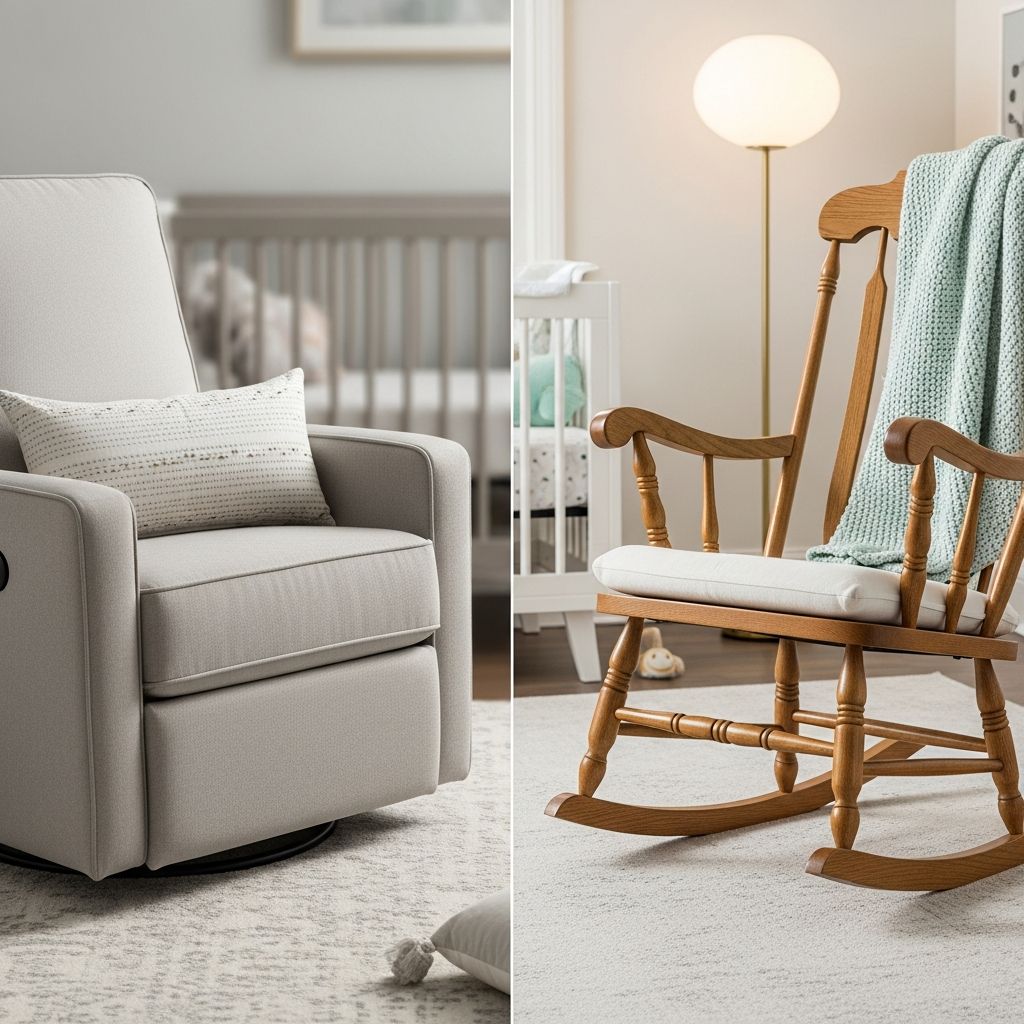
Designing a nursery usually starts with a crib and storage, but the chair you choose will shape your everyday life far more than most other items. Whether you pick a glider or a rocking chair affects how easy night feeds feel, how comfortable you are while recovering postpartum, and even how safely older siblings can move around the room.
This guide walks through what sets gliders and rockers apart, the pros and cons of each, and how to match the right chair to your home, body, and baby.
What Is a Nursery Glider?
A nursery glider is an upholstered chair that moves smoothly back and forth along a fixed track or mechanism rather than tipping on curved rockers. Instead of the arcing motion of a traditional rocking chair, the whole seat slides in a nearly horizontal path, often on a metal or ball-bearing track built into a stationary base.
Key Characteristics of Gliders
- Smooth, linear motion: The chair glides back and forth on a track, producing a gentle, even movement rather than a strong arc.
- Stationary base: The base stays flat on the floor, which can improve stability, especially on soft carpet.
- Upholstered, cushioned design: Many gliders resemble cozy armchairs with padded arms, high backs, and deep seat cushions.
- Optional extras: Common add-ons include swiveling, reclining, integrated footrests, or matching ottomans.
Why Gliders Appeal to New Parents
Gliders have become especially popular in modern nurseries because their smoother motion can be soothing without requiring as much effort from the caregiver. The even, repetitive movement may help calm a fussy baby, and the cushioned support helps parents maintain more ergonomic posture during long feeds or cuddles.
What Is a Rocking Chair?
A rocking chair, or rocker, is a chair mounted on curved rockers that allow it to tip backward and forward in an arc. The base is not fixed; instead, the curved runners contact the floor directly and create the signature rocking motion.
Key Characteristics of Rockers
- Arched runners: The chair is attached to two curved pieces of wood or metal that create the rocking arc.
- Stronger motion: The movement can be more pronounced and dynamic than a glider’s gentle slide.
- Traditional look: Many rockers have a classic wood-frame design, though upholstered versions are increasingly common.
- Simple construction: Fewer moving parts often makes them lighter and can reduce cost.
Why Rockers Remain a Classic
The rhythmic rocking provided by rockers has long been used to soothe infants and adults alike. Research shows that gentle rocking during sleep can improve sleep stability and promote certain brain rhythms in adults, which may help explain why rocking is naturally calming for many people, including babies. While the exact motion in a nursery rocker may differ from laboratory setups, the basic principle that periodic motion can be soothing is well supported.
Glider vs Rocking Chair: Core Differences
Both chairs offer motion and a place to sit, but they behave very differently in real life. The table below summarizes the main distinctions.
| Feature | Glider | Rocking Chair |
|---|---|---|
| Type of motion | Back-and-forth glide on a fixed track | Arc-like rocking on curved runners |
| Feel of movement | Smoother, more controlled, generally gentler | Stronger, more pronounced sway |
| Seat and padding | Often wider, plusher, more like an armchair | Can be wood or upholstered; size and padding vary |
| Base stability | Flat, stationary base; often feels very stable | Moves on runners; tips up with motion |
| Space needs | Needs clearance behind and in front to glide and recline | Requires an arc of open floor in front and back |
| Cost range | Usually mid-to-high due to mechanics and upholstery | Often more budget-friendly, especially simple wood designs |
Comfort Considerations: You and Your Baby
Comfort is not just about soft cushions. For postpartum parents, body mechanics, support, and how easy it is to stand up while holding a newborn can matter more than how plush a chair feels.
Seat and Back Support
- Gliders: Typically offer a higher back, padded armrests, and soft upholstery that can help maintain a more neutral spine and supported shoulders during feeding sessions.
- Rockers: Range from bare wooden frames to fully upholstered models. Traditional wood rockers may need added cushions or pillows to provide equivalent lumbar and arm support.
Because breastfeeding or bottle-feeding often involves prolonged sitting, many lactation and postpartum resources recommend good back support and arm support to reduce strain on the shoulders and lower back. In practice, that often means a well-structured glider or an upgraded, cushioned rocker.
Getting In and Out with a Baby
- Gliders: The stationary base and often slightly higher seat can make it easier to stand up while holding a baby, especially for people recovering from a cesarean or pelvic floor injury.
- Rockers: Because the base moves, some parents find it less stable when attempting to stand, particularly on slippery floors. Choosing a model with a broad base and using a non-slip rug pad can help.
How the Motion Feels
- Gliders: The gentle glide requires relatively little effort to maintain motion, which can be helpful during long, sleepy feeds at night.
- Rockers: A more vigorous rocking motion appeals to some babies and caregivers but may feel too intense or tiring for others.
Safety and Practicality in the Nursery
Any moving chair in a child’s room introduces potential pinch points and tipping risks, but design details vary between gliders and rockers.
Glider Safety Features
- Covered mechanisms: Many nursery gliders are designed so the moving parts are covered, reducing the chance that small fingers get caught.
- Locking functions: Some gliders include a lock that stops motion entirely, useful when older children are playing near the chair or when you want a stable seat.
- Stable footprint: The fixed base typically provides good stability, especially on carpet or rug.
Rocking Chair Safety Considerations
- Open runners: Classic rockers have exposed curved legs that can pinch toes or fingers beneath the rocker if children play too close.
- Tipping dynamics: Because the chair tips as it rocks, it may feel less stable on thick carpet or very uneven flooring.
- Weight and placement: Lighter wood rockers can shift if pushed hard. Positioning the chair away from busy play zones and against a stable floor surface can reduce risk.
General Nursery Safety Tips for Either Chair
- Keep a clear zone in front of and behind the chair so no one sits or crawls where the base moves.
- Use a rug with a non-slip pad under lightweight chairs to prevent sliding.
- Supervise toddlers when they’re near the chair, especially when it is in motion.
Space, Style, and Long-Term Use
Your choice is not just about the baby years. Many families keep their nursery chair well into the preschool years or relocate it to another room later.
Fitting the Chair into Your Space
- Gliders: Because their bases usually do not extend beyond the footprint of the chair, gliders can work well in relatively tight corners. However, recliner-style gliders need extra space behind them when fully reclined.
- Rockers: The arcing motion means you must account for the swing both forward and backward, which can be tricky in very small rooms.
Decor and Aesthetic
- Gliders: Often feature a contemporary, upholstered look that blends easily into living rooms or bedrooms once it leaves the nursery.
- Rockers: Provide a more traditional, sometimes rustic or vintage feel, though there are many modern, upholstered interpretations as well.
Will You Use It After the Baby Stage?
Some questions to ask yourself:
- Could this chair later live in the living room or a reading nook?
- Will the fabric and style still feel appealing in three to five years?
- Do you prefer a piece that looks like a nursery chair or like general home furniture?
If you plan to keep the chair long term, a glider that resembles a standard armchair or a neutral upholstered rocker may offer better value than a nursery-specific style.
Budget and Durability
Prices for both gliders and rockers range widely based on materials, padding, brand, and features.
Typical Cost Patterns
- Gliders: Tend to be more expensive due to the internal track mechanism, upholstery, and added features like swivel or recline.
- Rockers: Simple wood designs are often the most budget-friendly option; fully upholstered rockers may cost as much as mid-range gliders.
Durability Factors
- Mechanisms: Tracks, bearings, recline levers, and swivels can wear over time. High-quality gliders rated for repeated use can provide many years of service but may cost more up front.
- Frame material: Solid wood or metal frames in either gliders or rockers typically outlast lightweight composites.
- Fabric: Stain-resistant, tightly woven fabrics and removable cushion covers are helpful in nurseries where spills and spit-up are common.
How to Choose: Decision Checklist
When you weigh all the pros and cons, the “best” chair depends on your priorities, body, and space. Use this quick checklist to narrow your decision.
Choose a Glider If You:
- Want very smooth, gentle motion with less physical effort.
- Prefer a plush, armchair-style seat with strong back and arm support.
- Are recovering from a cesarean or pelvic floor issues and need a chair that’s easier to stand up from while holding baby.
- Have room in your budget for a mid-to-higher price item you can keep in your home for years.
Choose a Rocking Chair If You:
- Love the classic rocking motion and nostalgic feel of a traditional nursery.
- Have a smaller budget and want a simpler design that still offers soothing movement.
- Prefer wood furniture or an heirloom-style piece you might pass down.
- Are comfortable managing a stronger, arc-like rocking movement while holding your baby.
Frequently Asked Questions
Is a glider safer than a rocking chair in a nursery?
Safety depends on design and how you use the chair. Many nursery gliders have covered mechanisms and sometimes locks that prevent motion, which can reduce the risk of pinched fingers compared with classic rockers that have exposed curved runners. Regardless of the chair type, supervising children around any moving furniture and keeping a clear zone around the base are important.
Do I really need a special chair for feeding my baby?
Not strictly, but having a dedicated, supportive chair can make frequent night feeds and contact naps more comfortable and may reduce back and shoulder strain over time. Many parents find that a glider or rocker quickly becomes the most used seat in the nursery.
Which is better for small spaces: a rocker or a glider?
Compact gliders with a tight, stationary base often fit neatly into corners and need only a little clearance behind them to move, especially if they do not recline. However, a small-scale wood rocker can also work in a tiny room if you have enough arc space in front and behind the chair.
Can I use a glider or rocker outside the nursery later?
Yes. Many families move an upholstered glider into the living room or a reading nook after the baby phase. A neutral upholstered rocker or classic wood rocking chair can also transition well to other rooms, especially if you choose colors and fabrics that match your broader decor.
Which option is better for motion sickness?
People who are sensitive to motion sometimes prefer the smoother, linear glide of a glider over the more pronounced arc of a rocker. If you know you are prone to motion sickness, testing each type in person before buying can help you avoid discomfort.
References
- Glider Vs. Rocker: Which One Best Suits Your Needs? — Nurture&. 2023-05-10. https://nurtureand.com/blogs/posts/glider-vs-rocker-which-one-best-suits-your-needs
- Glider vs. Rocker: Choosing the Right Chair — Living Spaces. 2022-08-15. https://www.livingspaces.com/inspiration/ideas-advice/guides/glider-vs-rocker
- Glider vs. Rocker: How to Decide on a Nursery Seat — Wayfair Ideas & Advice. 2022-04-20. https://www.wayfair.com/sca/ideas-and-advice/rooms/glider-vs-rocker-how-to-decide-on-a-nursery-seat-T22049
- Gliders & Rockers — Bellini Baby Furniture. 2021-06-01. https://www.belliniofboca.com/furniture/gliders-rockers/
- Rocking Chair Vs Glider: What’s the Difference? — My First Nursery. 2022-09-12. https://myfirstnursery.co.uk/blogs/news/rocking-chair-vs-glider-whats-the-difference
- The Difference Between a Rocker and a Glider Explained — iL Tutto. 2023-03-28. https://www.iltutto.com.au/blogs/baby-tips/difference-between-a-rocker-and-a-glider
- Glider vs. Rocker: Which Should You Choose? — Pottery Barn Kids. 2021-11-05. https://www.potterybarnkids.com/tips-and-ideas/design-guides/glider-vs-rocker-which-should-you-choose/
- Glider or Rocker? — Monte Design. 2020-09-18. https://montedesign.com/blogs/news/glider-or-rocker
- Rocking synchronizes brain waves during a short nap — Bayer et al., Current Biology (Elsevier). 2019-01-24. https://doi.org/10.1016/j.cub.2018.12.026
- Breastfeeding and Posture — La Leche League International. 2020-07-01. https://www.llli.org/breastfeeding-info/posture/