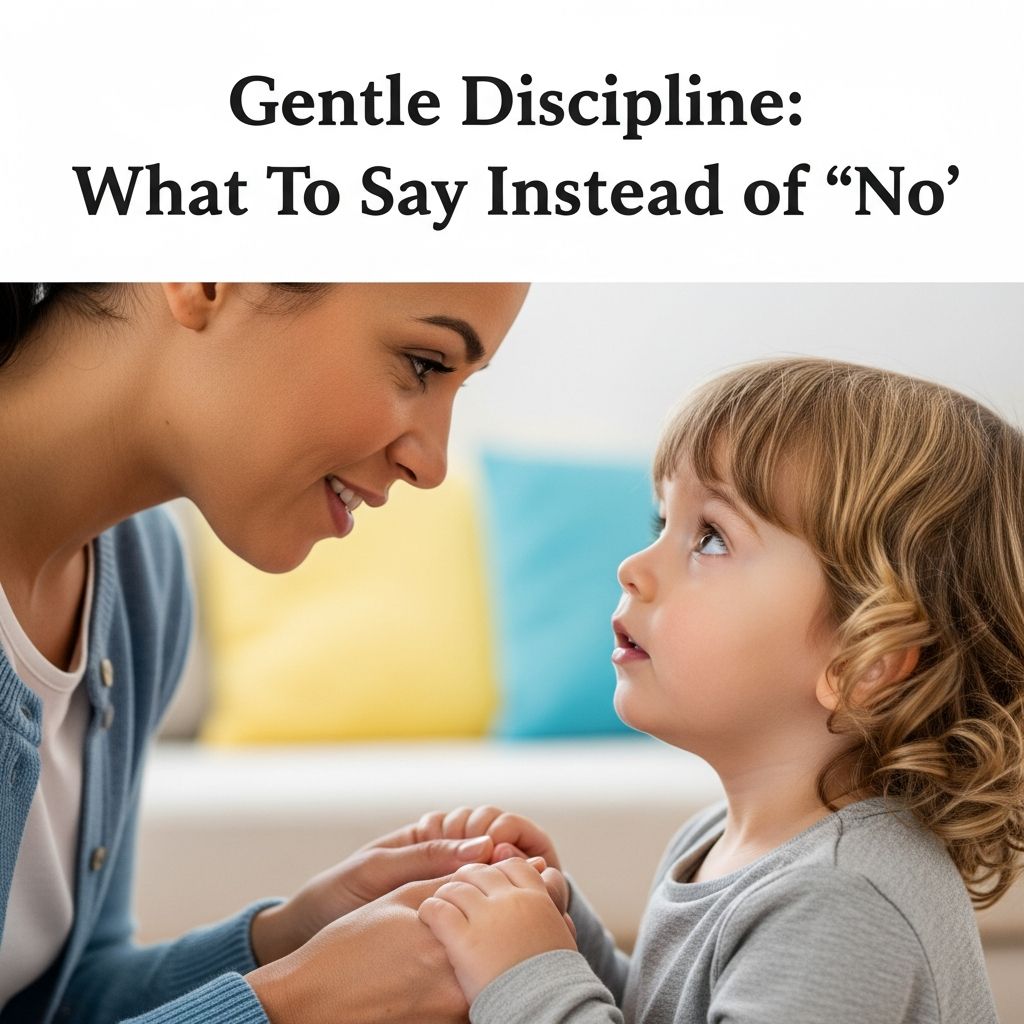
Most parents reach for the word “no” dozens of times a day, especially with curious babies and strong-willed toddlers. Yet when “no” becomes the soundtrack of home life, it can lose its power, create more conflict, and leave everyone feeling frustrated and disconnected.
Gentle discipline is not about letting children do whatever they want. It is about guiding them firmly and kindly, using language and actions that teach what they can do instead of only what they cannot. This approach helps children feel safe, respected, and more likely to cooperate over the long term.
Why “No” So Often Backfires
There is nothing wrong with the word “no” itself. The problem is how often and how automatically it is used. When “no” is the default response to every small misstep or experiment, several unhelpful things can happen.
- “No” starts to lose meaning. If children hear it constantly, it becomes background noise instead of a meaningful signal.
- It tells them what to stop, not what to do. Young children, especially under three, understand simple, concrete directions better than vague prohibitions.
- It can invite a power struggle. A sharp “no” often triggers resistance, tears, or defiance, especially when children already feel tired, hungry, or overstimulated.
Reserving “no” for safety issues and using more specific, positive guidance for everyday mischief helps restore its power and keeps the emotional climate at home calmer.
The Principles Behind Gentle Alternatives
Before changing the words you use, it helps to understand the principles behind more effective limit-setting. These ideas form the backbone of every script and strategy in this article.
- Connection first. Children cooperate more readily when they feel seen, understood, and emotionally safe.
- Clarity over criticism. Clear, concrete instructions (“Feet stay on the floor”) are easier to follow than vague negatives (“Don’t climb”).
- Consistency with warmth. Limits work best when they are predictable and enforced calmly, not only when a parent’s patience runs out.
With these principles in mind, you can shift from automatic “no” to language that guides your child toward better choices.
Positive Phrases to Use Instead of “No”
Replacing reflexive “no” with positive, action-focused phrases is one of the simplest and most powerful changes you can make. These phrases tell your child what to do, keep the tone respectful, and still hold firm boundaries.
- “Hands stay gentle.” Use instead of “Don’t hit your brother.”
- “Food stays on the table.” Use instead of “Stop throwing your food.”
- “Toys are for the floor, not the wall.” Use instead of “No drawing on the wall.”
- “You may splash in the tub, not on the floor.” Use instead of “No more splashing.”
These phrases are short, specific, and framed around what is allowed. Over time, they become familiar cues that support self-control.
Redirection: Pointing Toward a Better Choice
For babies and toddlers, simply stopping a behavior is rarely enough. They need help finding an acceptable alternative that meets the same need—curiosity, comfort, movement, or attention. This is where redirection shines.
- Match the urge. If a child wants to throw, offer a soft ball and a basket instead of simply stopping them from throwing blocks.
- Change the environment. Move breakables up high, use baby gates, or create a “yes zone” where almost everything is safe to touch.
- Add novelty. Offer a new activity or object that engages their senses when their behavior is drifting toward trouble.
Redirection lets you honor your child’s developmental drive to explore while still keeping them and your home safe.
When to Save “No” for Serious Situations
Using fewer “no”s does not mean never using the word. In fact, saving it for genuine danger makes it more impactful. A firm “no” followed by swift action can help a child learn to avoid truly risky situations.
| Situation Type | Examples | Best Response Style |
|---|---|---|
| Immediate safety risk | Running into the street, reaching for a hot stove, climbing unsafe furniture | Firm “no,” quick physical intervention, then brief explanation |
| Annoying but harmless | Dropping toys repeatedly, banging a spoon, silly noises | Redirection, humor, or ignoring if appropriate |
| Learning social skills | Grabbing toys, rough play, interrupting | Positive guidance, modeling, and practice, with calm limits |
Thinking in terms of “safety first, skills next” helps you decide when “no” is necessary and when a gentler approach is more effective.
Age-by-Age Strategies for Babies and Toddlers
What works for a crawling baby will not be enough for a talkative toddler. Adjusting your approach to your child’s stage makes cooperation more likely and frustration less frequent.
For Babies Under 12 Months
Babies explore the world with their hands and mouths, and they do not yet understand rules. At this stage, discipline is less about instruction and more about protection and gentle guidance.
- Rely on the environment. Baby-proof thoroughly so you can say “yes” more often while your baby explores.
- Use simple, calm words. Short phrases like “Soft touch” or “Not for baby” paired with moving their hand or body are enough.
Your tone and body language speak louder than your specific words. Calm, consistent responses help your baby feel safe.
For Toddlers 12–24 Months
Toddlers are mobile, determined, and just beginning to understand simple directions. They also have strong feelings and limited language to express them, which can lead to conflict.
- Offer clear, positive commands. Say “Walk inside” instead of “Don’t run,” and “Blocks stay on the floor” instead of “No throwing.”
- Redirect quickly. Move them toward a new activity as soon as you interrupt a problem behavior, before frustration escalates.
Expect to repeat yourself many times; repetition is how toddlers learn. Consistency, not perfection, is what matters most.
For Toddlers 2–3 Years
Older toddlers are testing independence and boundaries. They can understand more complex language and explanations, but they still need concrete choices and consistent follow-through from adults.
- Offer limited choices. “You may jump on the floor or the cushion, not the couch. Which one do you choose?”
- Prepare them in advance. Give warnings before transitions: “Two more turns with the slide, then we go home.”
At this age, you are teaching not just rules but also self-regulation. Gentle limits paired with empathy help build that skill.
Sample Scripts for Everyday Situations
Having a few ready-made phrases can make it easier to stay calm in the moment. Here are example scripts you can adapt to your child and your home.
When Your Child Throws Food
- “Food stays on the tray. If you’re finished, you can put it here.” (Offer a small bowl or spot for uneaten food.)
- “It looks like you’re done eating. I will take the plate now.” (Remove the plate calmly if throwing continues.)
When Your Child Hits or Bites
- “I won’t let you hit. Hands stay gentle. Let’s move over here together.” (Hold or move them away from the other child.)
- “You are angry, but biting hurts. You may bite this teether, not people.”
When Your Child Grabs Toys
- “You really want that toy. Your friend is using it now. You may have a turn when they are finished.”
- “You grabbed it. Let’s give it back and ask, ‘Can I have a turn?’ I will help you wait.”
These scripts combine a limit (“I won’t let you hit”) with acknowledgement of feelings and a clear alternative, which is the heart of gentle discipline.
Balancing Empathy and Firm Limits
One fear many parents have is that using fewer “no”s will make them seem weak or permissive. Real gentle discipline is the opposite: it pairs strong boundaries with emotional support.
- Lead with empathy. “You really wanted to keep playing. It’s hard to stop when you’re having fun.”
- Hold the boundary. “Playtime is finished now. We are going home.”
Empathy does not change the rule, but it helps your child feel understood rather than controlled. Over time, this builds trust and reduces the intensity of power struggles.
Managing Your Own Reactions
Even the best scripts fall flat when a parent is overwhelmed, exhausted, or triggered. Taking care of your own emotional state is an essential part of parenting with fewer “no”s.
- Pause before reacting. Take a breath, lower your voice, and decide what you want to teach in that moment.
- Use simple mantras. Phrases like “Teach, not punish” or “Connection first” can help you reset quickly.
When you inevitably slip into snapping or shouting “no,” repair the moment afterward. A simple “That was a loud voice; I was feeling upset, but you are safe” models accountability and emotional regulation.
Creating a “Yes” Environment at Home
One of the most effective ways to use fewer “no”s is to design your home so that your child can explore more freely. A prepared environment reduces conflict before it starts.
- Set up safe exploration zones. Create spaces where almost everything is touchable, movable, and age-appropriate.
- Rotate toys and activities. Keep only a small selection within reach to reduce overwhelm and increase focused play.
By designing your space with your child’s needs and abilities in mind, you lighten the emotional load on yourself and make cooperation the default.
Frequently Asked Questions
Is it ever okay to say “no” to a baby?
Yes. When a baby is about to do something dangerous—like reaching for an electrical cord or rolling toward the edge of a high surface—a firm “no” combined with quickly moving them to safety is appropriate. For non-dangerous situations, gentle redirection and a calm tone usually work better than frequent “no”s.
Won’t my child become spoiled if I stop saying “no” so much?
Spoiling comes from a lack of consistent boundaries, not from kind words. You can be warm and empathetic while still holding firm limits on behavior. When children experience both compassion and consistency, they actually become more secure and more likely to cooperate.
What if my toddler laughs when I correct them?
This response is common and can mean many things: nervousness, a desire for attention, or testing limits. Stay calm, restate the limit once, and then follow through with action—for example, ending the activity or moving them to another space—without turning it into a drawn-out conversation.
How do I get other caregivers on board?
Share a few simple phrases and explain why you are trying to use fewer automatic “no”s. Offer examples of what to say instead and emphasize that you still expect clear rules and consistent follow-through. Over time, caregivers often notice that children respond better to this approach and become more willing to use it.
What if I was raised on strict “no” and punishment?
Shifting to gentle discipline can feel unfamiliar or even uncomfortable at first. Remember that you are not erasing all rules; you are choosing to teach with more clarity and connection. Small changes—like using one new phrase a day—can gradually transform the tone of your home without overwhelming you.
Bringing It All Together
Using alternatives to “no” is about more than just changing a word. It is a shift from controlling behavior through fear or constant correction to guiding behavior through connection, clarity, and consistent limits. Babies and toddlers thrive when they know what is expected and feel supported as they learn.
By saving “no” for serious safety issues, speaking in positive, specific terms, and pairing every limit with empathy and redirection, you create a home where curiosity is welcomed, boundaries are respected, and power struggles lose much of their intensity. This is not only easier on children—it is gentler on parents too.