Learning body parts in the preschool years lays the foundation for language development, motor skills, safety awareness, and self-confidence. Well-chosen activities turn these abstract concepts into joyful, hands-on experiences that children remember.
Why Body Part Learning Matters in Early Childhood
When preschoolers name, point to, and move different body parts, they build important connections between words, sensations, and movements. This kind of learning helps them communicate needs, follow directions, and participate more fully in everyday routines.
- Language growth: Naming eyes, nose, shoulders, and more adds everyday vocabulary that children use in conversation.
- Motor development: Touching toes, clapping hands, and bending knees build both fine and gross motor skills.
- Body awareness: Recognizing where body parts are, and how they move, supports coordination and balance.
- Safety and self-care: Knowing body parts helps with explaining pain or discomfort and with learning hygiene routines.
Planning Developmentally Appropriate Body Part Activities
Before choosing activities, consider children’s age, attention span, and comfort level with movement and touch. Simple, repetitive games work best for toddlers, while older preschoolers enjoy more complex rules and pretend play.
- Start with large, easy-to-see parts like head, hands, feet, and belly.
- Add smaller or trickier parts later, such as elbows, ankles, and eyebrows.
- Use a mix of sitting, standing, and whole-body activities to keep energy balanced.
| Age Range | Focus Body Parts | Best Activity Types |
|---|---|---|
| 18–24 months | Head, hands, feet, tummy, nose | Simple songs, pointing games, mirror play |
| 2–3 years | Arms, legs, mouth, ears, knees, shoulders | Action songs, basic movement games, matching pictures |
| 3–4 years | Elbows, ankles, wrist, fingers, toes | Obstacle courses, tracing, puzzles, pretend play |
| 4–5 years | Joints, chest, hips, eyebrows, chin | Cooperative games, drawing people, storytelling with actions |
Warm-Up Games to Introduce Body Parts
Short, simple warm-ups help children tune in before more structured activities. These games can be used at circle time, transitions, or anytime you need to re-focus the group.
1. Touch and Tell Circle
Have children sit or stand in a circle. Call out a body part and model touching it; invite everyone to copy.
- Begin with slow, clear instructions: “Touch your head… touch your knees… touch your shoulders.”
- Invite children to take turns choosing the next body part for the group to touch.
- Vary speed: first slow and careful, later fast and silly to keep engagement high.
2. Mystery Body Part Bag
Fill a small bag or box with simple items that relate to parts of the body, such as a toy hat, sock, glove, sunglasses, or toothbrush. Children reach in, feel an item, and guess how the item is used and which body part it belongs with.
- Ask open questions like, “What do we wear this on?” or “Which part of your body needs this?”
- Encourage children to place the object on the corresponding part of a doll or on a body poster.
Movement-Rich Body Part Games
Preschoolers learn best when they are moving. These large-motor activities link body part vocabulary to real physical experience.
3. Freeze and Point
Play lively music and let children dance freely. When you pause the music, call out a body part. Everyone freezes and points to or gently touches that part on their own body.
- Begin with one body part per freeze; later, progress to two-part directions like “Touch your nose and wiggle your fingers.”
- Let children volunteer body parts for the next round to build confidence and language.
4. Body-Part Obstacle Path
Create a simple path using tape on the floor, pillows, cones, or chairs. At each station, post a picture of a body part and an action to go with it.
- Examples: “Hop on two feet,” “Crawl using hands and knees,” or “Tap your shoulders three times before moving on.”
- Keep instructions short enough to remember but challenging enough to practice listening skills.
5. Mirror Me Movement
Stand facing the group and act as a “mirror.” Move one part at a time: shrug shoulders, stomp feet, wiggle fingers, or nod your head. Children copy everything you do.
- Use clear language as you move: “Now my shoulders are moving up and down.”
- Invite a child to become the leader mirror once the group understands the game.
Table Activities and Fine-Motor Practice
Not all learning has to be high energy. Quiet activities at tables or on the floor give children time to focus on details like fingers, toes, and facial features while strengthening hand muscles.
6. Build-a-Person Mat
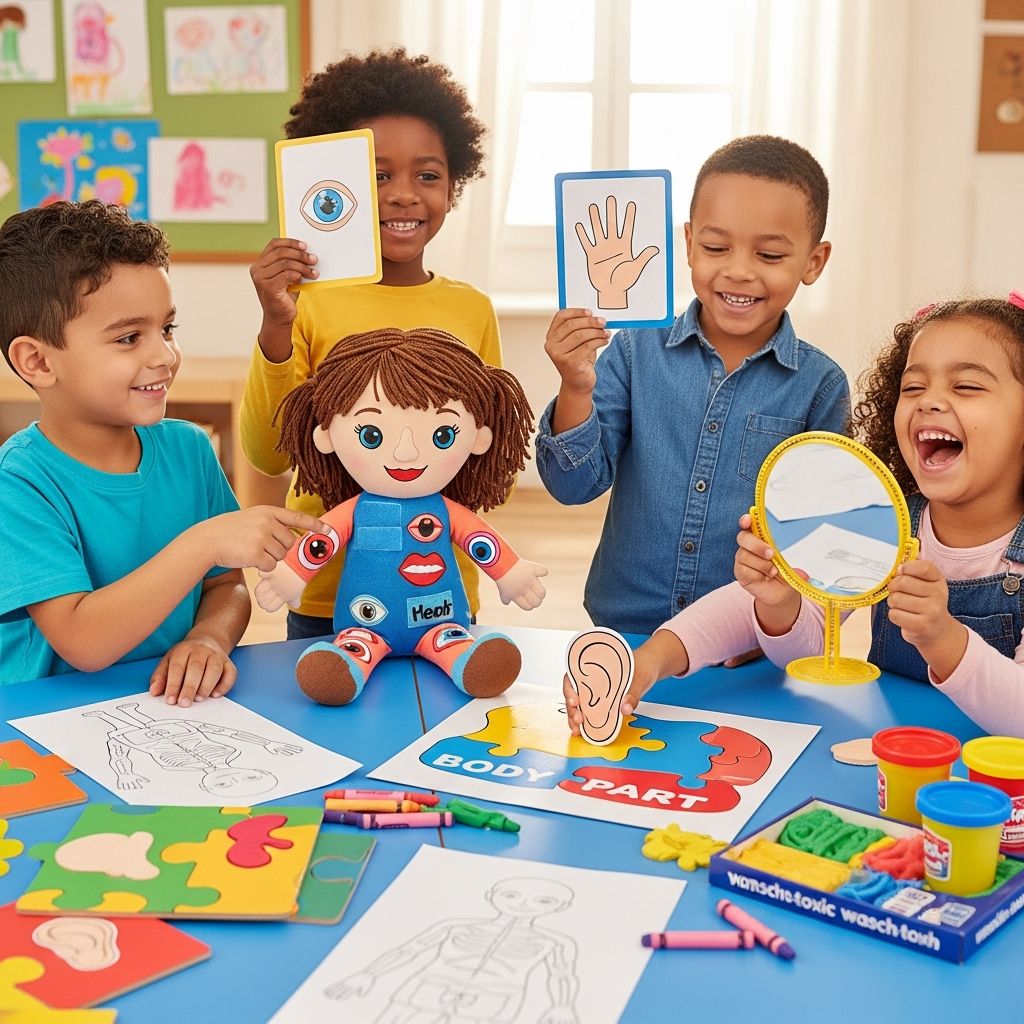
Provide a laminated mat with an empty body outline and a set of detachable pieces (heads, arms, legs, hands, feet, eyes, mouth, etc.). Children place the pieces in the correct spots.
- Start with fewer pieces for younger children and add more details for older groups.
- Ask questions: “Where could the knees go?” or “Can eyes go on the hands?” to prompt reasoning and humor.
7. Playdough Face Studio
Offer blank face templates or simple round shapes. Children use playdough to create eyes, nose, mouth, ears, eyebrows, and hair.
- Encourage them to make different expressions—happy, surprised, sleepy—and name the parts that move for each.
- Integrate color and counting: “How many eyelashes did you make?” or “Can you make two blue eyes?”
8. Roll-and-Draw a Body
Use a simple number cube. Assign each number a body part (1 = head, 2 = body, 3 = arms, 4 = legs, 5 = hands, 6 = feet). Children roll, then draw that part on their paper person.
- Continue until the child completes a whole body, even if they roll the same number multiple times.
- For a challenge, add extra body parts (like ears or a neck) and use two dice.
Storytelling and Music for Body Awareness
Stories and songs help children connect words with actions and feelings. Using imagination keeps learning fresh and memorable.
9. Action Story Adventures
Tell a simple story featuring a child or animal getting ready for the day. As you mention each body part, invite children to touch or move that part.
- Include routines: brushing teeth, washing hands, combing hair, and putting on socks.
- Pause often to ask, “Which part did we just use?” and let children answer in unison.
10. Create-Your-Own Movement Song
Instead of relying on familiar songs, make up a short chant using a predictable pattern. Insert body part names and matching actions suggested by the children.
- Example structure: “We tap our [body part], tap, tap, tap.” Children fill in the blank with “knees,” “elbows,” or “shoulders.”
- Repeat verses in different speeds and volumes to maintain interest.
Using Mirrors and Self-Observation
Seeing their own reflection helps children understand that body parts are part of who they are. These activities support both vocabulary and self-esteem.
11. Mirror Face Exploration
Give each child a small, shatter-resistant mirror. Ask them to find specific facial features, then make expressions or little movements.
- Prompt exploration: “Can you wiggle your nose?” or “Show me your tongue.”
- Introduce new vocabulary, like “eyelashes,” “eyebrows,” or “chin,” when children notice them.
12. Emotion and Body Check-In
Connect body parts to feelings by asking where they feel different emotions in their bodies. Keep language simple and affirming.
- Use prompts: “Where do you feel excitement?” or “Where does your body feel tired today?”
- Emphasize that all feelings are okay and that bodies give helpful signals.
Arts, Crafts, and Visual Learning
Art projects offer a concrete way to show how body parts fit together. Children love seeing themselves represented on paper or in three-dimensional forms.
13. Life-Size Silhouette Poster
Tape large paper to the floor, have a child lie down, and gently trace around their body. Later, invite them and classmates to add details.
- Children can draw and label eyes, ears, arms, legs, fingers, and toes.
- Display the posters at child height so they can revisit and point to each part.
14. Magazine Human Collage
Provide old magazines or printed photos featuring people. Children cut out arms, legs, hands, feet, and faces and glue them onto paper to make funny or realistic characters.
- Talk about each part as children choose where to place it: “You put two hands at the end of the arms.”
- Compare sizes: big feet versus small feet, long legs versus short legs.
Incorporating Body Part Learning into Daily Routines
Everyday moments provide natural opportunities to review body parts without planning a full lesson. Short, frequent practice keeps learning alive.
- Dressing time: Name body parts while putting on shoes, hats, and coats.
- Snack time: Talk about the mouth, tongue, and teeth while eating and drinking.
- Outdoor play: Mention legs running, arms swinging, hands catching and throwing.
- Rest time: Guide gentle relaxation, inviting children to feel their toes, knees, shoulders, and face soften.
Tips for Supporting Diverse Learners
Preschool groups often include children with different learning styles, languages, and abilities. Flexible, multi-sensory activities make body part learning more inclusive.
- Use clear pictures, gestures, and real objects along with spoken words.
- Repeat key vocabulary often and in a consistent way across activities.
- Allow children to participate by watching, pointing, or moving at their own comfort level.
- Offer choices so children can opt for quieter roles or more active leadership.
Sample Weekly Plan for Body Parts Exploration
The following sample plan shows how to blend different activity types across a week. Adapt it based on group size, age, and interests.
| Day | Main Goal | Key Activity |
|---|---|---|
| Monday | Introduce basic body parts | Touch and Tell Circle plus a short movement game |
| Tuesday | Practice movement vocabulary | Freeze and Point with music and simple directions |
| Wednesday | Connect art and anatomy | Playdough Face Studio at tables |
| Thursday | Explore self-awareness | Mirror Face Exploration and emotion check-in |
| Friday | Review and celebrate learning | Life-Size Silhouette Poster and child-led game choice |
Frequently Asked Questions
When should I start teaching body parts?
Many children are ready to begin identifying body parts between 18 months and 2 years, but learning can start earlier through simple pointing and naming. The key is consistency: repeat body part names during everyday routines so they become familiar over time.
How many body parts should preschoolers know?
There is no strict number, but by age three or four many children can reliably name and point to at least eight to ten common parts, such as head, hair, eyes, nose, mouth, ears, hands, feet, knees, and tummy. Rather than counting, focus on how confidently children use these words in conversation and play.
What if a child is shy or hesitant to join in movement games?
Some children need more time to feel comfortable moving in front of others or being the center of attention. Offer quieter options, like holding a picture card or helping you choose body parts to name, and allow them to participate from the edge of the group until they are ready to move more.
Can I teach body parts without using songs?
Yes. While songs are popular, there are many effective alternatives, including stories, obstacle paths, art projects, and simple pointing games. Choose activities that fit your style and the children’s preferences, and mix in music only if it feels natural.
How can I support children who are learning more than one language?
Teach body part names in the primary language of your setting, and, when possible, invite families to share the same words in the child’s home language. Use consistent gestures and pictures, so children can connect meaning across languages even if the words sound different.
Bringing It All Together
Body part activities for preschoolers work best when they combine movement, visuals, and meaningful interaction. With a mix of games, songs, art, and everyday routines, children not only learn the names of their body parts but also discover what their bodies can do and how to care for them.