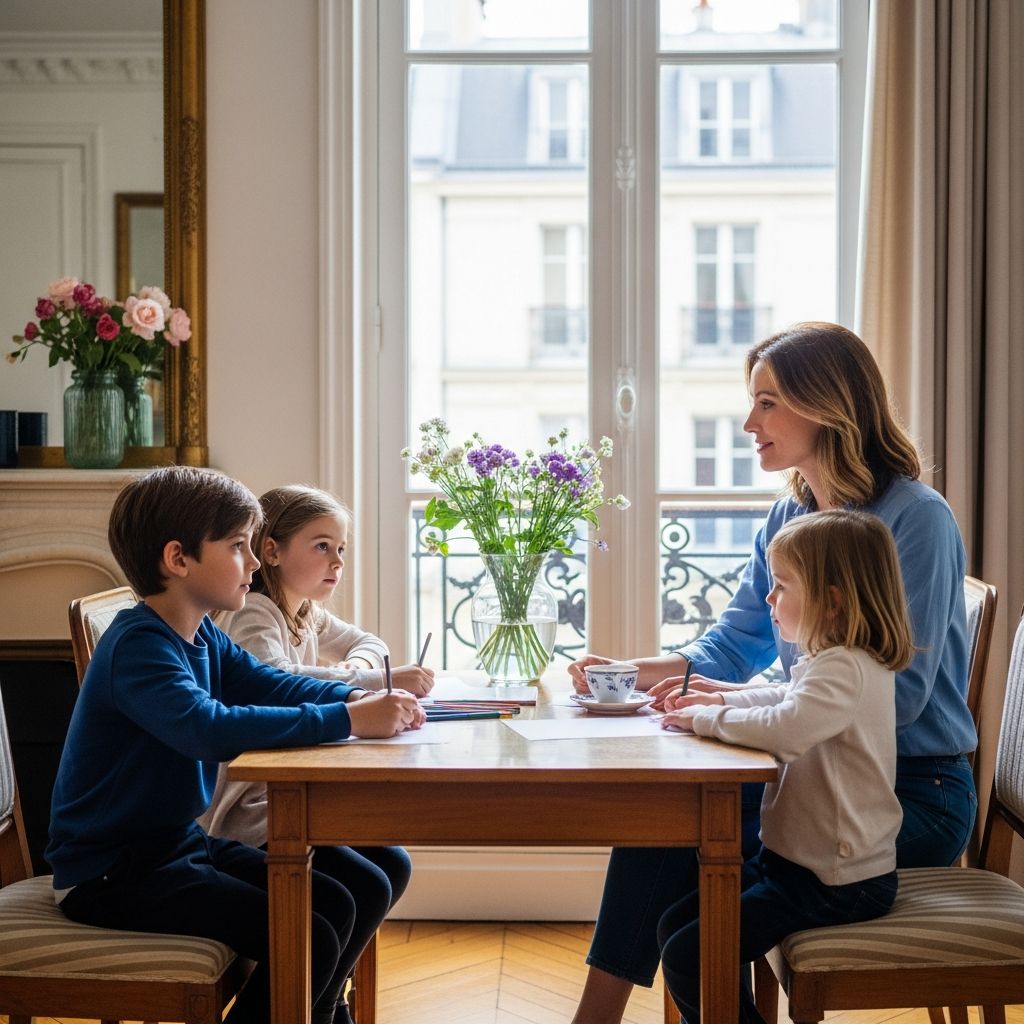
Many parents feel stuck in a daily cycle of repeating themselves, raising their voices, and bribing or threatening just to get simple things done. French-style parenting offers a different approach: calm authority, clear limits, and respectful expectations that teach children to listen without constant battles.
This article draws inspiration from French family culture to show how you can adapt similar strategies in your own home—without needing to live in France or adopt every aspect of French life.
Why Children Sometimes Don’t Listen
Before borrowing ideas from French parents, it helps to understand why listening often breaks down in the first place.
- Inconsistent rules: Children receive different answers on different days, so they keep testing.
- Too many words: Long lectures drown out the actual instruction.
- Unclear authority: Kids sense when adults sound unsure or negotiable.
- Overstimulation: Tired, hungry, or distracted children tune out easily.
French-style parenting tackles these problems by building a predictable framework, or what many French parents call le cadre (the frame).
The French Idea of a Parenting “Framework”
In France, many families emphasize a clear, stable framework that surrounds a child’s daily life. Within that framework, kids have freedom—but the edges are firm.
| Aspect | Typical Flexible Zone | Typical Non-Negotiable Zone |
|---|---|---|
| Daily routine | Choice of game, book, or quiet activity | Bedtime, school, meals at set times |
| Food | How much they eat from what’s offered | Everyone sits at the table together |
| Social behavior | Shyness or talkativeness | Basic manners and greetings |
| Leisure | Preferred hobbies or toys | Screen limits and homework time |
Research on authoritative parenting—high warmth combined with firm limits—shows that children raised in clear frameworks display better self-regulation, social competence, and academic outcomes than those raised with either harshness or total permissiveness.
Speaking with Calm Authority
One of the most noticeable features of French-style discipline is how adults talk to children. The tone is generally calm, firm, and matter-of-fact—not pleading, not threatening.
Key Communication Principles
- Short, clear instructions – One sentence, one message: “Put your shoes on now.”
- Adult vocabulary – Parents avoid baby talk once children can speak and instead use grammatically correct, respectful language.
- Consistent wording – The same phrases are used around rules and permissions, so children instantly recognize limits.
- Brief explanations – A short reason is often given, which respects the child’s intelligence and models logical thinking.
Speaking in this way helps children understand that when a parent gives an instruction, it is both serious and reasonable, not simply a wish that might change if they protest.
The Power of a Clear “No”
In many French families, “no” truly means no. The word is used sparingly, but when it is used, parents generally stick to it.
This has several effects:
- Children learn that pushing, whining, or bargaining does not change the outcome.
- Parents do not need to escalate to yelling, because their baseline answer is reliable.
- “Yes” becomes meaningful, not automatic.
Child development research supports this: inconsistent responses to misbehavior tend to increase testing and tantrums, while consistent, predictable limits reduce power struggles over time.
Boundaries with Warmth, Not Harshness
French-style parenting is often firm, but not necessarily cold. Many families combine clear authority with affection, routines, and family closeness.
This balance—high expectations plus warmth—matches what psychologists describe as authoritative parenting, which is linked to better mental health, higher self-esteem, and more cooperation compared to authoritarian (harsh, rigid) or permissive (few rules) styles.
What Boundaries with Warmth Look Like
- A parent may calmly insist, “We are leaving the park in five minutes,” while still empathizing: “I know you’re having fun.”
- Hugs, jokes, and shared meals coexist with clear rules about manners and behavior.
- Disapproval is directed at the behavior (“Throwing toys is not allowed”), not at the child as a person.
Teaching Patience and Waiting
A striking element of French parenting is the early emphasis on patience and delayed gratification—skills that help children tolerate frustration and listen even when they cannot have what they want immediately.
Everyday Ways to Practice Waiting
- Children are often asked to wait briefly before getting what they requested.
- They learn to entertain themselves quietly for short periods while adults talk or finish a task.
- Rewards are sometimes saved for later instead of given instantly.
Studies on delayed gratification, including the classic “marshmallow test,” suggest that children who learn to wait and manage impulses have better long-term outcomes in areas like school achievement and emotional health.
Routines That Support Listening
French families often rely on predictable routines—especially around meals, sleep, and school—to reduce daily friction.
Benefits of Predictable Routines
- Less negotiation: When bedtime or mealtimes are always at roughly the same hour, there is less room for debate.
- Emotional security: Regular rhythms help children feel safe, which supports better behavior.
- Better sleep: Consistent bedtimes are associated with improved attention and fewer behavioral problems.
Simple, repeated patterns—dinner, bath, story, bed—send a clear signal about what happens next. When the schedule is predictable, children are more prepared to listen because fewer transitions come as a surprise.
Respect Runs Both Ways
French children are taught early to greet others, say please and thank you, and respect adults’ space and time.
At the same time, many parents show respect for their child’s perspective by:
- Listening seriously when the child explains what happened.
- Offering short reasons for rules instead of “because I said so.”
- Allowing choices in small, safe areas (which shirt to wear, which book to read) while keeping firm limits on essentials.
Research on social development suggests that children who are treated as capable conversational partners—listened to, but not obeyed automatically—develop better language skills and social understanding.
Age-Appropriate Independence
Another hallmark of French-style parenting is expecting children to manage small tasks on their own from an early age.
Common Responsibilities for Young Children
- Putting toys back in baskets or shelves.
- Carrying their own small backpack.
- Helping set or clear parts of the table.
- Pouring water from a small pitcher.
By giving children real responsibilities, parents send a clear message: “You are capable.” This sense of competence often leads to more cooperation and fewer battles over basic tasks.
Practical Ways to Apply These Ideas at Home
You do not need to be French—or follow every French custom—to use these principles. Here are practical steps you can adapt to your family and culture.
1. Decide Your Non-Negotiables
Choose a few areas where the answer will almost always be firm: for example, bedtime, safety rules, or screen limits.
- Write them down with your partner, if you have one.
- Make sure both adults give the same answer.
- Use “no” less often, but mean it every time.
2. Simplify Your Instructions
- Use one clear sentence: “It’s time to put your shoes on.”
- Get the child’s attention first—eye contact, touch on the shoulder, or saying their name.
- Follow up with a brief explanation only if needed: “We’re leaving in five minutes.”
3. Build Micro-Moments of Waiting
- When a child asks for something, occasionally say, “In two minutes,” and follow through.
- Use timers so children can see and hear when waiting is over.
- Offer ideas for quiet, independent activities during short waits.
4. Create Predictable Anchors in the Day
- Choose regular times for waking, meals, homework, and bed as much as your schedule allows.
- Keep the sequence of bedtime the same most nights.
- Use the same phrases to signal transitions: “After this story, it’s lights out.”
5. Model Respectful Speech
- Speak to children in full sentences without sarcasm or insults.
- Teach specific phrases for politeness and disagreement: “May I have…,” “I don’t agree because…”.
- Correct rudely phrased requests by asking them to try again more politely.
Common Challenges and How to Handle Them
When a Child Still Refuses to Listen
- Stay calm and repeat the instruction once in the same words.
- Follow through with a pre-agreed consequence (for example, losing a short privilege) without a long lecture.
- After things are calm, briefly review what happened and what to try next time.
When Parents Disagree on Rules
- Discuss rules privately, not in front of the child.
- Try to reach a small list of shared fundamentals—safety, sleep, respect.
- Explain to children that different adults may have slightly different rules, but all must be followed.
When You Lose Your Temper
- Pause, lower your voice, and if needed, step away for a moment.
- Apologize for yelling while keeping the rule: “I shouldn’t have shouted. The rule about hitting still stands.”
- Plan for next time: more warning before transitions, earlier bedtimes, or simplified routines.
Frequently Asked Questions (FAQs)
Is French-style parenting too strict for modern families?A: It can be strict if copied without adaptation, but the core ideas—clear boundaries, calm authority, and respect—fit many cultures. You can choose firmness without harshness by combining limits with warmth and listening.
Q: Do I have to say “no” all the time to get my child to listen?
No. In fact, using “no” less often but more consistently is more effective. Save it for safety issues and key family rules. For smaller matters, offer choices within limits or redirect instead of automatically forbidding.
What if my child already ignores me when I speak?
Start by changing your own patterns. Get their attention before you talk, give a short instruction, and calmly follow through. It may take days or weeks for them to realize that you now mean what you say, so consistency is essential.
How young can I start using these strategies?
Even toddlers can benefit from predictable routines, simple limits, and short waiting periods. The language and expectations should always match their developmental stage, but the principles of consistency and calm apply very early.
Won’t firm boundaries crush my child’s creativity or independence?
Evidence suggests the opposite: when children know the limits, they feel safer exploring within them. Authoritative parenting—warmth plus clear rules—is linked with higher independence, better problem-solving, and stronger social skills.
References
- Unveiling the Secret: Why French Children Often Behave Better Than Others — Le Bebe Plus Blog. 2023-04-10. https://lebebeplus.com/blogs/le-bebe-blog/why-french-children-behave-better
- French Parenting: The Secret Behind Well-Behaved Kids in France — Talk in French. 2018-06-01. https://www.talkinfrench.com/french-parenting/
- Parenting Like a Parisian: 4 Lessons From French Parents — HiP Paris Blog. 2020-02-05. https://hipparis.com/parenting-like-a-parisian-take-the-best-leave-the-rest/
- How French Parenting Culture Shapes the Language of Childhood — Polyglottist Language Academy. 2025-08-17. https://www.polyglottistlanguageacademy.com/language-culture-travelling-blog/2025/8/17/how-french-parenting-culture-shapes-the-language-of-childhood
- Oui Maman! Discipline in France — EDIT Change Management Blog. 2016-09-22. https://www.editcm.com/blog/2016/9/22/oui-maman-discipline-in-france