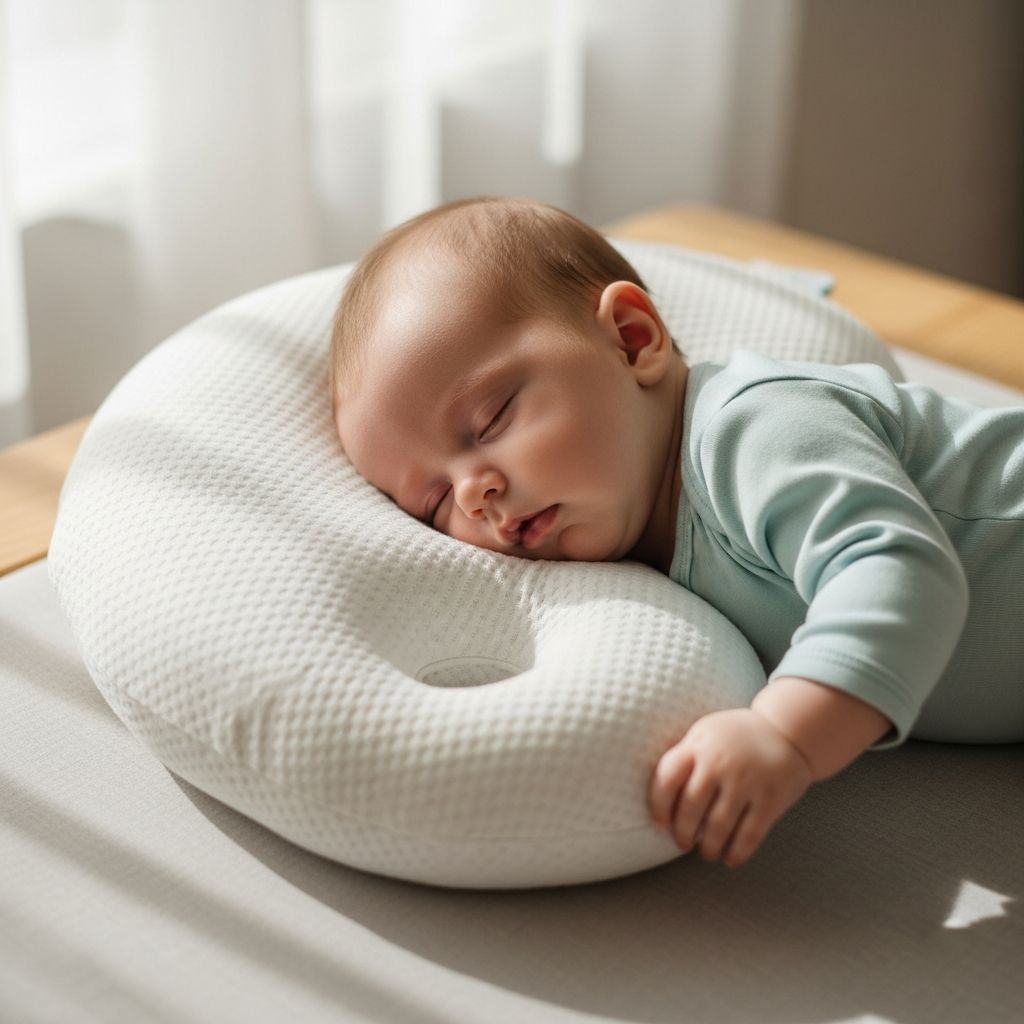
Many parents first notice flat head syndrome when looking at photos of their baby and spotting a slight asymmetry or flat spot at the back of the head. Positional flat head, also called positional plagiocephaly or brachycephaly, has become more common since babies are rightly placed on their backs to sleep to reduce the risk of SIDS.
This article explains what flat head syndrome is, how to prevent it primarily through positioning and tummy time, and where specially shaped flat head pillows can play a role during supervised awake time. It is not medical advice and does not replace talking with your pediatrician about your baby’s specific needs.
Understanding Flat Head Syndrome in Babies
Flat head syndrome typically develops when a baby’s soft skull is exposed to repeated pressure in the same area, such as lying on the same part of the head for long periods. Because the bones of the skull are still flexible in early infancy, this constant pressure can gently reshape the head over time.
Health professionals often use the term “positional plagiocephaly” when the head is asymmetrically flattened on one side, and “brachycephaly” when the back of the head is more evenly flat. In most cases, these conditions are cosmetic and do not affect brain development, but they can be distressing for parents and may sometimes be associated with tight neck muscles (torticollis) that also need attention.
Common Causes and Risk Factors
Flat spots on a baby’s head usually arise from a combination of natural vulnerability and environmental factors. Babies spend many hours sleeping and resting, and if they favor one position, the same area of the skull may bear most of the pressure.
- Prolonged time on the back on firm surfaces such as mattresses, car seats, or bouncers.
- Neck preference or torticollis that makes a baby consistently turn to one side.
- Prematurity, because preterm babies often have softer skulls and may spend longer in one position.
- Multiple births or limited space in the womb, which can shape the head before birth.
Safe back-sleeping should never be abandoned to avoid flat head syndrome, because placing babies on their backs has significantly reduced sudden infant death syndrome. Instead, prevention focuses on what happens when the baby is awake and how to vary positions through the day.
Safe Sleep First: Where Pillows Do Not Belong
Before looking at flat head pillows, it is vital to separate sleep safety from daytime positioning aids. Leading pediatric and child-health organizations advise that babies sleep on a firm, flat surface with no pillows, bumpers, or soft items in the sleep space, because these can increase suffocation risk.
- Flat head pillows should not be used in cribs, bassinets, or other sleep spaces during unsupervised sleep.
- Products that claim to “hold” a baby in place or elevate the head are not recommended for sleep and can even be dangerous.
Any use of a flat head pillow should be strictly limited to supervised periods when the baby is awake or closely monitored, such as during play on a firm surface or in a stroller while an adult is actively watching.
Prevention Basics: Positioning and Tummy Time
Research and clinical guidance consistently emphasize that the most effective way to prevent and improve mild flat head is to change your baby’s position often and provide generous tummy time while awake.
- Tummy time from birth: Begin brief sessions of tummy time from the first weeks of life and gradually increase to multiple sessions totaling 30–60 minutes per day as tolerated.
- Alternate head positions during sleep: While always placing baby flat on the back, you can gently turn the head to different sides on different nights to avoid constant pressure on the same spot.
- Vary the crib orientation: Rotating which end of the crib the head points toward encourages your baby to look in different directions toward the room or door.
- Limit container time: Reduce prolonged use of car seats, swings, and bouncers when not traveling, so the head is not always resting on a firm shell.
These strategies help distribute pressure more evenly across the skull and build neck and upper-body strength, which in turn enables babies to move their heads more freely and spend less time on any one spot.
How Flat Head Pillows Fit Into the Picture
Flat head pillows are contoured or shaped cushions designed with a central depression intended to reduce pressure on the back of the skull. Manufacturers often market them as a simple way to prevent or improve flat spots. However, experts generally view them as optional extras rather than the main solution.
The primary tools for addressing positional flat head remain positional changes, tummy time, and, when needed, physical therapy or helmet therapy in more severe cases. Pillows can sometimes complement these efforts in closely supervised situations, but they should never replace medical evaluation when there is significant asymmetry or associated neck tightness.
Types of Flat Head Pillows You May Encounter
Parents shopping for flat head pillows will find many shapes, materials, and marketing messages. While exact designs vary, most products fall into a few broad categories.
- Donut-style pillows: Typically feature a circular or heart-shaped cushion with a small center depression intended to cradle the back of the head while spreading out pressure.
- Wedge or inclined designs: Slightly elevate the upper body; these are generally not recommended for sleep because inclines can increase the risk of sliding and airway obstruction.
- Memory foam or contour pillows: Use adaptive foam or molded shapes designed to match the curve of a baby’s head and neck, often marketed for use in strollers or on play mats.
- Pillows integrated into positioners: Some products combine side bumpers, wedges, or straps with a head support; these are especially problematic from a safety standpoint for any sleep use.
The safest approach is to reserve any pillow or padded head support for short, supervised, awake-time sessions and to follow all safety warnings provided by your pediatrician and the product manufacturer.
Key Features to Look For (and Avoid)
When considering a flat head pillow for supervised use, focus on simple, breathable designs that do not restrict movement or pose suffocation risks. Safety and practicality matter far more than aesthetic details.
| Preferable Features | Features to Avoid |
|---|---|
| Thin, low-profile design that does not significantly elevate the head. | Thick, soft pillows that could envelop the head or obstruct breathing. |
| Breathable materials and removable, washable covers for hygiene. | Non-breathable plastics or covers that trap heat and moisture. |
| Simple shape without straps or devices that restrain the baby. | Built-in harnesses, wedges, or side bolsters that lock baby in one position. |
| Clear labeling that the product is for supervised use only. | Claims that the pillow is “safe for overnight sleep” or “prevents SIDS.” |
Always remember that even a well-designed pillow is an optional accessory. If you use one, treat it as a tool to gently redistribute pressure during awake time, not as a medical device or cure-all for head shape concerns.
Practical Ways to Use Flat Head Pillows Safely
If your pediatrician agrees that a flat head pillow could be helpful as part of a broader plan, keep usage short, supervised, and purposeful. The goal is to make life a little easier while still prioritizing active positioning and movement.
- Place the pillow on a firm, flat surface such as a play mat while your baby is awake and being watched.
- Use it during brief play sessions, photo time, or while you chat with your baby, rather than for long, passive stretches.
- Rotate your baby’s orientation on the pillow so pressure is not always on the same exact area.
- Stop using the pillow once your baby begins rolling reliably, because rolling increases the chance they may bury their face or get into an unsafe position.
Do not use a flat head pillow in car seats, as aftermarket pads can interfere with harness fit and safety. Car seats are rigorously tested without extra accessories, and additional padding can change how the seat performs in a crash.
When to Talk to Your Pediatrician
Early discussion with a healthcare provider is often the most valuable step in managing flat head concerns. Many cases improve with simple changes, but more severe flattening or associated muscle tightness may benefit from professional support.
- If you notice a flat spot that seems to worsen over several weeks despite repositioning.
- If your baby strongly prefers looking only one way or seems to have limited neck motion.
- If the forehead, face, or ears appear noticeably asymmetrical.
- If your baby is older than 4–6 months and changes in position no longer seem to improve the shape.
Healthcare providers may recommend physical therapy to address torticollis or, in more persistent or severe cases, discuss helmet therapy, particularly in the first year when the skull is growing rapidly. Any use of flat head pillows should form just one small part of this larger plan, if used at all.
Helmet Therapy vs. Pillows: Different Roles
Helmet therapy involves a custom-fitted cranial orthosis that applies gentle contact to guide head growth toward a more symmetrical shape. It is usually considered for more significant flattening that has not responded to repositioning, often between about 4 and 12 months of age.
Flat head pillows, by contrast, are consumer products that provide cushioning and pressure redistribution but do not control growth in a targeted way. They cannot replace the structured, monitored nature of helmet therapy and should not be used in an attempt to delay or avoid professional evaluation when helmet treatment has been recommended.
Simple Daily Routine to Support a Round Head Shape
For many families, consistency matters more than specific gadgets. A predictable routine that mixes varied positions, interactive play, and short periods of supervised head support can go a long way toward maintaining a rounded head shape.
- Morning: After a diaper change, place baby on the tummy for a few minutes of play at eye level. Increase the time gradually as strength improves.
- Daytime: Alternate between tummy time, being carried in a sling or on your arm, and time on a firm flat surface. Limit long stretches in swings or bouncers.
- Supervised pillow use: If you choose a flat head pillow, use it briefly while baby is awake and you are engaged, such as during songs, talking, or visual play.
- Night: Always place baby on the back in a bare crib with a firm mattress and no pillows, occasionally changing which side of the crib faces the room.
Over time, these small habits encourage your baby to turn the head freely, strengthen neck and core muscles, and avoid constant pressure on any single area of the skull.
FAQs About Flat Head Pillows and Baby Head Shape
Do flat head pillows really work?
Flat head pillows can redistribute pressure when a baby is lying down, which may help protect a vulnerable area during short, supervised periods. However, most mild cases of positional flat head improve mainly through repositioning, tummy time, and natural growth, not through pillow use alone.
Are flat head pillows safe for newborns?
For sleep, pillows are not recommended at any age in cribs or bassinets. For awake, supervised newborns, a thin, breathable flat head pillow may be used cautiously if your pediatrician agrees, but many families focus first on tummy time and varied carrying positions instead.
Can I use a flat head pillow in the crib at night?
No. Safe sleep guidelines recommend a firm, flat mattress with no pillows or soft items in the sleep space, because these increase the risk of suffocation or entrapment. Any head-support pillow should be reserved for supervised awake time only.
Will my baby’s flat spot go away on its own?
Many babies show significant improvement as they grow, move more, and spend less time on their backs, especially when caregivers actively change positions and encourage tummy time. More pronounced or persistent cases may need physical therapy or helmet therapy, so regular check-ins with your pediatrician are important.
Should I buy a helmet instead of a pillow?
A helmet is a medical device prescribed for moderate to severe flat head that does not respond sufficiently to repositioning and exercises. A pillow is a consumer accessory for brief pressure relief and cannot replace evaluation by a healthcare professional or the corrective effect of a properly fitted helmet.
Final Thoughts
Flat head pillows can be a helpful accessory for some families when used sparingly and safely during supervised awake time, but they are not essential and must never compromise safe sleep practices. The foundations of prevention and treatment remain varied positioning, plenty of tummy time, and early guidance from healthcare professionals when concerns arise.
By combining simple daily habits with thoughtful use of any baby gear, caregivers can support both a healthy head shape and safe sleep habits throughout the first year of life.