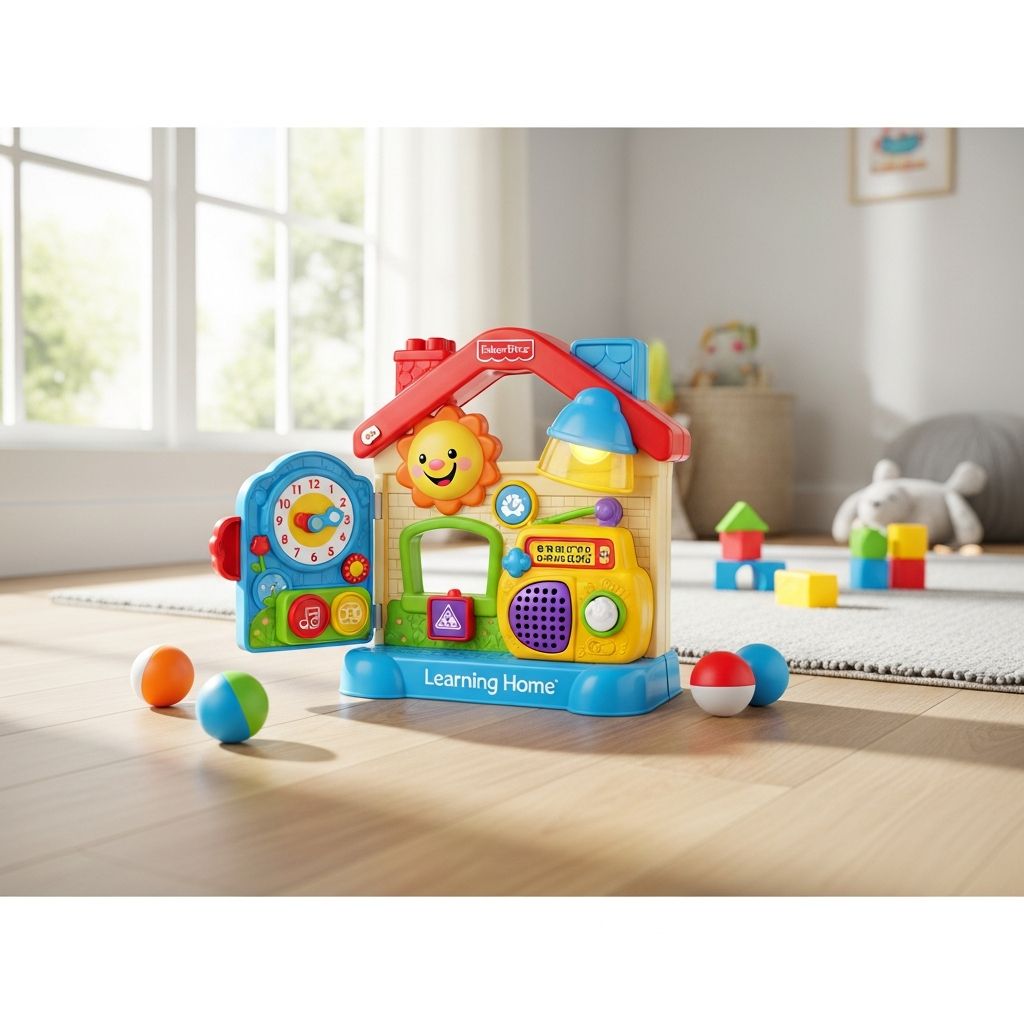
The Fisher-Price Laugh & Learn Learning Home is a classic, interactive playhouse designed as a doorway into early learning, pretend play, and hands-on exploration for babies and toddlers.
This guide walks through its main features, how children actually use it, what skills it supports, and practical pros and cons so you can decide if it fits your home and your child’s stage of development.
What Is the Laugh & Learn Learning Home?
The Laugh & Learn Learning Home is a freestanding plastic doorway with both an indoor and outdoor side, surrounded by buttons, flaps, and moving parts that respond with lights, sounds, words, and music.
It was designed as a baby and toddler activity center that doubles as a mini playhouse, inviting children to crawl through the doorway, open and close the door, sort shapes, and experiment with common household themes like mail, music, and greetings.
Key Features at a Glance
- Two-sided play (inside and outside) around a central pretend doorway.
- Interactive elements like a shape sorter, doorbell, mailbox, and light switch.
- Two primary play modes: learning time and musical fun, selectable by a switch.
- Content that introduces early concepts such as letters, numbers, opposites, greetings, and simple songs.
Design and Main Components
The Learning Home centers on a sturdy archway with a door that opens and closes, framed by panels filled with themed activities.
Each section is aimed at a particular kind of exploration, from fine-motor tasks like turning a knob or placing shapes, to social pretend play such as knocking, ringing the bell, and saying hello or goodbye.
Interactive Elements
- Front door: A door that opens and shuts, often triggering sound effects or spoken phrases when moved.
- Doorbell: A button children can press to hear a chime or greeting, reinforcing cause and effect.
- Mailbox: A slot and door for putting in and taking out plastic “mail,” supporting object permanence and role play.
- Shape sorter: Openings and corresponding pieces that encourage shape recognition and problem-solving.
- Light switch and other knobs: Simple controls that respond with lights or sounds, rewarding experimentation.
Learning and Music Modes
One of the central design choices is the two-mode system: “learning time” and “musical fun.”
- Learning time: Emphasizes spoken words, counting, the alphabet, colors, shapes, and simple phrases tied to each action.
- Musical fun: Focuses more on songs, melodies, and sound effects, turning the playhouse into a small music and sound station.
Developmental Benefits for Babies and Toddlers
The Learning Home is built to support multiple areas of development through repeated, open-ended play rather than single-purpose activities.
Because children can approach it from both sides, crawl through, stand, and walk around it, it invites whole-body movement as well as finger-level exploration.
Cognitive and Early Academic Skills
- Exposure to letters, numbers, and basic vocabulary through spoken prompts and songs.
- Shape sorting and matching that build early problem-solving skills and visual discrimination.
- Simple cause-and-effect understanding, as children learn that pressing, turning, or opening something leads to light, sound, or words.
Motor Skills and Coordination
- Gross motor: Crawling through the door, pulling to stand using the doorway, and cruising around the frame help strengthen large muscles.
- Fine motor: Grasping shapes, flipping the mail slot, ringing the doorbell, and turning knobs develop finger strength and coordination.
Social, Emotional, and Imaginative Play
- Pretend “coming and going” through the door helps young children practice greetings, goodbyes, and basic social rituals.
- Mailing letters and answering the doorbell support early turn-taking and simple role play with parents or siblings.
- As children grow, the playhouse becomes a prop for imaginative scenarios like “home,” “school,” or “store.”
Age Range and Suitability
The Laugh & Learn Learning Home is generally marketed to children from around 6 months to early toddlerhood, with the sweet spot often between about 9 and 24 months, depending on the child’s development.
Younger babies typically enjoy banging, pressing buttons, and listening to music, while older toddlers use more of the pretend play and language features built into the toy.
How Use Changes Over Time
| Approximate Age | Typical Ways of Playing |
|---|---|
| 6–9 months | Listening to music, watching lights, batting at lower buttons, beginning to crawl through the doorway. |
| 9–15 months | Crawling in and out, opening and closing the door, pressing the doorbell, dropping shapes or mail, imitating simple sounds. |
| 15–24+ months | Using shape sorter intentionally, role playing “house,” pretending to deliver mail, repeating words and songs, playing with siblings. |
Educational Content and What Children Learn
The Learning Home weaves early learning into brief spoken prompts and songs that play when children interact with different areas.
This keeps the experience playful while still exposing children to important building blocks of early literacy, numeracy, and everyday language.
Core Concepts Introduced
- Letters and numbers: Simple introductions to the alphabet and counting in short, catchy formats.
- Shapes and colors: Highlighted especially through the shape sorter and colored parts of the toy.
- Opposites and positional words: Actions like open/close or in/out are paired with language that labels what the child is doing.
- Greetings and daily routines: Phrases around hello, goodbye, mail delivery, and doorbell interactions mirror everyday life.
Language and Listening Skills
- Short phrases and songs give children repeated exposure to the same words in consistent contexts, supporting recognition and early comprehension.
- Because children trigger the audio by acting on the toy, they experience language as a response to their own choices, which can encourage more engagement than passive listening.
Pros, Cons, and Realistic Expectations
Like most large activity centers, the Laugh & Learn Learning Home has clear strengths but also limitations that matter depending on your space, budget, and your child’s preferences.
Understanding these ahead of time helps you set expectations and decide how it fits with other toys in your home.
Main Advantages
- Multi-skill design: Supports cognitive, motor, and social play in one footprint.
- Two-sided structure: Allows more than one child to play at once, reducing competition over a single panel or button.
- Longer play life than many baby toys: Many children continue using it into toddler years, especially for pretend play.
- Clear feedback: Sounds, lights, and phrases respond reliably to actions, which helps children understand cause and effect.
Potential Drawbacks
- Size and storage: The playhouse takes up noticeable floor space and is not a collapsible toy, which can be challenging in small rooms.
- Noise level: The music and spoken phrases can feel repetitive or loud to adults, though a volume control may help manage this.
- Battery dependence: Many of the most engaging features rely on batteries, so parents need to replace them periodically.
- Plastic build: As with most large plastic toys, it is not a subtle piece of décor and may show scuffs over time.
Practical Tips for Setup and Use
Setting up the Laugh & Learn Learning Home typically involves snapping major pieces together and securing them with screws, following the included instructions.
Most parents find assembly straightforward, but planning a bit of time and choosing the right location can make the experience smoother.
Placement and Safety Suggestions
- Place the toy on a flat, non-slip surface where the doorway area is clear for crawling and walking.
- Avoid tight corners so children can move freely around both sides without bumping into furniture.
- Check regularly that screws are tight and that no small parts or shape pieces are left where younger siblings might mouth them.
- Use the volume control to keep sound at a comfortable level for both children and adults.
Ideas to Extend Play
- Incorporate simple games like “knock and answer,” where your child knocks, you open, and you take turns saying hello and goodbye.
- Hide the shape pieces nearby and encourage your child to find the right piece, walk or crawl to the playhouse, and then place it in the correct slot.
- Use the mailbox to exchange simple notes or pictures as your child gets older, transforming the toy into part of a storytelling or pretend “post office.”
Who Will Enjoy the Learning Home Most?
The Laugh & Learn Learning Home tends to be a strong fit for babies who are curious about sounds, lights, and moving parts, and for toddlers who love pretend scenarios like knocking on doors and delivering mail.
Families with more than one young child often appreciate that the structure invites shared play, especially when children can explore different sides at the same time.
Signs It Might Be a Good Match
- Your baby or toddler is drawn to doors, drawers, and switches and enjoys exploring cause and effect.
- You want one larger toy that covers music, early learning content, and pretend play in a single station.
- You have a playroom or open living area with enough space for a small playhouse footprint.
Frequently Asked Questions (FAQs)
1. What age is the Fisher-Price Laugh & Learn Learning Home best for?
It is generally recommended for babies from around 6 months and up, with many features becoming especially engaging once children can sit independently and begin to crawl or pull to stand.
Many toddlers continue to enjoy the pretend play aspects into the second and even third year, depending on interest and what other toys are available.
2. How much space does the Learning Home need?
The playhouse is compact compared with a full indoor playhouse but still requires enough space for children to move freely through the central doorway and around both sides.
Leaving clearance around the door area and sides not only helps with safety but also makes it easier for more than one child to play at once.
3. Does it require batteries, and how often do they need replacing?
The interactive lights, sounds, and spoken prompts are powered by batteries, which are required for the learning and music features to function.
Battery life depends on how heavily the toy is used, but many parents find that using moderate volume and switching the unit off when not in use helps batteries last longer.
4. Is the Learning Home easy to assemble?
Assembly typically involves connecting the main panels and door, then securing them with screws using common household tools, following step-by-step instructions.
Most adults can complete the setup in one session, though it may be easier with two people when aligning larger pieces before tightening screws.
5. Can more than one child play with it at the same time?
Yes, the two-sided design around the doorway and the placement of activities on multiple surfaces allow siblings or playmates to engage from different angles at once.
This can reduce conflicts over access to a single panel and encourages shared games like taking turns ringing the doorbell or delivering mail.
6. How educational is it compared with simpler toys?
The Learning Home provides rich sensory feedback and structured exposure to early academic concepts like letters and numbers, which can be engaging for many children.
At the same time, its greatest value often lies in how adults use it to spark conversation, naming, and small social routines, which turn the built-in audio into part of a broader learning experience.
7. How does it hold up over time?
The sturdy plastic design is intended to withstand frequent crawling, pulling, and everyday bumps, though cosmetic wear like scratches may appear with heavy use.
Because it appeals to both babies and toddlers, families sometimes keep it in rotation longer than many single-stage baby toys, especially if younger siblings are expected.
Final Thoughts for Parents
The Fisher-Price Laugh & Learn Learning Home is best understood as a multi-purpose early play station that combines lights and sounds with everyday themes like doors, mail, and greetings.
For families who have the space and want a toy that can bridge the gap from early baby exploration to toddler pretend play, it can be a valuable centerpiece in a play area, especially when paired with responsive, interactive involvement from caregivers.