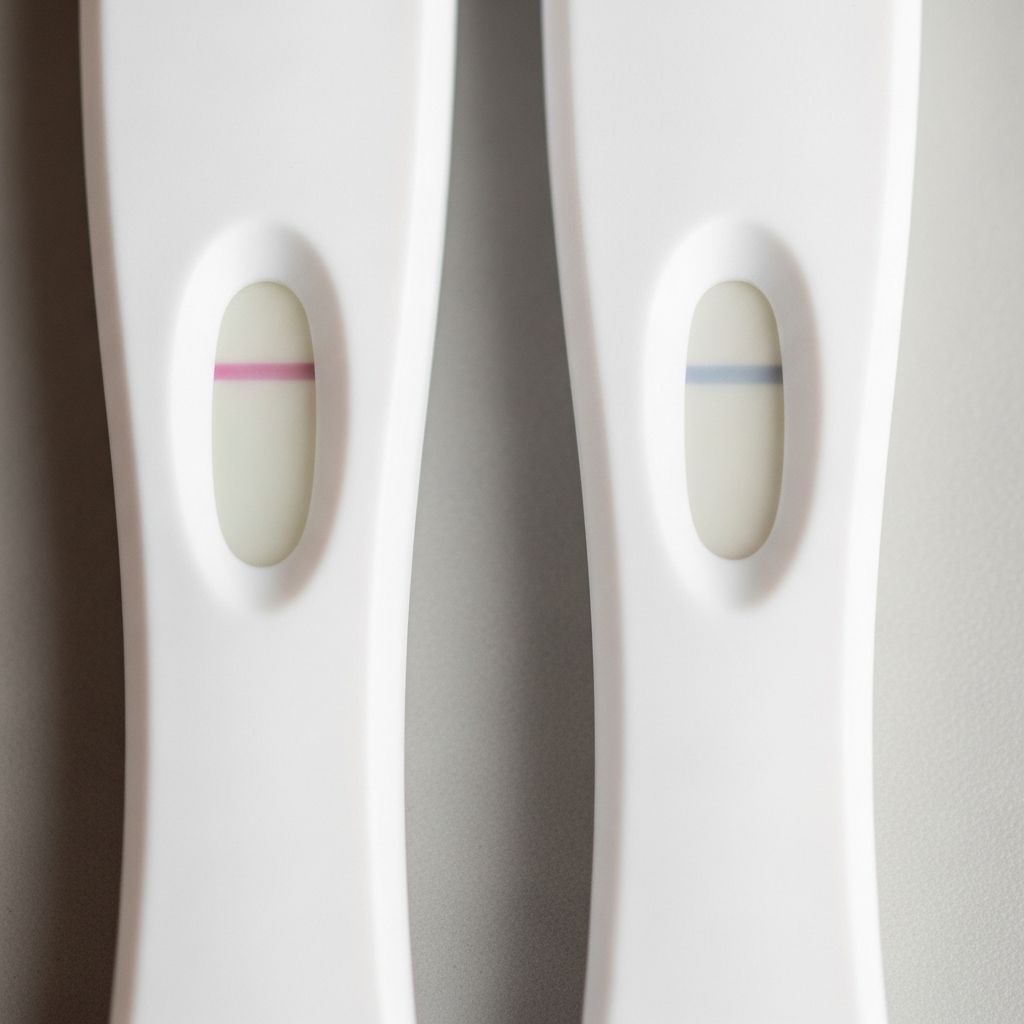
Home pregnancy tests offer a convenient way to detect early pregnancy by identifying human chorionic gonadotropin (hCG), the hormone produced after implantation. However, interpreting results can be tricky due to **evaporation lines**, faint marks that mimic positive outcomes but stem from urine drying rather than hormone presence.
How Home Pregnancy Tests Function
These tests use monoclonal antibodies that bind to hCG in urine, triggering a color change in the test region. A control line always appears to confirm the test’s validity, while a test line signals pregnancy if hCG exceeds the detection threshold, typically 20-50 mIU/mL. Results must be read within a specified window, usually 3-10 minutes, to prevent misleading artifacts.
Clearblue, First Response, and similar brands employ dye-based strips where urine wicks across, activating reagents only during the active phase. Beyond this, drying urine can leave residue, creating confusion.
Defining the Evaporation Line Phenomenon
An **evaporation line** forms when urine evaporates from the test strip after the recommended reading time, depositing colorless residue or concentrating ink faintly in the test area. Unlike true positives, these lines lack dye activation, appearing gray, white, or translucent rather than pink or blue.
They typically emerge 10 minutes or later post-test, though some appear sooner if urine volume is low or the strip dries quickly. Evaporation lines do not indicate pregnancy and are invalid results, often causing emotional rollercoasters for users.
Why Do Evaporation Lines Develop?
Several factors contribute to their appearance:
- Excessive Wait Time: Urine dries post-reaction window, pulling salts or ink remnants into a line-like pattern.
- Low Urine Volume: Sparse samples evaporate faster, heightening risk.
- Test Storage Issues: Exposure to heat or humidity can degrade strips, promoting artifacts.
- Brand Variations: Some tests, like First Response, are prone if read late.
- Environmental Factors: High bathroom humidity or direct light accelerates drying.
Indent lines, another mimic, are manufacturing imprints where ink pools faintly but are present from the start, distinct from evaporation effects.
Spotting Evaporation Lines vs. Genuine Positives
Differentiating requires careful observation. Use this comparison:
| Feature | True Positive Line | Evaporation Line |
|---|---|---|
| Color | Pink, blue, or matches control (dye-activated) | Colorless, gray, shadowy |
| Thickness | Consistent, even width | Thin, uneven, or streaky |
| Timing | Within 3-5 minutes | After 10+ minutes |
| Darkening | May intensify over time with rising hCG | Fades or stays faint |
| Context | Control line bold; possible symptoms | Often on negative tests left out |
A faint positive from early testing or dilute urine shows color and appears promptly, unlike evaporation artifacts. Lighting can distort views—check in natural light and photograph immediately.
Prevention Strategies for Clear Results
Avoid evaporation pitfalls with these practices:
- Read instructions precisely and adhere to the time frame (e.g., 5 minutes for Pregmate).
- Test with first morning urine for concentrated hCG.
- Place test flat on a dry surface, avoiding water exposure.
- Use tests before expiration and store at room temperature.
- Set a timer to check results promptly—discard after the window.
If unsure, discard and retest rather than waiting longer, as prolonged exposure guarantees artifacts. Digital tests reduce ambiguity by displaying words like “Pregnant” or “Not Pregnant”.
What to Do After a Suspected Evaporation Line
A questionable line warrants:
- Retest: Wait 48 hours for hCG doubling; use a different brand.
- Check Urine Concentration: Avoid excessive fluids pre-test.
- Consult a Professional: Blood tests at clinics detect hCG quantitatively from 6-8 days post-ovulation, far more reliable.
Track cycles via apps or ovulation kits for optimal timing—test 12-14 days post-ovulation or after missed period. Persistent doubt? OB-GYN ultrasounds confirm viability around 5-6 weeks.
Common Myths and Misconceptions
- Myth: All faint lines mean pregnancy. False—colorless ones are evaporation.
- Myth: Lines disappear if evaporation. They often persist faintly.
- Myth: Inverting test removes lines. No—professional verification needed.
- Myth: Only cheap tests show them. Common across brands if misused.
Frequently Asked Questions
Can an evaporation line turn into a true positive?
No. Evaporation lines result from drying, not hCG; retest for confirmation.
How soon after testing can evaporation lines appear?
As early as 10 minutes, but typically after the specified window.
Are evaporation lines more common on certain tests?
Yes, dye-based like First Response if read late; digitals minimize issues.
Does a pink evaporation line exist?
Rarely—true pink indicates dye activation, likely positive, but confirm timing.
Should I trust a line appearing hours later?
No—always invalid; discard and retest.
Advanced Testing Options for Accuracy
Beyond strips, consider:
- Blood hCG Tests: Qualitative (yes/no) or quantitative (levels), available at labs.
- Digital Tests: Eliminate line interpretation.
- Early Detection Kits: Sensitive to 10 mIU/mL for pre-miss period use.
Combine with symptom tracking—nausea, fatigue, breast tenderness—for holistic assessment.
Understanding evaporation lines empowers confident testing. Patience and protocol yield reliable insights into pregnancy status.
References
- What are pregnancy test evaporation lines? — Pregmate. 2023. https://www.pregmate.com/blogs/news/what-are-pregnancy-test-evaporation-lines
- Decoding Pregnancy Test Results: Evaporation, Indent, and Faint Lines — MiraCare. 2023-12-01. https://shop.miracare.com/blogs/resources/evaporation-line-on-a-pregnancy-test-positive-or-negative
- Evaporation Line on Pregnancy Test: Causes, How to Avoid — The Bump. 2024. https://www.thebump.com/a/evaporation-line-on-pregnancy-test
- Evaporation Line on a Pregnancy Test: What Does It Mean? — Inito. 2024. https://blog.inito.com/evaporation-line-on-a-pregnancy-test/
- Evaporation Line Pregnancy Test: Positive or Negative? — Healthline. 2018-12-06. https://www.healthline.com/health/pregnancy/evaporation-line-pregnancy-test