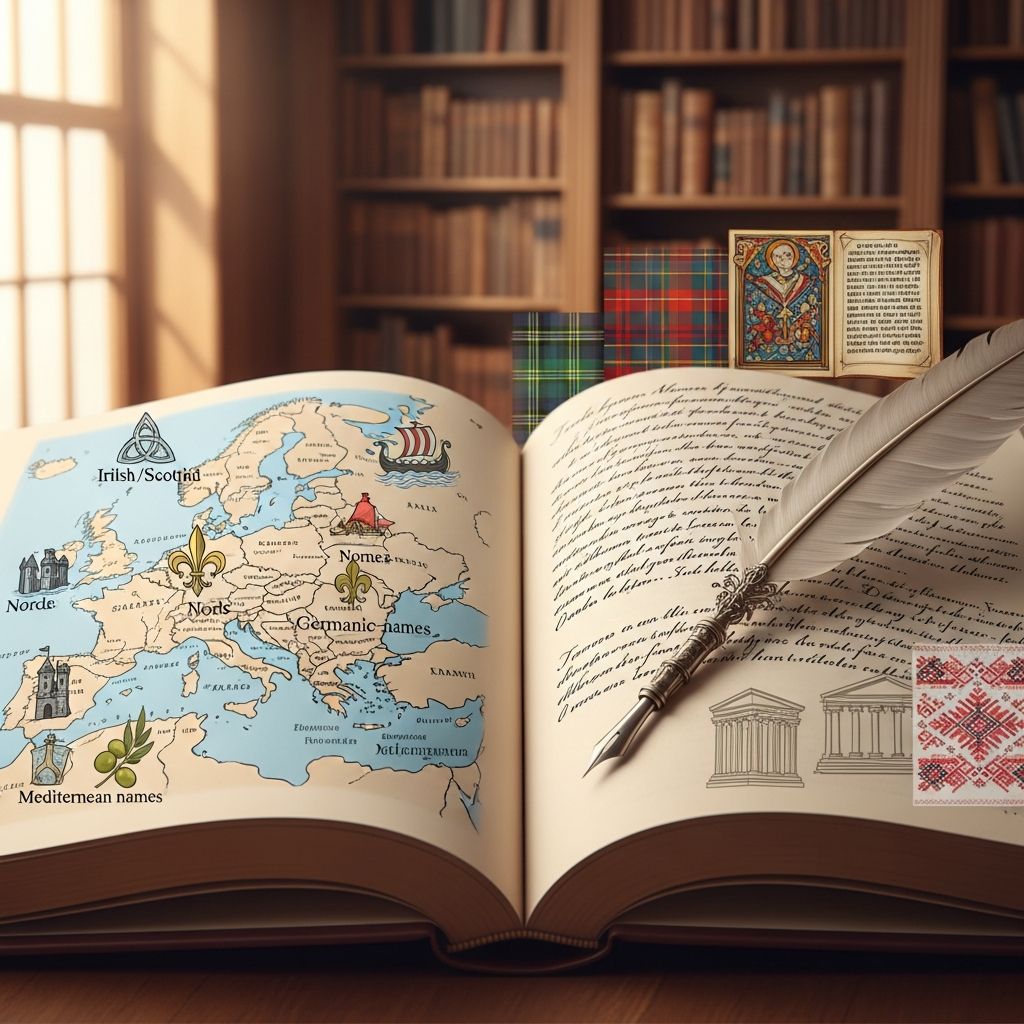
Across Europe, last names do more than identify us; they preserve traces of language, migration, religion, and social change. Understanding European surnames can help you uncover where your family came from, what your ancestors did for a living, and how naming customs evolved over centuries.
This guide explains the main types of European last names, highlights patterns in different regions, and offers practical tips for anyone curious about their surname or researching family history.
How European Surnames Came to Be
In most parts of Europe, hereditary surnames became common between the 12th and 19th centuries, arriving at different times in different places. Governments, churches, and tax authorities gradually encouraged or required stable family names so they could track people more easily.
- Early use in cities: Growing medieval towns needed clearer identification for trade, property, and legal matters.
- Religious records: Parish registers for baptisms, marriages, and burials pushed toward consistent family names.
- Tax and conscription: States introduced censuses and military drafts, which demanded fixed surnames.
The pace of adoption varied:
- Many Italian and French families used stable surnames by the 1500s.
- In parts of Scandinavia and Eastern Europe, permanent surnames became standard much later, often in the 18th–19th centuries.
- Iceland still mostly uses patronymics instead of hereditary surnames.
Four Core Types of European Last Names
Although each language has its own forms, most European surnames fall into a few broad categories. Many names blend more than one type, but this breakdown offers a useful starting point.
| Type | What it indicates | Typical examples (generalized) |
|---|---|---|
| Patronymic / Matronymic | Descent from a father or mother | “son of Anders”, “daughter of Ivan” |
| Occupational | Trade or role | “miller”, “smith”, “shepherd” |
| Locational / Topographic | Place of origin or landscape feature | “from the hill”, “by the river” |
| Descriptive / Nickname | Physical traits or personality | “short”, “curly”, “cheerful” |
1. Patronymic and Matronymic Names
Patronymic surnames are based on a father’s given name, while matronymic surnames derive from a mother’s name. These were especially common where people once used changing by-name systems instead of fixed family names.
- Nordic patterns: Traditional naming used endings meaning “son” or “daughter”. In modern fixed surnames you still see these endings across Scandinavia.
- Slavic patterns: Endings like -ovich, -ev, or -ić often signal “son of” in Eastern and Southeastern Europe.
- Celtic and English patterns: Prefixes like Mac-, Mc-, O’-, and endings like -son show descent.
In some countries, patronymics turned into permanent surnames. In others, they remained flexible for centuries and only later became fixed under state regulation.
2. Occupational Surnames
Occupational surnames describe the profession or role of an ancestor. In many European cities, craft guilds and rural work generated a rich vocabulary of job-based names.
- Common trades like smiths, millers, butchers, bakers, and carpenters appear in nearly every European language.
- Some names refer to specific feudal positions, such as stewards, reeves, bailiffs, or local officials.
- Other names may point to more unusual roles: musicians, heralds, or religious offices.
Because many people shared the same trades, occupational surnames quickly became widespread, and unrelated families might carry the same job-based name.
3. Locational and Topographic Names
Locational surnames identify people by where they came from, while topographic surnames describe the landscape near where they lived.
- Locational: Often derived from towns, villages, regions, or farms. They frequently contain prepositions like “from” or “of” in various languages.
- Topographic: Linked to features such as hills, woods, marshes, bridges, or churches.
- In areas with scattered farms, house names sometimes evolved into hereditary surnames.
Migration from countryside to towns increased the use of locational by-names—”the one from that village”—which later stabilized as surnames.
4. Descriptive or Nickname-Based Names
Descriptive surnames often started as nicknames, capturing physical traits, character, or habits.
- Appearance: height, hair color or texture, complexion, or build.
- Personality: cheerful, quiet, stubborn, brave, or generous.
- Behavior or reputation: someone known for traveling, joking, or particular skills.
Over generations, the original descriptive meaning may no longer match the family’s appearance or character, but the surname remains a faint echo of an ancestor’s identity.
Regional Patterns Across Europe
Each part of Europe shows distinctive surname patterns shaped by language, law, and history. While there are many exceptions, the trends below can help you interpret unfamiliar names.
Western Europe
Western Europe includes countries like France, Spain, Portugal, Belgium, and the Netherlands, each with layered naming traditions influenced by Latin, Germanic, and local languages.
- Romance-language roots: In areas that once spoke Latin, many surnames derive from Latin personal names and occupations.
- Prepositions and articles: Elements meaning “of” or “from” may be attached to place names or descriptive words.
- Multilingual border zones: In Belgium, Switzerland, and border regions, surnames can appear in multiple languages within a small area.
Trade, colonial expansion, and migration have also brought non-European surnames into Western Europe, especially in major port cities.
Southern Europe
Southern Europe (Italy, Greece, parts of the Balkans, and Mediterranean islands) preserves especially rich surname traditions tied to religion, clan structures, and local geography.
- Italian diversity: Many areas developed their own surname endings and particles. Names can reflect saints, professions, or village nicknames.
- Greek naming: Names may reference Orthodox saints, ancient personal names, or village origins, often with region-specific endings.
- Island influences: On islands, limited space and tight-knit communities led to highly localized surname clusters.
Centuries of Venetian, Ottoman, and other foreign rule in the Mediterranean left additional layers of linguistic influence on local surnames.
Central Europe
Central European countries such as Germany, Austria, Switzerland, Czechia, Hungary, and Poland show complex mixtures of Germanic and Slavic elements, shaped by historical empires and shifting borders.
- German surnames: Common types include occupational names, compound descriptive names, and locational names formed from settlements or landscapes.
- Slavic-German contact zones: In border areas, surnames may appear in either language or in adapted hybrid forms.
- Legal standardization: Imperial governments often required fixed surnames for taxation and record-keeping, especially in the 18th–19th centuries.
Jewish families in Central Europe were sometimes compelled to adopt permanent surnames under state laws, leading to distinctive sets of names connected to languages such as German, Yiddish, and Hebrew.
Northern Europe and Scandinavia
In Northern Europe—especially Denmark, Norway, Sweden, Finland, and the Faroe Islands—patronymic systems played a major role in surname history.
- Patronymic endings: Many common surnames still end with forms equivalent to “-son” or “-sen”.
- Transition to fixed surnames: In the 19th–20th centuries, governments encouraged families to keep a single inherited surname rather than changing it each generation.
- Farm names and nature: In rural areas, surnames sometimes came from farm names or natural features like lakes, forests, or fields.
Iceland remains an exception within Europe: most people still use true patronymics or matronymics that change each generation, and hereditary family surnames are relatively rare.
Eastern Europe and the Baltic Region
Eastern Europe, including countries such as Poland, Lithuania, Latvia, Estonia, Ukraine, and parts of the Balkans, exhibits strong Slavic and Baltic surname patterns.
- Characteristic endings: Many surnames share recognizable suffixes that can signal gender, region, or linguistic background.
- Animal and nature names: A number of common names refer to animals, trees, or natural forces, sometimes combined with descriptive or diminutive endings.
- Multilingual states: Historical unions and empires, such as the Polish–Lithuanian Commonwealth and the Russian Empire, created areas where surnames from different languages coexist.
In some regions, surnames were recorded differently in church, civil, and official languages, leading to multiple spellings for the same family.
What Your Last Name Can Reveal
While a surname cannot tell the whole story of a family, it often provides valuable clues. When combined with documents and DNA evidence, names can help reconstruct migration paths and social backgrounds.
Clues About Ancestral Occupations
If your surname clearly refers to a trade, it may indicate that an ancestor once worked in that field. That said, you should be cautious:
- Different families can share the same occupational name without being related.
- Occupations changed over time, so a medieval “miller” may have descendants in completely different professions.
- Some occupational-looking names might be symbolic, honorary, or translated from another language.
Geographic and Ethnic Origins
Many European surnames point to a town, region, or landscape, which can provide starting points for research.
- Locational names may match existing places on old maps, though spellings often changed.
- Characteristic name endings and sounds can hint at which language or ethnic group a family once belonged to.
- Clusters of a surname in certain regions can be visualized with surname distribution tools.
Mapping surname frequency by country or region can help you identify likely homelands before specific records are located.
Family Structure and Social History
Certain naming patterns reflect older family structures and social conditions:
- Patronymics: Emphasize the role of fathers and male lines in naming traditions.
- Matronymics: In some cases, may mark strong maternal lines or special legal circumstances.
- Nobility indicators: Particles meaning “of” or “from” once distinguished landowning families in some areas, though later usage broadened.
Religious shifts, such as the Reformation or changes in state religion, also affected naming practices, with some families adopting or dropping certain elements over time.
Researching a European Last Name
If you want to understand a European surname more deeply, a mix of linguistic analysis, historical context, and documentary research is helpful.
Step-by-Step Approach
- 1. Check the language family: Identify whether the name looks Romance, Germanic, Slavic, Celtic, Baltic, or from another language group.
- 2. Examine endings and prefixes: Look for familiar patterns that suggest “son of”, place-of-origin markers, or diminutives.
- 3. Consider spelling variants: Historical clerks often adapted names to their own spelling habits, especially after migration.
- 4. Use surname dictionaries: Specialized works and trusted databases can provide etymologies and historic distributions.
- 5. Correlate with records: Match name theories with parish registers, censuses, and civil records to see where and how the surname was used.
Helpful Tools and Sources
Reliable surname research combines online tools with archival records.
- Distribution maps: Visual tools that show where a surname appears most frequently at different times can narrow down likely origins.
- Onomastic studies: Academic research on names (onomastics) offers detailed analyses for particular countries or regions.
- Genealogical databases: Reputable platforms aggregate historical records and can help trace a surname through time.
Always cross-check crowd-sourced information with primary records, as surname explanations are sometimes repeated without strong evidence.
Common Pitfalls and Misconceptions
Interpreting surnames is not always straightforward. These common issues can mislead new researchers:
- Assuming a single origin: Many surnames arose independently in different regions, especially those from common trades or descriptive words.
- Ignoring language change: A name that looks like a modern word may originally derive from an older or dialect form with a different meaning.
- Overemphasizing noble particles: Not every name with an element meaning “of” or “from” indicates nobility, especially after such markers became fashionable or widespread.
- Forgetting female forms: In some languages, women’s surnames historically changed ending or form, which can complicate record searches.
Approaching surname study with caution and cross-checked evidence will produce more reliable results.
Frequently Asked Questions About European Last Names
Can I reliably trace my ancestry just from my last name?
No. A surname can suggest likely regions, languages, or occupations, but accurate family trees require records such as church books, civil registrations, censuses, and sometimes DNA evidence.
Why are there so many spelling versions of the same European surname?
Spelling was not standardized for many centuries. Clerks often wrote names the way they sounded in their own language, especially after migration. As a result, one family may appear under several spellings in records.
Do all European countries follow the same naming rules?
No. Each country has its own legal framework and traditions. Some, like Iceland, still allow or require patronymics, while others have long-established hereditary surnames. Law reforms in the 19th and 20th centuries gradually standardized modern practices.
Are common surnames less useful for genealogy?
Common surnames can be harder to track because many unrelated families share them. However, when combined with locations, given names, and dates, even very frequent names can be researched successfully.
Where can I find trustworthy information about my surname’s meaning?
Consult academic surname dictionaries, national onomastic institutes, and reputable genealogical databases that cite their sources. Distribution maps and official archives can help confirm or challenge popular explanations.
References
- Name Distribution — Polmanarkivet. 2019-05-01. https://polmanarkivet.com/research/name-distribution/
- Lists of most common surnames in European countries — Wikipedia (summary of national statistical offices). Various dates. https://en.wikipedia.org/wiki/Lists_of_most_common_surnames_in_European_countries
- Most common surnames by country in Europe — Jakub Marian. 2016-08-08. https://jakubmarian.com/most-common-surnames-by-country-in-europe/
- Surname Distribution Maps — FamilySearch Research Wiki. 2023-02-15. https://www.familysearch.org/en/wiki/Surname_Distribution_Maps
- Origin, etymology and popularity of your last name — Geneanet. 2022-09-10. https://en.geneanet.org/surnames/