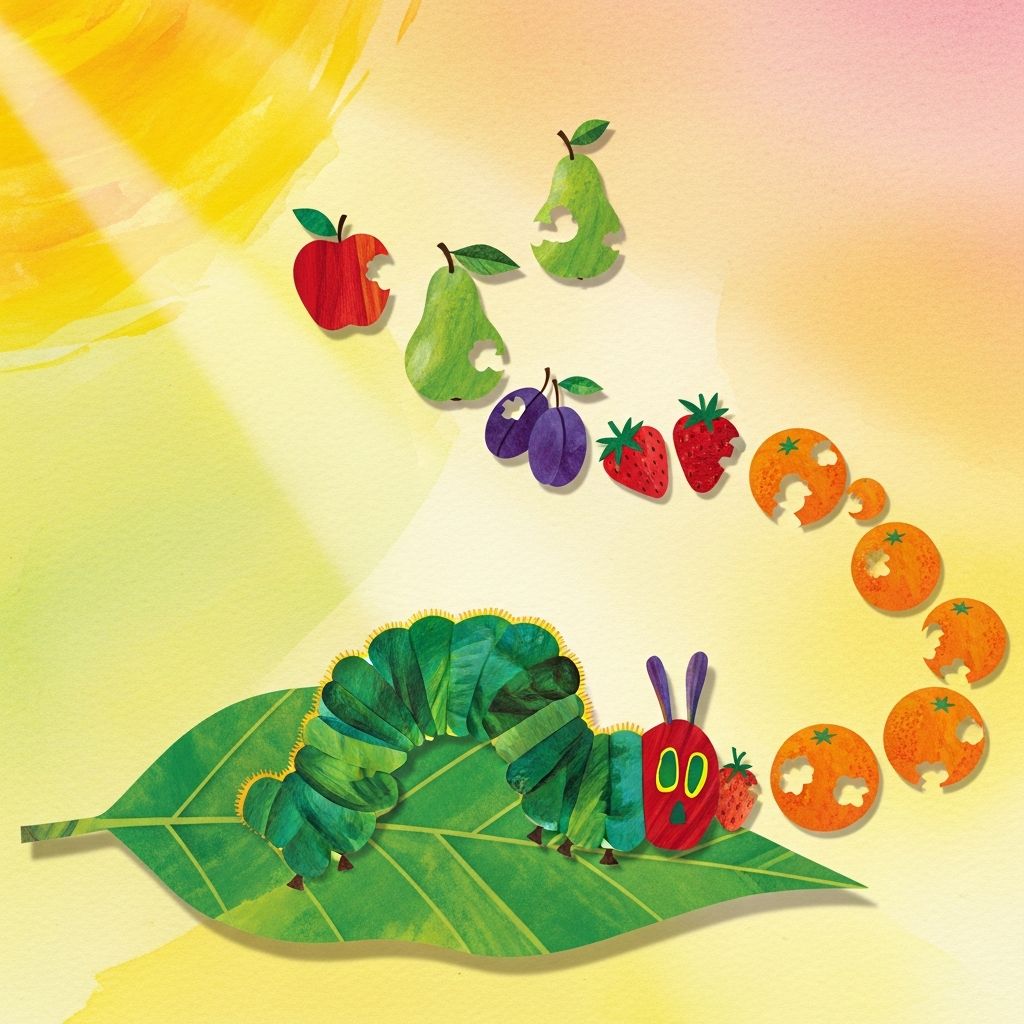
For more than half a century, parents and children have turned the pages of The Very Hungry Caterpillar and entered a tiny world that somehow feels as big as childhood itself. Author and illustrator Eric Carle did far more than create a bestselling picture book; he reshaped how families talk about growth, curiosity, and hope at bedtime and beyond.
From Syracuse to Worldwide Storytime: Who Was Eric Carle?
Eric Carle was an American author, illustrator, and designer best known for his vibrant collage artwork and deceptively simple stories for very young readers. Born in 1929 in Syracuse, New York, to German immigrant parents, he spent much of his childhood in Germany after his family returned there in the 1930s.
Those early years were complex: war, scarcity, and strict schooling contrasted with long walks in nature with his father and an art teacher who secretly showed him modern art that the regime considered unacceptable. These experiences seeded themes he would later revisit: the healing power of nature, the importance of color and creativity, and the idea that books could offer comfort when the world feels frightening.
- Born: June 25, 1929, Syracuse, New York
- Background: German-American; spent formative years in Germany
- Professions: Graphic designer, art director, author, illustrator
- Books created: More than 70 picture books, many both written and illustrated by him
The Long Road to a Very Hungry Caterpillar
Carle’s career did not begin in a nursery but in the world of commercial art and design. After returning to the United States as a young adult, he worked as a graphic designer and later as art director for a New York advertising agency. His distinctive, bold layouts and love of color caught the attention of children’s author Bill Martin Jr., who asked him to illustrate a manuscript that would become Brown Bear, Brown Bear, What Do You See?
The success of that collaboration gave Carle the confidence to create his own stories. In 1969, he published two books that would launch his career as a leading figure in children’s literature: the counting book 1, 2, 3 to the Zoo and, just months later, The Very Hungry Caterpillar.
| Milestone | Approximate Year | Why It Matters |
|---|---|---|
| Graphic design and advertising work | 1950s–early 1960s | Honed Carle’s visual storytelling and bold, simple layouts. |
| Illustrates Brown Bear, Brown Bear, What Do You See? | 1967 | First major success in children’s publishing, leading to more book projects. |
| Publishes 1, 2, 3 to the Zoo | 1969 | First book he both wrote and illustrated, showing his interest in visual literacy. |
| Publishes The Very Hungry Caterpillar | 1969 | Becomes one of the most popular children’s books in history. |
Inside the World of The Very Hungry Caterpillar
The Very Hungry Caterpillar may look like a tiny book about an insect who eats too much, but its design and structure were quietly revolutionary. Carle used hand-painted tissue paper collages, bold colors, and die-cut holes to invite children to explore the pages with their fingers as well as their eyes.
Beyond its visual charm, the book weaves multiple early-learning concepts together in a way that feels like play, not instruction.
- Counting and numbers: Children practice counting as the caterpillar eats more each day.
- Days of the week: The story follows a simple calendar rhythm, reinforcing time concepts.
- Food and sequence: The varied foods and repetitive structure support memory and sequencing skills.
- Science and metamorphosis: The transformation from caterpillar to butterfly introduces a real biological process in an accessible way.
Since its publication in 1969, the book has sold tens of millions of copies and has been translated into more than 60 languages, securing its place among the best-known children’s picture books worldwide.
Why This Small Story Feels So Big to Children
Parents often describe a sense of recognition when their toddler sees the caterpillar grow, change, and finally emerge as a butterfly. Carle himself believed that young readers identify with the “small and insignificant” caterpillar who eventually unfolds its wings and talents.
For a child facing new experiences—starting school, welcoming a sibling, moving homes—the idea that they, too, can grow into something strong and beautiful is profoundly reassuring. Carle has said that he wanted his books to counteract the fear of the unknown and to replace it with a message of hope and curiosity.
Emotional Themes Woven Into a Simple Plot
- Growth: The caterpillar’s steady change mirrors children’s own rapid development.
- Overwhelm and comfort: After eating too much, the caterpillar doesn’t feel well, offering a gentle way to talk about limits and self-care.
- Transformation: The final butterfly scene communicates that today’s smallness is not permanent.
- Predictability: Repetition and pattern provide a sense of stability that young children often crave.
How Eric Carle’s Art Speaks to the Youngest Readers
Carle’s technique is instantly recognizable: layers of painted tissue paper cut into shapes, arranged into animals, plants, and everyday objects, then finished with black line details. This collage method makes the images look both sophisticated and approachable—something a child might try to imitate with construction paper and glue.
His subjects are usually drawn from the natural world: insects, mammals, oceans, forests, and the changing sky. That choice was deliberate. Early childhood research consistently shows that many young children are especially drawn to animals and nature, and that picture books can foster both early science understanding and empathy.
- Bold shapes: Clear, high-contrast forms help very young children recognize and label objects.
- Rich color: Saturated hues keep visual attention and communicate mood.
- Simple faces: Friendly expressions reduce fear and invite emotional connection.
- Interactive elements: Cut-outs, textures, and repeating motifs turn the book into “a toy you can read,” as Carle once described his work.
Beyond One Book: A Body of Work Built Around Childhood
Although The Very Hungry Caterpillar is his best-known creation, Carle wrote and illustrated dozens of other books that explored counting, friendship, sound, night and day, and feelings. Across these stories, a few patterns emerge:
- Respect for children: Carle spoke often about his belief that children are naturally creative and eager to learn, and that books should treat them with dignity rather than condescension.
- Bridging home and school: He saw stories as a way to ease the transition from the safety of home to the structure of school—a change he considered one of childhood’s major emotional challenges.
- Playful learning: Many of his books invite kids to touch, tilt, listen, or search the page, supporting emerging literacy and curiosity.
Over the course of his career, Carle’s books sold well over 100 million copies worldwide and earned numerous honors, including a Lifetime Achievement Award from the Society of Illustrators and the Children’s Literature Legacy Award from the American Library Association.
Reading Eric Carle Together: What Parents and Caregivers Notice
For adults, returning to an Eric Carle book can be unexpectedly emotional. The small, rounded pages and familiar phrases often trigger memories of being read to—or of reading the same book night after night to a sleepy child. That emotional pull is not accidental; Carle wanted his books to be shared, not just consumed alone.
When families read The Very Hungry Caterpillar or his other titles together, several things often happen:
- Shared rhythms: Repetitive text and predictable patterns make it easy for children to join in, turning the story into a duet rather than a monologue.
- Built-in conversation starters: Parents can naturally ask questions about colors, counting, or feelings as they turn each page.
- Ritual and routine: The same book, read night after night, becomes a comforting anchor in a young child’s day.
Simple Ways to Enrich a Caterpillar Read-Aloud
- Pause on each food page and have your child count the holes with you.
- Ask how the caterpillar might be feeling at different points in the story.
- Connect the transformation to something in your child’s life—a new skill, a recent growth spurt, or a big upcoming change.
- Invite your child to draw or collage their own imaginary creature after you finish reading.
The Museum That Turned a Career Into a Conversation
In 2002, Eric Carle and his late wife Bobbie founded The Eric Carle Museum of Picture Book Art in Amherst, Massachusetts. The museum does more than celebrate one artist’s legacy; it treats picture-book illustration as a serious art form worthy of galleries, archives, and study.
By collecting original artwork and hosting exhibitions, workshops, and educational programs, the museum highlights how images and words work together to shape a child’s first encounters with stories. For families, it offers a tangible way to show children that the books they love are made by real people—and that their own drawings might matter, too.
What Eric Carle’s Legacy Means for Today’s Families
Eric Carle died in 2021, but his work continues to circulate in classrooms, libraries, and homes around the world. Every time a toddler pokes a tiny finger through the holes of a caterpillar page, or a preschooler proudly counts out loud with a grown-up, his vision of joyful learning comes alive again.
For parents and caregivers, Carle’s legacy is an invitation:
- To take children’s questions seriously, even when they are simple.
- To use color, play, and repetition to make books feel accessible and fun.
- To see picture-book time not as an obligation, but as a small daily act of hope and connection.
Frequently Asked Questions (FAQs)
Why is The Very Hungry Caterpillar considered so important in children’s literature?
The book combines art, story, and early-learning concepts—counting, days of the week, food, and metamorphosis—in a way that feels playful rather than didactic. Its innovative design, with die-cut pages and collage illustrations, influenced later picture books and has reached generations of children across more than 60 languages.
At what age can children start enjoying Eric Carle’s books?
Many families introduce his books in the toddler years, but even infants can enjoy the bold colors and simple shapes during shared reading. Research on early literacy suggests that reading aloud from birth supports language development and bonding, and Carle’s visually clear pages are especially well-suited to very young eyes.
How did Eric Carle come up with the caterpillar story?
Carle has described how his love of nature and his interest in metamorphosis helped shape the idea. Early versions reportedly focused on a different insect, but the caterpillar and butterfly ultimately provided a more powerful metaphor for growth and change, aligning with his belief in children’s potential to “unfold their wings.”
What other Eric Carle books are good starting points for a home library?
In addition to The Very Hungry Caterpillar, many families gravitate toward his counting, animal, and nature-themed titles, including collaborations like Brown Bear, Brown Bear, What Do You See? and later works that explore sound, friendship, and nighttime. Across these books, you will find the same collage style, simple text, and focus on early concepts.
Did Eric Carle receive formal recognition for his contributions to children’s books?
Yes. Over his career, Carle received numerous national and international awards, such as the Japan Picture Book Award, the Regina Medal, a Lifetime Achievement Award from the Society of Illustrators, and the Children’s Literature Legacy Award from the American Library Association, honoring the lasting impact of his work on young readers.
References
- The life and legacy of beloved author and illustrator Eric Carle — Encyclopaedia Britannica. 2021-05-27. https://www.britannica.com/video/who-was-Eric-Carle
- Eric Carle’s Biography — Eric Carle Official Site. 2021-05-24 (last updated). https://eric-carle.com/about-eric-carle/eric-carles-biography/
- Eric Carle — Illustration History / Norman Rockwell Museum. 2021-06-01. https://www.illustrationhistory.org/artists/eric-carle
- About Eric Carle — The Eric Carle Museum of Picture Book Art. 2021-06-15. https://carlemuseum.org/about/about-eric-carle
- Eric Carle — Reading Rockets (WETA). 2019-03-05. https://www.readingrockets.org/people-and-organizations/eric-carle
- Eric Carle — Emily Rudolph, Kutztown University Design Pioneers. 2021-11-01. https://research.library.kutztown.edu/designpioneers/38/
- About Eric Carle Museum — The Eric Carle Museum of Picture Book Art. 2020-10-20. https://carlemuseum.org/about