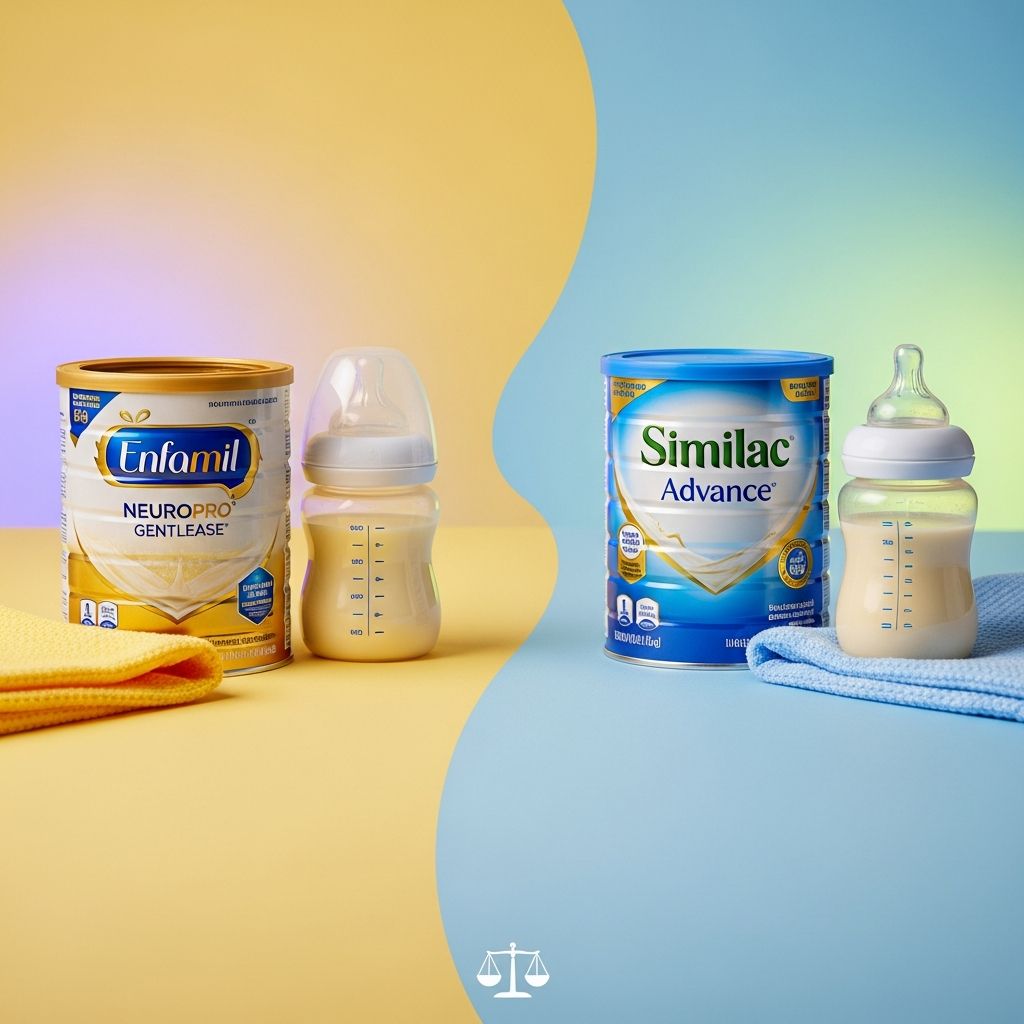
Parents comparing Enfamil and Similac usually want one thing: a formula that keeps their baby fed, comfortable, and growing well. Both brands are long-standing, regulated, and capable of meeting your baby’s core nutritional needs, so the real question becomes which one best matches your baby’s specific needs and your family’s preferences.
This guide walks through the major differences and similarities between Enfamil and Similac, from ingredients and specialty lines to price, convenience, and how to think about gas, spit-up, and fussiness.
Safety and Nutrition Basics
In the United States, infant formulas must meet strict federal standards, so both Enfamil and Similac provide complete nutrition for most healthy, full-term babies. Both brands offer cow’s milk–based formulas, alternatives for lactose sensitivity, and specialized options for digestion, allergies, and prematurity under the oversight of pediatric nutrition science.
Breast milk remains the gold standard for infant feeding, but for families who use formula, these two brands are among the most widely recommended and studied options.
Brand Philosophy in Plain Language
Enfamil is produced by Mead Johnson and tends to emphasize brain and cognitive development, often highlighting ingredients like DHA and additional components tied to neural and eye development. Similac, produced by Abbott, strongly markets its effort to mimic aspects of breast milk, including immune-supporting components and prebiotics that support gut health.
For parents, this means the branding language may sound different, but the real-world choice comes down to how your baby reacts to specific formulas rather than the marketing focus alone.
Major Formula Types from Each Brand
Both companies offer parallel product lines so that, for most feeding challenges, you can find a roughly equivalent option in either Enfamil or Similac. That makes it possible to switch brands while still targeting the same underlying issue, such as reflux, lactose sensitivity, or prematurity.
Below is a simplified view of how their major formula categories line up.
Key Formula Categories Table
| Feeding goal | Typical Enfamil option | Typical Similac option |
|---|---|---|
| Standard cow’s milk–based infant formula | Enfamil Enspire / NeuroPro (core lines) | Similac Advance / Total Care lines |
| Thickened formula for spit-up/reflux | Enfamil A.R. (added rice starch) | Similac for Spit-Up |
| Gentle / easy-to-digest milk protein | Enfamil Gentlease | Similac Pro-Total Comfort / similar comfort lines |
| Hypoallergenic / extensively hydrolyzed | Enfamil Nutramigen | Similac Alimentum |
| Soy-based (lactose-free, dairy-free) | Enfamil ProSobee | Similac Soy Isomil |
| Preterm/low-birth-weight support | Enfamil Enfacare | Similac NeoSure |
| Toddler transition formulas | Enfamil Enfagrow | Similac Go & Grow |
Ingredients and Additives: What Actually Differs?
Standard formulas from both brands share a similar base: nonfat milk, vegetable oils, and carbohydrate sources, along with a full panel of vitamins and minerals such as vitamins A, D, E, K, and various B vitamins. However, the exact amounts and additional components vary slightly, and these differences sometimes matter for tolerance and parental preference.
One commonly discussed point is that certain Similac formulas contain higher levels of added sugars compared with comparable Enfamil products, while Enfamil emphasizes fewer added sugars and more ingredients linked to brain development in some of its core lines. Both brands are non-GMO in many of their flagship products.
Feature Focus: Brain, Gut, and Immunity
- Brain and eye development: Enfamil often highlights DHA, ARA, and milk fat globule membrane components that support sustained attention and cognitive outcomes in clinical studies.
- Immune and gut support: Similac typically emphasizes prebiotics and human milk oligosaccharide–inspired ingredients that may support the immune system and intestinal health.
- Fat and protein balance: Both brands keep fat and protein levels within pediatric recommendations, though the ratios of whey to casein may differ slightly between specific products.
How Enfamil and Similac Compare at a Glance
When formulas are matched by purpose—such as two gentle options or two standard cow’s milk–based options—the overall nutritional patterns are more alike than different, which is why many pediatricians are comfortable with either brand. The chart below summarizes some general tendencies often discussed by parents and experts.
Side-by-Side Snapshot
| Aspect | Enfamil (general tendencies) | Similac (general tendencies) |
|---|---|---|
| Overall focus | Highlights brain and cognitive development with DHA, ARA, and specific neural-support ingredients. | Highlights resemblance to breast milk, with an emphasis on immune and gut support. |
| Added sugar in some lines | Often has lower added sugars in key flagship products. | Certain formulas may have more added sugars, which some parents feel babies prefer in taste. |
| Digestive comfort reports | Some babies appear less gassy or fussy on Enfamil in anecdotal reports and small evaluations. | Some parents find Similac easier to digest for sensitive babies, especially in gentle lines. |
| Foaming and mixing | Certain products may foam more when shaken vigorously, though performance varies by line. | Some Similac products may clump at first but foam less, depending on preparation method. |
| Specialty coverage | Robust range for reflux, allergies, prematurity, and soy-based needs. | Similarly broad catalog, often with closely matched alternatives for most Enfamil types. |
| Price range | Comparable to Similac; sometimes slightly lower on powder, higher on ready-to-feed, depending on product. | Comparable overall; certain package sizes and promotions can make Similac slightly more expensive per container but similar per ounce. |
Formats, Convenience, and Cost
Both brands provide formulas as powder, liquid concentrate, and ready-to-feed bottles, with pricing that varies mostly by format and specialty rather than brand name alone. Ready-to-feed options usually cost more but save time, reduce mixing errors, and may be especially convenient for travel or nighttime feeds.
Enfamil and Similac both run savings programs that offer coupons and rewards, such as Enfamil Family Beginnings and Similac StrongMoms, which can significantly lower costs over a year of formula feeding. Warehouse clubs and bulk online purchases also help bring the per-ounce price down for both brands.
How to Match a Formula to Your Baby
No chart can fully predict which brand or specific formula your baby will tolerate best, so it helps to approach the choice as a guided experiment rather than a one-time decision. Pediatric input is especially important if your baby is premature, has known allergies, or has had growth or digestion concerns.
When selecting between Enfamil and Similac, consider both medical needs and everyday practicalities like what is stocked at your usual stores and which loyalty programs you use.
Step-by-Step Decision Approach
- Clarify your baby’s specific needs: reflux, gas, suspected cow’s milk protein allergy, or standard feeding with no major issues.
- Ask your pediatrician which category of formula is most appropriate (standard, gentle, hypoallergenic, preterm, soy, etc.).
- Within that category, compare one Enfamil and one Similac option to see which is more available and affordable in your area.
- Try one product consistently for at least several days, unless your pediatrician advises otherwise, while tracking spit-up, stools, gas, and overall comfort.
- If issues persist, consult your pediatrician about switching to the parallel product from the other brand or moving to a more specialized formula.
Signs a Formula Might Not Be the Best Fit
Mild gas, occasional spit-up, and small changes in stool are very common in babies and are not always caused by the specific formula brand. However, certain patterns suggest that you should discuss a possible change in formula or further evaluation with your pediatrician.
- Persistent, inconsolable crying after feeds that continues over multiple days.
- Frequent, forceful vomiting or significantly increased spit-up volume.
- Blood or mucus in stools, severe constipation, or very watery diarrhea.
- Rashes, swelling, or signs of allergic reaction around feedings.
- Poor weight gain or falling off growth curves as measured by your baby’s healthcare provider.
Practical Tips for Switching Between Brands
Many babies can move between Enfamil and Similac without problems, especially when changing between formulas that serve the same purpose, such as two standard cow’s milk–based products. Still, changes should be guided by a pediatric professional if your baby has complex medical needs or is on a specialized formula.
- Avoid hopping rapidly from one formula to another in response to every fussy day; babies have normal fluctuations in mood and digestion.
- When switching, some parents offer half-and-half bottles (half old formula, half new formula) for a short transition period if approved by their pediatrician.
- Track changes in a simple log for a week: how much baby takes, spit-up, number of wet and dirty diapers, and overall demeanor.
Frequently Asked Questions
Is Enfamil or Similac “better” overall?
There is no universal winner; both meet regulatory standards and provide complete nutrition for most infants, and both offer specialized formulas for unique medical or digestive needs. For many families, the “better” formula is simply the one that their baby tolerates well, that is easy to find, and that fits their budget.
Can I mix Enfamil and Similac in the same bottle?
Most pediatric experts advise preparing each formula exactly according to its own instructions and generally recommend using one product at a time to avoid dosing errors. If you are considering mixing brands or alternating formulas in a structured way, discuss this first with your pediatrician so that total nutrient and calorie intake stays appropriate.
Which brand is better for gas and fussiness?
Some caregivers report less gas and fussiness with specific Enfamil formulations, while others find Similac’s gentle or comfort lines more effective for their baby. Because responses are individual, the best approach is to choose an appropriate gentle or partially hydrolyzed formula from either brand, then evaluate your baby’s comfort over several days with pediatric guidance.
Does one brand cost significantly more than the other?
When matched by formula type and package size, Enfamil and Similac tend to be very close in price per ounce, though individual products and retailers may create small differences. Using store promotions, bulk purchasing, and the brands’ coupon and rewards programs can make either option more affordable over time.
How do I choose if my baby was premature?
Preterm and low-birth-weight babies usually require specialized formulas such as Enfacare or NeoSure, which are designed to support catch-up growth and particular nutrient needs. These choices should always be made with a neonatologist or pediatrician, who may later transition your baby to standard or gentle formulas from either brand once growth stabilizes.
Key Takeaways for Parents
Both Enfamil and Similac are trusted, research-informed brands with overlapping product ranges that can be tailored to many different feeding situations. Rather than searching for a single “best” brand, focus on medical guidance, your baby’s day-to-day comfort, and reasonable consistency so that your baby’s digestive system has time to adjust.
If your baby is growing well, seems content after most feeds, and your healthcare provider is satisfied with progress, then whichever formula you are using—Enfamil, Similac, or another regulated brand—is likely the right choice for your family at this time.