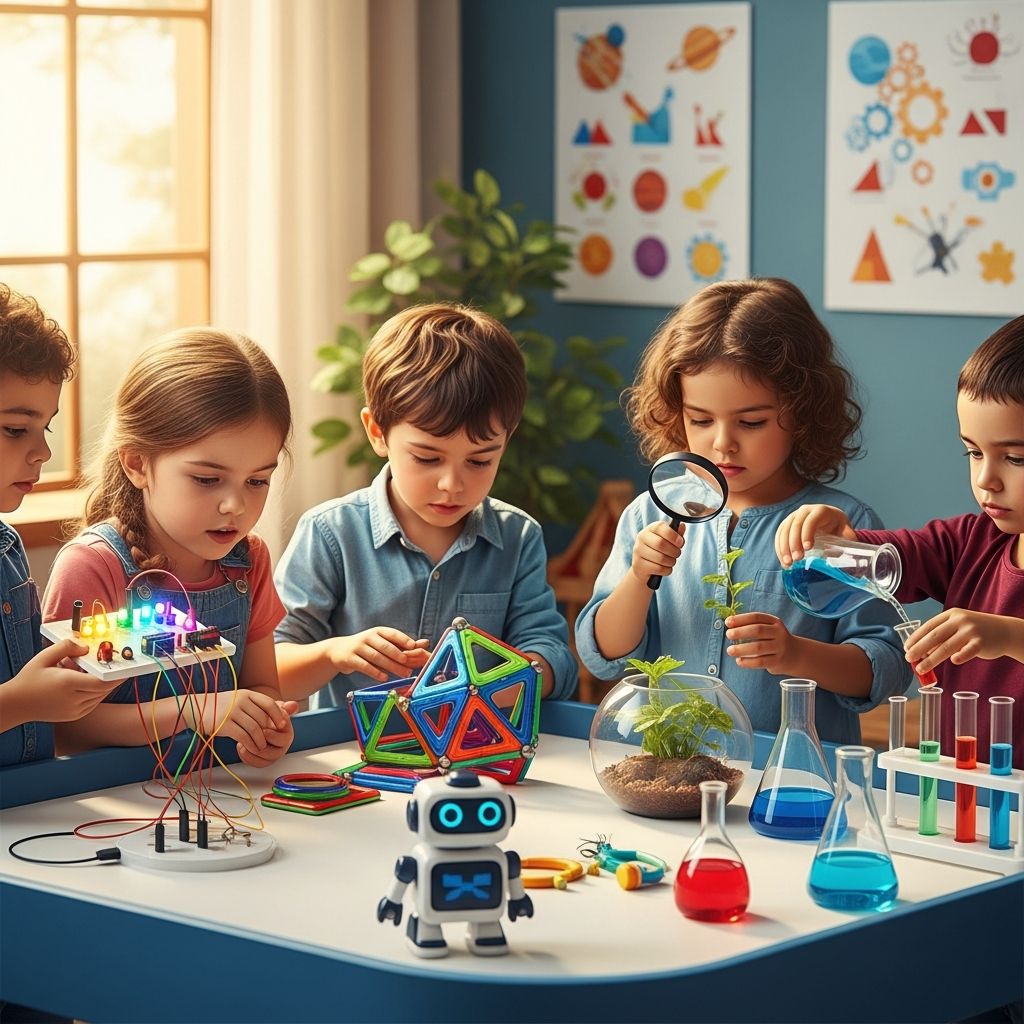
Introducing **STEM**—science, technology, engineering, and mathematics—to children during their earliest years lays a strong foundation for cognitive growth, creativity, and problem-solving abilities. These disciplines, when presented through play, help young minds grasp complex concepts naturally, preparing them for academic success and innovative thinking later in life.
Why Early STEM Exposure Matters for Development
From infancy, children are natural explorers, constantly testing cause and effect through trial and error. Early STEM engagement builds neural pathways associated with logical reasoning and spatial awareness. Research shows that toddlers involved in age-appropriate STEM play demonstrate improved math readiness and executive function by kindergarten.
Moreover, consistent exposure counters enrollment gaps in STEM fields, particularly among underrepresented groups, by sparking interest early. Parents and caregivers play a pivotal role, turning everyday moments into learning opportunities without needing fancy equipment.
Building Blocks of STEM: Key Concepts for Toddlers
Break down STEM into accessible components tailored for little ones:
- Science: Observing the world, like how plants grow or water behaves.
- Technology: Simple tools and interactive devices that respond to actions.
- Engineering: Designing and constructing stable structures.
- Mathematics: Counting, sorting, patterns, and basic measurements.
Integrating these through **STEAM**—adding arts—makes learning holistic and engaging.
Everyday Household Activities to Ignite STEM Interest
No lab required; transform your home into a STEM playground with these ideas.
Manipulate Toys for Cause-and-Effect Learning
Offer toys with moving parts, such as balls, rattles, or stacking blocks. Encourage kids to experiment: build taller towers or adjust rattles for different sounds. This repetitive manipulation teaches physics basics like gravity and balance long before formal lessons. Repetitive actions, like dropping a spoon repeatedly, reinforce persistence and prediction skills.
Explore Tools and Mechanisms Around the Home
Point out everyday items: Demonstrate a door hinge’s pivot or a can opener’s gear action. Ask open-ended questions like, “What happens if we turn it slowly?” This guided inquiry fosters mechanical understanding and vocabulary building.
Water Play and Bubble Experiments
Fill a basin with water and provide cups, spoons, and objects of varying densities. Challenge kids to predict sink-or-float outcomes, introducing volume, weight, and buoyancy. Blowing bubbles reveals light refraction and elasticity as they chase iridescent spheres.
These activities promote sensory development and hypothesis testing in a mess-friendly setup.
Outdoor Adventures for Natural STEM Discovery
Nature is the ultimate classroom. Step outside to connect children with real-world science.
- Take nature walks, journaling sights with simple drawings. Prompt observations: “What shapes are those leaves? How many birds do you see?”
- Cloud watching on a blanket: Identify formations and discuss weather patterns.
- Hunt for rocks, sorting by size, color, or texture to practice classification.
Outdoor play boosts physical health while embedding math and science seamlessly.
Engineering Fun with Construction and Design
Engineering thrives on trial and error. Supply safe, household materials for building challenges.
| Activity | Materials | Skills Developed |
|---|---|---|
| Tower Challenge | Blocks, pillows, boxes | Balance, stability, measurement |
| Bridge Building | Straws, tape, books | Structure, load-bearing |
| Fort Construction | Blankets, cushions | Design, spatial planning |
Test structures: How many books can the bridge hold? Failure is key—discuss why it toppled and iterate. These exercises cultivate resilience and creative problem-solving.
Technology and Coding Without Screens
Introduce tech through unplugged methods to avoid overstimulation.
Movement-Based Coding Games
Tape a grid on the floor with a goal marker. Kids sequence steps (forward, left, right) to navigate, like human robots. This teaches algorithms, sequencing, and debugging.
Interactive Toys
Wheel-connect toys like Code-a-Pillar let children program paths by linking segments. Toy cars following verbal commands mimic coding logic. Age-appropriate tablets with story apps can follow, emphasizing interaction over passive viewing.
Math Moments in Daily Routines
Weave numbers into mealtimes and chores for organic learning.
- Count utensils or ingredients: “Two eggs, three spoons.” Compare portions: more/less/full/empty.
- Sort laundry by color/shape or measure water for plants.
- During naptime, count cots or predict how many more are needed.
These build number sense and data skills effortlessly.
Play Types That Maximize STEM Gains
Diverse play styles ensure well-rounded development.
- Pretend Play: Role-play scientists mixing potions.
- Exploratory Play: Dismantle toys (supervised) to see insides.
- Guided Play: Adult-led experiments like plant growth tracking.
- Free Play: Unstructured time for self-directed discovery.
Balance with safety: Allow mess but set boundaries.
Group Projects for Collaborative Learning
Mimic classroom STEAM with home projects. For a garden: Research seeds, design plots, plant, and chart growth. Weekly summaries (e.g., “Three sunny days”) teach data analysis. Play fosters teamwork and sustained inquiry.
Edutainment and Museum Visits
Supplement home play with STEM toys like LEGOs or DIY kits, and visit science museums. Hands-on exhibits captivate pre-readers, reinforcing concepts visually. Discuss trending tech like AI: “People build these tools for jobs!”
Frequently Asked Questions (FAQs)
What age should STEM start?
From infancy with manipulative toys; deepen for toddlers/preschoolers.
Do I need special materials?
No—household items suffice; focus on process over products.
How to handle failures in activities?
Celebrate them as learning opportunities; encourage ‘try again’.
Can STEM be integrated into screen time?
Yes, with interactive, educational apps, but prioritize unplugged play.
How does STEM benefit underrepresented kids?
Early exposure builds confidence, closing future gaps.
Overcoming Common Challenges
Parents worry about mess or time. Start small: 15-minute sessions. Safety first—supervise exploratory play. Track progress via journals to see growth.
Collaborate with preschools using curricula like Problem Solvers for consistent reinforcement.
References
- Eight ways to introduce young kids to STEM at an early age — Hechinger Report. Accessed 2026. https://hechingerreport.org/eight-ways-introduce-young-kids-stem-early-age/
- Simple Ways to Introduce Your Child to STEM at an Early Age — Engineering For Kids. 2019-01. https://www.engineeringforkids.com/about/news/2019/january/simple-ways-to-introduce-your-child-to-stem-at-a/
- Breaking Down STEAM for Young Children — NAEYC. 2020-02. https://www.naeyc.org/resources/pubs/tyc/feb2020/breaking-down-steam
- Importance of STEM in Early Childhood Education — Hiba Academy. Accessed 2026. https://bayarea.hibaacademy.org/en/post/importance-stem-early-childhood-education
- STEM Educators: Introduce Kids to These Subjects Early — GovTech. Accessed 2026. https://www.govtech.com/education/k-12/stem-educators-introduce-kids-to-these-subjects-early
- Top 5 STEM Activities to Help with Early Childhood Education — The Newport School. Accessed 2026. https://www.newportschool.com/resources/top-5-stem-activities-to-help-with-early-childhood-education
- STEM Activities for Toddlers — ZERO TO THREE. Accessed 2026. https://www.zerotothree.org/resource/stem-activities-for-toddlers/