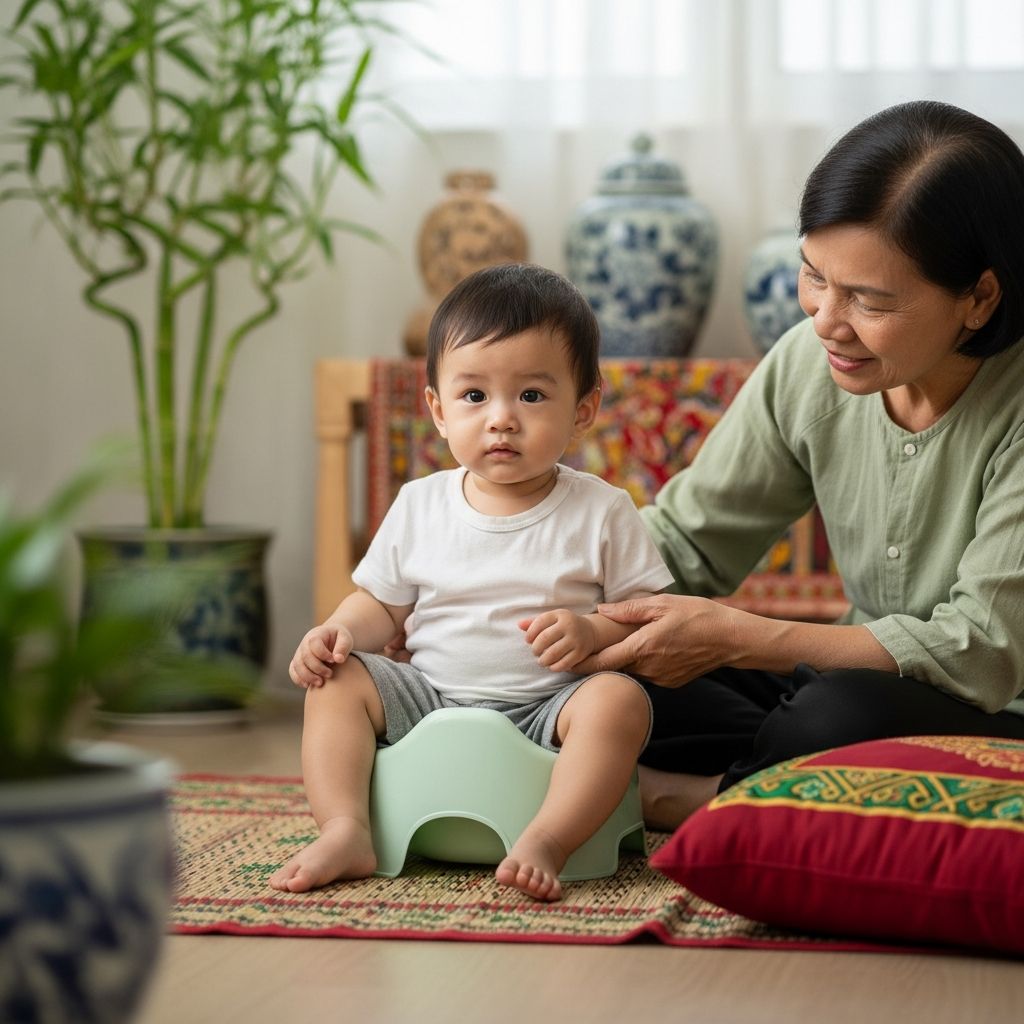
In many Western countries, parents often begin potty training around age two or three. By contrast, in Vietnam it is common for babies to start using a potty within their first year of life, with many regularly eliminating on cue by around nine months. This difference is not the result of a magic trick or a quick hack, but of a caregiving style built on close observation, routine, and cultural expectations.
This article uses the Vietnamese experience as inspiration to explore what early potty training (often called infant toilet learning or elimination communication) looks like, what research says about it, and how parents in other cultures might thoughtfully adapt aspects of the approach.
Why Potty Training Starts Earlier in Vietnam
Early toilet learning in Vietnam happens within a particular social and cultural context. Understanding that context is essential before trying to borrow any one technique.
Cultural expectations and values
Research in Vietnam has found that many mothers see early potty training as part of being a “good” caregiver and as a normal parenting responsibility rather than a special project. Several factors influence this mindset:
- Pride in early independence: Early potty skills are often viewed as a sign of attentive parenting and a capable child.
- Community norms: When neighbors, relatives, and grandparents all expect babies to use a potty early, parents receive strong social reinforcement for starting soon.
- Economic practicality: Historically, disposable diapers were expensive or unavailable, so families relied on other ways to stay clean and dry.
Limited use of diapers
Studies of Vietnamese mothers have reported that diapers were used only rarely or for special circumstances, especially in rural or low-income settings. Instead, caregivers typically:
- Hold the baby in a supported squat over a potty, basin, or outdoor space.
- Dress infants in clothing that makes elimination easy (such as open-crotch pants or loose garments).
- Clean up immediately if accidents happen, rather than relying on an absorbent diaper.
Because the baby is not constantly in a diaper, caregivers notice small early signals that elimination is coming — changes in facial expression, muscle tension, fussiness, or pausing during play. Over time, they learn the baby’s patterns.
The Core Idea: Communication Around Elimination
Early potty training in Vietnam is less about drilling a skill and more about two-way communication. Caregivers watch, anticipate, and respond; babies gradually connect caregiver cues with their own bodily sensations.
Reading a baby’s signals
In qualitative research with Vietnamese mothers, caregivers described learning to recognize when their baby needed to urinate or pass stool by tracking:
- Body movements: sudden stillness, squirming, or arching.
- Facial cues: straining, focused expression, or a surprised look.
- Sounds or cries: brief fussing that did not match hunger or tiredness.
- Timing: predictable intervals after waking, feeding, or drinking.
Caregivers then respond by quickly holding the baby in a supported position over a potty or designated spot.
Using an audio cue (often a whistle)
One distinctive feature of the Vietnamese approach is the use of a consistent sound cue whenever the baby eliminates. In the most commonly described pattern:
- The caregiver makes a specific sound (often a whistle) while the baby urinates or defecates.
- Over time, the baby associates this sound with the physical act of releasing.
- Later, the caregiver starts making the sound just before offering the potty, encouraging the baby to eliminate in that moment.
This is similar to how parents in some other cultures use phrases like “pss-pss” or “go potty” from early infancy. The sound becomes a cue and a shared language around elimination.
How Early Potty Training Typically Progresses
While individual families differ, research with Vietnamese mothers suggests a general pattern of development from birth to age two. The table below summarizes this gradual progression.
| Age range | Caregiver focus | Baby’s role |
|---|---|---|
| Newborn–3 months | Observe patterns, begin holding baby over a receptacle at likely times, use a consistent sound cue during elimination. | Mostly passive; experiences being held in a specific position when eliminating. |
| 3–6 months | Increase frequency of potty offers at predictable times; refine recognition of baby’s signals. | Begins to anticipate position and sometimes waits until offered the potty. |
| 6–9 months | Use sound cue before and during potty time; maintain consistent routines throughout the day. | Often eliminates in response to the cue and position; many are regularly using a potty by this stage. |
| 9–24 months | Gradually encourage more independence — helping the child sit, wait, and later manage clothing. | By around two years, many children can manage potty use largely on their own in this setting. |
What the Research Actually Shows
The most frequently cited modern study on this topic followed a group of Vietnamese mothers from their baby’s birth to age two. Here are key points from that and related analyses:
- Sample and method: Forty-seven mothers were interviewed multiple times about their experiences with early potty training, and observations of the children’s potty skills were collected as part of a broader project.
- Use of cues: All participating mothers reported using a distinctive sound (often whistling) to encourage urination and help the child start or continue the flow.
- Outcomes: Within this group, all children were said to be able to use a potty by about nine months. By 24 months, most managed the process with little help.
- Ongoing communication: Researchers concluded that early success depended on continuous, responsive communication between mother and child rather than a one-time training event.
It is important to note that this was a relatively small, qualitative study in one cultural context. It cannot prove that any specific technique (such as whistling) would work the same way in other settings, and commentators have emphasized that media claims about “guaranteed” success are often oversimplified.
Possible Benefits and Considerations
Parents curious about early potty learning often wonder whether it helps or harms children’s development. Current evidence is limited but suggests a few potential advantages, along with important caveats.
Potential benefits
- Earlier toilet awareness: Because elimination is discussed and responded to from birth, children may become aware of their bodily sensations and toileting routines sooner than peers who spend years in diapers.
- Reduced diaper use: Using fewer diapers may lower family costs and reduce solid waste, which aligns with broader environmental concerns about disposable diaper burdens on landfills.
- Closer caregiver–baby attunement: Constant attention to subtle cues can deepen some caregivers’ sense of connection and responsiveness to their infants.
- Cultural fit where constant care is common: In homes where an adult or grandparent is usually present, this approach may feel natural and not overly burdensome.
Key cautions
- Evidence about bladder health is limited: Some popular articles claim that early training might strengthen the bladder. However, pediatric urology experts note that robust data on long-term bladder function with very early training are scarce, and more research is needed.
- Risk of pressure: In any culture, intense pressure for early dryness can lead to conflict, anxiety, or withholding behaviors. Pediatric experts in North America and Europe generally recommend avoiding punishment or shaming during toilet learning and encourage a child-centered, supportive approach.
- Practical demands: Early potty training as practiced in Vietnam assumes someone can be physically present, observant, and responsive much of the day. This may conflict with work schedules, childcare arrangements, or housing realities in other settings.
How Parents Elsewhere Can Adapt the Ideas
You do not need to reproduce Vietnamese routines exactly to benefit from the underlying principles. Parents can borrow what fits and leave the rest.
Foundations to focus on
- Responsiveness over results: Prioritize learning your child’s rhythms and responding with patience rather than aiming for a particular age of full toilet independence.
- Make elimination discussable: Use simple words or consistent sounds for pee and poop from early on. Treat it as a normal body function, not a source of shame.
- Offer, don’t force: Provide regular opportunities to use a potty or toilet at times when elimination is likely (waking, after eating, before outings), but do not insist if your child resists.
- Be flexible: Some families use early potty communication only at home in the mornings or evenings, while relying on diapers at daycare or during busy days.
Example: A gentle cue-based routine
Here is a sample routine inspired by Vietnamese practices and by broader elimination communication methods described in cross-cultural accounts of early toileting in Asia. Adjust as needed for your family:
- Choose a sound (a soft whistle, “pss-pss,” or a short phrase like “pee-pee time”). Use it every time your baby urinates, whether in a diaper or over a potty.
- Notice when your baby usually pees: after feeds, after naps, or at regular intervals.
- At those times, gently hold your baby in a supported squat over a sink, potty, or toilet insert and make the chosen sound.
- If nothing happens after a short while, stop and try later. Keep the experience low-pressure, brief, and calm.
- As your child grows, invite them to sit on a small potty at routine times and continue using the same cue.
This kind of routine does not need to replace traditional toilet training later; rather, it can make that later phase smoother because the child already recognizes the position, cue, and basic expectation.
How This Differs From Conventional Western Potty Training
Parents familiar with standard potty training guides may notice several differences between common Western advice and Vietnamese-style early training. The table below outlines some of these contrasts.
| Aspect | Common Western approach | Vietnamese-inspired early approach |
|---|---|---|
| Typical start age | Around 2–3 years, when the child shows readiness signs such as staying dry for several hours and following simple instructions. | From birth, with gradual shaping of habits and communication; many babies use a potty regularly by about 9 months. |
| Main tools | Diapers (often until training begins), pull-ups, child-size potty, reward charts or praise systems. | Minimal diaper use, cue sounds, supported squat position, small pot or basin. |
| View of the process | Discrete training period focused on teaching a new skill. | Ongoing communication and habit-building from infancy. |
| Caregiver time demands | Intense for a relatively short training period. | Moderate but continuous attention over many months. |
Is Early Potty Training Right for Every Family?
No single approach suits all families or all children. When considering whether to experiment with Vietnamese-style early training, reflect on:
- Your daily reality: Do you or another caregiver have the time and flexibility to offer frequent potty opportunities and observe signals?
- Your child’s temperament: Some babies seem to enjoy routines and predictability; others strongly resist being interrupted for toileting.
- Your support network: Are other caregivers (partners, grandparents, childcare providers) willing to use the same cues and routines?
- Your stress level: If early potty learning feels like just another pressure point, it may be better to wait and choose a more conventional timeline.
Health organizations in North America and Europe generally emphasize that there is a wide range of normal for age at toilet training completion and that forcing the issue can create more problems than it solves. Borrowing ideas from Vietnam or other cultures should always be filtered through what is safe, respectful, and sustainable for your own household.
Frequently Asked Questions (FAQs)
Q: Does early potty training mean a baby is physically “ready” earlier?
Early potty learning in Vietnam relies heavily on caregiver timing and cues. It does not necessarily mean that a baby’s nervous system is mature in the same way as an older toddler’s. The process is more about habit, communication, and routine than about a sudden change in bodily readiness.
Q: Is there proof that whistling or sound cues improve bladder health?
Research confirms that Vietnamese caregivers widely use sound cues and that their children often use a potty by nine months, but strong evidence that this specifically changes long-term bladder health is lacking. Current studies are small and mostly descriptive, so claims about medical benefits should be treated with caution.
Q: Could starting too early cause toileting problems later?
Most concerns about harm come from situations where children are pressured, punished, or asked to hold urine or stool for long periods. Pediatric guidance stresses avoiding power struggles and watching for signs of withholding, constipation, or distress. A gentle, responsive, low-pressure approach — whether early or later — is less likely to create problems.
Q: Can I combine diapers with early potty communication?
Yes. Many families outside Vietnam use a hybrid approach: they keep diapers for convenience but still offer the potty at predictable times and use a consistent sound or word. This can reduce, though not eliminate, diaper use and may make later training easier.
Q: What if my childcare provider will not participate?
You can still practice routines at home without expecting the same pattern at daycare or with other caregivers. Consistency helps, but it does not have to be perfect. If trying to coordinate across settings becomes too stressful, it may be better to focus on a single approach that all caregivers can realistically maintain.
References
- Vietnamese mothers’ experiences with potty training procedure for children from birth to 2 years of age — Duong TH, Jansson U-B, Hellström A-L. Journal of Pediatric Urology. 2013-12. https://pubmed.ncbi.nlm.nih.gov/23182948/
- Toilet Training: Guidelines for Parents — American Academy of Pediatrics. HealthyChildren.org. 2022-03-17 (updated). https://www.healthychildren.org/English/ages-stages/toddler/toilet-training/Pages/default.aspx
- Claims whistling can potty train babies ‘far-fetched’ — NICS Well / Public Health Agency (Northern Ireland). 2012-11-23. https://www.nicswell.co.uk/health-news/claims-whistling-can-potty-train-babies-far-fetched
- Infant Potty Training in Indigenous Asia: How People Potty Their Babies in Countries Without Diapers — Go Diaper Free (summarizing ethnographic accounts such as The Tibetan Art of Parenting). Accessed 2025. https://godiaperfree.com/infant-potty-training-in-indigenous-asia-how-people-potty-their-babies-in-countries-without-diapers-part-2/