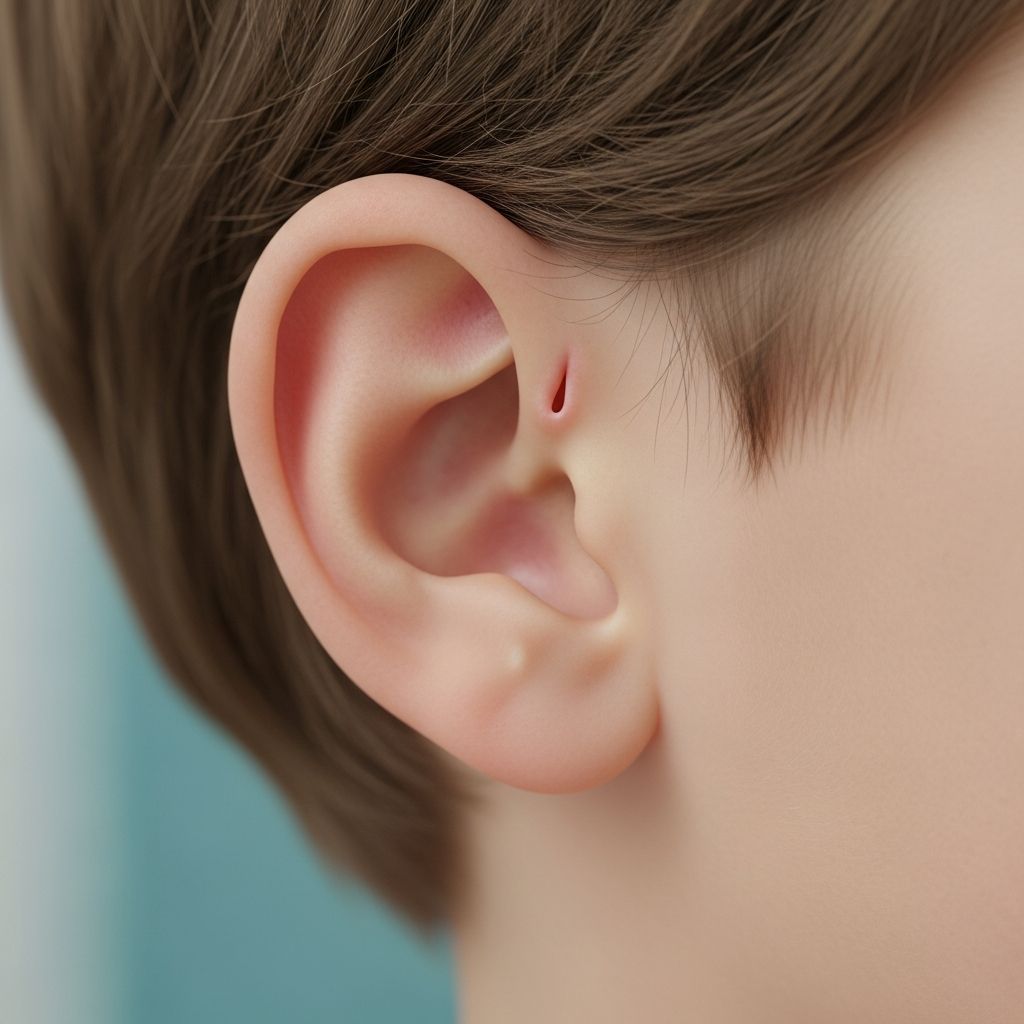
Many parents first notice a tiny hole near their baby’s ear during a diaper change or bath and immediately worry something is wrong. This small opening is often an ear pit, also called a preauricular pit. In most cases, it is harmless, but it can sometimes be linked with infection, hearing problems, or rare genetic conditions.
This guide explains what ear pits are, why they form, how doctors evaluate them, and when treatment is needed, using clear language for families while reflecting current medical recommendations.
What Exactly Is an Ear Pit?
An ear pit is a tiny opening or dimple of skin usually found just in front of the upper part of the ear. It looks like a small pinhole, sometimes barely visible.
- Medical name: preauricular pit or preauricular sinus
- Location: typically where the ear’s cartilage (the rim or helix) meets the side of the face, just above the ear canal
- Structure: the hole often connects to a thin tunnel under the skin, called a tract
- Number: can occur on one or both ears; one-sided pits are more common
Most children with an ear pit feel completely fine, and the pit causes no pain or discomfort unless it becomes infected.
How Common Are Ear Pits?
Ear pits are considered a common minor birth difference, even though they still occur in less than 1% of babies overall.
| Feature | Details |
|---|---|
| Overall frequency | Estimated 0.1–0.9% of children in the United States |
| Side affected | More than half are on one ear only; the right ear is somewhat more often involved |
| Boys vs. girls | Appear to affect both sexes equally |
| Family patterns | May occur sporadically or run in families; bilateral pits are more likely to have a family history |
Why Do Ear Pits Form?
Ear pits are present at birth. They develop during early pregnancy while the outer ear is forming.
- The external ear, called the auricle, forms around the sixth week of gestation from six small tissue swellings that must grow and fuse correctly.
- If the fusion process is slightly disrupted, a small sinus tract can remain under the skin, leaving a visible surface opening (the pit).
- This is a structural difference, not something caused by anything a parent did or did not do during pregnancy.
In many children, this is an isolated, minor difference in development. In a smaller group, ear pits appear together with other ear or facial differences or as part of a genetic syndrome.
Are Ear Pits Dangerous?
On their own, ear pits are usually benign and asymptomatic. However, there are a few potential concerns parents should be aware of:
- Infection risk: The tract underneath the skin can trap skin oils and germs, which may lead to redness, swelling, pain, or pus drainage.
- Rare link with hearing loss: Some studies suggest that children with ear pits may have a higher rate of hearing impairment than children without them, especially when other ear abnormalities are present.
- Association with kidney and other anomalies: A small percentage of children with ear pits also have kidney anomalies or genetic syndromes affecting the ears, branchial (neck) structures, and kidneys, such as branchio-oto-renal (BOR) syndrome.
Most healthy babies with a single, simple ear pit and no other differences do not develop health problems from it. Doctors focus mainly on watching for infection and checking for any extra features suggesting a broader condition.
What Does an Infected Ear Pit Look Like?
Infection is the most common complication and can occur at any age, though it is often first noticed in childhood.
Signs of an infected ear pit include:
- Redness or warmth around the pit
- Swelling or a tender lump just in front of the ear
- Pain when the area is touched
- Yellow or whitish drainage from the opening
- Fever or your child generally feeling unwell (in more severe infections)
Sometimes a fluid-filled pocket known as a cyst forms under the skin, and this can turn into a pus-filled abscess. If this occurs, a doctor may need to drain the fluid in addition to prescribing antibiotics.
Could an Ear Pit Affect Hearing or Kidneys?
Most babies in many countries receive a newborn hearing screen shortly after birth, which helps pick up hearing issues early. For most children with an isolated ear pit and no other physical differences, large children’s hospitals state that hearing is usually normal, and no extra testing is required beyond newborn screening.
However, research has found that hearing impairment can be more common among infants with ear pits compared to those without, especially when there are additional ear malformations. For this reason, doctors may:
- Ask about your child’s newborn hearing screen result
- Watch speech and language development carefully
- Order a formal hearing test (audiogram) if there are other ear abnormalities or concerns about hearing or speech
Kidney problems are rare in children with isolated ear pits. In some cases, though, pits are part of syndromes such as branchio-oto-renal (BOR) syndrome, which includes ear pits, hearing loss, branchial cysts, and kidney anomalies.
A doctor may consider a kidney ultrasound if:
- There are ear pits plus neck pits or branchial cleft cysts
- Your child has significant facial or ear differences
- There is a strong family history of kidney disease or syndrome features
How Do Doctors Diagnose and Evaluate Ear Pits?
Diagnosis usually begins with a simple physical exam. Most of the time, a pediatrician can recognize an ear pit by looking closely at the area.
Evaluation may include:
- Visual inspection of the ear: to confirm the opening is an ear pit rather than another kind of lesion, such as a skin tag or branchial cleft cyst
- Checking both ears and the face: to look for asymmetry, abnormal ear shape, or other small abnormalities that might hint at a syndrome
- Review of newborn hearing screen results: and discussion of your child’s speech and responsiveness to sounds
- Hearing test (audiogram): usually reserved for children with additional ear differences, abnormal screening, or developmental concerns
- Imaging tests:
- Ultrasound of the soft tissues near the ear if a deep or recurrent infection is suspected
- Kidney ultrasound if ear pits occur together with neck anomalies or if a syndrome like BOR is suspected
Sometimes your pediatrician may refer your child to a pediatric ear, nose, and throat specialist (ENT) or a clinical geneticist for further assessment, particularly if there are repeated infections or multiple anomalies.
Treatment Options: When Is Surgery Needed?
Treatment depends largely on whether the ear pit causes problems. Many children never need any procedure beyond routine monitoring.
Conservative (Non-Surgical) Care
- No treatment for simple, symptom-free pits: If the ear pit is not infected and your child is otherwise healthy, most doctors recommend leaving it alone and simply watching for changes.
- Antibiotics for infection: When redness, swelling, or pus is present, oral antibiotics are usually prescribed. In milder cases, warm compresses may help with pain and swelling.
- Drainage for abscesses: If a large pocket of pus forms, a doctor may need to drain it using a small incision after numbing the area.
Surgical Removal
Surgery is considered when infections become recurrent or severe. The goal is to remove the entire tract so that infections do not keep coming back.
- Typically done by a pediatric ENT surgeon
- Usually scheduled once a current infection has cleared to reduce complications
- Performed under general anesthesia in most children
- Involves a small incision around the pit to follow and remove the tract under the skin
When the entire tract is removed successfully, outcomes are generally excellent, and the chance of recurrent infection is low.
Caring for a Child With an Ear Pit at Home
For most families, daily care is simple. The main goals are to keep the area clean, watch for signs of infection, and follow any medical advice from your child’s providers.
Practical tips include:
- Gently cleanse the area with water during regular bathing; no special soaps are usually needed.
- Avoid squeezing the pit or trying to remove anything from inside it.
- Teach older children not to pick at or scratch the area.
- Seek medical care promptly if you notice redness, swelling, pain, or drainage.
- Keep follow-up appointments with your pediatrician or ENT, especially if infections have occurred.
Frequently Asked Questions (FAQs)
1. Is an ear pit a birth defect?
An ear pit is a minor congenital malformation, meaning it is present at birth and results from a small difference in how the external ear formed in early pregnancy. It is usually isolated and does not indicate a serious problem on its own.
2. Did something I did during pregnancy cause my baby’s ear pit?
Current evidence does not link ear pits to specific actions, foods, or exposures during pregnancy. They arise from small variations in normal embryologic ear development, which parents cannot control.
3. Can an ear pit close on its own?
The surface opening may appear smaller over time, but the underlying tract usually remains. Spontaneous complete closure is uncommon. If a pit causes no symptoms, it can simply be observed; if infections are frequent, surgery to remove the tract is the standard approach.
4. Should every child with an ear pit get a hearing test?
Most newborns have a screening hearing test shortly after birth. For a child with an isolated ear pit and a normal newborn screen, many specialty centers do not routinely require additional testing unless there are other abnormalities or concerns about hearing or speech.
5. Does an ear pit mean my child has a kidney problem?
In the absence of other physical findings or a suggestive family history, children with a single, uncomplicated ear pit have about the same risk of kidney anomalies as the general population. Kidney imaging is often considered when ear pits are part of a broader pattern of anomalies.
6. Is surgery for ear pits dangerous?
Surgery is generally safe when performed by an experienced pediatric ENT surgeon, but as with all operations it carries risks such as bleeding, infection, and scarring. The decision to operate weighs these risks against the burden of repeated infections or abscesses.
When to Call the Doctor
Contact your child’s healthcare provider if you notice:
- Redness, tenderness, or swelling near the ear pit
- Any drainage (clear, yellow, or bloody) from the opening
- Fever or your child seems unusually fussy or ill
- Changes in your child’s response to sound or delayed speech
- The appearance of other dimples, tags, or lumps on the neck, face, or ears
Early evaluation allows doctors to treat infection quickly, monitor hearing, and decide whether any further testing is needed.
References
- Ectopic Unilateral Ear Pit in an Otherwise Well-Appearing Child — Costa F, et al. Cureus / U.S. National Library of Medicine. 2023-06-20. https://pmc.ncbi.nlm.nih.gov/articles/PMC10310060/
- Ear Pits — Rady Children’s Hospital–San Diego. 2022-05-12. https://www.rchsd.org/health-article/ear-pits/
- Preauricular Pit — Children’s National Hospital. 2022-03-01. https://www.childrensnational.org/get-care/health-library/preauricular-pit
- Preauricular Pits — Children’s Hospital of Philadelphia. 2021-09-15. https://www.chop.edu/conditions-diseases/preauricular-pits
- Preauricular Ear Hole: Symptoms and Treatment — WebMD. 2020-10-05. https://www.webmd.com/skin-problems-and-treatments/what-is-preauricular-pit