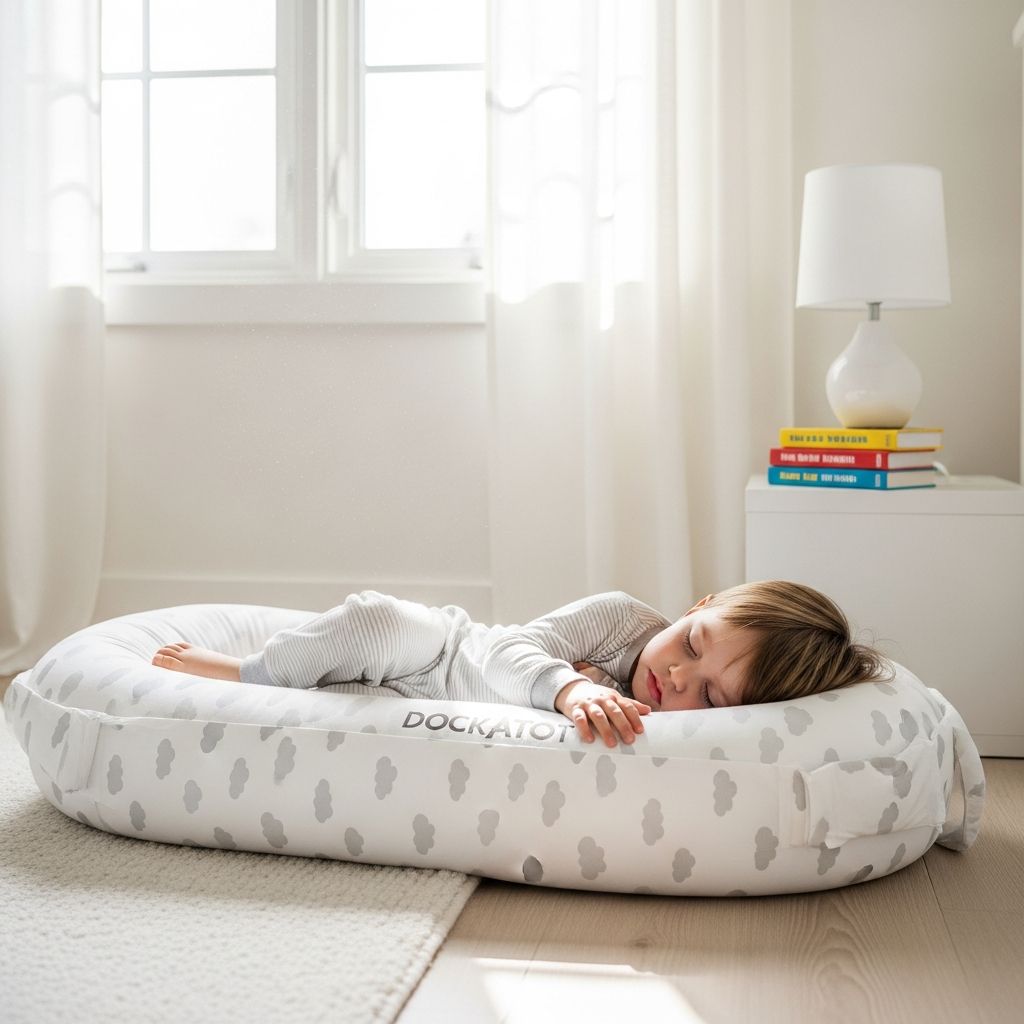
If you have a busy toddler and an unpredictable sleep schedule, you have probably seen the DockATot Grand mentioned in parenting groups or on social media. Many parents swear it transformed their days (and nights); others are unsure what it really does, where it fits in their routine, and how safe it is. This guide walks through how the DockATot Grand can fit into toddler life, where it shines, where it does not, and what science-based safety guidance says about loungers and sleep.
What Exactly Is the DockATot Grand?
The DockATot Grand is a large, padded lounger for older babies and toddlers, typically marketed for ages around 9–36 months. It is not a crib, not a bassinet, and not a traditional mattress. Instead, it functions as a cozy, portable spot where your child can:
- Lounge while you read books or sing songs
- Play with toys within arm’s reach
- Wind down before bed or naps
- Relax near you in the living room, on the floor, or on a larger bed
Structurally, the Grand has a soft padded base encircled by raised fabric-covered bolsters. The sides create a defined space that feels snug and familiar for kids, especially when you move from room to room or travel.
Age, Size, and Stage: Who Is the Grand For?
DockATot sells two main sizes: one aimed at infants and one for older babies and toddlers. The Grand is the stage 2 product.
| Feature | Infant Dock (Deluxe+) | DockATot Grand |
|---|---|---|
| Typical age range | Newborn–8+ months | 9–36+ months |
| Approx. weight range | 5–22 lb | 22–40 lb |
| Primary use | Infant lounging, tummy time supervision | Toddler lounging, play, bed transition support |
| Overall size | Smaller footprint | Considerably larger and wider |
The bigger footprint makes the Grand less suited to squeezing between adults in a bed, but more suitable as a separate lounging zone for toddlers or as a boundary on a larger bed surface.
Realistic Use Cases: What the Grand Actually Helps With
The DockATot Grand will not magically fix all sleep problems. However, it can be genuinely useful in several everyday parenting scenarios.
1. A Defined Spot for Lounging and Quiet Play
Toddlers often bounce from one activity to another. A familiar, padded space can help them slow down:
- Reading corner: Place the Grand near a basket of books and dim lighting to encourage winding down.
- Calm play: Soft blocks, stuffed animals, or a comfort blanket can turn it into a low-energy activity zone.
- Parent proximity: Set it next to the couch so you can rest while your toddler lounges safely within reach.
Parents often report that the raised sides help children feel contained and secure, especially in unfamiliar spaces like relatives’ homes or hotel rooms.
2. Supervised Naps and Rest Time
Some toddlers resist crib naps but will relax in more flexible spaces. The Grand can work for:
- Supervised nap attempts in the living room while you read or work nearby
- Post-illness rest when you want them close for monitoring
- Quiet time for older toddlers who have outgrown daily naps but still need midday downtime
Sleep experts emphasize that soft padded products like loungers are not considered a safe sleep surface for unsupervised sleep, especially in younger infants. For toddlers, suffocation risk is lower than in infants because they can roll, lift their heads, and move away from obstructions, but soft surfaces and loose bedding still conflict with standard safe sleep messaging.
3. Support for Bed Transitions
Many parents purchase the Grand when their child transitions from a crib to a toddler or full-sized bed. The bolstered sides can:
- Act as a soft boundary on a larger mattress
- Provide a consistent-feeling sleep zone from place to place
- Give children a sense of security when moved into a bigger bed
Some families place the Grand on top of a mattress to serve as an intermediate step between crib and open bed. This may reduce rolling off the side, although it is not a replacement for properly installed bed rails or a mattress placed directly on the floor for safety.
4. Travel and Overnights Away From Home
Because the Grand is relatively large, it is not as compact as a travel crib. Still, the familiar feel and smell can be helpful when you are away from home:
- At grandparents’ houses as a go-to lounging, reading, and rest spot
- On road trips for hotel rooms where you want a soft place for your toddler to relax
- At vacation rentals where the furniture layout is unfamiliar
Parents often mention that having the same lounger in different locations helps children settle more quickly because the sensory experience (fabric, shape, smell) remains familiar.
Safety First: What Experts Say About Sleep and Loungers
When any soft, padded product is connected with sleep, parents are right to ask tough questions. Here is what independent safety and health organizations say.
Safe Sleep Basics
The American Academy of Pediatrics (AAP) recommends that infants sleep on a firm, flat, non-inclined surface, such as a safety-approved crib or bassinet, with no soft bedding, pillows, or bumpers. The AAP strongly warns against products with soft sides, pillows, or padding being used as primary sleep surfaces for infants under 1 year.
For toddlers over 12 months, the risk of suffocation is lower because of increased motor control, but pediatricians still generally advise avoiding soft objects that could cover the nose and mouth, particularly if a child sleeps face-down and cannot extricate themselves easily.
How This Applies to the DockATot Grand
- Not a crib replacement: The Grand is best treated as a lounger, not as a primary sleep surface for unsupervised nighttime sleep.
- Supervision is key: Naps or rest time in the Grand should be supervised so you can quickly respond if a child wedges their face in the side padding.
- Follow local advisories: Some safety agencies have issued warnings about infant sleep products with padded sides, emphasizing that they are not equivalent to a crib or bassinet.
Parents should balance the convenience of the Grand with evidence-based safe sleep guidance and discuss any concerns with their child’s pediatrician, especially in families with a history of sleep-related incidents.
Pros and Cons for Sleep-Deprived Parents
To decide whether the Grand belongs in your home, it helps to weigh benefits against trade-offs.
Potential Benefits
- Cozy, contained space: Toddlers often enjoy the snug feel of the bolstered sides, which can encourage them to settle for quiet time.
- Predictable routine cue: Using the Grand consistently for stories, cuddles, and wind-down creates a strong association with rest.
- Versatility: It can be used for lounging, playing, supervised naps, and travel—sometimes for multiple children over several years.
- Portability around the house: Handles and a soft but sturdy structure make it easier to move than a crib or toddler bed.
Limitations and Drawbacks
- High price: The Grand is significantly more expensive than many simple toddler mattresses or foam play mats, and the price jump is larger than the size difference compared with the infant size.
- Not truly a travel crib: It takes up space in the car and is not ideal for air travel, where portable cribs or inflatable beds may be more practical.
- No shortcut for sleep training: It may help with comfort or routine, but it does not replace consistent sleep habits and age-appropriate schedules.
- Cleaning effort: While covers are washable, removing and reassembling pads and bolsters can take time, and large items can crowd small washing machines.
Cost vs. Value: Is It Worth the Investment?
Whether the Grand is “worth it” depends on your priorities and how many children might use it.
- Duration of use: Designed for roughly 9–36+ months, the Grand can cover up to two years or more for a single child and can then be reused by siblings.
- Alternative products: Less expensive options exist, such as firm play mats plus pillows (for awake time only), toddler mattresses on the floor, or simple foam loungers.
- Sleep-deprivation trade-off: Many parents look at the price through the lens of how much even one extra hour of peace or rest is worth during a demanding season of life.
If you expect to use the Grand daily for lounging, quiet time, and multiple kids, the investment may make more sense than if you only need an occasional travel solution.
Practical Tips for Getting the Most Out of the Grand
To maximize both safety and usefulness, consider these strategies:
- Introduce slowly: Let your toddler explore the Grand while awake with toys and books so it becomes a positive, familiar place.
- Create a wind-down ritual: Reserve the Grand for quiet routines—singing, back rubs, stories—so your child associates it with relaxing rather than wild play.
- Place on safe surfaces: Use it on the floor or on a large, stable bed away from edges; do not place it on elevated, narrow surfaces like tables or sofas.
- Maintain visibility: Keep the Grand in your line of sight when your toddler is resting or dozing inside.
- Keep it uncluttered: Avoid piling blankets, stuffed animals, or pillows inside, especially if your child tends to sleep face-down.
Maintenance, Durability, and Everyday Care
The Grand is built to be used heavily and washed regularly, but a few habits can keep it looking and functioning better for longer.
- Regular cover washing: Follow the care label and avoid overly hot water or harsh detergents that can shrink or fade fabrics.
- Spot-clean the interior padding: Wipe spills promptly and allow to dry fully before reassembling to prevent odor and mildew.
- Rotate the lounger: If your child always lies in the same direction, occasionally rotate the Grand so padding wears more evenly and bolsters do not become lopsided.
- Use in high-traffic areas: To justify the cost, keep it where your child spends most time so it becomes a daily tool rather than an occasional accessory.
How the DockATot Grand Compares to Other Toddler Sleep and Lounge Options
Parents often debate whether to purchase a Grand, stick with a standard toddler bed, or rely on simpler solutions. Here is a quick comparison.
| Option | Main Purpose | Pros | Cons |
|---|---|---|---|
| DockATot Grand | Lounging, supervised naps, bed transition support | Cozy, portable, strong routine cue, can span multiple ages | High cost, not a crib replacement, bulky for flights |
| Toddler bed with rails | Primary nighttime sleep | Structured, long-term solution; can follow safe sleep guidance | Less portable, may feel “too big” at first to some children |
| Mattress on the floor | Montessori-style low bed | Inexpensive, safe fall distance, easy access for child | Less contained; requires child-proofed room |
| Travel crib / play yard | Travel sleep and safe containment | Foldable, often meets crib safety standards | Less snuggly; some children resist the cage-like feeling |
Frequently Asked Questions (FAQs)
Q: Is the DockATot Grand safe for overnight sleep?
Most pediatric and safety organizations recommend that children, especially under 1 year, sleep on firm, flat, non-padded surfaces without soft sides. The Grand is best used as a lounger and for supervised naps, not as a primary sleep surface for unattended overnight sleep.
Q: Can I use the DockATot Grand for co-sleeping?
Because the Grand is wide and padded, it is not specifically designed or certified as a co-sleeping device, and the AAP discourages the use of soft-sided products in adult beds for infant sleep. For toddlers, the size can make it awkward in a shared bed and does not remove general risks associated with bed-sharing.
Q: How long will my child fit in the Grand?
The manufacturer markets the Grand for approximately 9–36+ months and 22–40 lb, though fit depends on your child’s height and preferences. Some petite children enjoy lounging in it beyond 3 years, primarily for reading and quiet time.
Q: Is the DockATot Grand machine washable?
The cover is typically removable and washable, while the internal padding and bolsters can be spot-cleaned and air-dried. Always follow the specific washing instructions on your label to avoid shrinking or damaging components.
Q: Will the Grand solve my toddler’s sleep problems?
It may help with comfort, routine, and transitions, which can indirectly improve sleep. However, evidence-based sleep improvements usually come from consistent schedules, age-appropriate bedtimes, and behavioral strategies rather than from any single product.
References
- DockATot Review and Safety Assessment — Mommyhood101. 2023-08-15. https://mommyhood101.com/dockatot-review-and-safety
- Grand Dock (9 to 36 months+) — DockATot UK. 2024-01-10. https://dockatot.co.uk/products/grand-dock
- Transitioning to a DockATot Grand — Say-n-Play Columbus. 2018-08-02. https://saynplaycolumbus.com/2018/08/02/transitioning-to-a-dockatot-grand/
- DockATot Grand – Is it worth the hype? – Tine’s Review — PetiteVie. 2017-06-20. https://petitevie.ca/travel/dockatot-grand-is-it-worth-the-hype-tines-review/
- Sleep-Related Infant Deaths: Updated 2022 Recommendations for Reducing Infant Deaths in the Sleep Environment — American Academy of Pediatrics. 2022-06-21. https://publications.aap.org/pediatrics/article/150/1/e2022057990/188594
- Crib Safety — U.S. Consumer Product Safety Commission. 2023-04-05. https://www.cpsc.gov/Safety-Education/Safety-Education-Centers/cribs