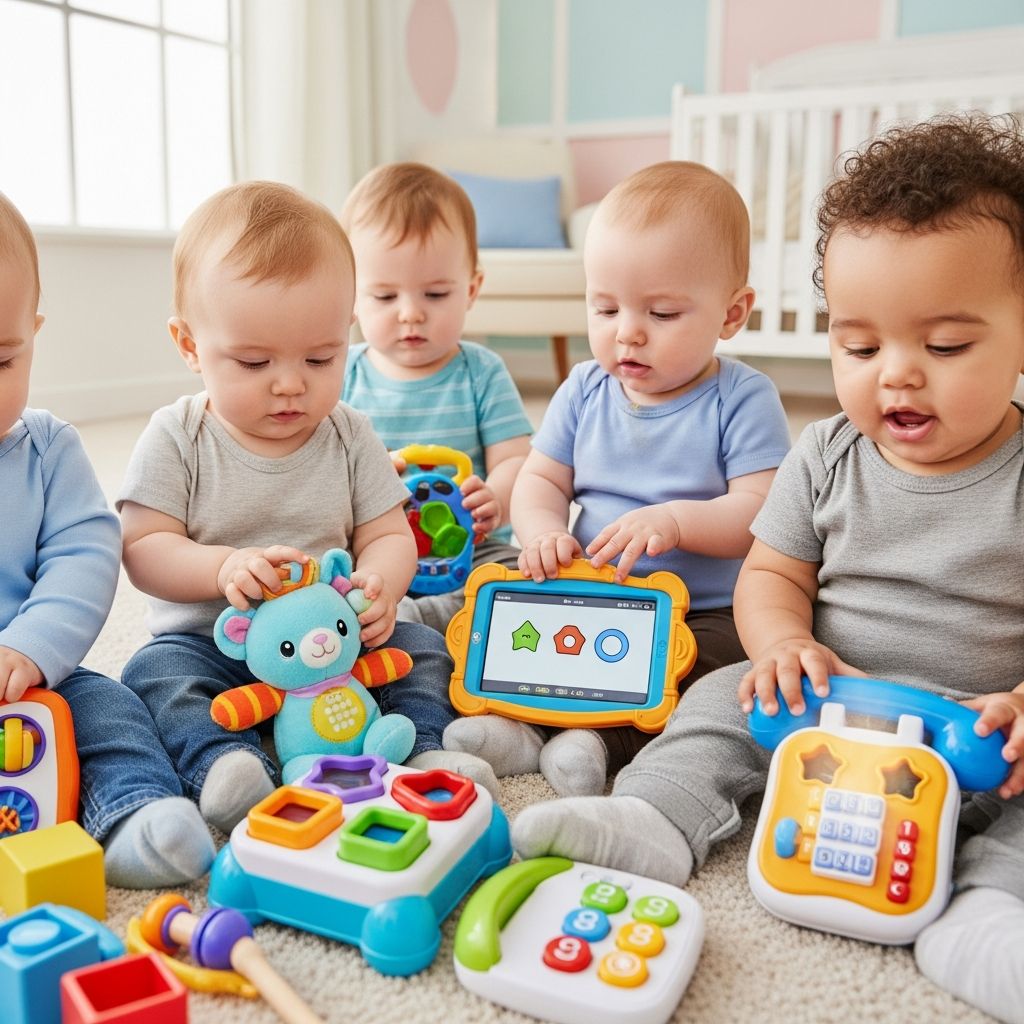
Electronic toys, with their flashing lights, songs, and automated voices, captivate infants but may hinder language development by limiting meaningful parent-child conversations. Studies reveal that these gadgets reduce both the quantity and variety of words exchanged during play, potentially slowing verbal skill acquisition in babies.
Understanding the Appeal and Hidden Drawbacks of Modern Toys
Today’s market overflows with interactive tech toys promising educational benefits for babies. These devices buzz, sing, and respond to touches, drawing young eyes and ears. Parents often view them as modern necessities for stimulation. However, peer-reviewed research indicates a downside: they disrupt the natural back-and-forth dialogue essential for language learning.
During typical play with simple toys like blocks or dolls, caregivers describe actions, label objects, and respond to a baby’s cues, fostering vocabulary growth. In contrast, electronic toys dominate the interaction. Lights and sounds overpower subtle child vocalizations, leaving less space for parental input or child output. A study involving toddlers aged 2-5 years, including those with autism spectrum disorder (ASD) and typically developing (TD) peers, found significantly fewer utterances and unique words per minute during electronic play compared to traditional toys.
Research Evidence: Quantifying the Language Gap
Scientific investigations consistently highlight diminished language during tech toy sessions. In one controlled experiment, parent-child dyads played with both toy types. Children produced over twice as many utterances with traditional toys—averaging 10 per minute versus 4 with electronics for some participants. Lexical diversity, measured by unique word roots, also dropped sharply.
| Toy Type | Avg. Child Utterances/Min (ASD) | Avg. Child Utterances/Min (TD) | Unique Words/Min |
|---|---|---|---|
| Traditional | ~10 | Higher baseline | Increased diversity |
| Electronic | ~4 | Significantly reduced | Decreased diversity |
This table summarizes key findings from a National Institutes of Health-funded study, showing uniform impacts across developmental groups.
Parents mirrored this pattern, speaking less and using fewer varied words. Phrases like “parents let the toys do the talking” capture the phenomenon, as noises from toys create pauses and reduce conversational turns. Earlier work with infants 10-16 months old confirmed fewer parent responses and child vocalizations with electronics.
Why Tech Toys Silence Conversations
- Distraction Factor: Flashing elements and sounds divert attention from human voices, key for mimicking speech patterns.
- Reduced Responsiveness: Caregivers engage less in teaching behaviors, offering fewer learning opportunities.
- One-Way Communication: Toys monologue, unlike bidirectional play that builds syntax and vocabulary.
- Pause Intervals: Electronic play features longer silences, stunting practice of language skills.
These dynamics matter because infants learn language through rich, responsive exchanges. Less input means slower progress in word recognition, sentence formation, and expressive speech.
Promoting Language Through Everyday Play Strategies
To counter tech toy limitations, experts advocate “toy talk”—a research-backed method enhancing syntactic development. Unlike traditional techniques focusing on actions, toy talk emphasizes describing toys’ attributes, positions, and fictional actions using full noun phrases.
Developed by University of Illinois researchers, toy talk trains parents to say things like “The red truck zooms fast down the ramp” instead of pronouns. A three-month intervention study showed parents increased such sentences, predicting children’s growth in diverse simple sentences over six months.
Combine toy talk with proven strategies:
- Responsive Labeling: Name objects as baby interacts, e.g., “Soft teddy bear!”
- Self-Talk: Narrate your actions: “Mommy stacks the blocks high.”
- Parallel Talk: Echo child’s play: “You’re rolling the ball!”
Integrating these during traditional play maximizes word exposure, crucial since diverse noun subjects help toddlers grasp sentence structure.
Choosing Toys That Spark Real Dialogue
Prioritize open-ended toys encouraging imagination and conversation:
- Wooden puzzles and shape sorters for problem-solving talk.
- Soft animals for pretend scenarios and emotion labeling.
- Blocks or nesting cups for counting and spatial descriptions.
- Simple musical instruments where parent-child duets emerge.
Avoid toys with pre-recorded speeches. If electronics are present, actively override: pause sounds, ask questions like “What does the cow say?” or expand on toy prompts to reclaim interaction.
Long-Term Implications for Speech Milestones
Consistent high-quality language input from birth to age 3 shapes lifelong communication. Tech toys’ reduction in turns and diversity could delay milestones like 50-word vocabulary by 18 months or two-word combinations by 24 months. Children practicing less miss chances to refine articulation and grammar.
For vulnerable groups like those with ASD, impacts amplify, as play-based interventions are vital. Yet, even TD children show uniform declines, underscoring universal needs for human-led play.
Practical Tips for Language-Boosting Playtime
- Schedule daily 15-20 minute toy sessions without screens or distractions.
- Model enthusiasm: Use exaggerated tones, varied pitches to engage baby.
- Follow baby’s lead: Expand on babbles, e.g., baby points—”Yes, big blue ball!”
- Rotate toys weekly to maintain novelty and descriptive opportunities.
- Track progress: Note new words weekly to celebrate gains.
These habits build neural pathways for fluency, outperforming passive toy features.
Frequently Asked Questions
Do all electronic toys harm language development?
Not inherently, but most reduce interactive talk. Choose ones requiring parental narration, and limit use.
At what age do tech toys pose risks?
From infancy through toddlerhood (0-3 years), when language foundations form most rapidly.
Can toy talk replace other methods?
No—integrate it with labeling and parallel talk for comprehensive growth.
How much traditional play is ideal daily?
20-30 minutes of focused, language-rich interaction suffices for gains.
What if my baby loves tech toys?
Incorporate them sparingly; pair with your voice to model speech and maintain bonds.
Balancing Technology and Timeless Play
While tech toys entertain, they cannot replicate human connection’s power in language nurturing. By favoring traditional play and strategies like toy talk, parents empower babies toward robust verbal skills. Research affirms: quality interactions trump gadget gimmicks every time.
References
- Electronic Toys Decrease the Quantity and Lexical Diversity of … – NIH — National Library of Medicine. 2022-07-05. https://pmc.ncbi.nlm.nih.gov/articles/PMC9286016/
- Are Electronic Toys “Bad” for Children’s Development? — Parenting Translator. 2023-08-15. https://parentingtranslator.substack.com/p/are-electronic-toys-bad-for-childrens
- Toy Talk promotes language development — University of Illinois. 2016-01-01. https://ahs.illinois.edu/toy-talk-promotes-language-development/