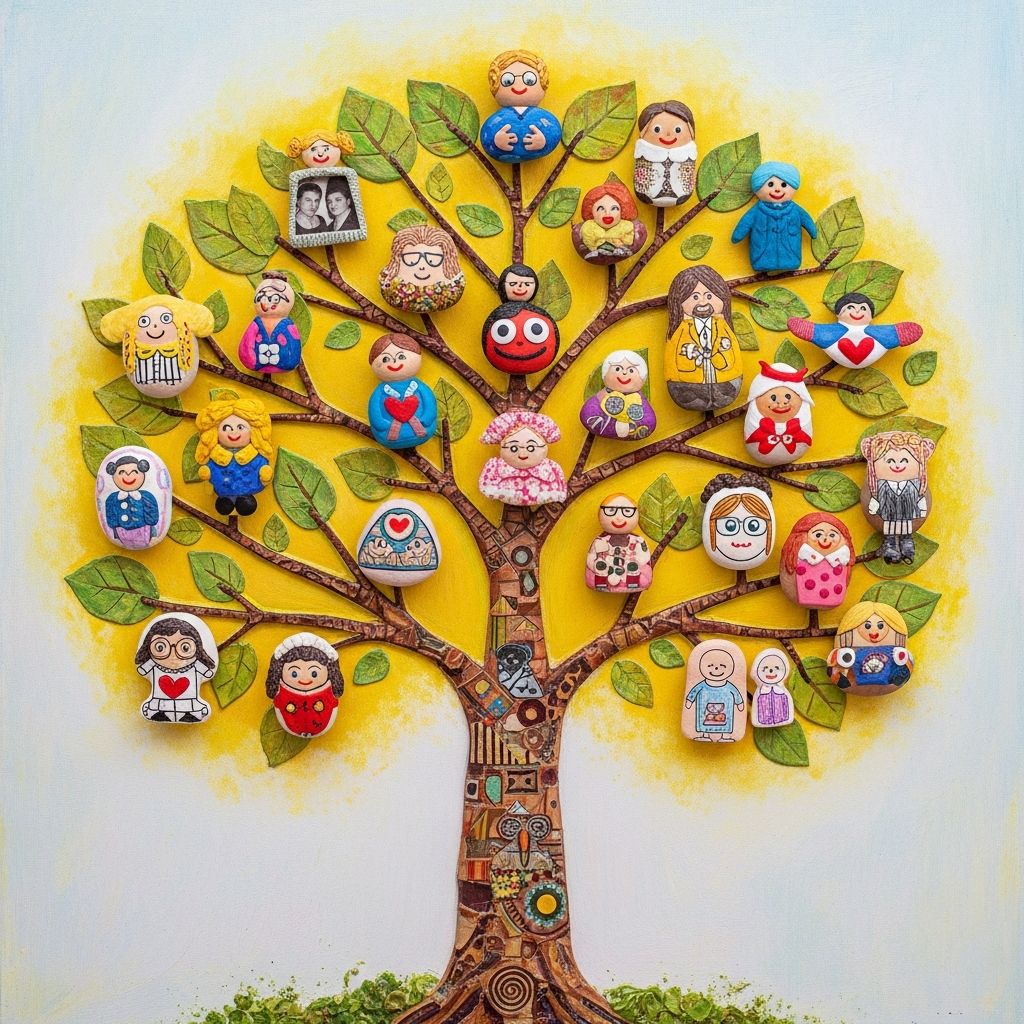
Family trees do more than list names and dates. When you turn them into artwork, they can become daily reminders of love, connection, and shared stories that kids and adults can enjoy together.
This guide shares fresh, creative ideas for transforming your family history into beautiful art projects. You will find options that are simple enough for preschoolers, stylish enough for your living room wall, and flexible for all kinds of modern families.
Why Make a Family Tree as Art?
Creating a family tree as artwork blends creativity with genealogy. Instead of hiding old documents in a folder, you turn family information into something you can see, touch, and talk about every day.
- Visual connection: Children understand relationships more easily when they see them drawn out in front of them.
- Conversation starter: Art on the wall naturally leads to stories about grandparents, migration, and traditions.
- Sense of belonging: Studies in developmental psychology highlight that knowing family history can support a child’s identity and resilience.
- Shared activity: Arts and crafts projects can strengthen communication and cooperation in families.
Planning Your Family Tree Artwork
Before you pull out glue and paint, take a few minutes to plan. A basic plan makes the craft smoother and helps you choose the right format for your space and your family story.
Decide Who to Include
There is no rule that says you must include every branch. Choose based on your goals and the age of your children.
- Simple tree: Child, parents, siblings, and maybe grandparents.
- Expanded tree: Add aunts, uncles, cousins, stepfamilies, and close family friends.
- Generational tree: Focus on grandparents and great-grandparents, even if the child never met them.
Pick a Style That Fits Your Space
| Style | Best For | Difficulty |
|---|---|---|
| Paper poster or canvas | Kids’ rooms, classroom displays | Easy |
| Framed print | Living room or hallway decor | Moderate |
| Mixed-media collage | Families who love crafting | Moderate–Advanced |
| Digital design | Sharing online or printing multiples | Moderate |
Gather Basic Supplies
You can make meaningful family tree art with very simple materials you already have.
- Thick paper, cardstock, or canvas board
- Pencils, markers, crayons, or watercolor paints
- Glue stick or liquid glue
- Scissors (kid-safe for young artists)
- Scrapbook paper or colored paper for leaves and labels
- Printed or photocopied family photos (if desired)
Kid-Friendly Family Tree Projects
Children learn best when they create with their hands. These family tree projects are designed for a range of ages, from toddlers to older elementary kids.
1. Handprint Roots Tree
This project uses your child’s hand as the tree trunk and branches, turning their unique print into the center of the family story.
How to make it:
- Trace your child’s hand and forearm on a sheet of paper to form the trunk and branches.
- Color or paint the traced area brown.
- Cut out leaf shapes from colored paper.
- Write family members’ names on the leaves and glue them around the fingertips and above the “branches.”
- Invite your child to add details like birds, hearts, or favorite family symbols.
Why kids love it: The tree literally grows out of their own handprint, making the project highly personal.
2. Shape and Sticker Family Tree
For very young children, pre-cut shapes and stickers keep things fun and frustration-free.
- Draw or print a simple tree outline with a trunk and large round canopy.
- Prepare circles, hearts, or stars from cardstock.
- Write each family member’s name on a shape.
- Let your child place the shapes onto the tree with glue dots or stickers.
- Optional: Color-code sides of the family (one color for one side, another color for the other).
This type of hands-on activity can help develop fine motor skills and hand-eye coordination in young children.
3. Story-Rich Photo Tree
Once children can handle scissors safely, adding photos opens the door to rich storytelling.
- Sketch a large tree trunk and branches on poster board.
- Print small head-shot photos of family members.
- Mount each photo on a small square or leaf of colored paper.
- Label with the person’s name and relationship (for example: “Aunt Maya”).
- Glue photos on branches, grouping nuclear families together.
Hang the finished piece at kid height to encourage everyday questions and conversations about relatives.
Creative Styles for Every Kind of Family
Families come in all shapes and sizes. These design ideas help you honor blended, adoptive, and extended families in ways that feel inclusive and joyful.
Symbol-Based Trees
Instead of focusing on strict branches, you can represent relationships using symbols.
- Hearts for households: Put people who live in the same home inside one large heart.
- Lines and arrows: Use different styles of lines to show biological, adoptive, or step relationships.
- Icon clues: Add tiny icons to show shared interests (music note, soccer ball, book).
Circle or Galaxy Layout
In a circular or galaxy-style design, no one is at the “top.” The focus is on how everyone connects.
- Place the child or household in the center circle.
- Draw rings or “orbits” around the center for close family, extended family, and ancestors.
- Connect people with curving lines, almost like a constellation map.
This can be especially helpful for children in adoptive or blended families who may have more than one central set of caregivers.
Timeline and Milestone Tree
A milestone tree combines a family tree with important life events.
- Draw a wide trunk and label it with your family name.
- On the trunk or lower branches, note key dates: marriages, moves, adoptions, graduations.
- Use separate leaves for each event, including a short note or symbol (for example: a small house for the year you moved).
This approach helps children connect family members with real historical moments, giving context to your story.
Decor-Ready Family Tree Art for Adults
If you want something polished enough for your living room wall, these ideas balance sentimentality and style.
Monochrome Silhouette Tree
For a modern look, skip bright colors and stick to a limited palette.
- Paint or print a simple black or dark-gray tree silhouette on white or cream cardstock.
- Use small, consistent labels for names and dates.
- Add subtle accents like gold ink for marriage lines or silver dots for important years.
- Frame with a wide mat to give the artwork breathing room.
Fabric or Embroidered Family Tree
A textile-based tree adds warmth and texture.
- Draw a tree on fabric with a fabric marker or light pencil.
- Stitch the trunk and branches with simple embroidery stitches.
- Embroider names directly or add small fabric leaves with names written in permanent fabric pen.
- Stretch the fabric over a frame or embroidery hoop for display.
Textile projects can become heirlooms that are passed down just like the stories they represent.
Digital Tree for Easy Updates
If your family is growing quickly, a digital design might be the most practical option.
- Use a simple graphic design tool to create a tree or branching chart.
- Type names and dates so you can easily edit later.
- Save the file in high resolution for printing and share copies with relatives.
- Update the file as babies are born or relationships change.
Digital formats make it easy to maintain accurate, legible records of your family history, which genealogists recommend for long-term documentation.
Making the Process Meaningful
The real value of family tree artwork is not only the final piece on the wall, but the conversations and memories you create while working on it.
Gather Stories While You Craft
- Call or video chat older relatives while you add their names.
- Ask open-ended questions, such as “What games did you play as a child?” or “What was school like for you?”
- Jot down short memories on the back of the art or in a notebook you keep nearby.
Research in family psychology suggests that children benefit from knowing both positive and challenging stories from their family’s past, as long as they are shared in an age-appropriate way.
Adapt for Different Ages and Abilities
Every family member can participate, regardless of age or artistic skill.
- Toddlers: Let them stick pre-cut leaves or dab paint in leaf shapes with a sponge.
- School-age kids: Put them in charge of writing names or drawing symbols.
- Teens: Invite them to handle layout, digital design, or research.
- Adults and elders: Contribute stories, dates, and historical context.
Protect and Store Your Artwork
Once your project is finished, a little care will help it last.
- Use acid-free paper or backing when possible to slow yellowing over time.
- Keep originals out of direct sunlight to prevent fading.
- Photograph or scan the artwork so every branch of the family can have a copy.
Frequently Asked Questions (FAQs)
How many generations should I include in a family tree artwork?
For a first project, two to three generations (child, parents, grandparents) is usually enough. You can always add more branches later or create a second artwork focusing on earlier ancestors.
What if I do not have information about one side of the family?
You can leave space blank, use symbols instead of names, or focus on the people you do know. Some families include a phrase like “Stories still to discover” where information is missing to keep the tone hopeful and open-ended.
How can I make my family tree inclusive of step, adoptive, or chosen family?
Use visual cues such as different line styles, colors, or icons to represent various kinds of relationships. Make your definition of “family” clear to your child: anyone who loves and cares for them can appear on the tree.
Do I need artistic talent to make a nice family tree?
Not at all. Simple shapes, clear labels, and a limited color palette often look cleaner than very detailed drawings. You can also trace a tree outline, use stencils, or create your design digitally.
How can I turn this into a school or classroom project?
Provide a basic tree template and let each student fill in as much as they comfortably can. Emphasize that families can look very different and that including supportive adults—such as guardians or grandparents—is welcome.
References
- Do You Know? The power of family history in adolescent identity and well-being — Marshall Duke & Robyn Fivush, Journal of Family Life. 2013-01-01. https://dx.doi.org/10.1080/15295192.2012.707012
- Arts and Crafts: Helping Children Develop — Michigan State University Extension. 2016-02-22. https://www.canr.msu.edu/news/arts_and_crafts_helping_children_develop
- Developing fine motor skills — Raising Children Network (Australian Government–funded). 2023-04-19. https://raisingchildren.net.au/babies/development/development-tracker/fine-motor-skills
- Guidelines for Preserving Family Papers — U.S. National Archives. 2019-09-23. https://www.archives.gov/preservation/family-archives
- How to Preserve Family Papers and Photographs — Library of Congress. 2019-05-01. https://www.loc.gov/preservation/family