Construction paper is one of the most affordable, flexible, and kid-friendly art supplies you can keep at home. With a few sheets, some kid-safe scissors, and glue, families can create activities that support creativity, coordination, and early learning while having fun together.
This guide gathers **creative construction paper craft ideas** inspired by classic projects, but organized in a fresh way to help you quickly choose the right activity for your child’s age, interests, and energy level.
Why Construction Paper Crafts Matter for Kids
Crafting with construction paper is more than a way to pass time indoors. It quietly supports key areas of development:
- Fine-motor skills: Cutting, tearing, folding, and gluing help strengthen small hand muscles needed for writing.
- Hand–eye coordination: Lining up shapes, matching edges, and placing pieces with glue reinforce control and precision.
- Early math and geometry: Working with shapes, patterns, and symmetry naturally introduces math concepts.
- Language and storytelling: Kids often narrate what they make, building vocabulary and narrative skills.
- Emotional regulation: Repetitive actions like weaving or tearing can be calming and help kids manage big feelings.
Research on arts in childhood shows that engaging in making and creating can support problem-solving, flexible thinking, and persistence when tasks feel challenging.
Essential Supplies for Paper Craft Time
You do not need a fully stocked craft closet to get started. A small, reliable set of materials will carry you through dozens of projects.
- Construction paper: A mix of bright and neutral colors; heavier than printer paper, easier for small hands to grip.
- Child-safe scissors: Blunt-tip scissors sized for kids, with adult supervision for younger children.
- Glue sticks or liquid glue: Glue sticks are less messy for quick crafts; liquid glue works better for layered projects.
- Crayons, markers, or colored pencils: For drawing details, faces, and backgrounds.
- Optional extras: Tape, yarn, string, paper plates, cardboard tubes, and stickers for added dimension.
Choosing Crafts by Age and Ability
| Age Range | Recommended Skills | Best Craft Types |
|---|---|---|
| Preschool (3–4) | Simple tearing, gluing, basic shape recognition | Tear-and-stick mosaics, simple puppets, paper crowns |
| Early Elementary (5–7) | Basic cutting, pattern following, folding in half | Paper chains, weaving mats, simple pop-up cards |
| Upper Elementary (8–10) | More precise cutting, planning, multi-step projects | Paper sculptures, mobiles, layered scenes |
| Tweens & Up | Fine detail work, longer attention span | Quilling-inspired designs, complex 3D builds, decor pieces |
Quick-Start Projects: 10-Minute Paper Ideas
On days when attention spans are short, try these **fast, low-prep projects** that use only paper, scissors, and glue or tape.
- Colorful paper chains: Cut strips and loop them together to decorate a bedroom, reading corner, or party.
- Instant paper crowns: Cut a long strip, snip triangles or arches along one side, decorate, and tape into a ring.
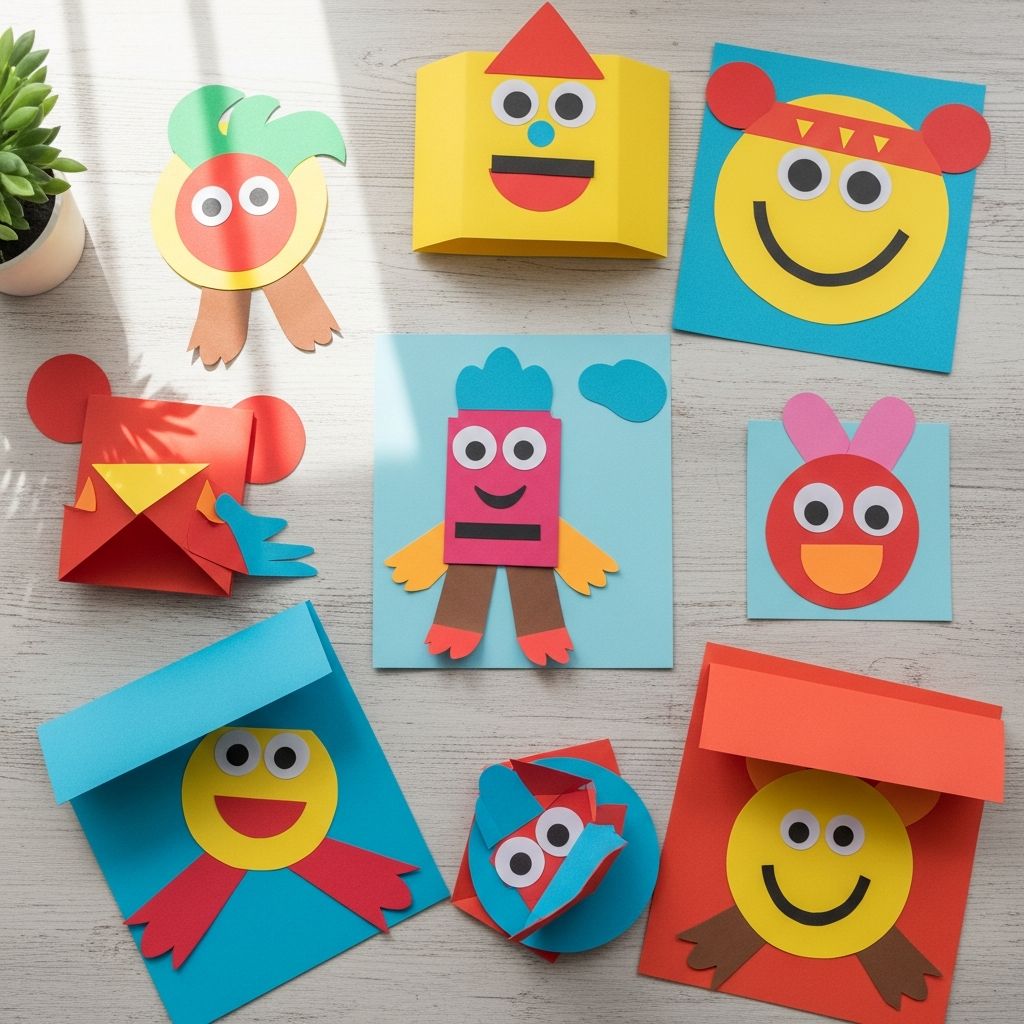
- Shape collage pictures: Pre-cut circles, squares, and triangles; let kids turn them into animals, vehicles, or cityscapes.
- Folded mini-books: Fold a piece of paper into quarters, staple the spine, and invite kids to write and illustrate a tiny story.
- Simple bookmarks: Rectangles of paper decorated with doodles, stickers, or glued shapes.
Theme 1: Animals and Creatures from Paper
Many kids love animals, so animal crafts are an easy way to invite even reluctant crafters to join in.
Layered Paper Pets
Turn simple shapes into favorite pets using circles, ovals, and rectangles.
- Use large circles for heads and smaller circles for cheeks or paws.
- Cut triangle ears for cats or floppy curves for dogs.
- Draw or glue on eyes, noses, and whiskers.
This style invites experimentation: kids can invent imaginary creatures, mix colors, or create entire families of animals.
Flapping or Wiggling Creatures
Introduce motion by attaching parts with tape loops or paper fasteners.
- Create long, folded bodies for snakes that wiggle when gently lifted.
- Attach wings to birds with small tape hinges so they can flap.
- Make frogs or fish that dangle from yarn and move like puppets.
Theme 2: Paper Landscapes and Mini Worlds
Construction paper is perfect for building simple 2D and 3D worlds for imaginative play.
Flat Story Scenes
Invite kids to build a scene and then tell a story about it:
- Use blue, green, and brown paper as sky, grass, and ground.
- Add houses, trees, and people from cut-out shapes.
- Encourage kids to name their town, park, or island and describe what happens there.
Stand-Up Paper Worlds
For a small engineering challenge, transform flat pictures into stand-up scenes.
- Cut out trees, animals, or buildings.
- Attach a folded strip of paper at the bottom like a kickstand.
- Arrange them on a table or large sheet of cardboard to create a small play world.
Projects like these help kids experiment with simple stability and balance concepts while they play.
Theme 3: Shape, Color, and Pattern Play
Paper makes abstract concepts like patterns and symmetry hands-on and concrete for children.
Easy Paper Weaving
Paper weaving is a classic activity that strengthens fine-motor skills and understanding of patterns.
- Cut slots in one sheet (the “loom”) and weave strips over-under.
- Use alternating colors to highlight the pattern.
- Trim the edges and turn the weaving into a placemat, bookmark, or card front.
Tear-and-Glue Mosaics
Instead of cutting, younger kids can **tear** paper into small pieces to create mosaics.
- Draw a simple outline (like a heart, star, or fruit) on heavier paper.
- Invite kids to fill the shape with torn paper bits in similar or contrasting colors.
- Older children can sort pieces by color first to create more detailed designs.
Tearing is easier than cutting for many preschoolers and still supports motor control and grip strength.
Theme 4: Functional Crafts Kids Can Use
Children are often more invested in projects they can **wear, display, or use** in daily life.
Wearable Paper Creations
- Paper bracelets and rings: Loop strips around wrists or fingers and tape; decorate with small cut-out shapes as “gems.”
- Simple masks: Cut a mask base, add eye holes, ears, or horns, and tie with yarn. Adult help is recommended for cutting near eyes.
- Party accessories: Make badges, medals, or ribbons to celebrate small achievements at home.
Desk and Room Decorations
- Hanging garlands: Tape or glue shapes onto string to hang in a window or over a bed.
- Paper pinwheels (decorative only unless safely mounted): Fold and secure on a stick; display in a cup of rice or sand.
- Mini signs: Kids can label drawers, toy bins, or shelves with illustrated paper labels.
Theme 5: Seasonal and Holiday Paper Projects
Construction paper crafts can become part of annual family traditions, marking seasons and celebrations.
- Spring: Layer petal shapes into flowers, add green stems, and tape to a window for an indoor “garden.”
- Summer: Make paper “ice pops,” suns, or underwater scenes to decorate a fridge or playroom.
- Autumn: Trace and cut handprint “leaves” in warm colors and cluster them as a wreath.
- Winter: Fold and cut paper snowflakes, glue them onto darker paper, or hang them from yarn.
- Birthday celebrations: Homemade banners, hats, and centerpieces crafted by kids make parties feel personal.
Keeping Craft Time Low-Stress for Adults
Parents sometimes avoid crafts because of mess or preparation. A few strategies can make the experience smoother and more enjoyable.
- Use a “craft tray”: Work on a plastic tray or old baking sheet to contain scraps and glue drips.
- Do a 5-minute prep: Before inviting kids, quickly gather supplies and pre-cut any tricky shapes.
- Set a time limit: Let kids know you have 20 or 30 minutes, so expectations are clear.
- Emphasize process over product: Focus on exploring and trying, not on picture-perfect results.
- Take photos: Capture finished projects in photos to reduce pressure to keep every single craft.
Safety Tips for Crafting with Kids
With a few precautions, construction paper crafts can be both fun and safe.
- Choose age-appropriate scissors: For young children, use blunt-tip, child-sized scissors and stay nearby.
- Store supplies safely: Keep scissors, glue, and small items out of reach when not in use.
- Encourage safe cutting habits: Teach kids to keep fingers behind the blades and cut while seated.
- Check for allergies: If a child has skin sensitivities, consider washable, non-toxic glue and markers.
Organizations focused on child safety emphasize supervision and developmentally appropriate tools when young children are using scissors and other craft materials.
Frequently Asked Questions (FAQs)
What makes construction paper different from regular printer paper?
Construction paper is typically thicker, more textured, and dyed in solid bright colors. The extra thickness makes it easier for young children to grasp, cut, and glue compared with smooth, thin printer paper, which tears more easily.
How can I make crafts work for kids of different ages at the same table?
Offer the same basic project, but adjust the steps. For example, with a paper mosaic, preschoolers can tear and glue random pieces, while older kids can cut precise shapes and create detailed designs. Let older children help younger ones with tracing or gentle cutting.
How often should kids do crafts to benefit their development?
There is no single “correct” frequency. Even short, regular sessions—15 to 30 minutes a few times a week—can support fine-motor development, creativity, and problem-solving. The key is providing consistent opportunities to explore materials and ideas.
What if my child gets frustrated when crafts don’t look like the example?
Normalize experimentation by talking about how artists try many ideas and that there is no single “right” outcome. Offer choices and let kids change colors or shapes. When needed, simplify the steps or provide extra pre-cut pieces so they can focus on arranging and decorating instead of tricky cutting.
Can construction paper crafts be educational without feeling like schoolwork?
Yes. You can casually weave in learning by naming shapes and colors, counting pieces, talking about patterns, or asking children to tell a story about what they made. These informal conversations support early literacy and numeracy without turning craft time into a lesson.
References
- Construction Paper Crafts for Kids to Make — How Wee Learn. 2023-02-10. https://www.howweelearn.com/construction-paper-crafts-for-kids-to-make/
- Construction Paper Crafts for Kids — Crayola. 2022-06-01. https://www.crayola.com/crafts/construction-paper-crafts
- The Arts and Achievement in At-Risk Youth — National Endowment for the Arts. 2012-03-30. https://www.arts.gov/sites/default/files/Arts-At-Risk-Youth.pdf
- Scissor Safety for Young Children — Nationwide Children’s Hospital. 2021-08-15. https://www.nationwidechildrens.org/specialties/occupational-therapy/scissor-skill-development-and-safety
- Arts Education and Positive Youth Development — U.S. Department of Education, Office of Innovation and Improvement. 2012-04-01. https://files.eric.ed.gov/fulltext/ED530822.pdf