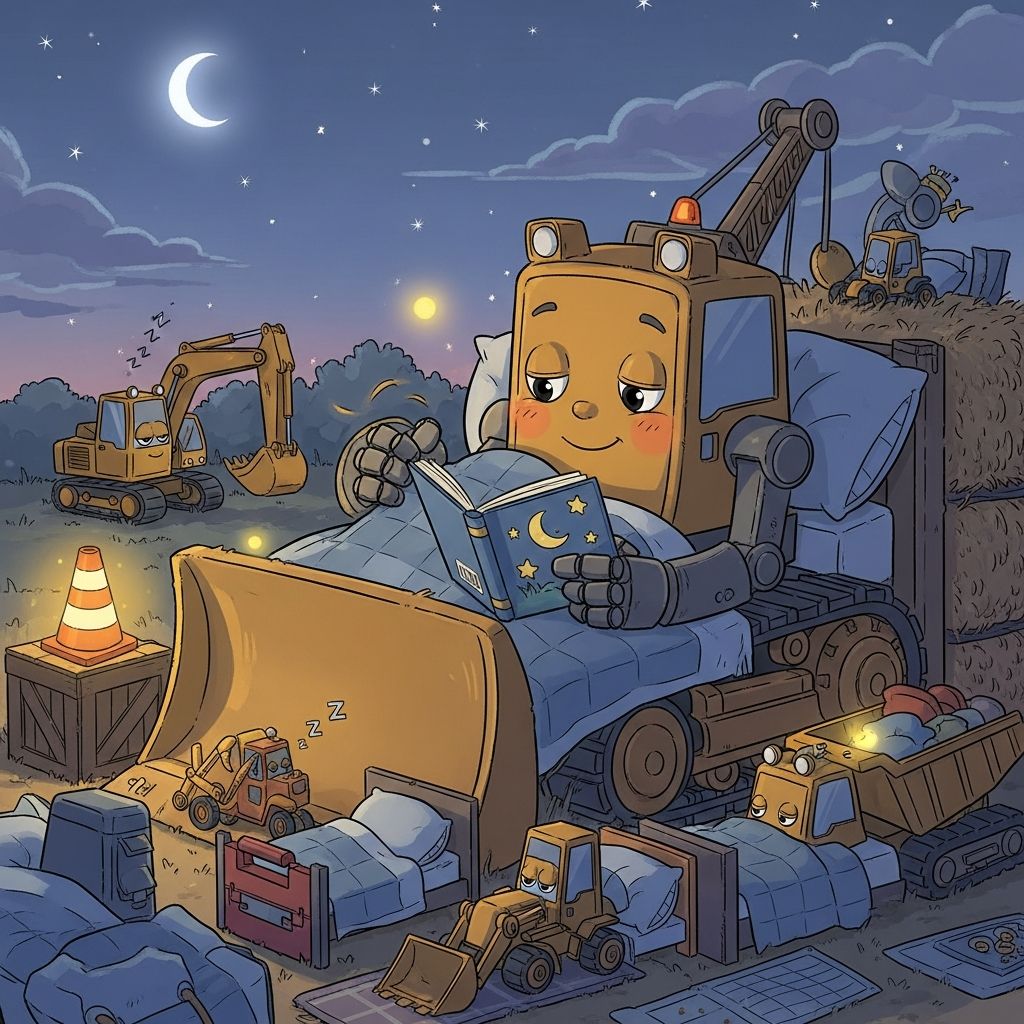
For many toddlers and preschoolers, the perfect bedtime ritual is built out of steel beams, rumbling engines, and a crew of hardworking trucks slowly powering down for the night.
Construction-themed bedtime books show big machines finishing their jobs, turning off their lights, and settling under the stars, giving energetic kids a gentle script for how to wind down their own busy bodies and minds.
Why Kids Love Sleepy Construction Stories
Young children are drawn to big machines because they represent power, movement, and clear purpose—everything a curious, energetic child feels inside.
When those same powerful vehicles yawn, dim their headlights, and curl up in a quiet construction yard, kids see that even the strongest workers need rest, making bedtime feel less like an interruption and more like part of the job.
Key Emotional Benefits
- Normalizes rest as a natural part of a busy day, not a punishment or abrupt stop.
- Models emotional regulation as trucks shift from noisy work to calm, sleepy routines.
- Gives anxious or high-energy kids visual cues that “slowing down” is expected and safe.
How Construction Stories Support Bedtime Routines
Books set on nighttime construction sites typically follow a predictable rhythm: hard work, sunset, clean-up, quiet, then sleep.
That familiar pattern mirrors a well-structured bedtime routine and helps children understand that bedtime is a sequence they can count on every night.
A Simple “Truck-Inspired” Bedtime Flow
- Finish the day’s “work”: Tidy toys together and “park” them like vehicles in a yard.
- Signal sunset: Dim lights in stages, just as the sun sets over the job site in many stories.
- Slow the engines: Use bath time or quiet play as the “cool-down” period.
- Story time in the yard: Snuggle up with a construction bedtime book, keeping your voice soft and steady.
- Lights out like headlights: Turn off lamps one by one and say goodnight to each “truck” (your child’s body parts, stuffed animals, or toys).
What Construction Bedtime Books Tend To Have In Common
Popular construction bedtime stories usually feature a small crew of distinct vehicles—like cranes, bulldozers, dump trucks, and cement mixers—each finishing one last task before settling down.
The language is often gentle and rhythmic, with repeated phrases and gradually softer descriptions that naturally guide kids from excitement toward sleepiness.
Common Elements That Help Kids Sleep
- Evening or sunset setting with fading light and slower action.
- One-by-one focus on each vehicle closing its day and resting.
- Soft rhymes, soothing repetition, and predictable page-turn patterns.
- Illustrations that move from bright, busy scenes to dark, starry stillness.
Character Types and What They Teach
Each construction vehicle in bedtime stories tends to represent a type of temperament or role that kids recognize in themselves: the leader, the helper, the heavy lifter, or the quiet detail-oriented worker.
Parents can use these personalities to talk about effort, teamwork, and rest in ways that feel fun rather than preachy.
| Vehicle Type | Typical Role in Stories | Lesson for Kids |
|---|---|---|
| Crane or tower crane | Careful lifter placing beams or big loads with precision. | Focus and patience matter more than rushing. |
| Dump truck | Hauls heavy loads all day, then empties the last one before bedtime. | It feels good to “empty out” worries or energy before sleep. |
| Bulldozer | Pushes and clears big piles, then parks after a final push. | Even strong kids need rest to be strong again tomorrow. |
| Excavator | Digs and shapes the land, often the most active worker. | Busy minds can slow down and dream instead of always doing. |
| Cement mixer | Turns and churns all day, then finally stops spinning at night. | Spinning thoughts and feelings can gently settle at bedtime. |
Practical Tips For Reading Construction Stories At Night
The way a bedtime book is read can matter as much as which book is chosen, especially when a child is keyed up from a long day.
With construction-themed stories, voice, pacing, and repetition can turn an already soothing book into a powerful winding-down tool.
Reading Strategies That Work
- Start with energy, end with whispers: Use a slightly more animated tone at the beginning of the book, then intentionally slow down and soften as the trucks get sleepy.
- Match your pace to the story: Linger on pictures of the darkening sky, tiny lights in windows, and curled-up machines.
- Use predictable refrains: If the story repeats a line or pattern when each truck goes to bed, encourage your child to say it with you as a calming chant.
- Connect to your child’s day: Pause briefly to say things like, “You worked hard building today, just like that bulldozer.”
Helping Reluctant Sleepers With Construction Imagery
Some children resist bedtime because their bodies still buzz with energy or their minds are busy reviewing the day.
Construction metaphors—like engines cooling, parking in the yard, or turning off headlights—can give kids concrete images for what “getting sleepy” actually looks and feels like.
Simple Phrases Parents Can Use
- “Let’s park your body like a tired dump truck and pull the covers up like a pile of soft dirt.”
- “Your eyes are like little headlights; they’re getting dimmer and dimmer.”
- “Your thoughts are spinning like a cement mixer; let’s help them slow down and settle.”
- “One more big stretch like a crane—and then we lower everything down to rest.”
Using Construction Stories To Talk About Feelings
Nighttime is often when worries and big emotions surface, because the distractions of the day fade away.
Construction bedtime books provide safe characters parents can use to explore feelings like frustration, pride, or fear of the dark without putting kids on the spot.
Conversation Starters After The Story
- “Which truck do you feel like today—busy excavator, strong bulldozer, or careful crane?”
- “Did any truck look a little nervous or tired before bed? When do you feel that way?”
- “What do you think your favorite truck dreams about when the job site is quiet?”
Adapting Construction Bedtime Themes For Different Ages
While many construction bedtime stories are written for toddlers and preschoolers, the themes can easily be adjusted for younger or older children.
The key is to match the level of detail, length, and emotional depth to your child’s developmental stage and attention span.
Ideas By Age Range
- Toddlers (1–3 years): Focus on naming trucks, making gentle sound effects, and using short, simple phrases about sleeping and quiet.
- Preschoolers (3–5 years): Emphasize team effort, routines, and how each truck finishes a job and then rests.
- Early elementary (5–7 years): Layer in conversations about responsibility, perseverance, and how rest helps the crew do even bigger projects tomorrow.
Creating Your Own Construction Goodnight Ritual
Even without a book in hand, parents can borrow the structure of construction bedtime stories to build a reliable nightly ritual.
Inventing a simple “job site” script can make kids feel like they are part of the same cozy world as their favorite storybook trucks.
Step-By-Step Ritual Blueprint
- Name the site: Decide that your child’s room is a “nighttime construction yard,” and that every evening, the crew returns here to rest.
- Assign roles: Let your child choose which truck they are and which adult is the “site supervisor” helping everyone rest.
- Do final tasks: Pretend to finish the last load, last lift, or last push while putting toys away.
- Inspect and park: Walk around the room together, checking that each “vehicle” (toy or stuffed animal) is safely parked.
- Say goodnight to the crew: One by one, say goodnight to trucks, tools, and finally to your child–the “hardest worker.”
FAQ: Construction Bedtime Stories
Are construction bedtime books too stimulating for sleep?
Most construction-themed bedtime stories are specifically written to wind down, not ramp up, with scenes that gradually quiet, darken, and soften in tone.
If a book feels too exciting at the start, balance it with slower page turns, a calm voice, and dim lighting to maintain a sleepy mood.
What if my child only wants construction stories every night?
It is common for young children to latch onto a favorite theme and request it repeatedly, and this repetition can actually make bedtime feel safer and more predictable.
Parents can gently introduce small variations—like different trucks, new jobs, or added details—while keeping the basic structure that their child finds comforting.
Can construction stories help with daytime behavior too?
Yes; many of the same themes that support bedtime—teamwork, perseverance, and knowing when to rest—apply to challenges at the playground, in preschool, or at home.
Referencing a favorite truck’s choices during the day gives kids a familiar model for sharing, taking turns, and calming down when frustrated.
How do I choose a good construction bedtime book?
Look for stories with clearly defined characters, gentle pacing, and artwork that moves from bright day scenes to peaceful night scapes.
Preview a few pages to see if the language feels soothing and if the story closes on a calm, reassuring final image of the job site at rest.
What if my child is scared of the dark or loud machines?
Construction bedtime stories can show big machines being kind, careful, and cozy, which softens their image and helps children feel safer.
Highlight scenes where trucks appear small under the stars or snuggled into the ground, and connect them to your child’s own safe, warm bed.
Building Calmer Nights, One Truck At A Time
When parents pair predictable bedtime routines with the comforting world of sleepy cranes and resting bulldozers, bedtime becomes less of a battle and more of a shared ritual.
Construction bedtime stories give families language, imagery, and structure that help children feel capable of putting their own “engines” into park, night after night.