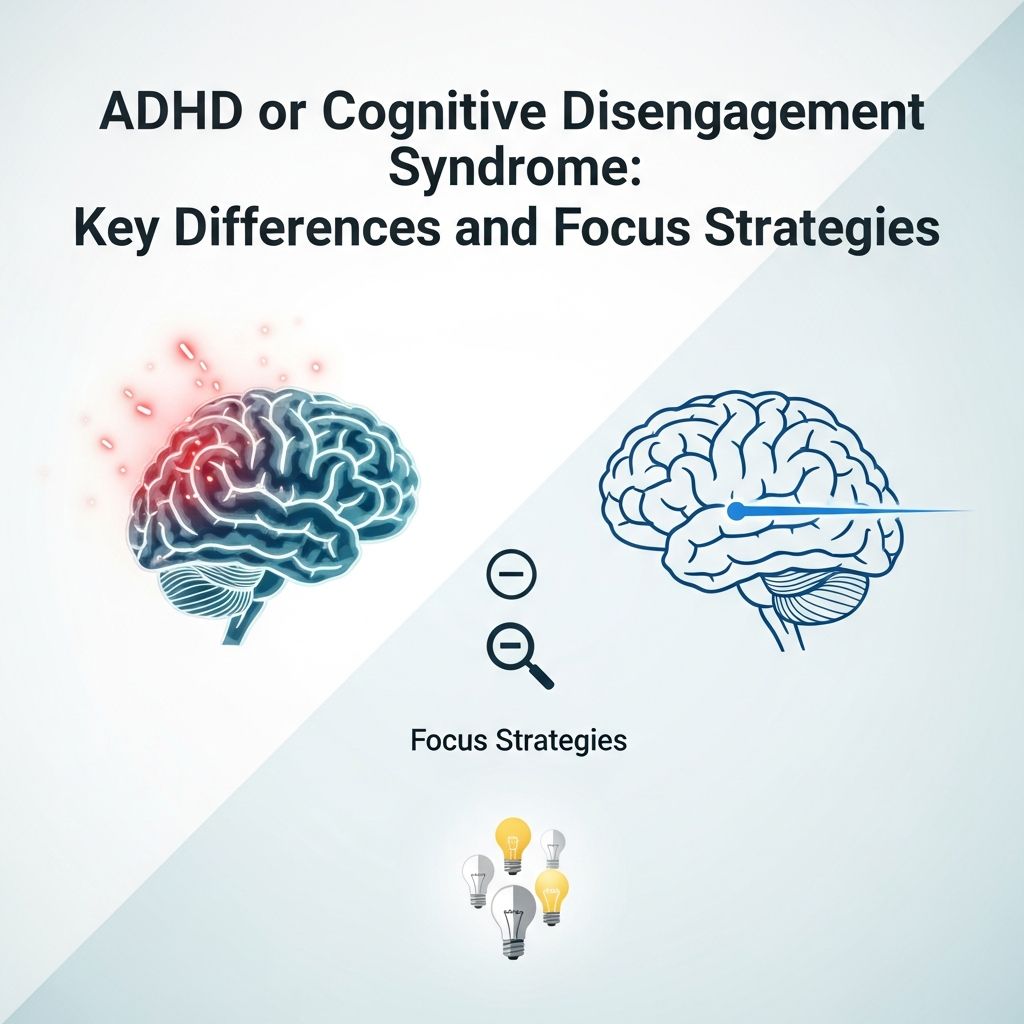
Cognitive Disengagement Syndrome (CDS), previously known as Sluggish Cognitive Tempo (SCT), represents a distinct attention-related condition characterized by daydreaming, mental fogginess, and slowed processing, separate from traditional ADHD symptoms. While overlapping with ADHD’s inattentive presentation, CDS features unique profiles like hypoactivity and internalizing issues, affecting 40-50% of cases independently or comorbidly.
Defining Cognitive Disengagement Syndrome and Its Core Traits
CDS manifests through persistent daydreaming, lethargy, confusion, and slow behavioral responses, differing from ADHD’s hyperactive or impulsive traits. Research from a national U.S. sample of over 2,000 children shows CDS symptoms load distinctly on their own factor, with minimal overlap on ADHD-inattentive or hyperactive-impulsive factors (mean loadings: SCT .75, ADHD-IN .06, ADHD-HI .03). Children with CDS often appear sleepy or hypoactive, impacting cognitive tasks without the executive function deficits typical in ADHD.
Two primary dimensions define CDS: a ‘daydreamy-confused’ factor hindering cognitive performance and a ‘sluggish-sleepy’ factor linked to motor slowness and reduced processing speed. Unlike ADHD, CDS does not severely impair executive functions like planning or inhibition, but it correlates with slower reaction times and attention shifting issues, as seen in fMRI studies showing hypoactivity in brain regions like the superior parietal lobule (SPL).
How CDS Differs from ADHD Inattention
ADHD inattentive type involves careless mistakes, difficulty sustaining attention, and disorganization, while CDS emphasizes excessive mind-wandering, drowsiness, and low energy. Categorical analyses reveal 52% of CDS cases do not meet ADHD criteria, and 65% of ADHD cases lack CDS elevation. SCT-only children exhibit higher anxiety, depression, sleep issues, and social shyness than ADHD-only peers, who show more oppositional defiant disorder (ODD) and executive dysfunction.
| Aspect | CDS (SCT) | ADHD Inattentive |
|---|---|---|
| Symptoms | Daydreaming, fogginess, hypoactivity, slow processing | Forgetfulness, distraction by stimuli, poor task follow-through |
| Activity Level | Low energy, sleepy appearance | Restless, fidgety |
| Comorbidities | Anxiety, depression, sleep problems | ODD, executive deficits |
| Brain Correlates | SPL hypoactivity (attention shifting) | SMA/thalamus issues (response prep) |
| Prevalence Overlap | 44-54% co-occur | 27-35% co-occur |
This table summarizes distinctions from peer-reviewed data; CDS developmental trajectory shows slight symptom increases into adolescence, unlike declining ADHD hyperactivity.
Prevalence, Comorbidity, and Long-Term Outcomes
In children, about 59% with CDS meet ADHD criteria, and 39% of ADHD cases show CDS traits, dropping to 46% and 54% in adults, indicating ~50% comorbidity. CDS uniquely ties to internalizing disorders like depression over anxiety, with modest sleep links, and persists into adulthood with poorer socioemotional adjustment. Academically, CDS impacts math, reading, and writing more than general achievement after ADHD controls, due to processing slowness.
- Internalizing Risks: CDS groups report elevated conflicted shyness and friendship issues similar to ADHD, but with greater emotional distress.
- Functional Impairment: Both conditions yield comparable social and academic challenges, underscoring need for targeted interventions.
- Diagnostic Overlap: 28-46% of elevated CDS avoid ADHD or depression diagnoses, supporting independent status.
Diagnostic Challenges and Assessment Approaches
Differentiating CDS from ADHD requires multi-informant scales measuring daydreaming, slowness, and fogginess alongside standard ADHD tools. Normative SCT scale data from large samples aids clinical cutoffs (top 5% elevation). fMRI evidence highlights CDS-specific neural hypoactivity in attention networks, aiding research validation. Clinicians should probe motivation, energy, and processing speed, as CDS lacks ADHD’s impulsivity.
Developmentally, CDS symptoms may intensify across childhood, contrasting ADHD’s plateauing inattention. Comprehensive evaluations include executive function tests, where ADHD shows deficits but CDS does not, and sleep/ mood screens for internalizing comorbidities.
Practical Strategies to Boost Focus and Engagement
Targeted interventions for CDS emphasize arousal, structure, and engagement over ADHD’s behavior management.
- Environmental Modifications: Minimize distractions with quiet zones; use timers for short, high-interest tasks to combat lethargy.
- Movement Integration: Incorporate brief physical activity breaks to counter hypoactivity and enhance alertness, unlike ADHD’s need for constant motion.
- Motivational Techniques: Pair tasks with rewards tied to completion speed; build self-esteem through mastery experiences addressing low energy.
- Cognitive Supports: Teach processing speed aids like visual checklists and chunked instructions to offset slowness.
Daily routines with consistent wake times combat sleep issues; mindfulness for daydreaming reduces mind-wandering. Parental modeling of focused behaviors fosters habits.
Supporting Academic and Social Success
CDS children benefit from extended processing time in schools, math/reading interventions, and peer social skills groups for shyness. Track progress with SCT-specific scales; combine with therapy for depression/anxiety. Long-term, early differentiation prevents mislabeling as ‘lazy,’ improving outcomes.
Frequently Asked Questions (FAQs)
What is the main difference between CDS and ADHD?
CDS involves daydreaming and slowness without hyperactivity, while ADHD inattentive type features distraction and disorganization; ~50% overlap exists.
Can a child have both CDS and ADHD?
Yes, 44-59% comorbidity rates occur, with combined groups showing highest symptom severity.
Does CDS affect school performance?
Yes, particularly math and reading due to slow processing, independent of ADHD effects.
How is CDS diagnosed?
Via validated scales assessing daydreaming/fogginess, alongside clinical history excluding other causes.
Are there medications for CDS?
No specific approvals; stimulants may help comorbid ADHD, but CDS focuses on behavioral strategies.
Emerging Research and Future Directions
Recent studies confirm CDS as a unique syndrome via factor analyses and neuroimaging, advocating DSM inclusion. Longitudinal data needed for adult outcomes; current evidence supports differentiated care for optimal child development.
References
- Sluggish Cognitive Tempo and ADHD Symptoms in a Nationally Representative Sample of U.S. Children — Becker SP et al. 2020-04-01. https://pmc.ncbi.nlm.nih.gov/articles/PMC7190416/
- Differentiating SCT and Inattentive Symptoms in ADHD Using fMRI During a Cognitive Control Task — McGrath LM et al. 2015-06-01. https://pmc.ncbi.nlm.nih.gov/articles/PMC4474281/
- ADHD vs Sluggish Cognitive Tempo – Differences in Deficit Disorders — Empowering Parents. 2023-01-01. https://www.empoweringparents.com/article/is-it-adhd-or-sluggish-cognitive-tempo-disorder-4-ways-to-help-your-child-focus/
- What ADHD is Not: Sluggish Cognitive Tempo — Dr. Steve Graham. 2022-01-01. https://www.drstevegraham.com/what-adhd-is-not-sluggish-cognitive-tempo/
- Sluggish Cognitive Tempo and ADHD: La Même Chose? — The Primary Care Companion for CNS Disorders. 2023-01-01. https://www.psychiatrist.com/pcc/sluggish-cognitive-tempo-adhd/