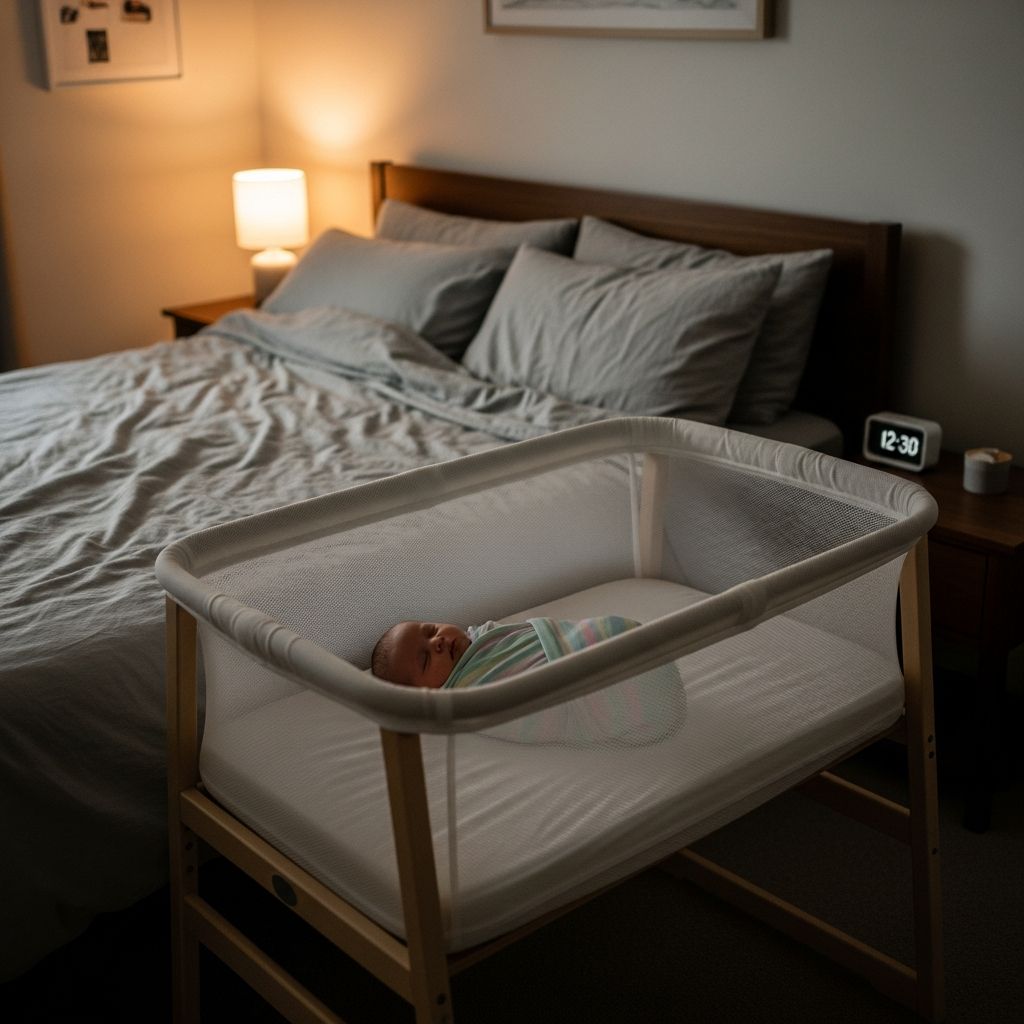
Sharing a room with your newborn can make nights easier and more reassuring, but it also raises a big question: how do you keep your baby close and safe? A dedicated baby co-sleeeper or bedside bassinet can bridge that gap when it is chosen and used correctly.
This guide explains what co-sleepers are, how they fit within expert safety recommendations, and what features matter most when comparing different models.
Co-Sleeping, Bed-Sharing, and Room-Sharing: What’s the Difference?
These terms are often used interchangeably, but they describe very different arrangements and safety levels.
- Bed-sharing: Baby and caregiver sleep on the same surface (usually an adult bed, sofa, or recliner). This is the arrangement most associated with increased risk of sudden infant death syndrome (SIDS), suffocation, and other sleep-related deaths.
- Room-sharing: Baby sleeps on a separate, dedicated sleep surface (crib, bassinet, or co-sleeper) in the same room as the caregiver. The American Academy of Pediatrics (AAP) highlights room-sharing (but not bed-sharing) as a way to reduce the risk of SIDS by up to 50%.
- Co-sleeping (broad sense): Any sleep arrangement where baby and caregiver sleep in close proximity. In medical literature, this can include both bed-sharing and room-sharing.
Co-sleepers as products are designed to support room-sharing, not bed-sharing. They allow your baby to have a separate sleep space while staying within arm’s reach.
Why Experts Recommend a Separate Sleep Surface
The AAP and multiple hospital systems strongly discourage bed-sharing in infancy because typical adult beds are full of hazards for newborns.
- Soft mattresses and pillows can block a baby’s airway or cause rebreathing of exhaled air, raising SIDS risk.
- Heavy blankets and duvets may cover a baby’s face, causing overheating or suffocation.
- Gaps and entrapment zones between mattress and headboard, wall, or furniture can trap a baby’s head or body.
- Adult body weight can compress or roll onto a baby, especially if caregivers are very tired or sedated.
Research has found that sharing an adult bed with an infant significantly increases the risk of SIDS and other sleep-related deaths, especially for babies under 3 months and for preterm or low-birth-weight infants.
In contrast, room-sharing with a separate surface like a crib, bassinet, or co-sleeper is associated with a substantially lower risk of sleep-related death and is the arrangement promoted by major pediatric organizations.
What Is a Baby Co-Sleeper?
A co-sleeeper is a baby sleep product that keeps your infant very close to your bed while still on a distinct, firm, and enclosed surface. Designs vary, but most fall into three broad categories.
| Type of Co-Sleeper | Where It Sits | Key Advantage | Primary Safety Goal |
|---|---|---|---|
| Bedside bassinet / side-car | On the floor, attached or adjacent to adult bed | Baby at same height as mattress, within reach | Maximize proximity while preserving separate surface |
| Freestanding bassinet in room | Near the bed, not physically attached | Flexible placement and easy to move | Standard bassinet with room-sharing convenience |
| In-bed “lounger” style | Directly on adult mattress | Attempts to create a baby zone in the adult bed | Often not recommended; hard to keep risk-free |
Most pediatric experts recommend the first two categories. In-bed products are harder to use safely because they still place baby on an adult sleep surface with adult bedding.
Core Safety Principles for Any Co-Sleeper
Regardless of the brand or style you choose, safe use matters more than features. The following principles align with the AAP safe sleep recommendations and major hospital guidelines.
- Firm, flat sleep surface with a tight-fitting mattress and fitted sheet only—no loose blankets, crib bumpers, pillows, or positioners.
- Baby on their back for every sleep, including naps, until 1 year of age.
- Keep the area clear: No stuffed animals, wedges, or thick sleep positioners inside the sleep space.
- Smoke-free environment, as exposure to smoke significantly increases SIDS risk.
- Room-sharing without bed-sharing as the default for at least the first 6 months (and ideally for the first year).
- Avoid sofas and armchairs for any sleep with baby, even briefly—these surfaces are associated with a very high risk of suffocation and entrapment when infants sleep with adults on them.
Features to Look For in a Co-Sleeper
Once you understand the safety basics, you can compare products more confidently. Consider the following features when choosing a co-sleeeper for your family.
1. Structural Safety and Stability
- Rigid frame that does not collapse or sag toward the adult mattress.
- Secure attachment to the adult bed (for side-car models) using straps or brackets designed by the manufacturer.
- No gaps where the baby could slip between the co-sleeeper and the adult mattress or wall.
- Weight and age limits clearly listed; plan to stop using the product once baby outgrows those guidelines or can roll and push up strongly.
2. Breathable Sides and Ventilation
- Mesh or slatted sides to support air flow and allow visibility.
- Panels high enough to prevent falls, but low enough that you can easily check on your baby.
- A design that keeps the baby’s face clear and away from any fabric that could press against the nose or mouth.
3. Height and Adjustability
- Adjustable height to keep the baby’s sleep surface level with your mattress.
- Stable settings that do not wobble or tilt once locked in place.
- Enough clearance for your bed frame, storage drawers, or baseboard heaters.
4. Ease of Nighttime Use
- Accessible sides (drop-down or removable panels) for easy pick-ups during night feeds.
- Simple assembly and adjustments so caregivers can use the product correctly even when exhausted.
- Washable fabrics and a waterproof mattress cover to manage inevitable leaks and spit-ups.
5. Portability and Space Constraints
- Compact footprint for small bedrooms or shared spaces.
- Foldable or travel-friendly options if you plan to visit family frequently in the first months.
- Wheels with secure locks if you need to move the co-sleeeper between rooms.
Matching Co-Sleeper Types to Your Lifestyle
Different households value different aspects of co-sleepers. Here are common scenarios and the types of products that often fit them well.
For Breastfeeding Parents
Keeping your baby close can shorten nighttime wake windows and make feeding more manageable. Research suggests that some families who bed-share do so to facilitate breastfeeding, but experts emphasize that room-sharing can still support frequent feeds with a much lower risk profile.
- Bedside bassinet or side-car models let you reach your baby without standing up.
- Choose designs with drop-down sides or open panels facing your bed.
- Plan in advance how you will return baby to the co-sleeeper after each feed, especially if you tend to fall asleep quickly.
If You Have Limited Space
- Look for a narrow, rectangular bassinet that fits along the side of your bed or at the foot.
- Check dimensions carefully to be sure doors can open and you can still walk around the bed.
- Multipurpose sleepers that convert to a small play yard can offer more value if you live in a small home.
For Cesarean Recovery or Mobility Concerns
- Prioritize a sleeper with adjustable height so you are not bending deeply or twisting often.
- Choose models with side opening panels instead of requiring you to reach over high rails.
- Consider a slightly larger bedside bassinet that leaves room for a partner or support person to assist with lifts.
Families Who Travel Often
- Portable bassinets or light travel cribs that meet safety standards can double as co-sleepers near your bed.
- Look for tool-free folding mechanisms and a carrying bag.
- Ensure the travel mattress is still firm and snug-fitting; avoid adding extra pads or cushions.
Age and Development: When to Stop Using a Co-Sleeper
Most co-sleepers and bassinets are intended for the newborn period and early infancy. Each product will list weight and/or developmental limits; follow those closely.
- Many bassinets are used for roughly the first 3–5 months, until babies begin rolling or pushing up on hands and knees.
- Once your baby can sit or pull to stand, they usually need a lower, more spacious crib with higher sides.
- Continue placing baby on their back initially even after they can roll; if they roll to their side or tummy on their own, you generally do not need to reposition them, as long as the sleep surface is safe and firm.
Risk Factors That Make Bed-Sharing Especially Dangerous
Experts emphasize that certain circumstances raise the risks of sharing an adult sleep surface with an infant even more.
- Preterm or low-birth-weight infants, who are already more vulnerable to SIDS.
- Caregiver impairment from alcohol, sedating medications, or extreme fatigue.
- Smoking during pregnancy or around the baby, including secondhand smoke.
- Very soft sleep surfaces such as couches, recliners, or waterbeds.
- Multiple people or pets in the bed, which increases the chance of accidental overlay or entrapment.
Using a well-designed co-sleeeper or bassinet in place of bed-sharing is one practical way to lower these risks while preserving closeness.
Creating a Safe Sleep Environment Around the Co-Sleeper
Think beyond the product itself and consider the whole room.
- Keep cords and strings (blinds, monitor cables, phone chargers) far from baby’s reach to prevent strangulation risk.
- Avoid placing the co-sleeeper under shelves with heavy objects that could fall.
- Maintain a comfortable room temperature; to prevent overheating, dress baby in light sleep clothing or a wearable blanket instead of loose blankets.
- Use a pacifier at sleep times if your baby accepts one, which has been associated with a reduced SIDS risk.
Frequently Asked Questions (FAQs)
Is any type of co-sleeping safe with a newborn?
Room-sharing on a separate sleep surface (crib, bassinet, or co-sleeeper) is the arrangement supported by the AAP and many hospital systems, and is associated with a lower risk of SIDS compared with sleeping in a separate room. Bed-sharing on an adult bed, couch, or armchair is not considered safe for infants.
Are in-bed baby nests or loungers safe for overnight sleep?
Most safety organizations advise that babies sleep on a firm, flat, dedicated surface without extra padding, pillows, or bumpers. In-bed loungers placed on an adult mattress can introduce soft surfaces and loose bedding, which increase suffocation risk. They are generally not recommended for unsupervised or overnight sleep.
How long should my baby sleep in a co-sleeeper in my room?
The AAP suggests room-sharing (without bed-sharing) for at least the first 6 months and ideally for the first year of life, as this period carries the highest SIDS risk. Many families transition from a co-sleeeper or bassinet to a crib in the same room and later to a separate nursery when they feel ready.
Can a co-sleeeper help me get more sleep as a parent?
Keeping your baby close often makes it easier to respond quickly to feeding cues and settle them back to sleep, which may reduce the time you spend fully awake at night. However, some parents find that every small sound wakes them; if that happens, you can try placing the co-sleeeper slightly farther from your pillow while still in the same room.
What if I accidentally fall asleep while feeding in bed?
Experts recognize that exhausted caregivers sometimes doze off while feeding. Planning ahead helps: reduce pillows and loose bedding near the baby, set an alarm if possible, and return baby to their co-sleeeper as soon as you wake. If you find you are frequently falling asleep during feeds, talk with your pediatrician about strategies to keep night feeds safe.
References
- Co-Sleeping Can Do More Harm Than Good — Children’s Hospital Los Angeles. 2018-10-03. https://www.chla.org/blog/advice-experts/co-sleeping-can-do-more-harm-good
- Co-Sleeping With Your Baby — Sleep Foundation. 2023-02-27. https://www.sleepfoundation.org/baby-sleep/co-sleeping
- Is Cosleeping with a Baby Safe? — Stony Brook Medicine Health News. 2022-06-15. https://health.stonybrookmedicine.edu/is-cosleeping-with-a-baby-safe/
- Co-Sleeping With a Toddler: Is It Safe? — WebMD. 2021-10-19. https://www.webmd.com/parenting/baby/is-it-safe-to-cosleep-with-a-toddler
- How to Safely Co-Sleep (Not Bed-Share) With Your Baby — Cleveland Clinic. 2022-09-06. https://health.clevelandclinic.org/cosleeping-bedsharing-pros-cons
- Benefits and Harms of Bed Sharing — NCBI Bookshelf, National Institutes of Health. 2015-01-01. https://www.ncbi.nlm.nih.gov/books/NBK571557/
- Evidence Base for 2022 Updated Recommendations for a Safe Infant Sleeping Environment to Reduce the Risk of Sleep-Related Infant Deaths — American Academy of Pediatrics (Pediatrics). 2022-07-01. https://publications.aap.org/pediatrics/article/150/1/e2022057991/188305/