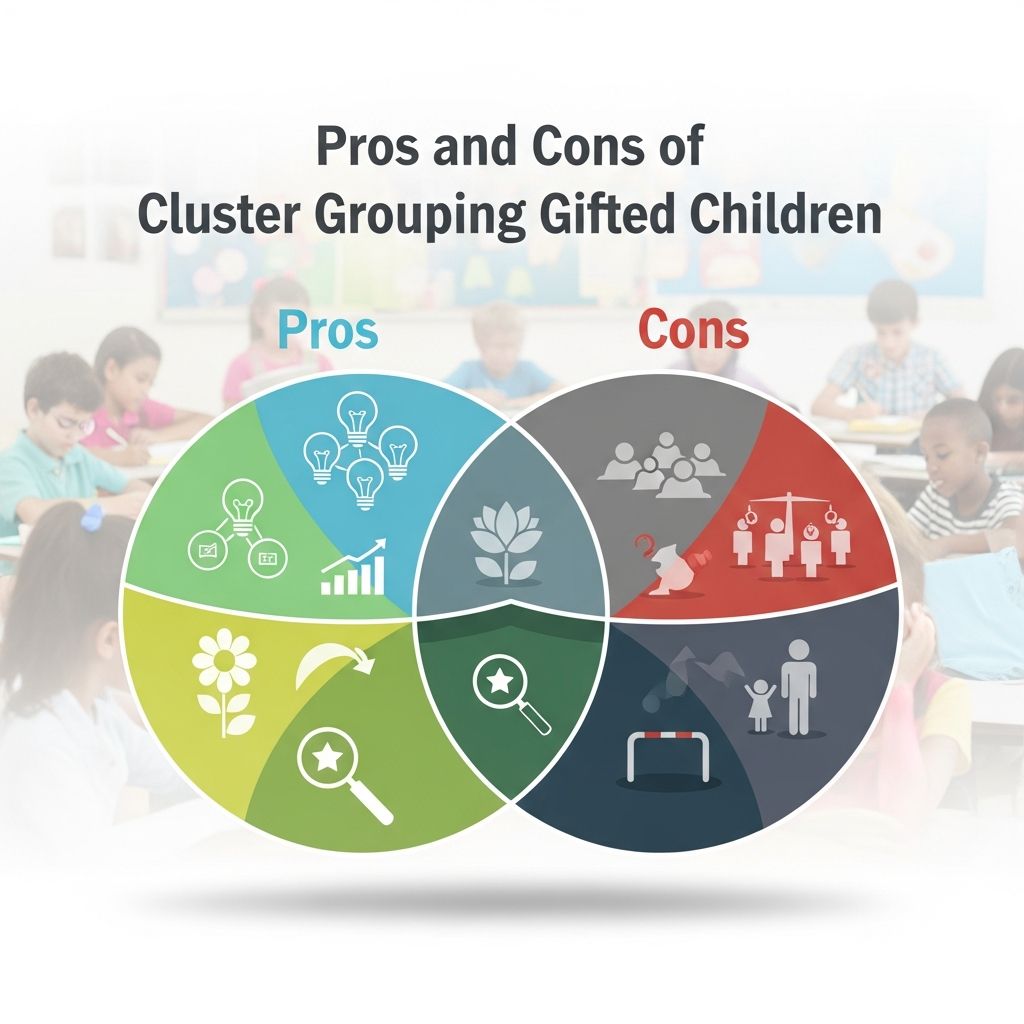
Cluster grouping is a common strategy in gifted education that places a small group of identified gifted or high-ability students together in an otherwise mixed-ability classroom. Instead of spreading these students across several rooms, one teacher hosts a “cluster” and delivers more advanced or differentiated instruction while teaching the rest of the class at grade level. This approach is often promoted as a cost-effective way to support gifted learners without creating separate gifted classes.
This article explains what cluster grouping is, how it works in practice, the major benefits and drawbacks, and what parents and schools should consider when deciding whether this model is appropriate. It also addresses common myths, implementation challenges, and alternatives so families can make informed choices about their children’s education.
What Is Cluster Grouping?
Cluster grouping places a defined number of gifted or high-achieving students—often 4 to 10—together in one general education classroom rather than distributing them evenly among all classes at that grade level. The cluster typically represents a formal group of students who have been identified through test scores, teacher recommendations, or other criteria as needing more challenging instruction.
In a cluster classroom, the teacher is responsible for:
- Teaching the whole group core curriculum at grade level.
- Providing enrichment, acceleration, or compacted content for the gifted cluster.
- Managing flexible small-group work so students spend part of the day with intellectual peers.
Unlike full-time gifted classrooms, cluster grouping keeps gifted students with age peers for most of the day while still creating a peer group of similar ability for advanced work. Schools often choose this model when numbers of gifted students are small, when budgets are tight, or when they want to avoid the political concerns that sometimes accompany separate gifted classes.
How Cluster Grouping Works in Schools
Although the basic idea is simple, cluster grouping can look different from school to school. The model depends heavily on how students are identified, how teachers are trained, and how class lists are constructed. Some schools use cluster grouping only in elementary grades, while others extend it into middle school subjects such as math or language arts.
Typical features of cluster grouping include:
- One or two teachers per grade level designated as cluster teachers.
- A cluster of gifted students placed together in those teachers’ classrooms.
- Other classrooms at the same grade level built with a narrower range of ability, often without the highest-ability students.
Ideally, cluster teachers receive additional training in differentiation, curriculum compacting, and social-emotional issues of gifted learners. They often work closely with a gifted specialist or enrichment teacher who helps design advanced projects, independent studies, and higher-level problem-solving tasks.
Key Features of Cluster Grouping
When implemented thoughtfully, cluster grouping is more than just putting bright students at the same table. It involves deliberate planning, ongoing assessment, and flexible grouping within the classroom. Done poorly, it can become little more than a label without meaningful changes in instruction.
Important design elements include:
- Clear identification criteria: Schools need consistent, transparent processes for determining who belongs in the gifted cluster.
- Balanced rosters: Class lists are created so that the cluster classroom is not overloaded with behavior challenges or wide ability ranges that make differentiation impossible.
- Curriculum adjustments: Gifted students may have content compacted (skipping what they have already mastered), enriched (deeper and more complex work), or accelerated (moving into higher-level material sooner).
- Flexible grouping: Gifted students sometimes work together, sometimes with the whole class, and sometimes in interest-based or skill-based groups.
Pros: Academic Benefits for Gifted Students
Supporters of cluster grouping argue that it offers several clear academic advantages for gifted learners compared with being isolated in mixed-ability classrooms. When gifted students are spread one per class, teachers can find it difficult to design meaningful challenge for a single child while meeting the needs of everyone else. Cluster grouping can make differentiation more realistic.
Common academic benefits include:
- Access to higher-level work: Gifted students are more likely to receive advanced assignments, complex problem-solving tasks, and opportunities for creativity when there is a small group of them who can work at a similar pace.
- Reduced repetition: In a well-run cluster classroom, gifted students are less likely to spend large amounts of time reviewing content they already understand, which helps maintain motivation and growth.
- More appropriate pacing: Teachers can move more quickly through basic material for the cluster group and spend additional time exploring depth, nuance, and applications.
Pros: Social and Emotional Benefits
Cluster grouping can also address the social and emotional needs of gifted children, who may feel different or isolated when they are the only advanced learner in a class. Being with true peers can be as important as academic challenge for their long-term well-being.
Potential social-emotional advantages include:
- Reduced isolation: Gifted students may feel less lonely or “weird” when there are others in the room who think and learn in similar ways.
- Healthy competition: Working alongside classmates who also grasp concepts quickly can encourage effort, persistence, and humility in a way that always being “the best” cannot.
- Improved self-understanding: Seeing a range of abilities among gifted peers helps children recognize that everyone has strengths and growth areas, supporting a more balanced sense of identity.
Pros: Benefits for Teachers and Schools
Cluster grouping is also appealing from a practical standpoint. It is significantly less expensive than creating separate gifted classrooms or programs, and it can be implemented even in small schools with only a handful of gifted students per grade. Administrators may view it as politically easier than more visibly separate programs.
Benefits for teachers and schools often include:
- More efficient differentiation: A teacher is more likely to invest time in planning advanced lessons when several students will benefit, rather than designing one-off modifications for a single child.
- Narrowed ability ranges in other rooms: When gifted students are clustered, non-cluster classrooms may have a more manageable span of abilities, allowing teachers to focus on grade-level instruction and support struggling learners more effectively.
- Cost-effective programming: Schools can claim to provide full-time services for gifted learners without the staffing and transportation costs associated with separate gifted classes.
Pros for Non-Gifted Classmates
Cluster grouping can unexpectedly benefit classmates who are not formally identified as gifted. In rooms without the gifted cluster, other high-ability or hard-working students often step into leadership roles and receive more attention than they would in a class dominated by a few very advanced peers.
Possible advantages for non-gifted classmates include:
- More chances to shine: In non-cluster classrooms, high-achieving students who are not officially in the gifted group may emerge as academic leaders and role models.
- Less pressure to compete: Some children feel more comfortable participating when they are not constantly comparing themselves to a much more advanced peer.
- Better-targeted instruction: Teachers in non-cluster rooms often find it easier to differentiate when they are not simultaneously serving a wide span from struggling learners to highly gifted students.
Cons: Potential Academic Drawbacks
Despite its advantages, cluster grouping is not a perfect solution. Its success depends heavily on teacher training, administrative support, and ongoing commitment to differentiation. Without these, cluster grouping can end up offering little more than a label without real academic benefits.
Key academic concerns include:
- Uneven quality of instruction: If the cluster teacher is not well trained in gifted education, students may receive the same grade-level curriculum with minimal differentiation.
- Insufficient challenge for highly gifted students: Children who are far above grade level may still find the pace and depth too slow even in a cluster, particularly if the rest of the class is working at or below grade level.
- Over-reliance on busywork: In poorly implemented programs, gifted students may receive extra worksheets or independent reading instead of meaningful, high-level tasks.
Cons: Social, Emotional, and Equity Concerns
Cluster grouping raises social and equity questions as well. When a group of students is labeled as “gifted” and placed together, other families may feel that their children have been left out or unfairly categorized. Misunderstandings about what giftedness means can create tension among parents, students, and staff.
Common concerns include:
- Perceptions of elitism: Parents of non-cluster students may worry that the cluster class is “the smart class,” leading to resentment or pressure to have their child placed there.
- Identification bias: If identification processes are not carefully designed, underrepresented groups—such as students from low-income backgrounds or English language learners—may be overlooked.
- Social division: Children may exaggerate differences between the cluster group and others, leading to teasing, social distancing, or unhealthy comparison.
Cons: Implementation Challenges for Schools
From a systems perspective, cluster grouping requires consistent administrative support. It is not enough to designate one room per grade as the cluster class; schools must monitor how students are placed, how instruction is differentiated, and how the model affects all classrooms.
Implementation problems can include:
- Parent pressure on placement: Families may lobby for cluster teachers or cluster classrooms even when their children are not identified as gifted, making class creation politically sensitive.
- Teacher overload: Cluster teachers must meet the needs of a wide range of learners while also planning advanced work for the gifted group, which can be demanding without sufficient planning time and support.
- Lack of ongoing training: Without regular professional development, even well-intentioned teachers may struggle to maintain a high-quality cluster program over time.
Cluster Grouping vs Other Gifted Models
Cluster grouping is only one of several models used to serve gifted students. Schools may also offer pull-out programs, subject-based acceleration, full-time gifted classrooms, or enrichment clubs. Each model has strengths and weaknesses, and many districts use a combination of approaches to reach different groups of students.
| Model | Where Students Spend Most Time | Main Advantage | Main Limitation |
|---|---|---|---|
| Cluster grouping | Mixed-ability classroom with a gifted cluster | Cost-effective; gifted students have intellectual peers without separate classes | Quality depends heavily on teacher training and school support |
| Pull-out program | General classroom plus weekly or periodic gifted sessions | Specialized instruction from gifted-trained teachers | Limited time; may not address daily needs in the regular classroom |
| Full-time gifted classroom | Self-contained gifted class most or all day | Consistent high-level instruction and peer group | Higher cost; not feasible in all schools; may be socially isolating from neighborhood peers |
| Subject acceleration | Age-level class plus higher grade level for specific subjects | Targets advanced ability where it exists (for example, math) | Scheduling challenges; may leave other needs unaddressed |
What Makes Cluster Grouping Successful?
The difference between effective cluster grouping and a superficial version usually comes down to planning and support. Successful programs are built on data, clear goals, and regular communication among teachers, administrators, and families. They treat cluster grouping as part of a broader gifted education plan rather than a stand-alone fix.
Key ingredients of successful cluster grouping include:
- Thoughtful, equitable identification of gifted students using multiple measures.
- Intentional assignment of skilled, open-minded teachers to cluster classrooms.
- Ongoing professional development in differentiation, curriculum compacting, and social-emotional needs.
- Collaboration between classroom teachers and gifted specialists.
- Regular progress monitoring and willingness to adjust placements and instruction.
Considerations for Parents
Families evaluating a cluster grouping option should look beyond the label and ask specific questions about how the program operates. Because implementation varies widely, knowing the details at a particular school is more useful than relying on general descriptions.
Helpful questions for parents to ask include:
- How are children identified for the gifted cluster, and how often is that list reviewed?
- What kind of training has the cluster teacher received in gifted education?
- What will day-to-day instruction look like for my child (for example, acceleration, independent projects, enrichment units)?
- How will the school monitor my child’s progress and adjust challenge if needed?
- What supports are in place for the social and emotional needs of gifted students?
Considerations for Schools
Schools considering cluster grouping need to think carefully about both logistics and culture. Class lists, identification criteria, staffing, and communication all matter. Equally important is how the school community understands and values diverse learners, including those who are gifted.
Before launching or revising a cluster program, school leaders may:
- Review data on achievement and engagement for advanced learners under the current model.
- Involve teachers, gifted specialists, and families in discussions about goals and design.
- Plan professional development and coaching for cluster teachers.
- Develop clear communication so all families understand the purpose of cluster grouping and how placements are made.
- Establish processes for monitoring results and making adjustments over time.
Frequently Asked Questions (FAQs)
Is cluster grouping the same as tracking?
No. Traditional tracking places students in separate ability-based classes for most of the day and often keeps them in the same track for years. Cluster grouping still uses mixed-ability classrooms; it simply ensures that gifted students are not isolated and can work together for part of the time.
Will my child be labeled or singled out?
In many schools, cluster grouping is implemented quietly, without publicly listing which students are in the cluster. While children may eventually recognize who receives advanced work, sensitive teachers can minimize stigma by emphasizing that everyone in the classroom has unique strengths and learning paths.
Can cluster grouping replace all other gifted services?
Cluster grouping is usually most effective as one component of a broader gifted program. Many students still benefit from additional opportunities such as pull-out classes, competitions, mentorships, or accelerated coursework, especially if their abilities are far above grade level.
What if there are very few gifted students in a grade?
Cluster grouping can still work with a small number of students, but in some cases schools may combine grades, use subject acceleration, or rely more heavily on individualized plans. The central goal remains to ensure that no gifted student is academically or socially isolated.
How do I know if cluster grouping is working for my child?
Signs of an effective placement include visible academic growth, sustained curiosity, a healthy level of challenge (not constant boredom, but not overwhelming stress), and generally positive feelings about school. Regular communication with the teacher and periodic review of work samples can help families gauge fit over time.