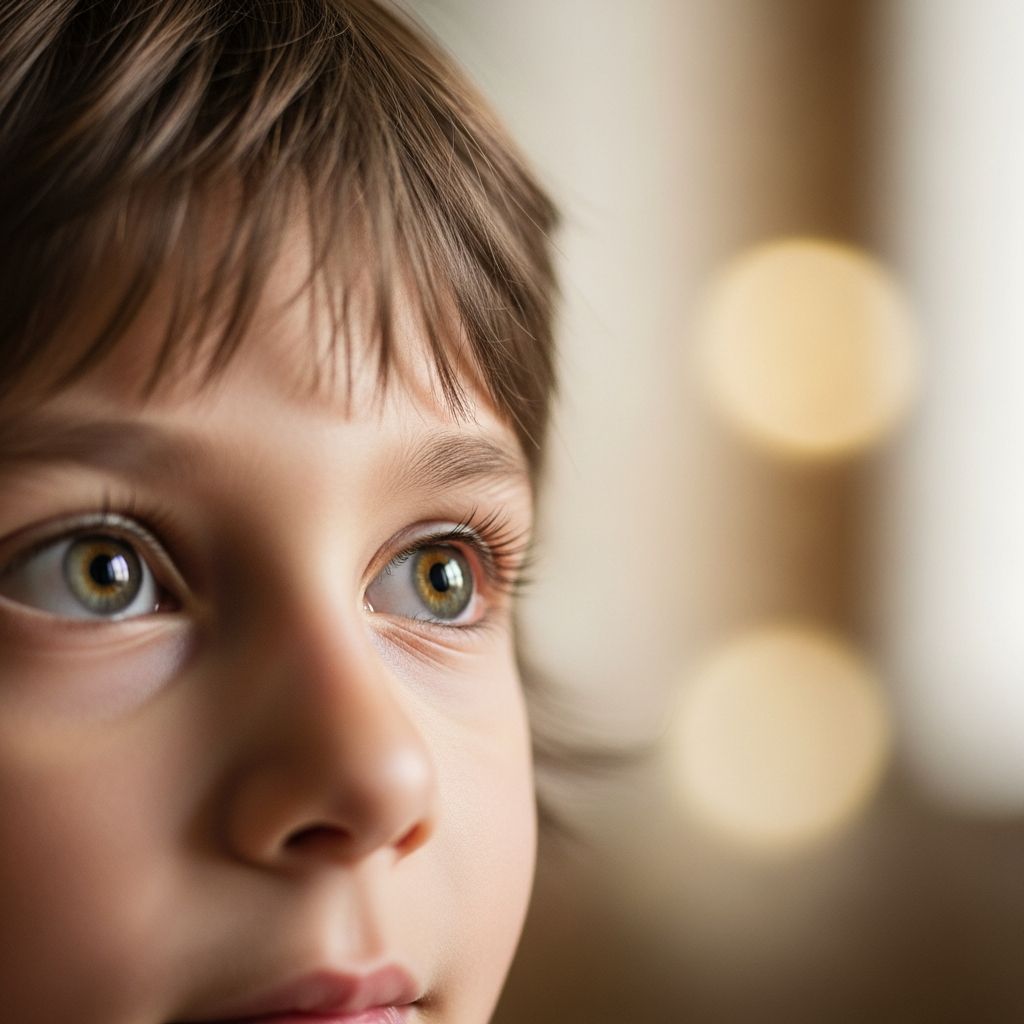
Your child uses their eyes to explore, learn, and connect with the world. Healthy vision supports everything from bonding with family in infancy to reading, sports, and social confidence in school. This guide explains how vision develops, signs that something may be wrong, and how to protect your child’s eyes.
Why Vision Matters So Much in Childhood
Vision is more than just seeing clearly. It includes how the eyes focus, move, and work together, and how the brain makes sense of what the eyes see. Research suggests that a large share of classroom learning relies on visual skills, so uncorrected vision problems can affect reading, attention, and academic performance.
Because the visual system is still developing in early childhood, untreated problems can sometimes lead to long-term or even permanent loss of visual potential in one or both eyes.
How Vision Develops From Birth Through School Age
Vision develops step by step. Knowing typical milestones helps you notice when something may not be progressing as expected.
Newborn to 3 Months: Early Visual Beginnings
At birth, babies can see, but their vision is blurry and not yet well coordinated.
- Focus range: Newborns see best at about 8–12 inches, roughly the distance to a caregiver’s face during feeding.
- Color vision: Newborns mainly detect high-contrast patterns; color vision begins to improve over the first weeks.
- Eye alignment: Occasional eye crossing or wandering in the first 1–2 months can be normal, as the eye muscles and brain learn to work together.
- Tracking: By around 2–3 months, most babies begin tracking faces and slow-moving objects with their eyes.
If one eye consistently turns inward or outward, or if the eyes never seem to fix on faces or lights, a professional eye evaluation is important.
3 to 12 Months: Rapid Skill Building
During the rest of the first year, vision and movement start to work as a team.
- Babies begin reaching accurately for objects they see, showing growing eye–hand coordination.
- Depth perception (judging distance) develops as the two eyes learn to work together to see in three dimensions, usually around 5 months.
- Color perception and the ability to notice finer details continue to improve.
- Crawling and cruising encourage the brain to link vision with balance and body movement, further strengthening visual skills.
If a baby is not tracking, reaching for objects, or making eye contact by the second half of the first year, talk with the child’s doctor and request an eye exam.
1 to 3 Years: Vision Supports Exploration and Language
Toddlers rely heavily on their eyes to explore their surroundings, recognize people and objects, and begin to understand pictures and symbols.
- By about 2 years, most children have well-developed eye–hand coordination and depth perception.
- They can identify familiar objects in books, stack blocks, and fit shapes into matching holes.
- They start to match pictures to real-life items and may name common objects they see.
During these years, some children show early signs of focusing problems, eye misalignment, or delays in visual attention, which deserve evaluation.
Preschool and Early School Years: Fine-Tuning Visual Skills
As children approach school age, vision becomes more precise and is used for increasingly complex tasks like puzzles, drawing, and early reading.
- Most children develop near-adult levels of visual clarity during the preschool years.
- They refine tracking skills needed for following a line of print in a book or watching a moving ball.
- They practice quickly shifting focus from near to far, such as from desk work to the board at school.
By about 6 years, many children’s basic visual abilities are close to fully developed, although the eyes and brain continue to refine coordination throughout childhood.
Common Childhood Vision Problems
Several types of eye and vision problems often appear in childhood. Finding and treating these early can protect your child’s long-term sight.
Refractive Errors: Blurry Vision From Focusing Problems
Refractive errors occur when the shape or length of the eye prevents light from focusing properly on the retina, causing blurred vision.
| Type | What It Means | Common Signs | Typical Treatment |
|---|---|---|---|
| Myopia (nearsightedness) | Distant objects look blurry, near objects look clearer. | Sits very close to TV, can’t see board at school, squints at far objects. | Glasses or contact lenses; sometimes additional myopia-control strategies. |
| Hyperopia (farsightedness) | Near objects may be harder to focus on; in some children, both near and far vision can be affected. | Eye strain with near work, poor attention to close-up tasks, possible crossing of one eye. | Prescription glasses for near or full-time wear, depending on severity. |
| Astigmatism | Irregular eye shape causes distorted or blurred vision at all distances. | Squinting, complaints that letters look fuzzy or doubled, headaches. | Glasses or contact lenses with astigmatism correction. |
Refractive errors are very common in children and are usually correctable with glasses or contact lenses.
Strabismus: Eyes That Do Not Point in the Same Direction
Strabismus happens when the two eyes are misaligned. One eye may turn inward, outward, up, or down while the other looks straight ahead.
- Misalignment can be constant or come and go.
- If the brain receives different images from each eye, it may begin to ignore the input from the turned eye.
- Untreated strabismus can lead to amblyopia (lazy eye) and depth perception problems.
Treatment may include glasses, eye patching, special eye drops, vision therapy, or sometimes surgery, depending on the cause and severity.
Amblyopia: “Lazy Eye”
Amblyopia is reduced vision in one (or less commonly both) eyes because the brain does not fully use the eye’s visual information, even when the eye itself appears healthy.
- Often develops when one eye is much more nearsighted or farsighted than the other, or when strabismus is present.
- The brain favors the clearer or straighter eye and can suppress input from the other eye.
- If not treated in early childhood, amblyopia can result in permanent vision loss in the affected eye.
Common treatments include prescribing glasses to correct focusing differences, patching the stronger eye for part of the day, or using a blurring drop in the stronger eye to force use of the weaker one. Early treatment is most effective.
Warning Signs of Vision or Eye Problems
Some vision issues are obvious, while others are subtle. Children may not realize their vision is different from others, so they might not complain.
Signs in Babies and Toddlers
- Lack of eye contact beyond the first few months.
- Eyes that always turn in, out, up, or down.
- Frequent squinting, head tilting, or closing one eye.
- Not tracking moving objects or not reaching for nearby toys by around 4–6 months.
- Apparent sensitivity to light, excessive tearing, or constant eye redness.
Signs in Preschool and School-Age Children
- Sitting very close to the TV or holding books very near the face.
- Complaints of blurry vision, headaches, or tired eyes.
- Covering one eye, tilting the head, or closing one eye when reading.
- Skipping lines, losing place while reading, or using a finger to keep track.
- Difficulty catching a ball, frequent bumping into things, or poor coordination.
- Drop in school performance or behavior changes related to reading or close work.
If you see one or more of these signs, it is important to schedule a comprehensive eye exam with an eye care professional experienced with children.
Vision Screening vs. Comprehensive Eye Exams
Many children receive basic vision screenings at the doctor’s office or at school, but these are not the same as full eye exams.
- Vision screenings quickly check for obvious problems such as distance blur. They can miss less obvious issues, including some focusing or eye teaming problems.
- Comprehensive eye exams are performed by an optometrist or ophthalmologist and include detailed testing of clarity, eye alignment, eye health, and how well the eyes work together.
Health authorities recommend regular vision screening in childhood and timely referral to eye care professionals when problems are detected or suspected.
When Should Children Have Their Eyes Checked?
Specific schedules vary by country and organization, but common guidance includes:
- A first eye assessment in infancy, particularly if there are risk factors such as prematurity, family history of serious eye disease, or noticeable eye abnormalities.
- At least one professional eye evaluation between ages 3 and 5 to check for amblyopia, strabismus, and refractive errors before starting school.
- Regular screenings and eye exams during school years, especially if your child has symptoms or a known vision problem.
Your child’s pediatrician can help you decide how often eye exams are needed and whether referral to a pediatric eye specialist is appropriate.
Helping Your Child Maintain Healthy Vision
Parents and caregivers play an active role in protecting children’s eyes and supporting visual development.
Encourage Visual Play and Learning
- Use high-contrast toys and faces for young infants to look at.
- Play peekaboo and simple tracking games with your baby.
- Offer blocks, puzzles, drawing, and age-appropriate books to preschoolers to build visual attention and coordination.
- Read regularly with your child to strengthen visual and language connections.
Support Safe and Comfortable Screen Use
- Follow pediatric guidance on limiting recreational screen time for young children.
- Encourage frequent breaks from close-up activities using easy rules, such as looking at something far away for a short period every 20–30 minutes.
- Make sure screens are at a comfortable distance and height to reduce eye strain.
Protect Eyes From Injury and Sunlight
- Use age-appropriate protective eyewear for sports or activities with risk of eye injury.
- Choose broad-brimmed hats and sunglasses that block most UVA and UVB rays when outdoors.
Promote Overall Health Habits
- Encourage outdoor play, which supports overall health and may help reduce the risk of some vision problems such as myopia in certain children.
- Ensure a varied diet with fruits, vegetables, and other foods rich in nutrients important for eye health.
- Keep up with routine health visits and immunizations recommended by your child’s doctor.
Frequently Asked Questions (FAQs)
My baby’s eyes sometimes look crossed. Is this normal?
In the first one to two months, occasional crossing or wandering of the eyes can be normal as the eye muscles and brain learn to work together. If one eye appears turned most of the time or if misalignment persists beyond the early months, schedule an eye evaluation.
How can I tell if my preschooler needs glasses?
Common signs include squinting, sitting very close to the TV, holding books close to the face, complaining of headaches, or avoiding close-up activities like coloring or looking at books. Any of these signs should prompt an eye exam.
Are school vision screenings enough?
Screenings are useful for finding some children with vision problems, but they can miss others, including certain focusing and eye teaming issues. A comprehensive eye exam by an eye care professional provides a more complete evaluation, especially if you or a teacher have concerns.
What happens if amblyopia is not treated early?
If amblyopia is left untreated during the years when the visual system is still developing, the affected eye can remain permanently weaker, even with glasses. Early detection and treatment offer the best chance for improving vision.
Can too much screen time damage my child’s eyes?
Extended close-up work, including screen use, can contribute to eye strain and may be associated with a higher risk of some focusing problems in certain children. Encouraging breaks, outdoor play, and balanced activities can promote more comfortable vision.
References
- Infant Vision: Birth to 24 Months of Age — American Optometric Association. 2024-01-01. https://www.aoa.org/healthy-eyes/eye-health-for-life/infant-vision
- How vision develops in children — My Kids Vision / Brien Holden Vision Institute. 2023-06-01. https://www.mykidsvision.org/knowledge-centre/how-vision-develops-in-children
- Infant Vision Birth to One Year — Nationwide Children’s Hospital. 2022-09-15. https://www.nationwidechildrens.org/family-resources-education/health-wellness-and-safety-resources/helping-hands/infant-vision-birth-to-one-year
- Keep an Eye on Your Child’s Vision — U.S. Centers for Disease Control and Prevention (CDC). 2023-08-01. https://www.cdc.gov/vision-health/prevention/youth-vision-problems.html
- Facts About Children’s Vision — Prevent Blindness. 2021-05-01. https://childrensvision.preventblindness.org/facts-about-childrens-vision/