Global health authorities like the World Health Organization provide clear directives on mask usage for children to curb the spread of respiratory illnesses such as COVID-19. These guidelines emphasize age-appropriate application, proper fit, and integration with other preventive strategies to ensure safety and efficacy.
Age-Based Recommendations for Mask Wearing
Mask policies vary significantly by a child’s age due to developmental stages, physical capabilities, and risks like suffocation. Children under 2 years old should never wear masks because of the heightened danger of choking or breathing difficulties.
For children aged 2 to 5, the WHO advises against routine mask use for asymptomatic kids, citing limited evidence of benefits, potential developmental impacts, and challenges in self-application. If essential, such as in high-transmission areas, adult supervision is mandatory.
Children over 5 years can safely use masks when taught properly, with masks fitted snugly to the face. Supervision remains key initially to ensure correct usage.
- Under 2 years: Prohibited due to suffocation risk.
- 2-5 years: Not recommended unless supervised in unavoidable situations.
- 6+ years: Encouraged with education on handling and hygiene.
Types of Masks Suitable for Young Users
Not all masks offer equal protection, and selection depends on the setting and child’s needs. Surgical masks provide basic barrier function, while N95 or equivalent respirators (like PFF2 or KN95) filter higher levels of particles but are harder for kids to wear comfortably.
Cloth or fabric masks serve as source control, mainly preventing outward spread from the wearer. They should have multiple layers and fit well, though many standard cloth options are now deemed less effective compared to medical-grade alternatives.
| Mask Type | Protection Level | Best For Children |
|---|---|---|
| Surgical Mask | Fair | Everyday community use, ages 3+ with supervision. |
| N95/KN95/PFF2 | High | High-risk children only, under professional advice. |
| Multi-layer Cloth | Basic | Source control in low-risk settings, ages 6+. |
High-risk children, such as those with immunocompromised conditions, may benefit from N95 masks, but only after healthcare provider assessment for fit and tolerance.
Ensuring Proper Fit and Comfort
A mask’s effectiveness hinges on a secure seal covering the nose and mouth without gaps. For children, select sizes designed for smaller faces to avoid slipping. Test fit by having the child speak, move, or cough—air should not escape sides.
Comfort prevents frequent adjustments that lead to face touching. Masks should not restrict breathing, get soaked with saliva, or impede vision. Teach removal from the back to avoid contaminating hands.
- Secure under chin and over nose bridge.
- No gaps along cheeks or forehead.
- Easy for child to remove independently (ages 3+).
Special Considerations for Vulnerable Children
Kids with disabilities, chronic illnesses, or breathing issues require tailored approaches. Consult pediatricians for alternatives if masks cause distress or are impractical. In group settings like schools, prioritize distancing where possible.
For those with weakened immunity, enhanced protection like N95 is advised during outbreaks, paired with family-wide precautions.
Mask Use in Schools and Community Settings
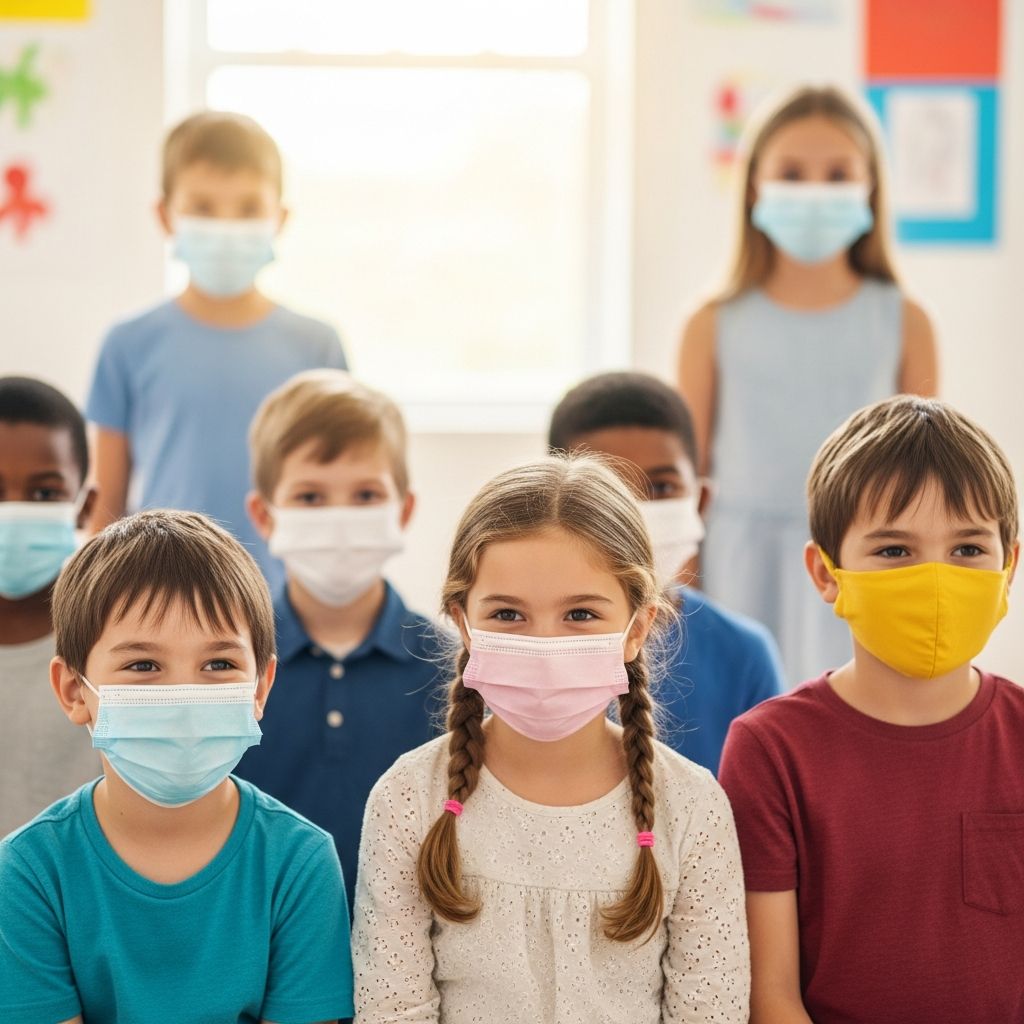
In educational environments, masks for children over 2 (with supervision for younger ones) complement ventilation, distancing, and handwashing. Avoid during high-intensity activities to prevent accidents or discomfort.
Community guidelines mirror this: masks in crowded indoor spaces, removed for eating or sports where feasible.
Combining Masks with Other Preventive Measures
Masks alone are insufficient; integrate with hand hygiene, ventilation, and distancing for optimal results. Studies show this layered approach significantly reduces transmission in pediatric populations.
Teaching Children Mask Habits
Make mask-wearing positive through games, stories, or rewards. Practice at home: demonstrate donning/doffing, emphasize nose/mouth coverage, and monitor for issues like fogging glasses.
Supervise young children closely to prevent mouthing or misuse. Gradually build independence as skills develop.
Potential Risks and When to Avoid Masks
Beyond suffocation in infants, risks include skin irritation, communication barriers, and developmental effects from obscured expressions in toddlers. Discontinue if a child struggles to breathe, touches face excessively, or shows distress.
Frequently Asked Questions
Can children under 2 wear masks?
No, masks pose a suffocation hazard for this age group.
Should my 4-year-old wear a mask in public?
WHO does not recommend it routinely; use only if supervised in high-risk scenarios.
What mask is best for school-aged kids?
A well-fitting surgical mask offers balanced protection and comfort.
How do I know if the mask fits my child?
It should cover nose/mouth fully without gaps; test with movement.
Are masks safe for kids with asthma?
Consult a doctor; they may tolerate well if monitored.
Can kids wear masks during sports?
Only if distancing is impossible; remove for intense activity.
This comprehensive guide draws from authoritative sources to empower parents in navigating mask decisions. Always check local health updates for evolving recommendations.
References
- Children wearing face masks to prevent communicable diseases — PMC. 2022. https://pmc.ncbi.nlm.nih.gov/articles/PMC9345171/
- Annex to the Advice on the use of masks in the context of COVID-19 — World Health Organization. 2020-04-30. https://www.who.int/publications/i/item/WHO-2019-nCoV-IPC_Masks-Children-2020.1
- Mask Guidance for Children and Youth — New Mexico Department of Health. 2020-05. https://cv.nmhealth.org/wp-content/uploads/2020/05/Mask-Guidance-for-Children-and-Youth_Final1.pdf
- Face Masks in Child Care Programs — California Childcare Health Program, UCSF. Accessed 2026. https://cchp.ucsf.edu/resources/health-safety-notes/face-masks-child-care-programs
- Face Masks for Children During COVID-19 — American Academy of Pediatrics. Accessed 2026. https://www.healthychildren.org/English/health-issues/conditions/COVID-19/Pages/Cloth-Face-Coverings-for-Children-During-COVID-19.aspx