Understanding Childhood Fall Risks and Prevention Strategies
Falls represent one of the most common causes of unintentional injury in children, yet many of these accidents are entirely preventable through thoughtful environmental modifications and consistent supervision. The risk of falls changes dramatically as children develop new physical abilities, progressing from infancy through toddlerhood and into the preschool years. Understanding the specific hazards at each developmental stage enables parents and caregivers to implement targeted safety measures that significantly reduce injury risk.
Effective fall prevention requires a multi-layered approach that combines environmental modifications, proper installation of safety equipment, and active supervision. While no single strategy can eliminate all fall risks, combining several protective measures creates a comprehensive safety system that addresses the most common and dangerous fall scenarios children encounter.
Creating a Secure Sleep Environment: Crib Safety Fundamentals
The crib represents the first controlled environment where infants spend extended periods, making it a critical area for fall prevention. Maintaining proper crib configuration throughout your child’s infancy requires adjusting the mattress height as developmental milestones are reached.
Initially, keep the mattress at its highest setting to make it easier to place your infant inside and remove them for feeding and diaper changes. However, once your baby demonstrates the ability to push upward using their hands or begins moving onto all fours, it becomes essential to lower the mattress. This prevents them from pushing themselves over the crib rail, which poses a serious fall risk. As your child approaches the standing stage, lower the mattress a second time to maintain adequate clearance between the mattress surface and the top of the crib rail.
Additional crib safety measures include:
- Keep all crib sides elevated whenever your infant is sleeping, regardless of their current climbing abilities
- Remove all soft objects, including pillows, blankets, bumper pads, and decorative mobiles from the crib
- Avoid using cribs with drop-side mechanisms, which create entrapment hazards
- Regularly inspect the crib for loose or broken components that could create safety concerns
- Ensure that no adjacent furniture allows children to access the crib from above
Mastering Stair Navigation: Teaching and Protecting on Steps
Stairs present a particular challenge because they combine height, hard edges, and the complexity of coordinated movement. Proper stair safety requires both physical barriers and active teaching to help children develop safe movement patterns.
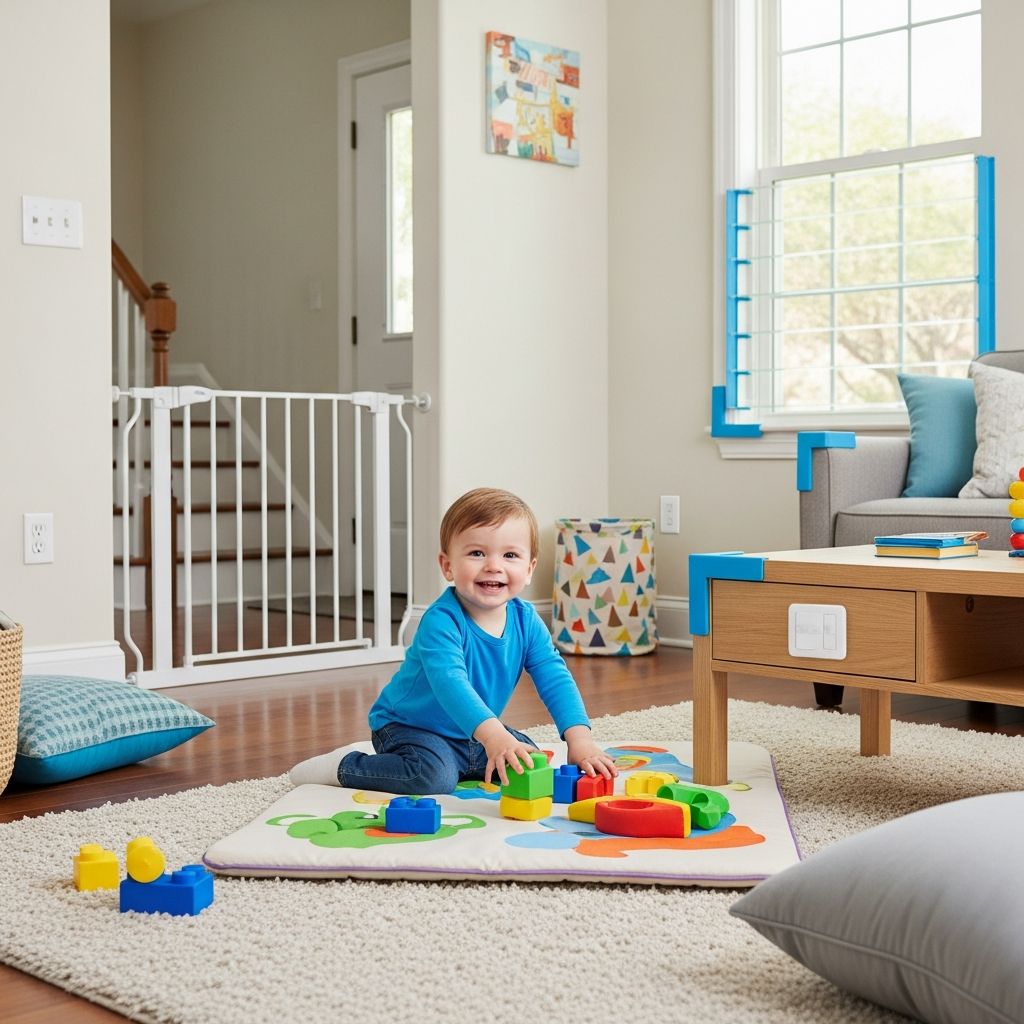
Install hardware-mounted safety gates at both the top and bottom of every staircase in your home. Unlike pressure-mounted gates that rely on friction to stay in place, hardware-mounted gates are securely fastened to the wall studs, providing reliable containment. Ensure that gates are always kept closed and locked in place when not in active use. Pressure-mounted gates present inadequate security for stairway applications because determined children can dislodge them through climbing or pushing.
When selecting safety gates, avoid accordion-style designs, which feature large diamond-shaped openings that can trap a child’s head, creating a serious strangulation hazard. Look for gates with smaller openings or solid panels that prevent any portion of a child’s body from becoming stuck.
Teaching your toddler to navigate stairs safely requires patience and active participation. Introduce backward descent as the primary method for going down stairs, as this technique allows children to maintain grip on the stair above while moving downward, providing better balance control. Actively supervise your child during stair use, holding their hand and encouraging proper handrail grip. Keep stairs well-lit, remove tripping hazards, and ensure that loose carpeting or stair runners are securely fastened.
Additional stair safety practices include:
- Never leave a child unattended around stairs, even when gates are installed
- Remove toys, shoes, and objects that could cause tripping
- Install guards on railings or banister openings if your child can fit through the gaps
- Prohibit running or play-fighting on stairs
- Ensure adequate lighting along the entire stairway
Window Safety: Preventing Falls from Significant Heights
Windows pose a particular danger because children can fall from openings much smaller than most parents realize. Children have fallen from windows opened as little as five inches, making window safety an essential priority in any home with young children.
Window screens provide no protective function against falls; they are designed to filter insects, not to support the weight or pressure of a child falling against them. Many parents incorrectly assume that closed screens prevent falls, but screens can easily separate from their frames when a child pushes against them, creating a false sense of security.
Install window guards that prevent the window from opening more than four inches, or use guards that allow full opening only from the top portion of double-hung windows. Window guards must be designed so that adults can easily open them in case of emergency, such as fire evacuation. Select guards that meet safety certification standards and can be operated quickly without tools.
Arrange your home so that furniture—including beds, cribs, dressers, and chairs—cannot be used as climbing aids to reach windowsills. Children naturally explore their environment and will attempt to climb any accessible structure, so maintaining clear space beneath windows eliminates this pathway to danger. Keep windows locked when closed, and lock window stops when using them to prevent further opening.
Window safety recommendations include:
- Install window guards with emergency release mechanisms in second-story or higher windows
- If using window stops, set them to limit opening to no more than four inches
- Open windows from the top only when ventilation is needed
- Keep windows locked at all times when closed
- Never rely on screens as a safety device for fall prevention
- Position window treatments where children cannot use them as climbing aids
Furniture Stability and Tip-Over Prevention
Furniture tip-overs cause serious injuries when children climb on or use drawers as steps to reach higher surfaces. Televisions, dressers, bookcases, and entertainment centers can cause devastating injuries when they fall onto a child.
Secure all furniture that children might attempt to climb using wall anchors, L-brackets, or furniture straps. Pay particular attention to top-heavy items like tall bookcases, overloaded shelves, and entertainment centers. These pieces present extreme tip-over risk because their weight is concentrated in the upper portion, making them unstable when a child applies downward pressure by climbing.
Teach children not to climb on furniture or use drawers and shelves as steps. Store attractive items or toys at child-accessible heights on lower shelves rather than encouraging children to climb to reach higher shelves. Select furniture with a wide, stable base that resists tipping, and avoid pieces with an unstable appearance or history of recalls.
Televisions require special attention due to their weight and frequent placement on unstable stands. Use wall mounts or secure furniture straps designed specifically for television stabilization. High chairs and baby swings should have wide, stable bases that cannot be tipped easily, and children should always be securely strapped in during use.
Changing Tables and Elevated Surfaces: Supervision Essentials
Never leave a child unattended on any elevated surface, including changing tables, beds, or couches. Even brief moments of inattention create significant fall risk, particularly during diaper changes when parents might be distracted by phone calls or other activities. If you must answer a phone or attend to something else, hold your child or place them in a secure location such as a crib or playpen rather than leaving them on the changing table.
Select changing tables with adequate guardrails at least two inches high, and ensure that the table has a stable base that won’t collapse under normal use. Some parents find that changing diapers on a bed or other low surface reduces the consequences of falls while still providing adequate workspace.
Mobile Devices and Early Movement: Walkers and Play Centers
Baby walkers on wheels present serious fall hazards, particularly on stairs where babies can gain unexpected momentum and plunge down multiple steps before anyone can intervene. Wheeled walkers also restrict parents’ ability to see and monitor where their child is moving and what hazards they might encounter.
Replace wheeled walkers with stationary play centers or activity saucers that provide support for standing and movement practice without the ability to roll around the home. Stationary play centers allow babies to practice weight-bearing and balance while remaining safely contained in a confined area. These alternatives provide the developmental benefits of supported standing without the injury risks of mobile walkers.
Playground Safety: Environmental Design and Protective Surfaces
Playground falls often result in more severe injuries than home falls because children fall from heights onto hard surfaces. Select play areas with shock-absorbing surfaces such as rubber mulch, engineered wood fiber, sand, synthetic turf, or pea gravel. These materials cushion falls and significantly reduce the risk of serious injuries compared to asphalt, concrete, grass, or dirt.
Equipment should be age-appropriate, with clear labeling indicating the intended age range. Spacing between equipment should prevent overcrowding and reduce the likelihood of children being struck by other children or moving equipment. Moving equipment such as swings, seesaws, and roundabouts should be located in separate areas away from static structures to prevent collisions.
Protective gear becomes essential as children engage in more advanced activities. Bicycle riding requires properly fitted helmets, while skate parks necessitate helmets, knee pads, and elbow pads. Talk to your children about appropriate play behaviors and the importance of following equipment safety guidelines.
Playground safety guidelines include:
- Choose facilities with adequate shock-absorbing surface materials covering fall zones extending at least six feet around equipment
- Verify equipment age-appropriateness before allowing your child to use it
- Never allow children to play on elevated structures without adequate safety surfacing below
- Prohibit running in front of or behind swings or other moving equipment
- Ensure children sit in the middle of swing seats while holding on with both hands
- Supervise outdoor play actively and remain aware of hazards
Environmental Organization and Hazard Reduction
Maintaining clear pathways throughout your home reduces trip-and-fall hazards for children of all ages. Remove clutter from hallways, stairs, and floor areas where children play or move. Repair loose carpeting, secure area rugs with non-slip underlayment, and eliminate any obstacles that could catch a child’s foot.
Install non-slip mats or adhesive decals in bathtubs and showers to prevent slipping on wet surfaces. Use anti-slip rugs on smooth floors in high-traffic areas. Ensure adequate lighting throughout your home, particularly on stairs and in hallways where children might move during evening hours.
Clear outdoor sidewalks and steps of toys, objects, and debris that could cause tripping. Repair cracks or missing sections in walkways, and ensure that outdoor steps are safe and well-maintained. These environmental modifications create safer spaces where falls are less likely to occur.
Bicycle Safety and Protective Equipment
As children develop the skills to ride bicycles, proper safety equipment becomes essential to prevent head injuries from falls. Require helmet use for all bicycle riding, enforcing consistent helmet rules regardless of ride distance or location. Head injuries from bicycle falls remain alarmingly common in this age group, making helmet compliance a non-negotiable safety priority.
Ensure that your child is well-versed in bicycle safety principles, including understanding traffic signals, hand signals, and appropriate riding behaviors. Supervise early riding experiences closely, and gradually allow increased independence as skills improve and understanding of safety principles develops.
The Critical Role of Active Supervision
No safety device, modification, or protective equipment can substitute for attentive supervision by a responsible adult. Environmental changes and safety equipment provide foundational protection, but active watching—knowing where your child is, what they’re doing, and what hazards are nearby—represents the most effective fall prevention strategy.
Supervision means more than simply being in the same room; it requires maintaining awareness of your child’s location and activities, anticipating potential hazards, and intervening before dangerous situations develop. Different environments and developmental stages require different supervision approaches, but the fundamental principle remains constant: your watchful eye provides protection that devices alone cannot achieve.
Frequently Asked Questions About Childhood Falls
Q: At what age should I start teaching my child to use stairs safely?
A: Begin teaching safe stair techniques once your child shows readiness, typically around 12-18 months as climbing ability develops. Use safety gates to prevent unsupervised access while teaching, and actively supervise all stair use with hand-holding and verbal guidance.
Q: Are pressure-mounted safety gates safe for use at the top of stairs?
A: No. Always use hardware-mounted gates at the top of stairs because pressure-mounted gates lack adequate security and can be dislodged by determined climbers. Reserve pressure-mounted gates only for doorways and openings where a fall would not occur.
Q: What should I do if my child falls and appears seriously injured?
A: Call 911 immediately. Do not attempt to move your child, as movement could worsen spinal injuries or other serious trauma. Allow trained medical personnel to assess and move your child with proper precautions.
Q: How often should I inspect safety equipment like gates and window guards?
A: Inspect all safety equipment regularly for signs of wear, damage, or loosening. Check that gates are closing properly, latches are secure, and anchors remain firmly mounted. Perform detailed inspections at least monthly and after any impact or apparent shifting.
Q: Can window screens prevent my child from falling out the window?
A: No. Window screens are designed to filter insects only and cannot withstand the weight or pressure of a falling child. Never rely on screens as a safety device; always use proper window guards and stops instead.
References
- Preventing Injuries From Falling, Climbing, and Grabbing — Nemours Children’s Health. Accessed January 2026. https://kidshealth.org/en/parents/safety-falls.html
- Fall Prevention for Kids — University Health. Accessed January 2026. https://www.universityhealth.com/services/trauma/injury-prevention/fall-prevention/kid-fall-prevention
- Childhood Falls Prevention: Information For Parents — Rhode Island Department of Health. Accessed January 2026. https://health.ri.gov/injury/fallsprevention/for/parents
- Preventing Falls — Nationwide Children’s Hospital. Accessed January 2026. https://www.nationwidechildrens.org/conditions/health-library/preventing-falls
- Falls Prevention Tips — Safe Kids Worldwide. Accessed January 2026. https://www.safekids.org/tip/falls-prevention-tips
- Fall-Related Safety — Children’s Hospital of Philadelphia. Accessed January 2026. https://www.chop.edu/centers-programs/injury-prevention-program/fall-related-safety
- Preventing Falls — North Dakota Department of Health and Human Services. Accessed January 2026. https://www.hhs.nd.gov/health/prevention-healthy-living/injury-prevention/falls