The Myth of Childhood Colorblindness in Racial Understanding
For decades, popular culture has perpetuated the notion that young children are “colorblind” — unable to perceive or understand racial differences. This widely accepted belief has shaped parenting approaches, educational strategies, and social policies across many Western societies. However, contemporary developmental research paints a dramatically different picture. Scientific evidence consistently demonstrates that children begin recognizing racial categories far earlier than previously thought, and they develop complex attitudes about race during their earliest years of life. Understanding this reality is crucial for parents, educators, and caregivers who want to support healthy child development and foster inclusive communities.
When Does Racial Awareness Begin in Infants?
The timeline for racial awareness development starts remarkably early. Groundbreaking research following approximately 200 Black and white children from six months to six years of age revealed surprising findings about infant cognition. Infants as young as six months old demonstrate the ability to nonverbally categorize people by race and gender. In these studies, six-month-olds looked significantly longer at unfamiliar faces of a different race compared to unfamiliar faces of their own race. This visual preference pattern is so consistent across six-month-old populations that researchers conclude initial racial awareness likely begins even earlier in development.
This finding challenges the assumption that race is an abstract concept children cannot grasp until middle childhood. Instead, babies are processing and organizing visual information about human diversity from their earliest months, developing mental categories that will shape their future understanding of the social world.
Toddler Years: From Recognition to Categorization
As children progress from infancy into toddlerhood, their racial awareness becomes more sophisticated and actionable. By age two, toddlers begin using racial categories to reason about people’s behaviors and characteristics. This marks an important developmental shift from passive recognition to active cognitive processing. Young toddlers start making connections between racial categories and other attributes, beginning to form mental frameworks about how race relates to the wider world around them.
During this period, toddlers are developing language skills that allow them to label and discuss racial differences explicitly. They may begin asking questions about skin color variations, hair texture, and other visible characteristics that distinguish people from one another. These early inquiries represent normal developmental curiosity and cognitive growth rather than inappropriate fixation.
Preschool Age: Formation of Explicit Racial Bias
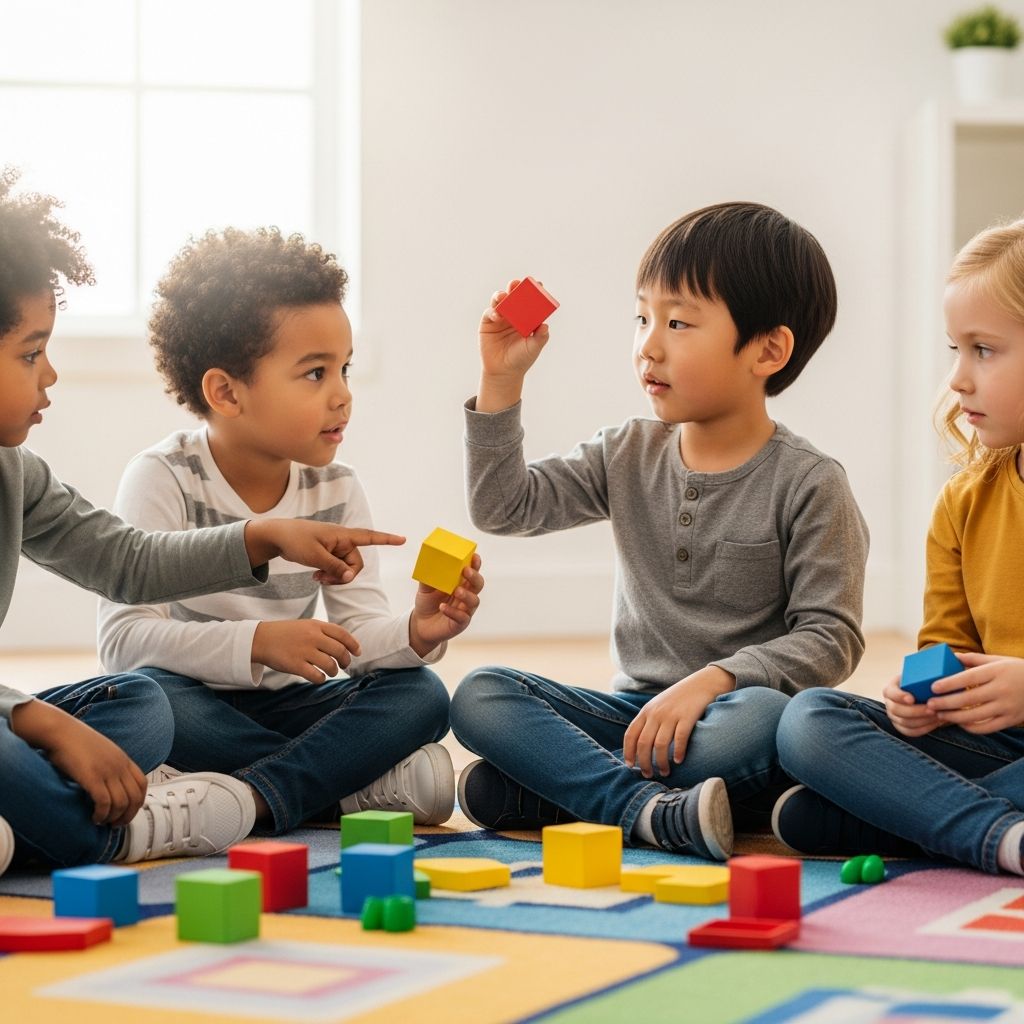
By the preschool years, children’s racial awareness crystallizes into more defined attitudes. Numerous studies demonstrate that three- to five-year-olds not only categorize people by race but also express preferences and develop biases that don’t necessarily mirror the racial attitudes held by adults in their immediate families. This is a critical finding because it suggests that children are constructing their own racial understandings through observation, pattern recognition, and social learning rather than simply absorbing parental attitudes.
Research indicates that racial biases emerge during this period through a process researchers call solving a “cognitive puzzle.” Children observe patterns in their environment — noticing which people work in particular occupations, live in specific neighborhoods, or hold positions of authority. When children repeatedly see these patterns, where certain racial groups are overrepresented in higher-status positions while others are underrepresented, they begin constructing implicit hierarchies about which groups are more valued or capable. Height and hairstyle may seem randomly distributed across occupations and neighborhoods, but skin color appears systematically linked to these outcomes, creating a puzzle children actively work to solve.
The Biological Basis of Color Vision and Its Variations
To fully understand children’s perceptual abilities, it’s helpful to examine how human vision actually works. Color perception is a complex biological process involving the eyes, brain, genetics, and learned associations. Light enters the eye and strikes the retina, where specialized cells called photoreceptors receive visual signals. Two main types of photoreceptor cells operate in human vision:
- Rod cells — detect light intensity and shades of gray, functioning most effectively in low-light conditions
- Cone cells — responsible for detecting color vision, containing three types sensitive to different wavelengths of light
The three types of cone cells include:
- S-cones (short wavelength) — respond to blue light
- M-cones (medium wavelength) — respond to green light
- L-cones (long wavelength) — respond to red light
The structure and sensitivity of these photoreceptor cells is determined by genes, which explains why color vision varies among individuals. Even among people with typical vision, small genetic variations can create subtle differences in how colors are experienced and perceived.
Color Blindness and Visual Diversity
When photoreceptor cone cells are absent or malfunction, color vision deficiency (CVD) results. This condition, commonly called color blindness, affects the individual’s ability to perceive certain colors accurately. Color blindness is a genetic condition that affects more men than women, inherited through family lines.
Several types of color blindness exist, each affecting different cone cells:
- Deuteranomaly — the most common form of red-green color blindness, affecting green cone cells and making it difficult to distinguish between red and green hues
- Protanomaly — another red-green color blindness type affecting red cone cells, creating challenges in differentiating red and green colors
- Tritanomaly — blue-yellow color blindness caused by blue cone cell malfunction, affecting perception of blue and yellow colors
- Monochromacy — a rare condition where individuals have only one type of cone or no functional cones, resulting in grayscale vision
The Subjective Experience of Color: What We Cannot Know
Perhaps the most philosophically intriguing question about color perception concerns whether everyone experiences colors identically. Consider a baby learning about the world, with a caregiver pointing to an apple and saying “red.” The baby eventually learns to associate that object with the word “red.” However, here lies a profound epistemological puzzle: we have no way of knowing whether the baby’s subjective experience of “red” matches anyone else’s.
The baby’s internal experience of the color red could feel completely different from how red appears to another child. To the first child, red might feel warm and vibrant, while to another child it might feel entirely different — perhaps more like orange or something without a precise parallel. Yet because both children learn to call the color “red,” society assumes they’re seeing the same thing. In reality, we cannot verify whether the subjective experience is identical.
This philosophical concept, sometimes called “qualia” in philosophy of mind, represents a fundamental limitation of human knowledge. Unless scientists develop technology to directly access someone else’s mind and conscious experience, we may never truly know whether our color experiences match those of others. We can measure wavelengths, study photoreceptor function, and observe behavior, but subjective experience remains private and inaccessible.
Why This Matters for Understanding Child Development
The distinction between biological color perception and subjective color experience has important implications for understanding how children learn about their world. Children use color as a primary organizing principle for categorizing objects, people, and experiences. When adults teach children color names and associations, they’re building cognitive frameworks that will influence learning across multiple domains.
More significantly for racial awareness development, children learn that certain skin colors are associated with particular social meanings, opportunities, and status levels. Just as they learn that red means “stop” and green means “go,” children learn that certain racial categories are associated with particular social positions. This learning occurs through both explicit instruction and implicit observation of patterns in their environment.
Implications for Parents and Educators
The research on childhood racial awareness carries important practical implications. Rather than hoping children won’t notice or understand racial differences, adults can acknowledge that children naturally observe and categorize these differences from infancy. By age three to five, children are actively developing their own attitudes about race based on environmental patterns and social learning.
This suggests that intentional, age-appropriate conversations about race can help children develop more accurate and equitable understandings. Avoiding the topic entirely doesn’t protect children’s innocence; instead, it leaves them to construct racial understandings based solely on environmental patterns and implicit messages. Active guidance from trusted adults can help children develop critical thinking skills about the patterns they observe.
Educators can also ensure that environments represent racial diversity broadly across positions of authority, expertise, and status. When children see diverse racial representation across all types of roles and achievements, they develop more expansive and equitable mental models of human potential and capability.
New Frontiers in Color Science
Color science continues evolving in unexpected directions. Recent scientific breakthroughs reveal that humans may be capable of perceiving colors previously unknown to science. Researchers at UC Berkeley used targeted retinal stimulation to reveal a new color called “olo” that had never before been seen or perceived by the human eye. This discovery suggests that human color perception has broader potential than typically assumed, and that our subjective experiences of color may be richer and more complex than current language and categories capture.
The Complexity of Perception
Color perception ultimately represents just one aspect of how children develop understanding about their world. While the biology of color vision involves photoreceptors, cone cells, and neural processing, the subjective experience of color remains deeply personal and impossible to fully share. Similarly, while children demonstrate measurable racial awareness from infancy, their internal experiences and feelings about race represent complex, multi-layered development shaped by biology, experience, and social learning.
Understanding that children are not colorblind — whether we’re discussing visual perception or racial awareness — requires acknowledging both what science can measure and what remains fundamentally unknowable about human experience. This balanced perspective can guide more thoughtful, evidence-based approaches to supporting children’s development across all domains.
Frequently Asked Questions
Q: At what age do children begin recognizing racial differences?
A: Research demonstrates that infants as young as six months old can nonverbally categorize people by race, with initial awareness likely beginning even earlier in development.
Q: Do children develop racial biases on their own or from their parents?
A: Children develop their own racial biases through observing environmental patterns and social cues, which don’t necessarily mirror the attitudes of adults in their families. By ages three to five, they’re actively constructing their own racial understandings.
Q: Is color blindness the same as not perceiving racial differences?
A: No. Color blindness refers to visual color perception differences (difficulty distinguishing certain colors like red and green). Children being “not colorblind” about race refers to their ability to recognize and categorize racial differences from infancy.
Q: Can we know if everyone sees colors the same way?
A: No. While people share similar biological systems for color vision, we cannot verify whether the subjective experience of color is identical between individuals. This represents a fundamental limitation of human knowledge about consciousness.
Q: What should parents do if young children ask about skin color differences?
A: Rather than avoiding these questions, parents can acknowledge that people have different skin colors and ethnic backgrounds, providing age-appropriate, factual responses that normalize diversity and encourage curiosity about human variation.
References
- Children Are Not Colorblind: How Young Children Learn Race — Erin N. Winkler, Ph.D., University of Wisconsin-Milwaukee. 2009. https://nmaahc.si.edu/sites/default/files/2021-12/children_are_not_colorblind.pdf
- Questions by Kids: Since We Know Some People Are Colorblind, How Do We Know That Everyone Else Sees Color the Same Way? — Boise State University. 2025-09-02. https://www.boisestate.edu/news/2025/09/02/questions-by-kids-since-we-know-some-people-are-colorblind-how-do-we-know-that-everyone-else-sees-color-the-same-way/
- The Science of Color: How Color Blindness Creates Unseen Barriers in Science — Phys.org. 2024-01. https://phys.org/news/2024-01-science-unseen-barriers.html
- The Science of Colour: How Colour Blindness Creates Unseen Barriers in Science Communications — Keirissa Lawson and Mark Lindsay, CSIRO. 2024-01-15. https://www.csiro.au/en/news/all/articles/2024/january/colour-vision-deficency-sci-comms