Understanding how children develop speech and language skills is crucial for parents. These abilities form the foundation for learning, social connections, and emotional expression. From initial cries to full sentences, each stage builds on the last. This guide outlines expected milestones, potential concerns, and ways to encourage growth, drawing from established developmental patterns.
Foundations in Infancy: Birth to 6 Months
In the first six months, babies shift from basic cries to more varied sounds, laying groundwork for speech. Newborns use crying to signal needs, varying pitch and intensity to convey hunger or discomfort. By 1-3 months, they coo softly, producing vowel-like sounds such as ‘oo’ and ‘ah,’ often in response to caregivers’ voices. These interactions strengthen bonds and introduce rhythm to communication.
From 4-6 months, babbling emerges with consonant-vowel combinations like ‘ba-ba’ or ‘da-da.’ Babies turn toward sounds, respond to tone changes, and mimic simple noises, showing they process auditory input. They enjoy toys that rattle or play music, which stimulates listening skills. Recognizing familiar voices and quieting to speech indicate healthy receptive language development.
- Reacts to loud noises and voices
- Smiles and vocalizes during interactions
- Begins repetitive babbling
- Locates sound sources visually
Daily talking, singing, and face-to-face play during this phase enhance neural pathways for language.
Emerging Words: 7 to 12 Months
Between 7 and 12 months, infants bridge sounds and meaning. They respond to their name, understand simple words like ‘no,’ and follow gestures such as pointing. Expressive skills advance with meaningful ‘mama’ or ‘dada,’ often paired with gestures like waving bye-bye or clapping.
By 10-12 months, first words appear, typically for family or objects. Babies jabber with inflection, imitating speech patterns heard around them. They participate in games like peek-a-boo, using sounds and actions to communicate joy or anticipation. Receptive vocabulary grows to include common items like ‘ball’ or ‘dog’.
| Milestone | Expected Behavior |
|---|---|
| Listening | Turns to name; enjoys rhymes |
| Expressive | 1-3 words; gestures actively |
| Speech Sounds | Babbles with rhythm; says ‘p,’ ‘b,’ ‘m’ |
Parents can support by narrating routines: ‘We’re washing hands now.’ Limit screen time to focus on human interaction.
Toddler Talk: 1 to 2 Years
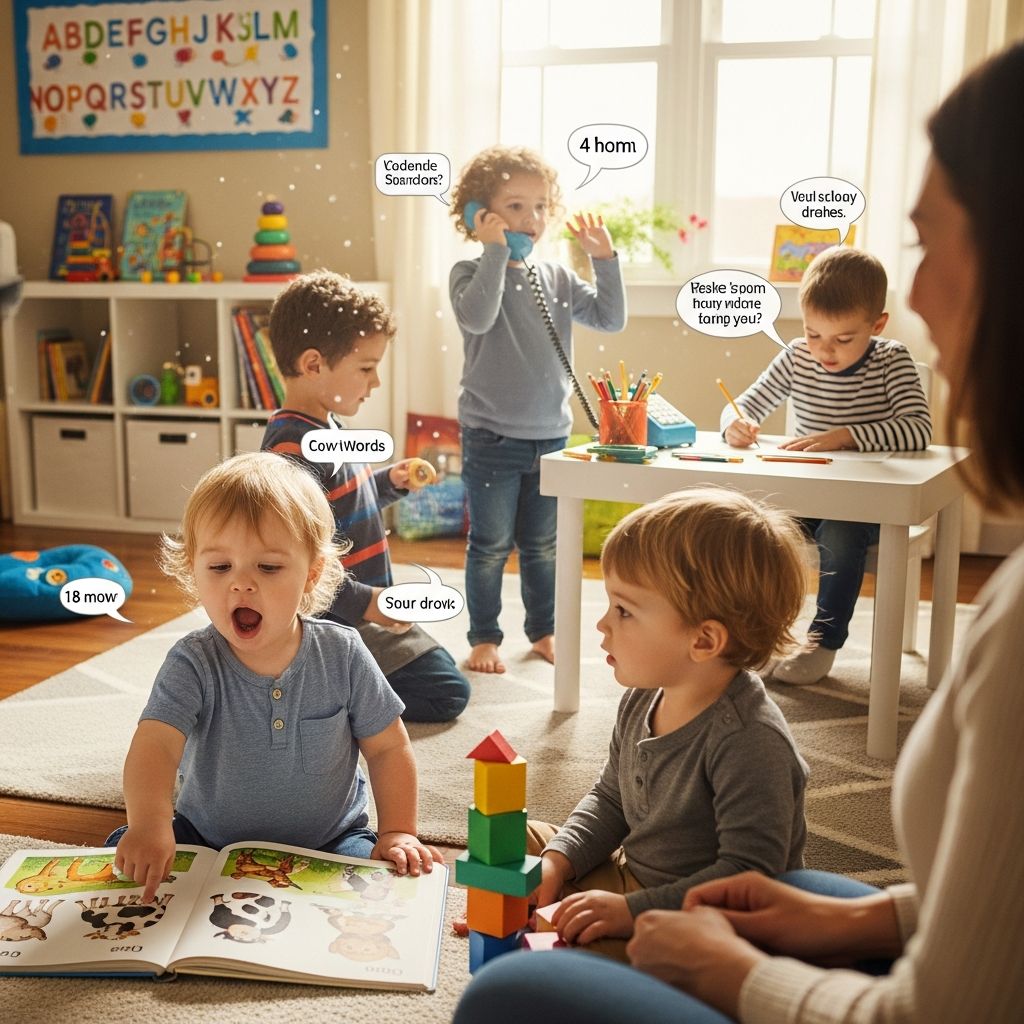
The second year explodes with vocabulary. Toddlers say 10-50 words by 18 months, combining them into two-word phrases like ‘more milk’ by 24 months. They name familiar objects, follow one-step directions (‘get the toy’), and point to body parts. Speech is 25-50% intelligible to strangers.
Grammar emerges with plurals (‘dogs’) and possessives (‘my ball’). They imitate songs, ask simple questions, and use gestures fluidly. Understanding grows to 200-300 words, enabling participation in basic conversations. Challenges like limited words or no two-word combos warrant monitoring.
- Points to pictures in books
- Uses 50+ words by age 2
- Follows simple instructions
- Identifies basic colors
Reading daily and expanding on utterances (‘Yes, big red truck!’) boosts expressive skills.
Preschool Progress: 2 to 3 Years
From 2-3 years, sentences lengthen to 3-4 words, with strangers understanding 75% of speech. Children describe actions (‘dog running’), use pronouns (‘me go’), and prepositions (‘under table’). They recount stories from books and engage in pretend play, naming letters or counting.
Sounds like ‘k,’ ‘g,’ ‘f,’ and endings like ‘-ing’ clarify speech. Receptive skills handle two-step directions (‘pick up toy and sit’). Vocabulary reaches 200-1,000 words, supporting turn-taking in talks.
Red flags include no two-word phrases by 24 months or speech less than 50% clear. Bilingual homes may see slight delays, but milestones align overall.
Refined Expression: 3 to 4 Years
At 3-4 years, children form complex sentences with ‘and’ or ‘because,’ using 1,000+ words. They follow three-step directions, answer ‘why’ questions, and name emotions. Speech includes trickier sounds like ‘r,’ ‘s,’ ‘z,’ with 90% intelligibility.
They retell stories, use past tense (‘I jumped’), and enjoy rhymes or jokes. Group play hones conversational skills. Pretend reading and following multi-step play enhance comprehension.
| Age | Key Skills | Sounds Mastered |
|---|---|---|
| 3 Years | 3-4 word sentences; prepositions | t, k, g, f |
| 4 Years | Compound sentences; numbers | l, sh, ch |
Encourage through discussions about daily events and diverse books.
School-Ready Speech: 4 to 5 Years
By 4-5 years, speech nears adult-like with detailed sentences and full intelligibility. Children grasp abstract concepts, make jokes, and use future tense. They follow multi-step rules in games and describe sequences.
Vocabulary exceeds 2,100 words; they debate, explain ideas, and recognize absurdities (‘silly elephant’). Playful language like puns emerges. Most sounds are correct except occasional ‘th’ or ‘r’.
- Recites songs or poems
- Asks complex questions
- Understands opposites
- Engages in role-play dialogues
Prepare for school by practicing narratives and listening activities.
Spotting Delays and Seeking Help
Not all children hit milestones exactly on time; wide variation exists. Persistent issues like no babbling by 12 months, fewer than 50 words at 2 years, or unintelligible speech at 3 years signal potential delays. Other signs: limited eye contact, not responding to name, or regression.
Factors like hearing loss, bilingualism, or prematurity influence pace. Early screening via pediatricians is key. Interventions like speech therapy yield best outcomes before age 3.
Practical Strategies for Parents
Active engagement drives development. Talk descriptively, read aloud daily (aim for 15-20 minutes), and limit screens under 18 months. Respond to all communication attempts, model correct speech without over-correcting, and play interactively.
For multilingual families, consistent exposure to each language works. Monitor via apps or charts, but consult experts for concerns.
Frequently Asked Questions
Is it normal if my 18-month-old says few words?
Some toddlers speak late; monitor for growth. If under 20 words or no gestures, see a doctor.
How can I help my child’s speech at home?
Narrate actions, sing songs, read books, and echo their words expansively.
What if my child stutters around age 2?
Developmental stuttering is common and often resolves; reduce pressure and model slow speech.
Does screen time affect speech?
Excessive passive viewing can delay skills; prioritize interactive play.
When should I worry about articulation?
If speech is unclear to strangers past 3 years or sounds don’t improve, seek evaluation.
References
- Speech and Language Developmental Milestones — NIDCD/NIH. 2023-10-01. https://www.nidcd.nih.gov/health/speech-and-language
- Stages of Listening, Language & Speech Development — John Tracy Clinic. 2024-05-15. https://www.jtc.org/stages-of-listening-language-speech-development/
- Age-Appropriate Speech and Language Milestones — Children’s Hospital of Philadelphia. 2023-08-20. https://www.chop.edu/health-resources/age-appropriate-speech-and-language-milestones
- ASHA’s Developmental Milestones: Birth to 5 Years — American Speech-Language-Hearing Association. 2024-02-10. https://www.asha.org/public/developmental-milestones/
- CDC’s Developmental Milestones — Centers for Disease Control and Prevention. 2025-01-01. https://www.cdc.gov/act-early/milestones/index.html