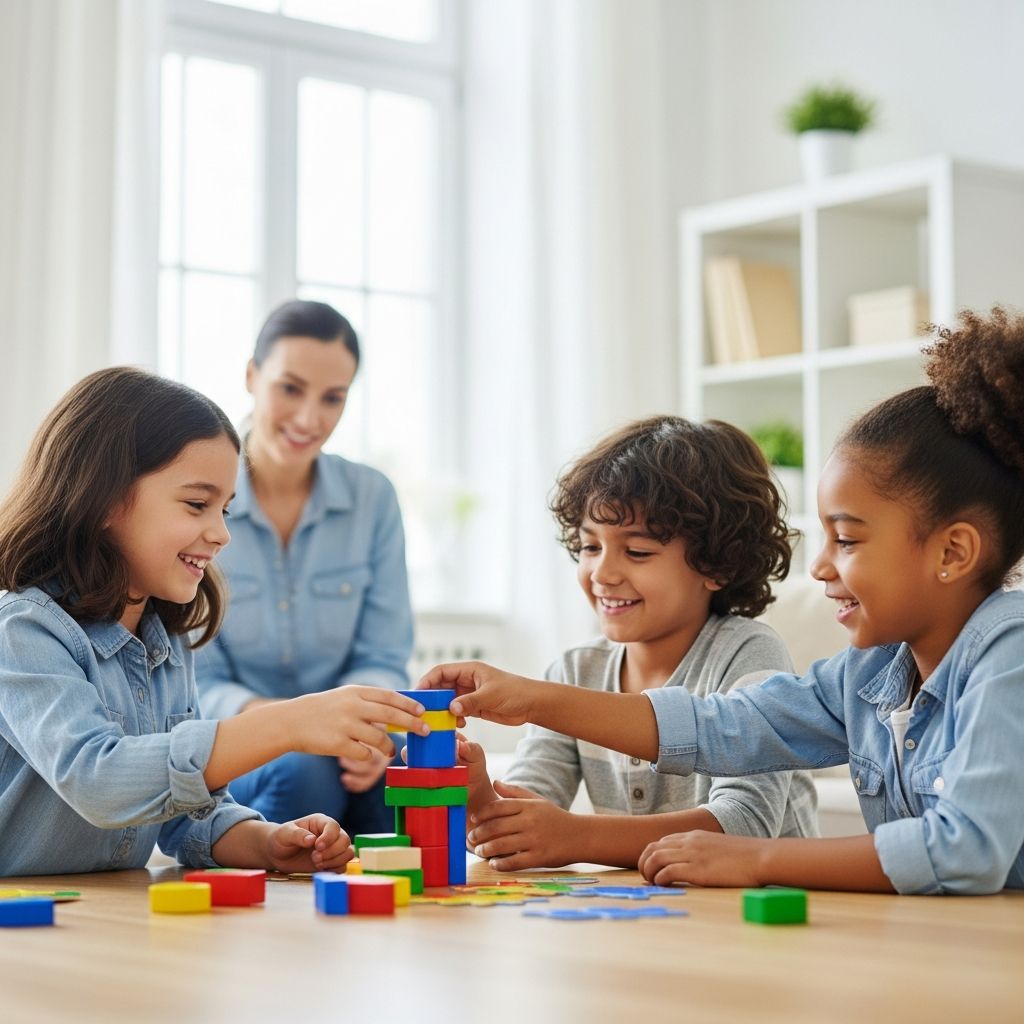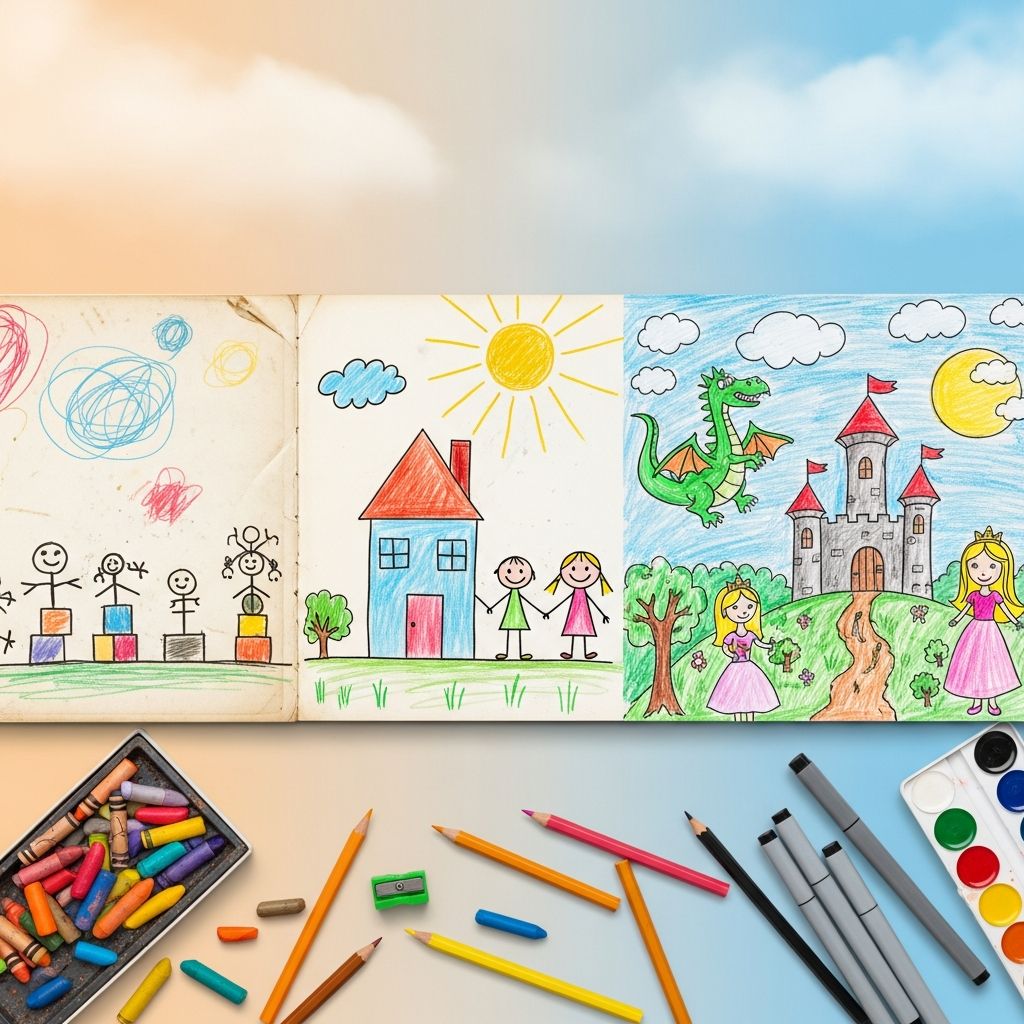
Children do not simply “make a picture” when they pick up a crayon; they reveal how they think, feel, and understand the world. Their artwork moves through recognizable stages, from random marks to detailed scenes and personal styles. Understanding these stages helps caregivers respond with encouragement instead of pressure or comparison.
Why Drawing Matters in Early Childhood
Drawing development is closely linked with language growth, motor coordination, problem-solving, and emotional expression. When a child experiments with lines and shapes, they are learning how to plan, control their muscles, and communicate ideas without words. Paying attention to these changes turns everyday doodles into a window on a child’s development.
- Drawing gives young children a safe outlet to express thoughts and emotions they may not yet verbalize.
- Using crayons, pencils, and markers strengthens small muscles in the hands and fingers that are later needed for writing.
- Art activities support focus, perseverance, and the ability to experiment and revise ideas.
Overview of Drawing Growth
Although every child is unique, many pass through similar stages as their drawing skills emerge. These stages are not strict rules or tests of intelligence; they are patterns that can help adults understand what to expect and how to offer support. Ages listed for each stage are approximate, and overlap is normal.
| Stage | Approximate Age Range | Main Characteristics |
|---|---|---|
| Exploratory Scribbling | 12–30 months | Random marks, large movements, enjoyment of the sensory experience |
| Intentional Marks and Simple Shapes | 2–4 years | Lines, circles, named drawings, beginning control and repetition |
| Recognizable People and Objects | 4–6 years | Basic figures, simple scenes, repeated ways of drawing common items |
| Organized Scenes and Details | 6–9 years | Ground and sky, overlapping objects, increasing detail and storytelling |
| Realism and Personal Style | 9–12+ years | Attention to proportion, shading, perspective, and individual preferences |
Stage 1: Exploratory Scribbling
In the earliest phase, many toddlers simply enjoy moving a marker or crayon across a page. The marks might look like scattered lines or patches of color, with no clear shapes or recognizable forms. At this point, the main goal is exploration: children discover that their actions leave a visible trace.
What you might see
- Large arm movements that sweep across the entire page or even off the paper.
- Dots, zigzags, arcs, and crisscross lines appearing without a clear pattern.
- Frequent switching between colors, tools, or surfaces simply for fun.
How to support this stage
- Offer large sheets of paper (or taped-together pages) so big movements are possible.
- Choose thick, easy-to-grip crayons or markers made for toddlers.
- Focus on the process instead of the outcome by commenting on effort and exploration, such as noticing colors or movement.
Stage 2: Intentional Marks and Simple Shapes
As coordination improves, children begin to control their marks more deliberately. Straight lines, circles, spirals, and enclosed shapes start to appear, and children often draw the same forms repeatedly. Many begin to tell stories about what they have drawn, even if the image still looks abstract to adults.
What you might see
- Repeated circles and lines that may be combined in simple ways.
- Marks that are labeled by the child, such as calling a circle a person or a pet.
- Early attempts to imitate shapes they see in books, signs, or around the house.
How to support this stage
- Invite conversation by asking open questions like, “Tell me about your drawing,” instead of guessing what it is.
- Introduce basic shapes in playful ways—tracing cookie cutters, drawing in sand, or using finger paint.
- Allow children to decide when their artwork is finished rather than asking them to add specific items.
Stage 3: First People and Objects
Preschoolers often begin drawing recognizable figures, such as people, houses, trees, and favorite animals. These images may appear in a consistent way each time: for example, a person might always have a round head with lines for arms and legs. Children use drawings to share stories, emotions, and daily experiences.
What you might see
- Simple human figures, sometimes with large heads and few body parts.
- Objects like houses, cars, or suns, often drawn larger when they are emotionally important.
- Collections of items that may not yet relate logically on the page but belong to the same story in the child’s mind.
How to support this stage
- Encourage storytelling by asking the child to describe who is in the picture and what is happening.
- Offer a variety of materials—colored pencils, markers, chalk—to spark experimentation.
- Display artwork at eye level to show that their efforts are valued, not judged.
Stage 4: Organized Scenes and Details
As children grow into the early school years, their drawings usually become more organized. People, animals, and objects relate to one another within a scene, and there is often a sense of “up” and “down” in the picture. Children start to notice smaller details in clothing, faces, buildings, and backgrounds.
What you might see
- Figures standing on a line that represents the ground, with sky or clouds near the top of the page.
- Overlapping objects, such as a person standing in front of a tree or furniture inside a room.
- Added details like buttons, shoelaces, hair styles, windows, or patterns on clothing.
How to support this stage
- Offer chances to draw from life, such as sketching a favorite toy, a plant, or a family pet.
- Provide time for longer projects where children can plan, sketch, and then add color or background details.
- Avoid correcting proportions or perspective; instead, praise attempt and observation.
Stage 5: Realism and Personal Style
Older children and preteens often work hard to make their drawings look “real.” They may compare their art with that of peers or media images and become more self-critical. At the same time, many start to show a distinctive style, preferring particular subjects such as animals, cartoon characters, landscapes, or fashion.
What you might see
- Attention to proportion, attempts at shading, and use of light and shadow.
- Interest in more complex views, such as drawing objects from the side, above, or at an angle.
- Refinement of favorite subjects over many drawings, sometimes filling sketchbooks.
How to support this stage
- Provide higher-quality materials, such as sketchbooks, different pencil grades, or fine-tip pens.
- Help manage frustration by emphasizing practice and growth over perfection.
- Expose children to a variety of art styles so they see that there is more than one “right” way to draw.
Signs of Progress Beyond Age
Because children develop at different speeds, a younger child might show features typical of a later stage or move between stages depending on mood or topic. Progress is best seen as a continuum, not a ladder. Noticing small changes over time—such as more control, richer storytelling, or new details—is often more helpful than comparing a child to age charts.
- Look for growing confidence in making marks and trying new ideas.
- Notice when a child begins to revise drawings, such as erasing and redrawing, as a sign of planning and evaluation.
- Celebrate individual strengths, whether they appear in color choices, inventive ideas, or technical skill.
Helpful Ways to Talk About Children’s Art
The way adults respond to drawings can either encourage creativity or accidentally shut it down. Children are sensitive to praise that focuses only on how “good” or “realistic” something looks. More constructive feedback emphasizes effort, curiosity, and personal meaning.
Supportive responses
- Describe what you see, such as noticing colors, shapes, or the number of people in the scene.
- Ask questions that invite reflection, like, “How did you decide to use those colors together?”
- Show genuine interest by making time to listen to the story behind the picture.
What to avoid
- Correcting drawings by taking over the pencil or redrawing for the child.
- Comparing siblings or classmates, which can create pressure and competition.
- Insisting that drawings must match reality exactly instead of allowing imagination.
Practical Art Ideas by Stage
Simple, low-pressure art activities can fit into everyday routines at home or in the classroom. Matching activities to your child’s general stage of drawing development makes creative time more enjoyable and less frustrating.
For early scribblers
- Crayon rubbings over textured surfaces like leaves or fabric.
- Large paper taped to the floor or wall for free movement.
- Washable finger paints in a tray or on an easel.
For shape explorers
- Drawing around hands, cups, or other safe household items to make outlines.
- Creating faces using paper cutouts of circles, lines, and simple shapes.
- Making pattern borders with repeated shapes or marks.
For emerging storytellers
- Drawing a favorite day and then dictating a sentence about it for an adult to write underneath.
- Making simple books with folded paper where each page shows a part of a story.
- Designing birthday cards, signs, or labels for personal spaces.
For detail-focused artists
- Observational drawing of real objects under good light, such as shells, leaves, or toys.
- Trying new media like charcoal, colored pencils, or watercolor.
- Copying favorite cartoon characters or game figures as a way to practice proportion and pose.
Common Questions About Child Drawing Development
Is it a problem if my child only scribbles?
For toddlers and very young preschoolers, scribbling is both normal and important. The focus is on learning how tools work, coordinating muscles, and enjoying the discovery process. As long as your child is offered chances to draw and seems engaged, there is usually no cause for concern.
What if my child does not like drawing?
Some children prefer building, pretend play, or physical activities, and that is also a valid way to learn. You can still support fine motor skills and creativity by offering short, low-pressure art moments and combining drawing with preferred interests, such as sketching favorite toys or sports scenes.
Should I correct mistakes in my child’s pictures?
It is more helpful to ask questions and invite problem-solving than to fix drawings directly. If a child notices something looks different from what they intended, you might ask, “What could you try next?” This keeps ownership of the work in the child’s hands and builds confidence.
When should I worry about delays?
Because development varies, falling outside typical age ranges is not automatically a concern. However, if a child avoids using their hands, struggles to hold tools, or shows very little interest in any kind of mark-making over a long period, discussing observations with a pediatrician or specialist can provide guidance.
How can drawing support reading and writing?
Drawing builds many of the same skills used in early literacy, including hand strength, control, attention to detail, and understanding that marks on a page can carry meaning. Encouraging children to dictate a caption for their artwork subtly links pictures and words in a way that feels playful instead of pressured.
Creating a Nurturing Art Environment
Children thrive when art materials are easy to reach, safe to use, and available often. A dedicated box or shelf with paper, crayons, and tape can signal that creativity is welcome anytime, not only during structured activities. Pairing this with patient, interested adults helps children feel that their ideas matter.
- Keep basic supplies in a consistent spot, and teach children how to clean up independently.
- Protect surfaces with washable covers so that adults can relax and allow genuine exploration.
- Rotate a few materials at a time to keep interest high without overwhelming choices.
When adults understand how drawing skills typically unfold, everyday sketches become more than refrigerator decorations. They are living records of a child’s growing body, mind, and personality. Respecting each stage—without rushing toward the next—helps children build both artistic ability and lifelong confidence in their own creative voice.