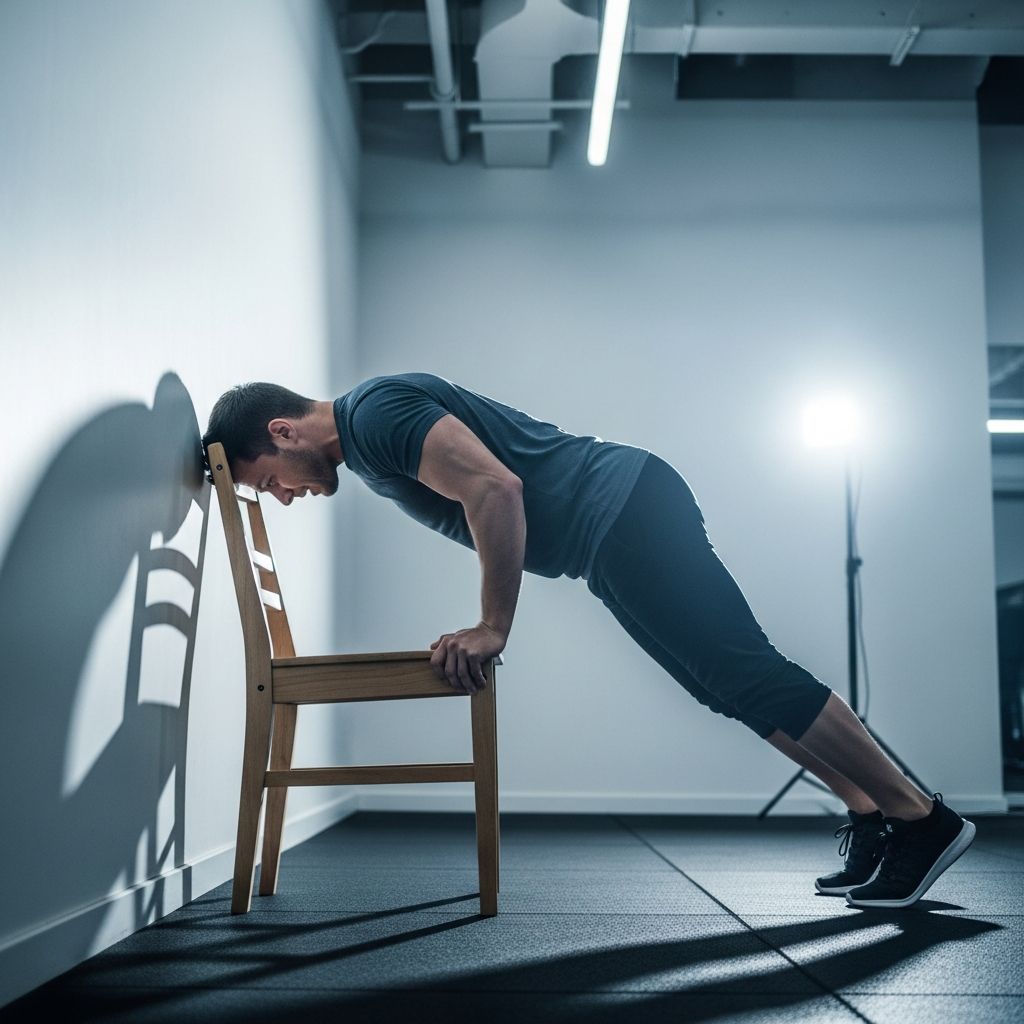
The chair challenge is one of those viral trends that looks laughably easy until you try it yourself and realize you can’t get off the wall without toppling forward. For many men, it’s almost maddening to watch women stand up effortlessly with a chair in their hands while they remain glued to the wall. This article breaks down what the challenge is, how it works, and why your body’s proportions and physics—not just strength—decide whether you succeed or fail.
What Exactly Is the Chair Challenge?
The chair challenge is a simple-looking balance and leverage task that involves standing near a wall, bending forward, lifting a chair, and then trying to stand up straight while holding it. At first glance, it appears to be a test of strength, but in reality it is mostly a test of how your center of mass lines up with your feet.
People are often surprised that they can perform heavy lifts in the gym but cannot complete this quick challenge in their living room. That surprise factor is part of why the trend spread so quickly on social media platforms and became a favorite among friends trying to stump each other.
- It requires minimal equipment: just a chair and a wall.
- It is quick to attempt and easy to film.
- It creates an apparent gender divide that people find intriguing and shareable.
How to Perform the Chair Challenge Step by Step
While variations exist, most versions follow the same basic setup. Tiny differences in foot distance or chair placement can change everything, so attention to detail matters.
- Stand with your toes touching a wall, feet together or hip-width apart.
- Take two small steps back, heel-to-toe, in a perfectly straight line away from the wall.
- Keep your legs mostly straight and bend at your hips until your upper body is roughly parallel to the floor, with your forehead or the top of your head touching the wall.
- Have a standard chair placed in front of you so that you can reach the seat while keeping your head against the wall.
- Lift the chair so it is pressed into your chest or abdomen while you remain bent forward.
- Without moving your head off the wall until you start the stand-up motion, try to rise to a fully upright standing position while still holding the chair.
Many women manage to stand up smoothly, while many men feel as if an invisible force is holding them down or pulling them forward. That sensation is physics at work more than anything else.
The Physics Behind the Challenge
The key to understanding the chair challenge is the idea of the center of mass. Your center of mass is the point where your body’s weight can be considered to be concentrated. When you stand upright, that point must remain above your base of support—usually the area between your feet—for you to stay balanced.
When you bend forward with your head touching a wall and then pick up a chair, you are moving your combined center of mass (your body plus the chair) forward. To stand without falling, you need to shift that center of mass back over your heels. The problem is that the wall and the fixed foot position make that shift much harder than it looks.
- If your feet start slightly farther from the wall, your upper body extends more, placing your center of mass further forward.
- Adding the weight of the chair increases the forward pull, demanding even more backward shift that your hips and ankles must generate.
Why It’s Often Easier for Women
A striking part of the trend is that women on average perform better at the chair challenge than men. This difference is less about effort or motivation and more about biomechanics and typical body proportions.
Two major factors play a role: relative foot size and the distribution of body mass. These are general trends and not rigid rules, but they explain why many women succeed where many men struggle.
Role of Foot Size and Distance from the Wall
When the instructions say to take two heel-to-toe steps back from the wall, the actual distance you move depends on how long your feet are. Larger feet mean you end up farther from the wall after the same number of steps compared with someone with smaller feet.
On average, men tend to have larger feet than women of similar height. That extra distance pulls the hips and torso slightly farther away from the wall when bending over, making the center of mass start out more forward. The further forward it begins, the harder it is to pull back over the heels once the chair is lifted.
Body Proportions and Center of Mass
Typical male and female body types also differ in how mass is distributed. Men often carry more muscle and bulk in the upper body—chest, shoulders, and arms—while women more frequently carry a greater proportion of mass around the hips and thighs. These patterns are averages, not universal truths, but they still influence performance.
In the chair challenge, more weight in the upper body, plus a forward head and arms holding a chair, pushes the center of mass even further in front of the feet. A body with more mass distributed lower, closer to the pelvis and legs, can sometimes maintain the center of mass nearer to the base of support, making the stand-up motion more achievable.
Strength vs. Balance: What Is Really Being Tested?
Many participants assume that the chair challenge is a raw strength test. It can be frustrating for a person who squats or deadlifts heavy weights to discover they cannot complete a seemingly light bodyweight-and-chair task.
What the challenge truly tests is your ability to coordinate balance, leverage, and joint position within a very constrained setup. Your muscles are working, but they are limited by geometry: your feet cannot move, your head must stay against the wall until you start to rise, and the chair pulls your mass forward.
- Lower body strength matters, but not as much as your ability to bring your hips back under your torso.
- Core stability helps you keep the chair close and prevent collapsing, but it does not automatically shift your center of mass.
Common Mistakes People Make
Small errors in setup or technique can make the chair challenge harder than it already is. Some people unknowingly change the rules in ways that either make it impossible or easier than intended.
Here are frequent mistakes:
- Taking oversized steps: Using big strides back from the wall instead of true heel-to-toe steps extends the distance and pushes your center of mass too far forward.
- Bending the knees too early: Excessive knee bend can shift your weight oddly and remove some of the hip hinge mechanics that make the movement possible.
- Holding the chair too far away: Letting the chair hang away from your torso increases the forward pull like a lever, making balance much tougher.
- Lifting a heavy or oversized chair: Using a bulky, heavy object instead of a standard chair amplifies the difficulty and risk.
Warm-Up and Safety Tips
Even though the chair challenge looks like a casual game, it can strain your lower back, hamstrings, or neck if you force it or skip a warm-up. Treat it like any other new physical activity: with preparation and caution.
Consider these warm-up ideas before you attempt it:
- Dynamic hamstring movements: Leg swings forward and back, or marching kicks with a gentle reach toward the toes, help prepare the back of your thighs.
- Hip hinge practice: Stand tall, place your hands on your hips, and repeatedly bend forward by pushing your hips backward while keeping your spine neutral, then stand back up.
- Light core activation: Simple planks or dead bugs prime your trunk muscles to support your spine during the bent-over position.
Stop immediately if you feel sharp pain, dizziness, or pressure in your lower back or neck. The challenge is a novelty, not a benchmark of your fitness or toughness, and there is no reason to push through discomfort.
Body Mechanics at Work: A Simple Table
The table below summarizes how a few key variables influence performance for many people.
| Factor | Typical Trend in Men | Typical Trend in Women | Effect on the Chair Challenge |
|---|---|---|---|
| Foot length | Longer feet on average | Shorter feet on average | Longer feet increase distance from the wall after the same number of steps, making balance harder. |
| Upper body mass | More mass in chest and shoulders | Relatively less upper body bulk | More upper body weight pulls the center of mass forward when bent over with a chair. |
| Lower body mass | Proportionally less concentrated in hips | Often more mass around hips and thighs | Mass closer to the pelvis can help keep the center of mass nearer the base of support. |
| Flexibility and hip hinge control | Highly variable, often dependent on training style | Also highly variable, often influenced by daily movement patterns | Better control over hip hinge and hamstrings allows more precise shifting of weight. |
Variations and Progressions to Try
If the traditional version of the chair challenge is too hard—or too easy—there are safe variations that can add fun without dramatically increasing injury risk. These tweaks also help highlight how sensitive the challenge is to small changes.
- Change step length: Use smaller steps back from the wall to reduce the forward pull, or slightly larger ones to increase difficulty if you already succeed easily.
- Use a lighter object: Swap the chair for a light box or cushion to experience the balance component without as much strain.
- Try different foot widths: Starting with feet slightly wider can sometimes give a more stable base, though it may also alter the intended difficulty.
- Hands-free drill: Practice the bent-over position with your head at the wall and arms crossed on your chest (without any object) before adding the chair.
What the Challenge Does (and Doesn’t) Say About Your Fitness
Trying the chair challenge can feel like a referendum on your strength or athleticism, but it is not a real fitness test in the conventional sense. Plenty of highly fit people cannot perform it, and some relatively untrained individuals can manage it without much trouble.
What it does reveal is how your unique body proportions, balance, and motor control interact with a very specific constraint. It also serves as a playful reminder that the human body obeys the rules of physics even in everyday, non-athletic situations.
- Failure at the challenge does not mean you have a weak core, legs, or back.
- Success does not automatically indicate superior athletic performance; it may simply reflect favorable proportions for this particular task.
FAQs About the Chair Challenge
Is the chair challenge safe for everyone?
The challenge is not appropriate for everyone. People with a history of back pain, balance issues, or neck problems should be cautious or skip it entirely, because the bent-forward position and sudden attempt to stand can strain vulnerable areas.
Why can some men do it while others cannot?
Not all men share the same height, foot size, leg length, or upper body mass distribution. Those with relatively smaller feet, different limb proportions, or more practice with hip hinge movements may find the challenge more manageable than peers with longer feet and heavier upper bodies.
Can practice make you better at the challenge?
Practice can improve your technique, coordination, and comfort with the hip hinge, which may help you get closer to success. However, if your proportions place your center of mass too far forward, there may always be a hard limit to what is possible within the standard rules.
Does using a different chair change the difficulty?
Yes. A lighter, smaller chair is easier to control and adds less forward pull, while a heavier or bulkier chair amplifies the demands on your balance and lower body strength. Even the height of the chair seat can affect your hand and arm position and therefore your center of mass.
Is the chair challenge a good workout?
On its own, the chair challenge is more of a novelty test than a structured workout. It can engage your legs, core, and back muscles briefly, but it does not replace regular strength training or endurance exercise for health or performance goals.
Using the Chair Challenge as a Teaching Moment
Beyond its entertainment value, the chair challenge is a useful way to spark conversations about biomechanics, physics, and how individual bodies differ. Teachers, coaches, and parents can use it to demonstrate concepts like center of mass, leverage, and the role of foot placement in balance.
By treating the trend as an educational tool rather than a pass-or-fail strength test, people can enjoy the silliness while gaining a deeper appreciation for the science that governs everyday movement. In that sense, failing the challenge can be just as enlightening—and fun—as succeeding.