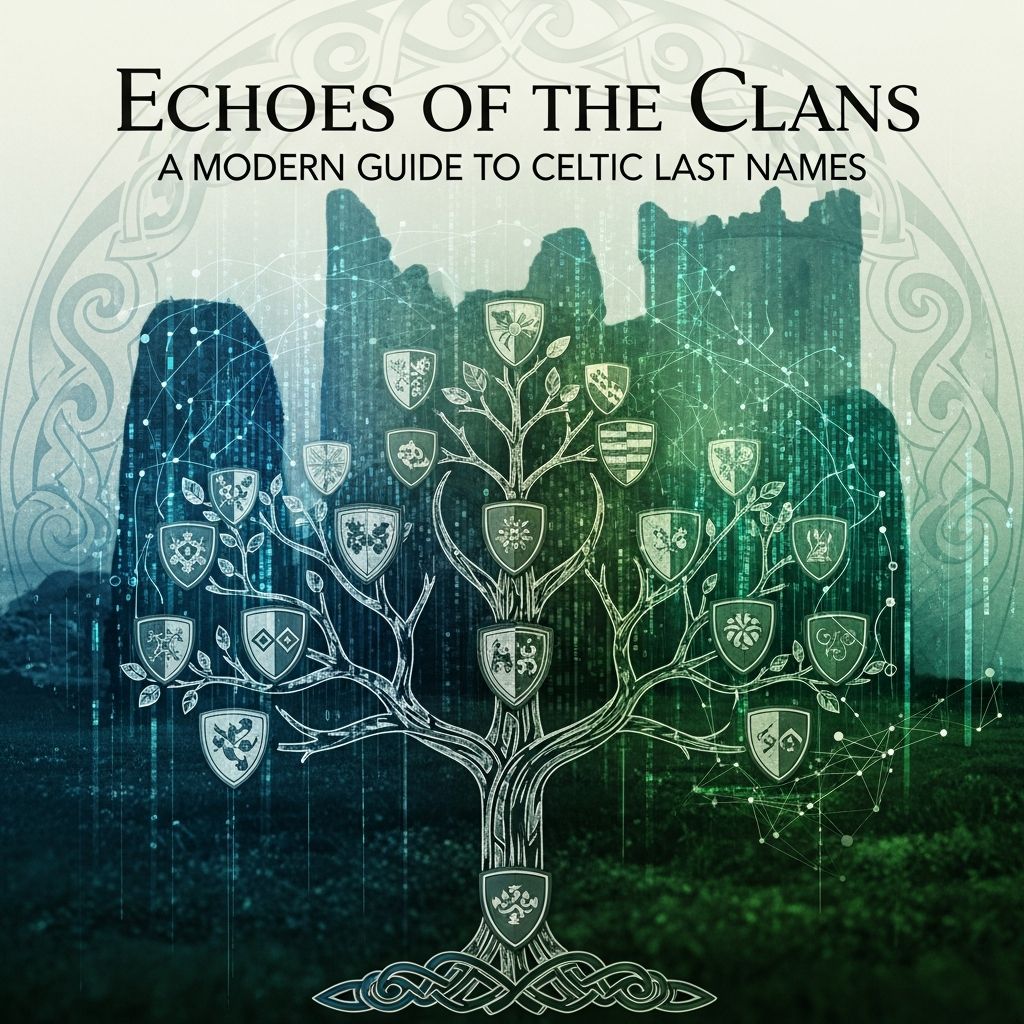
Celtic last names carry centuries of memory, tying families to ancient clans, landscapes, and legends. These surnames are more than labels; they are compact stories about who a family once followed, where they lived, or how an ancestor was known in their own community.
Whether you have an Irish, Scottish, Welsh, Cornish, Manx, or Breton name in your family tree, understanding Celtic surnames can turn dry genealogy into a living narrative. This guide introduces the key patterns, meanings, and regional traditions that shape Celtic last names, then offers practical tips and FAQs for exploring your own.
What Makes a Surname “Celtic”?
“Celtic” does not refer to a single country or modern nation, but to a family of cultures and languages that once stretched across large parts of Western Europe. Today, the main Celtic regions are Ireland, Scotland, Wales, the Isle of Man, Cornwall, and Brittany in France.
A surname is typically considered Celtic if it grew out of one of the Celtic languages – Irish and Scottish Gaelic, Welsh, Cornish, Manx, or Breton – or if it became closely tied to those cultures through clan identity and long residence.
- Many Celtic surnames preserve older forms of personal names that are no longer used as first names.
- They often encode family relationships, physical traits, occupations, or places in a compact and sometimes poetic way.
Core Types of Celtic Last Names
Across the Celtic world, surnames developed in several broad categories. Understanding these makes it easier to decode what your own name might mean.
Patronymic and Family-Based Names
Patronymic surnames identify a person as the child or descendant of a named ancestor. Instead of saying “John, son of Patrick,” the language eventually compresses this into a fixed family name that all descendants share.
- Irish and Scottish Gaelic use prefixes such as Mac and Ó to express descent.
- Welsh historically used a chain of “ap” (son of) connections before fixed surnames became common.
Descriptive and Nickname-Derived Names
Some Celtic surnames come from a striking personal characteristic of an ancestor. This might be hair color, size, temperament, or another memorable trait.
- Words for “red,” “dark,” “fair,” or “small” appear frequently in Gaelic and Welsh roots.
- Over time, a one-person nickname can solidify into the label for a large extended family.
Locational and Landscape Names
Other surnames are linked to a place, such as a valley, hill, fortress, or settlement. In Celtic regions with dramatic landscapes, many last names preserve old geographical vocabulary.
- Some names refer directly to a townland, island, or parish.
- Others describe a feature like a “stone fort,” “ridge,” or “church by the river.”
Occupational and Status Names
While less common than in English, occupational surnames do appear in Celtic traditions, especially for roles of religious, legal, or artisan importance. Over time these roles could become associated with particular families.
- Names connected with clerics, smiths, bards, or stewards occur in various Celtic regions.
- Some surnames hint at noble or leadership roles within a clan or territory.
Key Prefixes and Particles in Celtic Surnames
Many Celtic last names are easier to interpret once you recognize common prefixes. These markers often signal relationship or gender and can reveal how a name originally functioned.
| Prefix | Language/Region | Core Meaning | Example Pattern |
|---|---|---|---|
| Mac / Mc | Irish & Scottish Gaelic | “Son of” a named male ancestor | Mac + given name → MacName |
| Ó | Irish Gaelic | “Descendant of” or “grandchild of” | Ó + ancestor’s name → Ó Name |
| Nic / Ní | Irish & Scottish Gaelic (female forms) | “Daughter of” or “daughter of the descendant of” | Ní + Ó Name; Nic + Mac Name |
| Ap / Ab | Welsh | “Son of” (historical, often fused) | Ap + Rhys → modern Price |
| Ferch / Verch | Welsh (historical) | “Daughter of” | Name ferch Father |
| Tre- / Pen- / Lan- | Cornish & Breton | “Farm/settlement,” “head/end,” “church/enclosure” | Tre + place, Pen + feature, Lan + saint/place |
Irish Last Names: Kinship and Kingdoms
Irish surnames are among the earliest hereditary family names in Europe, developing from systems that emphasized kin groups and ancestral territories. Clans were often associated with a particular region, and their surnames reflected this status.
Many well-known Irish names use the Ó and Mac structures, connecting living descendants to a founder or notable forebear from the early medieval period.
- Ó-based surnames typically signal descent from a grandson or later descendant of a notable individual.
- Mac-based surnames began as more direct references to a son, though they too became hereditary over time.
Anglicization changed many Irish surnames, smoothing out original spellings and sometimes discarding prefixes. In some cases, related families now appear under slightly different English forms of the same Gaelic name.
Scottish Surnames and the Clan Ideal
Scottish surnames, particularly those from the Highlands, grew out of powerful clan structures that lasted into the modern era. A clan surname might connect a person not only to blood relatives but also to a broader community of allegiance.
The Mac prefix is highly visible in Scottish names and signals historical family-based naming, even when modern bearers are many generations removed from the original ancestor.
- Highland clans often linked surnames with territories, tartans, and a chief line.
- Lowland areas incorporated a greater mix of occupational and locational surnames of non-Gaelic origin that later became associated with Scotland.
Welsh, Cornish, Manx, and Breton Traditions
Beyond Ireland and Scotland, other Celtic regions developed their own surname customs, each influenced by local language and history. These traditions share a focus on kinship and place but use different linguistic tools.
Examining these systems broadens the understanding of what a Celtic surname can look like and explains why some names do not resemble the more familiar Irish or Scottish patterns.
Welsh Patronymics and Modern Forms
Traditional Welsh naming once used long chains of “X son of Y son of Z,” only later freezing into fixed surnames. As the language evolved and interacted with English, particles like ap fused into recognizable modern forms.
- Some common Welsh surnames today began as “ap + personal name” combinations that gradually lost the space and initial letters.
- Because of this process, many people share a small set of core Welsh surnames, even if their deeper family histories differ.
Cornish, Manx, and Breton Place-Linked Names
In Cornwall and Brittany, many surnames tie directly to settlements, farms, or religious sites, using distinct prefixes that reflect local geography and church-centered communities. On the Isle of Man, Manx names show a mixture of Gaelic roots and Norse influence.
- Cornish surnames often preserve old words for homesteads, headlands, and enclosures.
- Breton surnames sometimes link families to saints, parishes, or particular villages in the Armorican peninsula.
Common Themes in Celtic Surname Meanings
Despite regional variety, certain themes appear again and again across Celtic last names. Recognizing these patterns helps when translating or interpreting an unfamiliar surname.
- Nature and landscape: Words for hills, lakes, woods, stones, and fortifications are widespread.
- Color and appearance: Terms for red, fair, dark, or curly show up as descriptive elements.
- Animals and symbolism: Wolves, hounds, ravens, and other creatures appear as metaphors for strength, loyalty, or keen sight.
- War and leadership: Roots meaning battle, champion, or chief highlight martial or noble associations.
- Religion and learning: References to clerics, monks, and scholars emphasize learned or spiritual roles within communities.
How Celtic Surnames Changed Over Time
Celtic surnames did not remain frozen once established. Over centuries, political pressure, language shift, and migration reshaped their spelling, pronunciation, and even structure.
Several forces in particular affected the way these names look today, especially in English-speaking countries.
Anglicization and Standardization
Administrative records, church registers, and later censuses often required scribes to write Gaelic and other Celtic names using English spelling conventions. This practical need led to multiple recorded forms for the same underlying surname.
- Some families gradually adopted shorter or simpler spellings to fit easily into English-language contexts.
- Others dropped visible markers like the Ó or Mac prefix and later revived them during cultural renewal movements.
Migration and Diaspora
Large-scale emigration from Celtic regions carried these surnames to North America, Australia, and beyond. In new countries, officials and neighbors sometimes altered names further, either unintentionally or to ease integration.
- Ship manifests, immigration cards, and local accents all contributed to alternate spellings.
- Despite these changes, many families maintain a strong emotional link to their original Celtic surname and its homeland.
Practical Steps to Explore Your Celtic Surname
Researching a Celtic last name can feel overwhelming at first, especially with shifting spellings and ancient roots. Breaking the process into simple steps makes it more manageable and enjoyable.
1. Identify the Likely Region and Language
Start by asking older relatives what they know about the family’s origin. Even a vague memory of “Irish” or “Welsh” ancestry can point you toward the right language background for your surname.
- Check for familiar prefixes like Mac, Ó, or traces of ap that might be hidden in the spelling.
- Notice whether the name resembles known town names or landscape features in a particular Celtic region.
2. Gather All Spelling Variants
Before searching databases or historical records, make a list of every spelling of your surname you have seen in family documents. Older certificates, letters, and headstones often preserve clues that modern records do not.
- Include versions with and without prefixes, and note any unusual letters or diacritics.
- Keep an open mind; a single family line can appear under two or three different spellings in just a few generations.
3. Look Up Meaning and Historical Context
Once you have likely spellings and a rough region, consult reputable surname dictionaries, academic resources, or specialized websites that focus on Celtic names. These sources can provide translations, historical bearers, and regional distributions.
- Focus on the meaning of individual elements rather than chasing a single definitive story.
- Be cautious about romanticized or legendary explanations unless they are supported by historical evidence.
4. Connect the Name to Records and Places
The final step is to link your surname to specific people, parishes, and townlands. Census records, parish books, and civil registrations help place your ancestors in real locations at particular times.
- Map clusters of your surname to see if they align with known clan areas or traditional strongholds.
- Local archives, graveyards, and historical societies in Celtic regions can offer additional insight beyond online resources.
SEO-Friendly FAQ About Celtic Last Names
Are all “Mac” and “Mc” surnames Scottish or Irish?
Not every surname starting with Mac or Mc comes from a purely Gaelic background, but most of them do trace back to Irish or Scottish naming systems that used these prefixes to indicate “son of.” Over time, some names passed from Gaelic speakers into English-speaking communities and were carried to other countries, which is why they now appear worldwide.
Why do some families drop or restore the O’ or Mac in their surname?
Prefixes like O’ and Mac were sometimes removed under social, political, or bureaucratic pressure, especially in periods when Celtic languages and identities were discouraged. In more recent times, many people have chosen to restore these elements as a way of reclaiming cultural heritage and reinforcing a connection to their ancestral homeland.
Can two people share the same Celtic surname but be unrelated?
Yes, sharing a Celtic last name does not guarantee a close biological relationship. Popular surnames may have arisen independently in different places, or separate families might have adopted the same name when patronymic systems were converted into fixed surnames, especially in regions with dense populations.
Why are some Celtic surnames so common?
Certain surnames became especially widespread because they were linked to powerful clans, influential ancestors, or widely used personal names. When a common first name like an early chieftain or saint formed the basis for a patronymic surname, it naturally generated many descendants using similar or related family names.
How can I tell if my surname is Celtic if it looks English?
Some Celtic surnames were heavily reshaped by English spelling and pronunciation, making their origins less obvious. If your family has a tradition of Irish, Scottish, Welsh, Cornish, Manx, or Breton roots, it is worth checking surname resources that specialize in those regions, as the original form may be hidden beneath a more familiar English-looking spelling.
Do Celtic surnames always indicate a specific clan?
In some Scottish Highland and Irish cases, a surname is strongly associated with a particular clan or sept, but this is not universally true. Many surnames were used by multiple unrelated families or shifted between regions over time, so a clan connection is a possibility, not an automatic guarantee.
Can I change my surname back to an older Celtic form?
In many countries, people can legally change their surname if they follow local procedures, and some choose to adopt older Celtic spellings or restore lost prefixes. Before doing so, it is helpful to research the most historically accurate version of the name for your lineage and to consider how the change may affect documents and family members.
Using Celtic Surnames to Enrich Family History
Celtic last names invite curiosity and reward careful investigation. Each name represents a thread running from the present back through centuries of language, war, migration, and everyday life in villages and glens.
By learning how to read the structures and meanings hidden inside Celtic surnames, families can transform a simple list of ancestors into a vivid story that spans kingdoms, islands, and cultural revivals.