Resuming in-person learning requires careful planning to minimize health risks while maximizing educational opportunities. The Centers for Disease Control and Prevention (CDC) provides frameworks that balance safety with the need for consistent schooling. These protocols evolve with scientific insights, emphasizing practical measures for K-12 environments.
Core Decision Framework for School Operations
School administrators must evaluate local conditions before reopening. Key factors include alignment with state mandates, symptom screening at entry, and ongoing communication with health authorities. A structured decision tree helps determine readiness, assessing capabilities like hand hygiene promotion and ventilation improvements.
- Verify compliance with regional health orders.
- Implement daily health checks for symptoms and exposures.
- Monitor community case rates in partnership with local officials.
- Adopt enhanced cleaning routines and air quality measures.
This approach ensures decisions are data-driven, adapting to fluctuating transmission levels.
Transportation Safety Measures
School buses present unique challenges due to confined spaces. CDC advises spacing students by seating one per row in alternating seats to promote distancing. Drivers should don cloth masks, perform frequent handwashing, and disinfect high-touch areas daily or between runs.
| Bus Safety Practice | Description | Frequency |
|---|---|---|
| Seating Arrangement | One student every other row | Every trip |
| Surface Disinfection | Clean handles, seats, rails | Daily or between uses |
| Driver Protection | Wear masks, hand hygiene | Continuous |
| Staggered Schedules | Adjust pick-up/drop-off times | As needed |
These steps reduce close contacts and limit parental interactions at stops.
Health Screening and Isolation Updates
For the 2025-2026 school year, isolation rules have simplified. After a positive test, individuals isolate for 24 hours while monitoring symptoms. Return is permitted once symptoms improve overall and fever-free for 24 hours without medication. The following 5 days require extra precautions like improved ventilation and hygiene.
- Track symptom progression closely.
- Enhance air filtration upon return.
- Maintain rigorous handwashing protocols.
This shift reflects current virology data, shortening disruptions while safeguarding others.
Preventing Infections in Classroom Settings
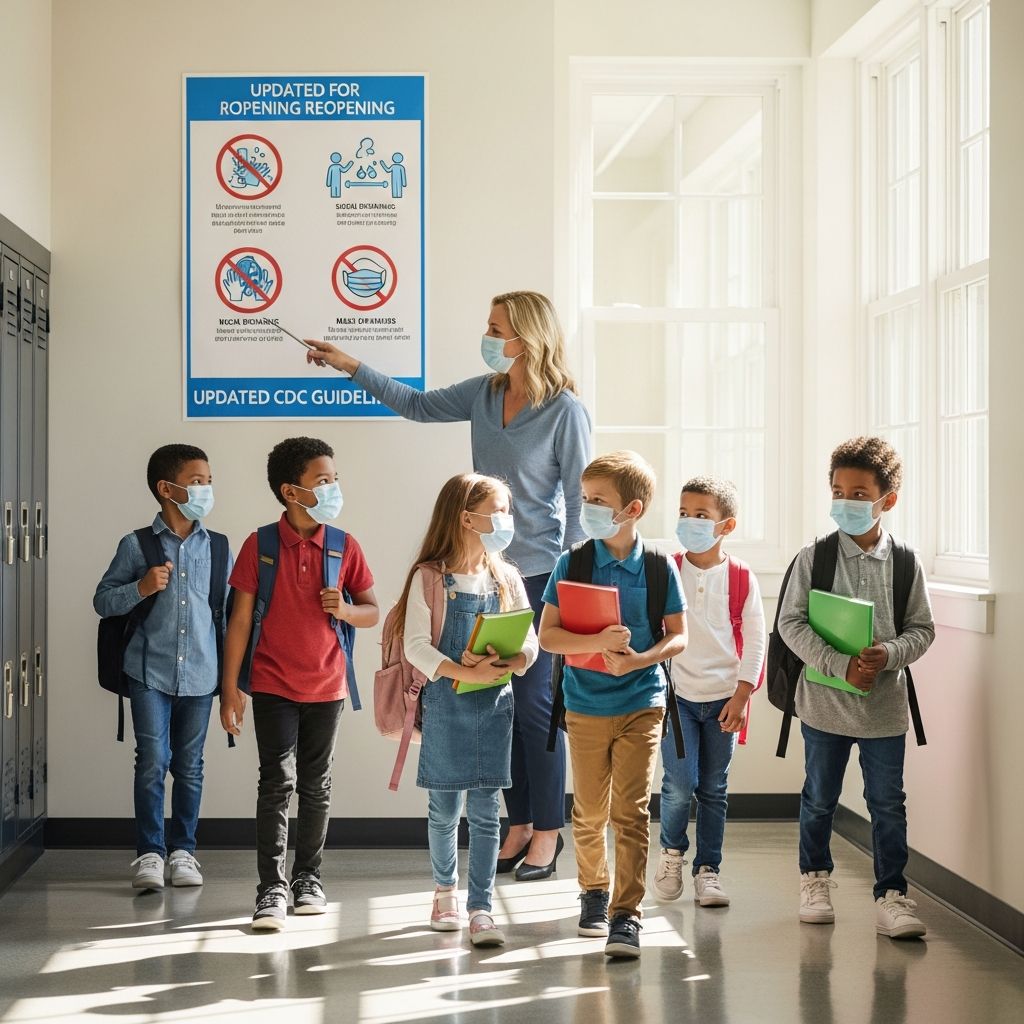
Recent CDC consolidations streamline K-12 infection control. Focus areas include universal masking when feasible, cohort grouping to limit mixing, and respiratory etiquette training. Schools should post signage and station sanitizers in high-traffic zones.
Ventilation upgrades are critical: open windows, use HEPA filters, and adjust HVAC systems for maximum airflow. Cleaning protocols tier based on threat levels, intensifying during outbreaks.
Masking and Distancing Strategies
Mask policies adapt to local data and CDC benchmarks. Universal masking may apply in high-transmission areas, with exemptions for medical needs. Distancing prioritizes 3-6 feet in classrooms, achieved via podding and scheduled breaks.
- Monitor local metrics with health departments.
- Use floor markers and one-way corridors.
- Schedule lunches to avoid crowding.
These maintain quality in-person instruction.
Facility Maintenance Essentials
Healthy buildings prevent spread. Daily disinfection of doorknobs, desks, and shared tools is standard. Respiratory hygiene integrates into routines, with staff modeling behaviors.
Handwashing stations feature soap, water, and timers for 20-second scrubs, prompted before meals and after restroom use.
Staff Training Imperatives
Employees receive comprehensive instruction on protocols, from screening to cohort management. Regular drills reinforce hand hygiene and distancing. Ongoing updates align with CDC revisions, last reviewed January 2026.
Immunization Schedule Adjustments
Beyond respiratory illnesses, CDC updated childhood vaccines per presidential directive. Categories include universal recommendations (e.g., MMR, polio), high-risk specifics, and shared decision-making options—all insurance-covered. This empowers families while protecting against outbreaks.
- Core vaccines: measles, pertussis, HPV.
- Risk-based: for vulnerable groups.
- Consultative: physician-parent discussions.
Implementation involves state agencies and clinicians.
Balancing Education and Safety
Full in-person learning is prioritized post-emergency, with protocols mitigating risks. Districts review plans biannually through 2023, though extensions may apply. Community engagement ensures buy-in.
Funding like proposed school aid supports upgrades. Outcomes show reopened schools with layered strategies yield low transmission when followed.
Frequently Asked Questions
What is the new isolation period after a positive COVID test?
Isolate for 24 hours until symptoms improve and no fever, then extra precautions for 5 days.
Should bus drivers wear masks?
Yes, cloth masks and handwashing are recommended for drivers.
How to space students on buses?
Seat one student every other row when possible.
Are masks required in classrooms?
Follow local data and CDC guidance; universal where transmission is high.
What vaccines remain universally recommended?
MMR, polio, pertussis, tetanus, Hib, pneumococcal, HPV, varicella.
Implementing Protocols Effectively
Success hinges on communication: notify families of cases promptly and transparently. Cohorts minimize mixing—assign stable groups for classes and activities. Ventilation audits ensure compliance.
For cafeterias, staggered seating and outdoor options reduce density. Playgrounds use timed rotations. These layered defenses create resilient environments.
Equity considerations address varying district resources. Federal resources guide upgrades, prioritizing underserved areas.
Monitoring involves weekly reviews of absenteeism and cases, triggering adjustments. Parent feedback loops refine approaches.
Long-term, these habits build healthier school cultures beyond pandemics.
References
- CDC Releases Guidance for Reopening Schools, Social Distancing on School Buses — School Bus Fleet. 2020. https://www.schoolbusfleet.com/news/cdc-releases-guidance-for-reopening-schools-social-distancing-on-school-buses
- COVID-19 GUIDELINES School Year 2025-2026 — Boston Renaissance Charter Public School. 2025. https://www.bostonrenaissance.org/wp-content/uploads/COVID-19-Guidance-2025-2026-.pdf
- 2025-2026 Plan for Safe Return to In-Person Instruction — Paramus Public Schools. 2025. https://www.paramus.k12.nj.us/accnt_308692/site_308693/Documents/Safe-Return-Plan.pdf
- CDC Acts on Presidential Memorandum to Update Childhood Immunization Schedule — CDC. 2026-01-05. https://www.cdc.gov/media/releases/2026/2026-cdc-acts-on-presidential-memorandum-to-update-childhood-immunization-schedule.html
- Preventing Spread of Infections in K-12 Schools — CDC. 2026-01-27. https://www.cdc.gov/children-and-school-preparedness/infection-prevention/index.html