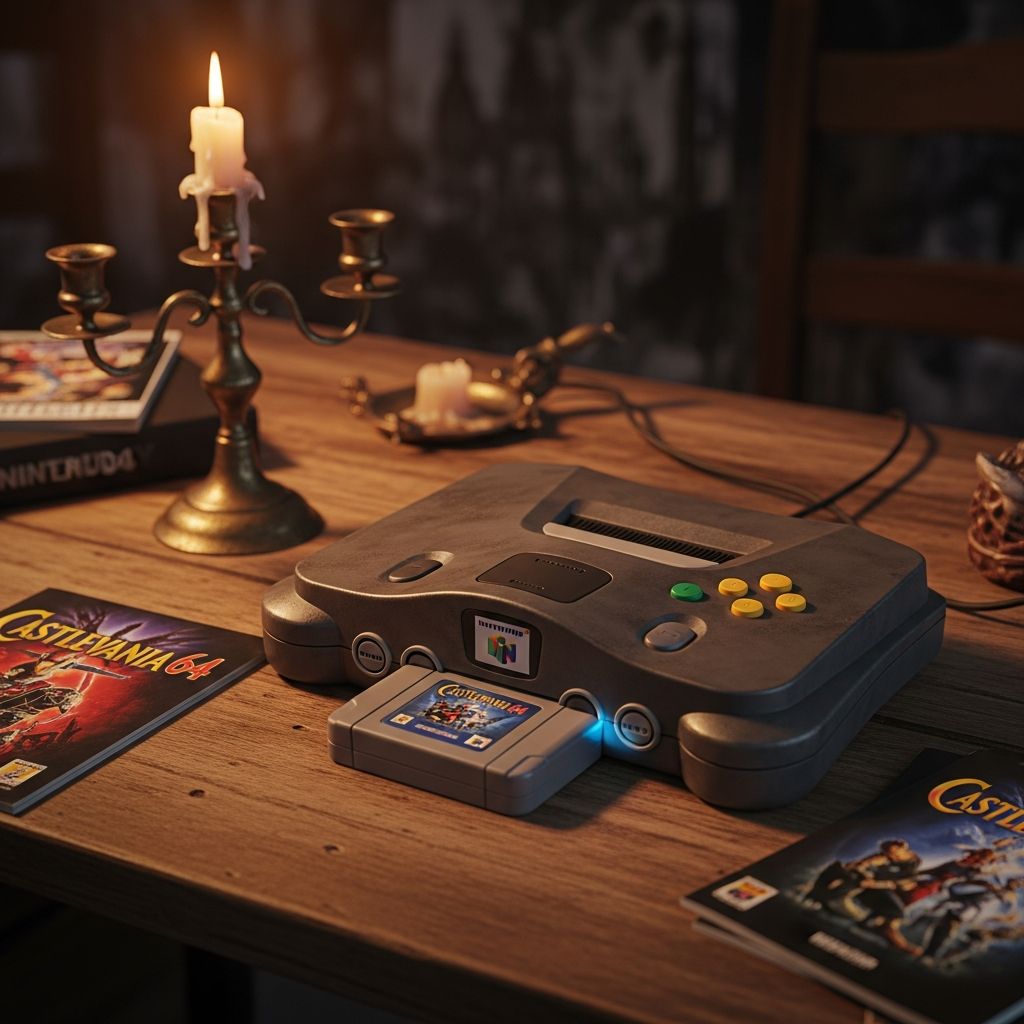
When Castlevania 64 arrived on the Nintendo 64 in 1999, it carried the weight of a legendary 2D franchise on its shoulders. It promised a dramatic leap into 3D gothic horror, but many players found something closer to a clumsy experiment than a graceful evolution. Decades later, its reputation remains fiercely contested: some dismiss it as a clunky misfire, while others quietly defend its eerie mood and ambitious ideas.
This article takes a fresh look at Castlevania 64, using hindsight and modern expectations to ask a simple question: is it still just bad, or has time revealed a more complicated legacy beneath the fog?
The Leap from 2D to 3D: A Series at a Crossroads
Earlier Castlevania games built their reputation on tight 2D platforming, carefully tuned difficulty, and instantly memorable music. Moving to 3D was not just a technical upgrade; it meant rethinking level design, combat, and even how players perceive space on screen.
- New perspective: 3D environments required camera systems, depth perception, and analog movement that many developers were still learning to master.
- Legacy expectations: Fans expected the precision of Castlevania III or Rondo of Blood, but with modern presentation.
- Hardware limits: The Nintendo 64’s fog, draw distance, and texture constraints shaped the look and feel of nearly every 3D game on the system.
Castlevania 64 stepped into this turbulent transition period with lofty goals and not nearly enough polish to match them.
Story, Setting, and Playable Heroes
Narratively, Castlevania 64 plays things very safe. Dracula returns (again), and a new generation of hunters answers the call.
- Reinhardt Schneider: A whip-wielding descendant of the famous Belmont line, positioned as the traditional action hero.
- Carrie Fernandez: A young sorceress with powerful magic attacks, offering a different combat feel and route variations.
The plot leans heavily on series staples: corrupted villagers, sinister mansions, cryptic allies, and looming undead horrors. What is more interesting than the story itself is the tone—a blend of earnest melodrama and unintentionally goofy cutscenes, amplified by stiff animations and dated voice acting.
Controls and Camera: The Core of the Controversy
Most modern re-evaluations of Castlevania 64 converge on a central complaint: the feel of the game is its biggest obstacle.
Movement and Platforming
Platforming is central to the experience, but the controls rarely feel trustworthy.
- Loose movement: Characters accelerate and decelerate in ways that make small, precise adjustments difficult.
- Floaty jumps: A lack of consistent feedback can make judging distances awkward, especially in vertical sections and narrow ledges.
- High punishment: Missed jumps often send you tumbling into instant-death pits, forcing long replays of earlier segments.
The Infamous Camera
The camera is arguably the game’s most notorious enemy.
- Automatic angles: The camera switches perspectives on its own, sometimes mid-jump, disorienting the player.
- Limited control: Players have very little direct influence over camera position, a common issue in early 3D games but particularly damning in platform-heavy stages.
- Depth confusion: Poor angles often make it hard to judge where platforms begin and end, causing unnecessary falls and frustration.
These issues would be inconvenient in an exploration-heavy game; in a precision-heavy platformer, they fundamentally undermine the experience.
Combat: Ambitious, but Often Unwieldy
Combat in Castlevania 64 tries to blend classic whip action with 3D targeting, but the implementation is inconsistent.
- Auto-lock behavior: The whip can unexpectedly snap toward a nearby enemy, swiveling your character mid-swing and sometimes causing you to step into hazards or off ledges.
- Sub-weapons: Secondary weapons still exist, but the combination of awkward aiming and moving targets makes them less satisfying than in 2D entries.
- Hit feedback: Sound and visual cues feel subdued, reducing the punchy satisfaction players expect from striking monsters in this series.
The result is a combat system that is serviceable at best and infuriating at worst, particularly when mixed with tricky platform layouts.
Atmosphere, Music, and Visual Design
One area where Castlevania 64 shows more promise is in its atmosphere, though even that remains controversial.
Graphics and Level Aesthetic
- Primitive 3D: Environments are blocky and heavily fogged, a combination that many players find ugly but some interpret as unintentionally eerie.
- Animation quality: Jerky character movement and stiff cutscenes often sap dramatic moments of their intended impact, sometimes drifting into unintentional comedy.
- The castle interior: Once you reach the castle proper, certain rooms and halls better capture the series’ gothic flair, with dramatic staircases and looming architecture.
Soundtrack and Audio
The Castlevania franchise is famous for unforgettable music. Here, the score is considerably more subdued.
- Sparse music: Long stretches of gameplay unfold with minimal or no background music, relying instead on ambient sound.
- Generic themes: When tracks do play, they lean into cliché horror motifs and lack the memorable melodies associated with earlier games.
- Atmospheric upside: Some defenders argue that the relative quiet and echoing sound effects contribute to a lonely, haunted mood that suits the castle setting.
Structure, Difficulty, and Replay Elements
Beneath the rough surface, Castlevania 64 experiments with structure and systems that hint at something more ambitious than a simple linear action game.
| Design Element | What It Does | Why It Divides Players |
|---|---|---|
| Multiple characters | Reinhardt and Carrie have distinct moves, damage output, and partial route differences. | Adds replay value, but also doubles the time needed to see all content. |
| Day–night cycle | Time passes as you play; certain events and endings depend on finishing by a specific in-game date. | Atmospheric and thematic, but easy to mismanage without outside knowledge. |
| Multiple endings | Different outcomes unlock based on decisions, timing, and character choice. | Encourages replays, but the best endings require strict conditions that can be frustrating to discover naturally. |
| Resource management | Hearts, healing items, and sub-weapons must be rationed carefully in later stages. | Traditional to the series, but made harsher by awkward controls and punishing checkpoints. |
Many of these mechanics echo what would later become standard in survival horror and action adventures, but here they co-exist uneasily with twitchy platforming and experimental 3D systems.
Why Some Players Defend It
Despite its well-documented issues, Castlevania 64 has slowly gathered a small but vocal group of defenders. Their arguments tend to cluster around a few key points.
- Moody worldbuilding: The lonely trek through forests, graveyards, and castle halls gives a distinct sense of place, even if the visuals are primitive.
- Old-school challenge: For players who enjoy mastering flawed systems, the game’s difficulty can feel like a badge of honor rather than a design failure.
- Experimental spirit: The day–night system, multiple endings, and light RPG elements offer more depth than many contemporaries, hinting at ambitious ideas that were never fully realized.
- Nostalgia factor: For those who played it at release, the game’s quirks are entangled with childhood memories of late-night N64 sessions and early 3D wonder.
In other words, its appeal often rests not in what it objectively does well, but in how players choose to engage with its peculiar mix of strengths and weaknesses.
Why Its Reputation Is Still So Harsh
The majority view, especially among critics revisiting the era, remains unsparing.
- Comparison to 2D classics: When measured against celebrated entries like Symphony of the Night, Castlevania 64 feels clumsy and rushed.
- Rough core mechanics: Camera, controls, and collision are not minor blemishes; they are constant irritants that shape almost every moment of play.
- Age poorly over time: Early 3D graphics and animation tend to date much faster than 2D sprites, making the game visually harder to revisit than its predecessors.
- Better alternatives exist: Later 3D entries in the series, and even other N64 action titles, refined many of the ideas Castlevania 64 attempted.
This combination explains why many reviewers still advise newcomers to explore other installments first, treating this one more as a historical curiosity than a must-play experience.
Who Might Still Enjoy Castlevania 64 Today?
Castlevania 64 is not a game for everyone, but there are specific types of players who might find value in revisiting it.
- Retro historians: If you are fascinated by the evolution of 3D game design, this is a telling snapshot of transitional thinking in the late 1990s.
- Series completionists: Dedicated Castlevania fans who want to see every official attempt to reimagine Dracula’s castle will find curiosities worth examining.
- Challenge seekers: Players who enjoy wrestling with janky mechanics for the satisfaction of overcoming them may discover a rough-but-rewarding project here.
- Atmosphere chasers: Those who can forgive dated visuals may still appreciate the game’s lonely corridors, moonlit courtyards, and unsettling enemies.
Tips for Approaching It with Modern Expectations
If you decide to play Castlevania 64 now, a few mindset shifts can help.
- Lower precision expectations: Treat platforming as cautious navigation rather than speedrunning; slow, deliberate movement reduces cheap deaths.
- Accept the camera: Assume you will fight it often. Take a moment before jumps to let it settle and read depth carefully.
- Prioritize survival: Stock up on healing items and hearts when possible; the game rarely feels generous with resources.
- Research endings: If you care about specific outcomes, consider looking up how the day–night system and key decisions affect them.
Even with these adjustments, the game will still feel rough—but it may also feel more understandable and, in flashes, oddly compelling.
Frequently Asked Questions (FAQs)
Q: Is Castlevania 64 worth playing for newcomers to the series?
For most newcomers, it is better to start with highly regarded 2D entries or later 3D installments. Castlevania 64 is best approached after you already know and enjoy the series, as a historical side trip rather than a main course.
Q: How difficult is Castlevania 64 compared to other classic games?
The game feels difficult less because of enemy design and more because of technical friction: camera shifts, awkward jumps, and limited healing punish mistakes harshly. If you are comfortable with older 3D platformers, you may find it challenging but manageable.
Q: Does the game still have any unique features compared to modern titles?
Its combination of a time-based progression system, multiple endings, survival-style resource management, and traditional gothic action remains distinctive, even if modern games handle these ideas more elegantly.
Q: Are there better 3D Castlevania games to try first?
Yes. Later 3D entries refine combat, movement, and camera systems significantly. Many critics suggest skipping Castlevania 64 until you are curious about how the franchise first experimented with 3D.
Q: Why do some people call it a “misunderstood” game?
Because beneath its obvious flaws, the game contains striking moments of atmosphere, genuinely tense resource management, and experimental ideas that were simply beyond what the team could fully realize on the hardware and timeline they had. Some players find those rough edges fascinating rather than disqualifying.
References
- Castlevania Review (Nintendo 64) — Nintendo World Report. 2015-01-17. http://www.nintendoworldreport.com/review/38880/castlevania-for-nintendo-64-review
- A Spirited Defense of Castlevania 64 — PixelDie. 2024-01-03. https://pixeldie.com/2024/01/03/a-spirited-defense-of-castlevania-64/
- Castlevania 64 review — Classic-Games.net. 2020-02-10. https://www.classic-games.net/nintendo-64/castlevania-64/
- Castlevania (Nintendo 64) Review — HonestGamers. 2009-07-24. http://www.honestgamers.com/7323/nintendo-64/castlevania/review.html
- Castlevania 64, A Twenty Year Reunion — WayTooManyGames. 2019-01-26. https://waytoomany.games/2019/01/26/castlevania-64-a-twenty-year-reunion/